Dreamdata Review 2026
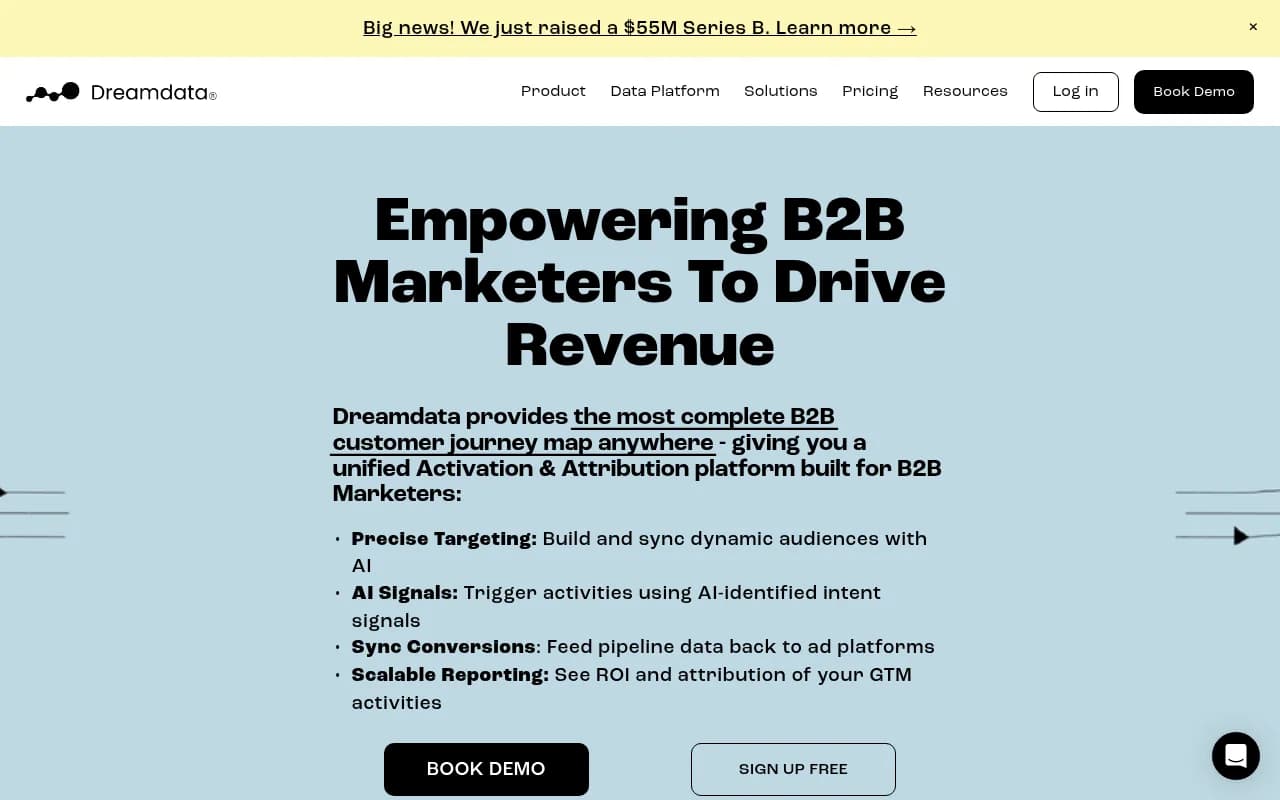
Dreamdata is a B2B activation and attribution platform that tracks every touchpoint across complex buying journeys, helping marketing teams prove ROI, build precise audiences, and optimize campaigns with AI-powered insights. Designed for B2B marketers managing multi-touch attribution, audience synci
Key Takeaways:
• Best for B2B marketing teams who need to prove marketing's impact on pipeline and revenue with multi-touch attribution across long sales cycles • Standout capability: Complete customer journey mapping that connects anonymous website visits to closed deals, with AI-powered intent signals and audience activation • Strong integrations with major ad platforms (LinkedIn, Google, Meta) for automatic audience syncing and offline conversion tracking • Pricing starts at $599/month with a free tier available for basic journey tracking and attribution • Limitation: Built specifically for B2B -- not suitable for B2C businesses or simple lead-gen campaigns
Dreamdata is a B2B activation and attribution platform built to solve a problem that keeps marketing leaders up at night: proving which marketing activities actually drive revenue when your sales cycles stretch across months and involve dozens of touchpoints. Founded in Copenhagen, the platform has grown to serve thousands of B2B companies including recognizable brands like ECI Software Solutions, and maintains a strong 4.6/5 rating on G2 based on user reviews.
The core insight behind Dreamdata is that 70% of the B2B customer journey happens before sales ever gets involved. A prospect might read three blog posts, attend a webinar, click two LinkedIn ads, visit your pricing page five times, and download a case study before they ever fill out a demo form. Traditional analytics tools like Google Analytics treat each of these as isolated events. Dreamdata stitches them together into a complete account-level timeline, then uses AI attribution models to determine which touchpoints actually mattered.
Complete Customer Journey Mapping The platform's foundation is its ability to track and connect every interaction an account has with your brand. This isn't just web analytics -- Dreamdata pulls data from your CRM (Salesforce, HubSpot, Pipedrive), marketing automation (Marketo, Pardot, ActiveCampaign), ad platforms (LinkedIn Ads, Google Ads, Meta Ads), and website behavior to build account-level timelines. You can see that Company X first discovered you through a LinkedIn ad on January 15th, then three employees visited your website over the next two weeks, someone attended your webinar on February 3rd, and they finally converted to SQL on February 20th. Each timeline is interactive and shows the specific people involved, the content they engaged with, and the channels that influenced them. This level of visibility is critical for understanding what's actually working in complex B2B sales cycles where multiple stakeholders are involved.
AI-Powered Attribution Models Dreamdata offers multiple attribution models (first-touch, last-touch, linear, time-decay, U-shaped, W-shaped) but the real power is in its AI attribution engine. The AI model analyzes patterns across thousands of customer journeys to determine which touchpoints statistically correlate with closed deals. Instead of arbitrarily assigning credit based on position in the funnel, it learns which combinations of activities actually predict revenue. For example, it might discover that webinar attendance plus a pricing page visit within 7 days is a strong signal, while generic blog traffic rarely converts. You can then use these insights to reallocate budget toward high-impact channels and campaigns. The attribution data flows into customizable dashboards that show ROI by channel, campaign, content piece, and even individual ads.
Audience Hub for Precise Targeting One of Dreamdata's most practical features is Audience Hub, which lets you build dynamic audiences based on any combination of journey data and sync them directly to ad platforms. You can create an audience of "accounts that visited pricing page but didn't convert in last 30 days" or "companies similar to our top 20 customers" and push it to LinkedIn, Google, or Meta with one click. The syncs happen daily and automatically, so your retargeting and lookalike campaigns always work with fresh data. This is a massive time-saver compared to manually exporting lists from your CRM and uploading them to ad platforms every week. The audience builder supports complex logic with AND/OR conditions, firmographic filters (company size, industry, revenue), behavioral triggers (page visits, content downloads, event attendance), and CRM data (deal stage, lead score, custom fields).
Offline Conversion Syncing Dreamdata also syncs offline conversions back to ad platforms, which is crucial for optimizing B2B campaigns. When someone clicks your LinkedIn ad and eventually becomes an SQL or closed deal weeks later, Dreamdata feeds that conversion event back to LinkedIn's algorithm. This allows the platform to optimize for actual pipeline and revenue, not just form fills or MQLs. Most B2B marketers optimize ads for top-of-funnel metrics because they can't connect ad clicks to closed deals -- Dreamdata solves this by automatically syncing SQLs, opportunities, and won deals as conversion events. The result is smarter bidding, better targeting, and campaigns that actually drive revenue instead of just vanity metrics.
AI Intent Signals (Reveal) The Reveal feature uses AI to identify high-intent accounts based on behavioral patterns across your entire go-to-market data. It analyzes website activity, content engagement, ad interactions, and CRM data to surface accounts that are showing buying signals. When an account crosses a certain intent threshold, Dreamdata can automatically notify your sales team via Slack or Microsoft Teams with context about what the account has been doing. For example: "Acme Corp just visited your pricing page for the third time this week, and two employees downloaded your ROI calculator." This allows sales to reach out at the exact moment when interest is highest, rather than waiting for a form fill that might never come. The AI learns from your historical data to understand which patterns of behavior predict deals in your specific business.
Performance Analytics and Reporting Dreamdata provides pre-built dashboards for channel performance, campaign ROI, content attribution, and pipeline velocity. You can see metrics like cost per SQL, cost per opportunity, cost per closed deal, and revenue influenced by channel. The platform calculates these metrics using your chosen attribution model and updates them in real-time as new data flows in. For marketing leaders who need to report to the C-suite, Dreamdata offers executive dashboards that show marketing's contribution to pipeline and revenue in clear, visual formats. You can also build custom reports using the platform's drag-and-drop report builder or export data to tools like Looker Studio for more advanced analysis.
Integrations and Data Platform Dreamdata integrates with 80+ tools across CRM, marketing automation, ad platforms, analytics, and data warehouses. Key integrations include Salesforce, HubSpot, Pipedrive, Marketo, Pardot, ActiveCampaign, LinkedIn Ads, Google Ads, Meta Ads, Google Analytics, Segment, and Snowflake. Most integrations are one-click setup with no engineering required. The platform also offers a REST API for custom integrations and data exports. Under the hood, Dreamdata uses a proprietary data model that normalizes and connects data from all your sources into a unified account-level view. This data model is what enables the AI features -- it provides clean, structured data that AI can actually learn from, rather than the messy, disconnected data most companies are stuck with.
Who Is Dreamdata For Dreamdata is built for B2B marketing teams at companies with complex sales cycles and multiple touchpoints. The ideal customer is a mid-market or enterprise B2B SaaS company, professional services firm, or B2B tech vendor with average deal sizes above $10K and sales cycles longer than 30 days. If you're running multi-channel campaigns (paid ads, content marketing, events, webinars) and struggling to prove which activities drive pipeline, Dreamdata is designed for you. It's particularly valuable for marketing leaders who need to justify budget to the CFO, demand gen managers optimizing campaign performance, and revenue operations teams building a single source of truth across marketing and sales data. Team size typically ranges from 5-50 person marketing teams, though the platform scales to support large enterprises with multiple business units (like ECI Software Solutions, which uses Dreamdata across 80+ products and 7 business units).
Dreamdata is NOT a good fit for B2C businesses, simple lead-gen campaigns with single-touch conversions, or companies with very short sales cycles (under 7 days). If your customer journey is "see ad, click, buy" then you don't need this level of sophistication. It's also overkill for very early-stage startups with limited marketing activity -- you need enough volume of touchpoints and conversions for the attribution models to be meaningful.
Pricing and Plans Dreamdata offers a free tier that includes basic customer journey tracking, attribution reporting, and up to 1,000 tracked accounts. This is a genuine free plan, not just a trial -- you can use it indefinitely to get started with attribution. Paid plans start at $599/month for the Growth plan, which includes unlimited tracked accounts, advanced attribution models, Audience Hub with ad platform syncing, and Reveal intent signals. The Pro plan at $1,499/month adds offline conversion syncing, custom attribution models, and priority support. Enterprise pricing is custom and includes features like multi-workspace support, dedicated customer success, and advanced API access. All paid plans include a free trial period. Compared to competitors like HockeyStack ($1,200+/month), Ruler Analytics ($499+/month), or Bizible/Marketo Measure (enterprise-only pricing), Dreamdata sits in the mid-range with a strong free tier that lets you test the platform before committing.
Strengths
• Complete journey visibility: The account-level timelines are genuinely comprehensive, pulling data from every relevant source and presenting it in an intuitive interface. This is the best customer journey mapping tool specifically built for B2B. • Audience activation: The ability to build complex audiences and sync them to ad platforms daily is a huge operational win. Most attribution tools just show you reports -- Dreamdata lets you act on the insights. • AI attribution quality: The AI attribution model is more sophisticated than simple rule-based models, and it learns from your specific data rather than generic benchmarks. • Integration breadth: 80+ integrations with one-click setup means you can get started quickly without engineering resources. • Free tier: The free plan is generous enough to be genuinely useful for small teams or companies testing attribution for the first time.
Limitations
• B2B-only focus: If you're not B2B, this platform isn't for you. The entire data model and feature set assumes account-based buying journeys. • Learning curve: While the interface is clean, understanding attribution models and interpreting the data requires some marketing analytics knowledge. Expect a few weeks of onboarding to get your team up to speed. • Limited content attribution: While you can see which content pieces are in the journey, the content-level attribution isn't as granular as dedicated content analytics platforms like Pathmonk or Factors.ai.
Bottom Line Dreamdata is the best choice for B2B marketing teams that need to prove ROI across complex, multi-touch customer journeys and want to activate that data to improve campaign performance. If you're tired of guessing which channels drive revenue and manually building audience lists for retargeting, Dreamdata gives you the attribution intelligence and activation tools to run a data-driven B2B marketing operation. Best use case in one sentence: B2B SaaS companies with 30+ day sales cycles that need to connect marketing touchpoints to closed deals and optimize ad campaigns for actual revenue.
Tags:
Similar and alternative tools to Dreamdata