Indexly Review 2026
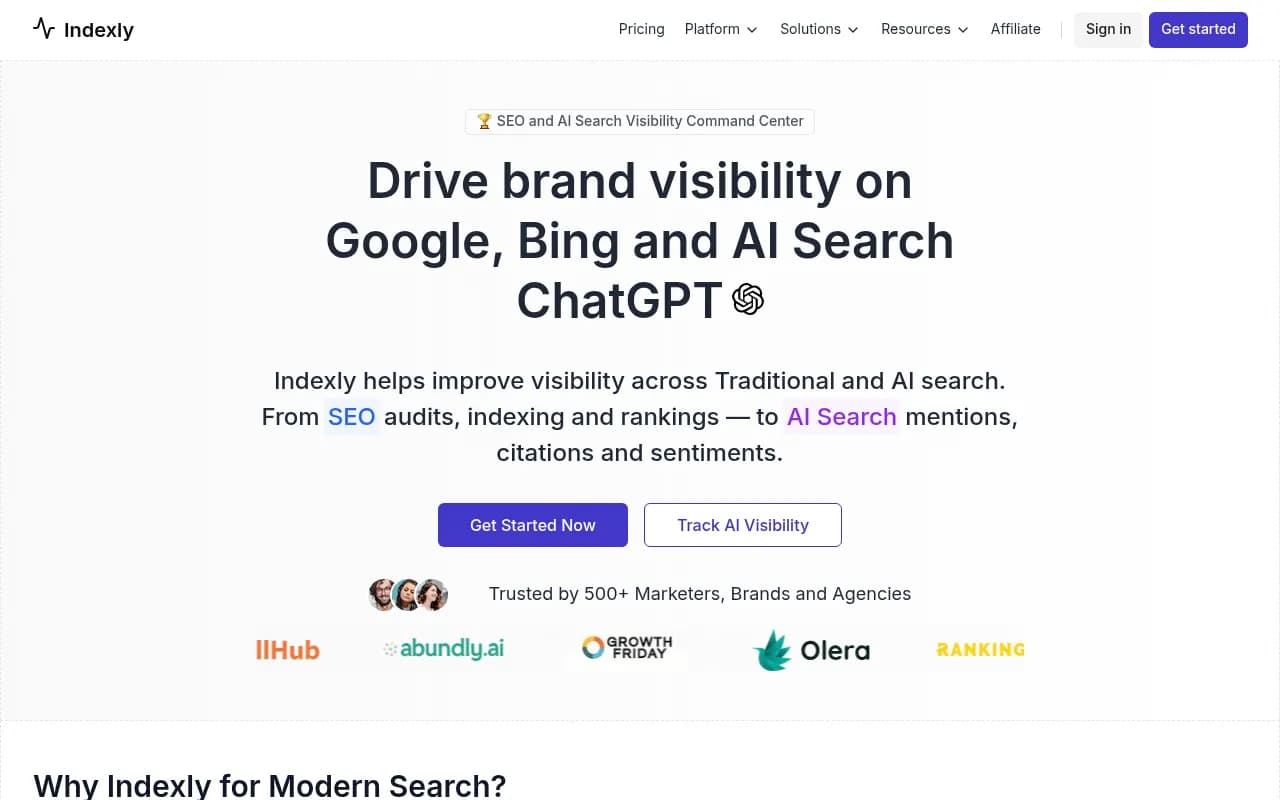
Indexly is a unified SEO and AI search visibility platform that helps brands monitor traditional search rankings while tracking how ChatGPT, Perplexity, Gemini, and Claude mention their brand. From automated indexing and site audits to AI sentiment analysis and prompt tracking, it bridges the gap be
Key Takeaways:
- Indexly combines traditional SEO tools (auto-indexing, audits, keyword tracking, backlinks) with AI search visibility features (brand mentions, sentiment analysis, prompt tracking across ChatGPT, Perplexity, Gemini, Claude)
- Best for: SaaS companies, digital agencies, and eCommerce brands managing 1-10+ websites who want a single dashboard for both Google/Bing rankings and AI model visibility
- Strengths: Automated indexing via Google Indexing API and Bing IndexNow, llms.txt generation for AI crawlers, white-label reporting for agencies, multi-user team management
- Limitations: Newer platform (launched 2024) with smaller user base than established SEO tools, AI visibility features still maturing compared to specialized GEO platforms
- Pricing starts at $14/month for individuals, scales to agency and enterprise tiers
Indexly positions itself as a "command center" for modern search visibility -- a platform that acknowledges search is no longer just about ranking on Google. With AI models like ChatGPT, Perplexity, and Gemini answering billions of queries directly (often bypassing traditional search results entirely), brands need to understand how they appear in AI-generated responses, not just SERP rankings. Indexly attempts to solve this by combining classic SEO essentials with AI search monitoring in one dashboard.
The platform launched in 2024 and claims 500+ customers including CallHub, Abundly, GrowthFriday, Olera Care, and RankingCo. It's built for marketing teams, SEO professionals, and agencies who want to track both traditional search performance and emerging AI visibility without juggling multiple tools.
Traditional SEO Features: The Foundation
Indexly's SEO toolkit covers the basics you'd expect from any modern SEO platform, with a focus on automation and speed.
Automated Indexing is the flagship feature. Instead of manually submitting URLs to Google Search Console or waiting weeks for crawlers to discover new pages, Indexly uses the Google Indexing API and Bing IndexNow to request instant indexing. You can enable "auto indexing" to automatically pull pages from your sitemap and submit them in batches, or use instant submission for single pages. The platform also supports bulk URL processing and one-click de-indexing for pages you want removed. According to their case study data, customers report a 100% reduction in manual indexing effort and 75% faster time-to-index. The dashboard shows submitted vs indexed vs error counts, with average indexing time tracked per batch.
Website Audit runs comprehensive technical SEO checks across your entire site. It scans for on-page issues (missing or duplicate title tags, meta descriptions, H1 tags, alt text), technical problems (broken links, 404 errors, redirect chains, mobile optimization), structured data validation, and Core Web Vitals monitoring (LCP, FID, CLS). The audit generates an overall score out of 100 and breaks down issues by severity. You can see exactly which pages have problems and get actionable recommendations. The interface shows counts like "298/318 title tags optimized" with warnings for missing or duplicate elements.
Keyword Tracking monitors your rankings across Google and Bing simultaneously. You can track brand keywords, competitor keywords, and set up weekly or monthly reports. The platform calculates average position, visibility percentage, and identifies "quick win" opportunities -- keywords where you're ranking #8-#20 and could realistically push into the top 5 with optimization. The keyword opportunity discovery feature scores keywords based on search volume, competition level, and current position, surfacing high-volume/low-competition targets. You can organize keywords by topic, product, or campaign using custom tags.
Backlink Intelligence provides a complete view of your link profile. It tracks total backlinks, referring domains, domain authority scores, and link quality assessment. The platform identifies toxic or spammy links (with spam scores) and lets you export them for disavowal in Google Search Console. Competitor link discovery shows you which high-authority sites link to competitors but not to you, helping you prioritize outreach targets. The backlink table displays domain authority, spam score, link type (dofollow/nofollow), and target page for each link.
These features are solid but not groundbreaking -- tools like Ahrefs, Semrush, and Moz offer more depth in areas like keyword research and backlink analysis. Indexly's advantage is speed and automation (especially for indexing) rather than exhaustive data.
AI Search Visibility: The Differentiator
This is where Indexly diverges from traditional SEO tools. The platform tracks how your brand appears in responses from ChatGPT, Perplexity, Gemini, and Claude -- the AI models that increasingly answer user queries directly without sending traffic to websites.
AI Readiness Audit checks whether your site is optimized for AI crawlers like GPTBot, ChatGPT-User, ClaudeBot, and Perplexity. It scans your robots.txt, generates an llms.txt file (a proposed standard for guiding LLMs on how to interpret your site), and provides recommendations for semantic keywords and schema markup that improve AI comprehension. The audit produces a crawl score out of 100 and shows which AI bots have accessed your site. This is useful for ensuring AI models can actually discover and understand your content -- a prerequisite for getting cited.
AI Brand Visibility tracks how often your brand is mentioned across ChatGPT, Gemini, Perplexity, and Claude compared to competitors. You can measure your "share of voice" within your industry and see which topics, queries, and scenarios trigger mentions of your brand. The dashboard shows total mentions, mention score (percentage of prompts where you appear), and competitor gap analysis. For example, you might see that your brand appears in 78% of AI responses for "best SEO tools" but only 34% for "AI content tools" -- highlighting where you're strong vs where competitors dominate.
Prompt Tracking lets you monitor specific prompts over time and organize them by tags (topics, products, verticals, campaigns). You can track prompts like "best SEO tools", "AI-powered platforms", or "alternatives to [competitor]" and see how often your brand appears in responses, how sentiment changes, and which AI models mention you most frequently. The platform tracks response evolution over weeks and months to identify trends. This is valuable for understanding which prompts drive visibility and where you're missing opportunities.
Mentions & Sentiment Analysis goes deeper than just counting citations. Indexly analyzes the context and tone of AI-generated mentions -- whether models describe your brand positively, negatively, or neutrally. You can see specific positive sentiments (e.g. "tools to compress my PDF", "free to use PDF tools") and negative sentiments (e.g. "limited features in free version", "privacy concerns with uploads") extracted from AI responses. Sentiment scores are tracked per model (ChatGPT, Claude, Gemini, Perplexity) so you can see if perception varies across platforms. The platform provides recommendations to improve your brand's AI perception based on the analysis.
These AI visibility features are useful but less mature than what specialized GEO platforms offer. Tools like Promptwatch provide deeper citation analysis (880M+ citations analyzed), prompt volume estimates, query fan-outs, Reddit/YouTube tracking, and AI-generated content creation -- capabilities Indexly doesn't match. Indexly's AI features are more about monitoring and awareness than optimization and action.
Who Is Indexly For?
Indexly targets three main audiences:
SaaS companies and eCommerce brands managing 1-10 websites who want a single dashboard for both traditional SEO and AI visibility. If you're a startup founder or marketing manager who needs to track Google rankings, fix indexing issues, and understand how ChatGPT talks about your product -- but doesn't want to pay for Ahrefs + a separate GEO tool -- Indexly offers a cost-effective all-in-one solution. It's particularly useful for brands in competitive categories (project management, CRM, design tools, etc.) where AI models frequently recommend alternatives.
Digital agencies managing multiple client sites. Indexly offers white-label reporting, multi-user team management with role-based permissions, and transparent per-client pricing. Agencies can generate branded reports that position them as experts in both SEO and AI search optimization. The platform scales from 10 clients to 1,000+ without performance issues. The whitelabel program lets agencies launch their own SEO + AI visibility platform under their brand.
SEO professionals and consultants who want to add AI visibility audits to their service offerings. If you're already doing traditional SEO work and clients are asking "how do we show up in ChatGPT?", Indexly gives you a way to answer that question with data. The AI readiness audit and llms.txt generation are particularly useful for demonstrating expertise in this emerging area.
Indexly is not ideal for enterprise brands needing deep competitive intelligence across dozens of AI models, or agencies focused exclusively on GEO/AEO who need advanced features like AI content generation, crawler log analysis, or Reddit/YouTube citation tracking. For those use cases, specialized platforms like Promptwatch, Profound, or Otterly.AI offer more depth.
Integrations & Ecosystem
Indexly integrates with Google Search Console for indexing and rank tracking, and uses the Google Indexing API and Bing IndexNow for automated submissions. The platform generates llms.txt files that can be uploaded to your site to guide AI crawlers.
There's no mention of API access, Zapier integration, or connections to other marketing tools (Slack, analytics platforms, CRMs). The platform appears to be a standalone dashboard rather than part of a broader ecosystem. For agencies, this means you'll need to manually export data or use the white-label reporting feature rather than pushing data into client dashboards automatically.
The platform supports unlimited websites and brand profiles, making it suitable for agencies and enterprises managing multiple properties from one account.
Pricing & Value
Indexly offers tiered pricing starting at $14/month for individuals. According to search results, the basic plan starts at $14, with the Professional plan at $49/month. Plans scale up to include additional domains, user seats, and advanced features. There's a free trial available, though no permanent free tier.
Compared to traditional SEO tools, this is competitive -- Ahrefs starts at $129/month, Semrush at $139.95/month. Compared to specialized GEO platforms, it's on the lower end -- Promptwatch starts at $99/month, Profound and Otterly.AI are in similar ranges. Indexly's value proposition is breadth over depth: you get both SEO and AI visibility in one platform at a lower total cost than buying separate tools, but with less sophistication in each area than best-in-class specialists.
For small teams and agencies just getting started with AI visibility tracking, the pricing is accessible. For enterprises needing advanced features, the lack of transparent pricing for higher tiers (agency/enterprise plans are listed as "custom") makes it harder to evaluate.
Strengths
Automated indexing via Google Indexing API and Bing IndexNow is genuinely useful -- most SEO tools don't offer this level of automation. The ability to submit batches of URLs and track indexing status in real-time saves significant manual work.
Unified dashboard for traditional SEO and AI visibility is the core value prop. Instead of juggling Ahrefs for backlinks, Google Search Console for indexing, and a separate GEO tool for AI mentions, you get everything in one place. For small teams, this consolidation is valuable.
White-label reporting and agency features are well-developed for a newer platform. Multi-user management, role-based permissions, and branded reports make it viable for agencies from day one.
llms.txt generation is a forward-thinking feature. While the llms.txt standard is still emerging, having a tool that automatically generates these files based on your site structure is useful for early adopters.
Limitations
AI visibility features lack depth compared to specialized GEO platforms. There's no mention of prompt volume estimates, difficulty scoring, query fan-outs, Reddit/YouTube citation tracking, or AI content generation -- capabilities that platforms like Promptwatch offer. Indexly shows you where you're mentioned but doesn't help you create content to improve visibility.
Limited AI model coverage. The platform tracks ChatGPT, Perplexity, Gemini, and Claude, but doesn't mention Google AI Overviews, Meta AI, Grok, DeepSeek, Mistral, or Copilot -- models that other GEO tools monitor. For comprehensive AI visibility, you'd need to supplement with another tool.
No API or advanced integrations. The lack of API access, Zapier connections, or integrations with analytics platforms limits automation and workflow flexibility. Agencies can't easily push Indexly data into client dashboards or reporting tools.
Newer platform with smaller user base. Launched in 2024 with 500+ customers, Indexly doesn't have the track record or community of established SEO tools. There's less third-party content (tutorials, case studies, integrations) available.
Bottom Line
Indexly is best for small-to-midsize SaaS companies, eCommerce brands, and digital agencies who want a single platform for both traditional SEO and basic AI visibility monitoring. If you're managing 1-10 websites, need automated indexing, and want to start tracking how ChatGPT and Perplexity mention your brand -- without paying for separate best-in-class tools in each category -- Indexly offers solid value at an accessible price point.
It's not the right choice for enterprises needing deep AI visibility intelligence, or agencies focused exclusively on GEO/AEO who need advanced features like AI content generation, crawler log analysis, or comprehensive multi-model tracking. For those use cases, specialized platforms like Promptwatch offer significantly more depth and actionability.
Best use case in one sentence: A cost-effective all-in-one platform for small marketing teams who want to track both Google rankings and AI search mentions without juggling multiple tools.
Tags:
Similar and alternative tools to Indexly