Sprout Social Review 2026
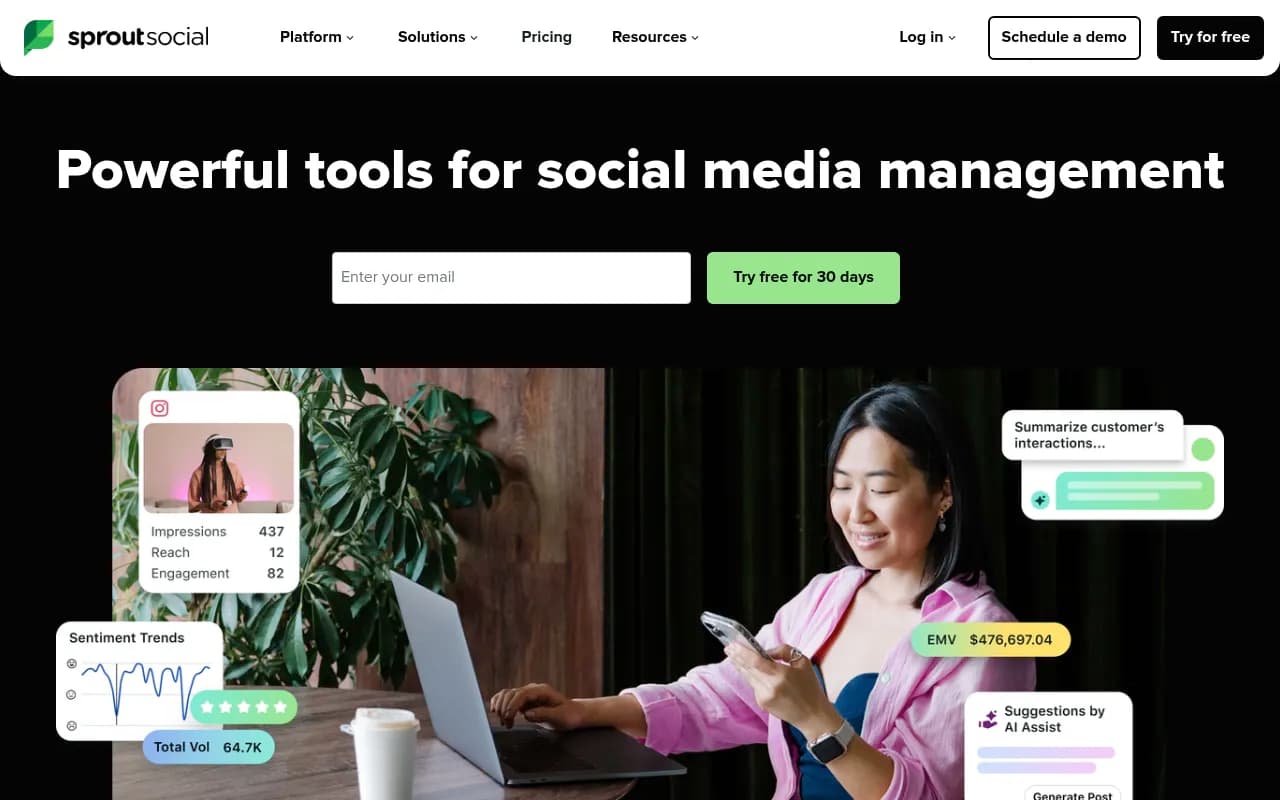
Comprehensive social media platform offering advanced analytics, scheduling, and engagement tools for marketers to master social strategy.
Key Takeaways:
- Best for: Mid-to-large marketing teams, agencies, and enterprises managing 5+ social profiles with high engagement volumes and cross-functional workflows
- Standout strengths: Unified Smart Inbox for customer care at scale, deep analytics with custom reporting, AI-powered content creation and response suggestions, native influencer marketing platform
- Pricing reality: Premium positioning at $199-$399/seat/month makes it one of the pricier options, but the feature depth and reliability justify the cost for teams that need enterprise-grade capabilities
- Notable limitation: Overkill (and expensive) for solopreneurs or small businesses with basic scheduling needs -- competitors like Buffer or Later offer better value for simple use cases
- Bottom line: The gold standard for serious social media operations that need publishing, engagement, analytics, and influencer marketing in one battle-tested platform
Sprout Social has been a fixture in the social media management space since 2010, evolving from a simple scheduling tool into what is now arguably the most complete enterprise social media platform on the market. Used by over 30,000 brands -- from Fortune 500 companies like HP and Equifax to fast-growing startups like Canva and Eventbrite -- it's the platform teams graduate to when they outgrow simpler tools and need industrial-strength capabilities.
The platform targets marketing teams at mid-to-large companies (typically 50+ employees), agencies managing multiple client accounts, and customer care teams using social channels as a primary support touchpoint. If you're a solo consultant or small business owner posting a few times a week, Sprout is almost certainly overkill. But if you're managing 10+ profiles, fielding hundreds of customer messages daily, or need to prove social ROI to executives with hard data, Sprout is built exactly for that reality.
Publishing & Content Management Sprout's content calendar is where most teams spend their day. The ViralPost feature analyzes your audience engagement patterns and automatically schedules posts for optimal send times -- not just generic "best times" but times specific to your actual followers' behavior. The calendar supports drag-and-drop rescheduling, bulk uploads via CSV, and a queue system that auto-fills your calendar based on category rules you define.
The AI Assist feature (added in 2023) can generate post variations, adjust tone, or create entire posts from prompts. It's not revolutionary compared to standalone AI writing tools, but having it native in the composer saves context-switching. You can also set up approval workflows where junior team members draft content that routes to managers for sign-off before publishing -- critical for regulated industries or brand-sensitive companies.
Asset Library stores all your images, videos, and templates with tagging and search. Integration with Adobe Express lets you create graphics without leaving Sprout. The platform supports all major networks: Facebook, Instagram, Twitter/X, LinkedIn, Pinterest, TikTok, YouTube, Google Business Profile, and newer platforms like Threads and Bluesky. Each network gets its own composer optimized for that platform's requirements (character limits, image specs, hashtag best practices).
Smart Inbox & Customer Engagement This is where Sprout truly separates itself from cheaper competitors. The Smart Inbox aggregates messages, comments, mentions, and reviews from every connected profile into one unified stream. You can filter by network, message type, sentiment, or custom tags. Collision detection prevents two team members from responding to the same message simultaneously -- a lifesaver for customer care teams.
Canned Responses (called Suggested Replies) let you save templated answers for common questions, with variable fields for personalization. The AI-powered response suggestions analyze the incoming message and recommend replies based on tone and context -- ScottsMiracle-Gro reported that this feature increased their social care team's action rate by 381% because agents could handle tickets faster without sacrificing quality.
Integrations with Zendesk, Salesforce Service Cloud, and HubSpot let you escalate social messages into formal support tickets or CRM records. You can also route messages to specific team members based on keywords, language, or account ownership. For enterprises doing social customer care at scale (think airlines, telecom companies, retail brands), this workflow automation is table stakes.
Analytics & Reporting Sprout's analytics go far deeper than the basic metrics you get in native platform dashboards. The Profile Performance Report shows follower growth, engagement rates, impressions, and reach across all networks in one view. Post Performance breaks down which content types, topics, and posting times drive the best results. Competitor Reports let you benchmark your performance against up to 5 competitors (you just need their public profile URLs).
The Trends Report identifies your top-performing hashtags, most engaging post formats, and optimal send times based on actual data, not guesses. Paid Performance integrates Facebook and Instagram ad metrics so you can see organic and paid performance side-by-side. Tag Performance lets you track custom campaigns or content themes by applying tags to posts and measuring their collective impact.
Custom Report Builder is where Sprout shines for agencies and enterprises. You can create branded PDF reports with exactly the metrics your stakeholders care about, scheduled to auto-generate and email weekly or monthly. The reports are presentation-ready -- many teams literally walk them into executive meetings without additional formatting. Competitors like Hootsuite offer similar reporting, but Sprout's interface is cleaner and the data visualizations are more polished.
Social Listening & Insights The Listening tool (available on Professional tier and above) monitors brand mentions, competitor activity, industry keywords, and trending topics across Twitter, Reddit, blogs, news sites, and review platforms. You can set up queries to track specific phrases, hashtags, or Boolean searches, then analyze sentiment, share of voice, and message volume over time.
Query Spike Alerts notify you when mention volume suddenly increases -- useful for catching PR crises early or jumping on viral moments. The Topic Clustering feature groups related conversations so you can see themes emerging in customer feedback. One retail brand used Listening to discover customers were confused about their return policy, which led to a website redesign that reduced support tickets by 22%.
Listening data feeds into the Trends Report, so you can see not just what your audience is saying to you, but what they're saying about your industry, competitors, and related topics. This is particularly valuable for product teams looking for feature requests or content marketers identifying trending topics to cover.
Influencer Marketing Platform Sprout acquired Tagger Media in 2021 and integrated it as a native influencer marketing module. The Creator Discovery tool lets you search for influencers by topic, audience demographics, engagement rate, and brand safety score. The AI-powered Brand Fit Score analyzes whether a creator's content, audience, and values align with your brand -- saving hours of manual vetting.
You can manage entire campaigns in Sprout: send outreach emails, negotiate contracts, approve content, track deliverables, and measure performance (EMV, reach, engagement, link clicks). The platform monitors FTC compliance to ensure creators properly disclose sponsored content. Campaign Reporting shows aggregate performance across all creators in a campaign, plus individual creator breakdowns.
This is a huge differentiator. Most social media management tools force you to use a separate influencer platform (like AspireIQ, Grin, or Upfluence), which means juggling logins, duplicate data entry, and disconnected reporting. Having influencer marketing native in Sprout means your organic posts, paid ads, and creator content all live in one analytics dashboard.
Integrations & Ecosystem Sprout maintains official partnerships with every major social network, which means features like Instagram Shopping, LinkedIn Lead Gen Forms, and TikTok Analytics are supported natively -- not through workarounds or third-party APIs that break when platforms change policies. The Salesforce integration syncs social profiles with CRM contacts, so sales teams can see a lead's social activity. The Slack integration sends notifications when high-priority messages arrive or when reports are ready.
Google Analytics integration tracks UTM parameters automatically, so you can measure how social traffic converts on your website. Shopify integration pulls product catalogs for social commerce posts. The platform also offers a robust API for custom integrations -- larger enterprises often build internal dashboards that pull Sprout data alongside other marketing metrics.
Mobile apps for iOS and Android are full-featured, not stripped-down versions. You can publish posts, respond to messages, and view reports from your phone -- critical for social media managers who need to handle crises outside business hours.
Who Should Use Sprout Social Sprout is purpose-built for:
Marketing teams at companies with 50-500+ employees managing 5-20+ social profiles across multiple brands or regions. If you have dedicated social media managers (not someone doing social as 10% of their job), Sprout's depth justifies the cost. Teams at companies like Atlassian, Cintas, and Rackspace use it to coordinate publishing across global offices.
Agencies managing 10-100+ client accounts need the multi-client workspace, white-label reporting, and permission controls Sprout offers. The ability to create custom branded reports for each client without manual reformatting saves hours per week. Agency-specific pricing is available for teams managing many clients.
Customer care teams using social as a primary support channel benefit enormously from the Smart Inbox, collision detection, Zendesk integration, and response time tracking. If you're fielding 100+ messages per day across multiple platforms, Sprout's workflow automation is a force multiplier. ScottsMiracle-Gro's testimonial about agents now requesting social tickets (instead of dreading them) speaks to how much smoother Sprout makes high-volume engagement.
Enterprises with complex approval workflows, compliance requirements, or cross-functional teams (marketing, customer care, PR, sales all using social) need Sprout's role-based permissions, approval queues, and audit logs. The Advanced and Enterprise tiers support unlimited workflows, custom user roles, and SSO integration.
Sprout is NOT ideal for:
Solopreneurs, freelancers, or small businesses with 1-3 profiles and light posting schedules. At $199/month minimum, you're paying for enterprise features you won't use. Buffer ($6/month), Later ($25/month), or Hootsuite's cheaper tiers offer better value for basic scheduling and analytics.
Startups or bootstrapped companies watching every dollar. Sprout's pricing assumes you have a real marketing budget. If $2,400/year for one seat feels steep, you're not the target customer. The 30-day free trial is generous, but there's no freemium tier or discounted startup plan.
Teams that only need publishing and basic analytics. If you don't need social listening, influencer marketing, or advanced reporting, you're paying for modules you won't touch. Competitors like Agorapulse or SocialBee offer solid publishing and engagement tools at half the price.
Pricing Breakdown Sprout uses per-seat pricing, which gets expensive fast for larger teams:
Standard ($199/seat/month): 5 social profiles, all-in-one social inbox, publishing calendar, review management, basic analytics. Good for small teams just starting with Sprout, but you'll quickly outgrow it.
Professional ($299/seat/month): Unlimited profiles, competitive reports, social listening (10 topics), custom workflows, Trends Report, paid performance analytics. This is the sweet spot for most mid-sized teams.
Advanced ($399/seat/month): Everything in Professional plus advanced listening (unlimited topics), message spike alerts, chatbot builder, digital asset library, advanced automation. For larger teams with complex needs.
Enterprise (custom pricing): Adds premium onboarding, dedicated account manager, custom integrations, advanced permissions, and priority support. Typically starts around $1,500-$2,000/month for 5 seats based on third-party reports.
All plans include a 30-day free trial with no credit card required. Annual billing saves roughly 15-20% versus monthly. Additional social profiles beyond plan limits cost extra. The influencer marketing module (Tagger) is priced separately and typically adds $500-$2,000/month depending on usage.
Compared to competitors: Hootsuite's Professional plan is $99/month (cheaper but less polished), Agorapulse is $79-$159/month (good value but weaker analytics), and Later is $25-$80/month (Instagram-focused, limited engagement features). Sprout is premium-priced, but you get what you pay for in terms of reliability, support, and feature depth.
Strengths
Unified Smart Inbox is best-in-class for teams doing customer care at scale. The collision detection, sentiment analysis, and CRM integrations are more mature than any competitor. If social customer service is a priority, Sprout's inbox alone justifies the cost.
Analytics and reporting are presentation-ready without manual cleanup. The custom report builder, competitive benchmarking, and Trends Report give you insights that actually inform strategy, not just vanity metrics. Executives and clients trust Sprout reports because they look professional and the data is accurate.
Native influencer marketing platform eliminates the need for a separate tool. Most competitors force you to use Grin, AspireIQ, or Upfluence alongside your social management tool. Having creator discovery, campaign management, and performance tracking in one platform is a massive workflow improvement.
Reliability and uptime are exceptional. Sprout rarely goes down, and when social platforms change APIs (which happens constantly), Sprout's engineering team fixes integrations within hours, not days. This stability matters when you're managing client accounts or time-sensitive campaigns.
Support is responsive and knowledgeable. Live chat and email support are available on all plans, with response times typically under 2 hours. The knowledge base is thorough, and the Sprout Social community forum is active with real employees answering questions.
Limitations
Pricing is prohibitive for small teams. At $199/month minimum, Sprout is 3-10x more expensive than competitors like Buffer, Later, or SocialBee. The value is there for teams that need the features, but it's a tough sell for bootstrapped startups or solo creators.
No freemium tier or discounted startup plan. The 30-day trial is generous, but there's no way to keep using Sprout for free or at a reduced rate if you're a small team. Competitors like Hootsuite and Buffer offer limited free plans that let you test the platform indefinitely.
Instagram Reels and TikTok analytics are less detailed than native apps. While Sprout supports posting to these platforms, the analytics don't include all the metrics you'd see in Instagram Insights or TikTok Analytics. You'll still need to check native apps for complete data on Reels plays, TikTok video views, or audience demographics.
Learning curve is steeper than simpler tools. Sprout's depth means there's more to learn. New users often feel overwhelmed by the number of features and settings. The onboarding process helps, but expect a 2-4 week ramp-up period before your team is fully productive.
Bottom Line
Sprout Social is the platform you choose when social media is a core business function, not a side project. If you're managing multiple profiles, fielding high volumes of customer messages, running influencer campaigns, or need to prove ROI with hard data, Sprout delivers everything you need in one reliable, well-designed platform. The pricing reflects its enterprise positioning -- this is a tool for teams with real budgets who need industrial-strength capabilities.
For agencies, mid-to-large marketing teams, and customer care organizations, Sprout is often the final platform they adopt after outgrowing cheaper tools. The unified inbox, advanced analytics, and native influencer marketing justify the premium price. But if you're a solopreneur, small business, or startup watching every dollar, there are more cost-effective options that cover 80% of what Sprout does for 20% of the price.
Best use case in one sentence: Marketing teams at growing companies (50-500+ employees) who need publishing, engagement, analytics, and influencer marketing in one enterprise-grade platform and have the budget to pay for best-in-class execution.
Tags:
Similar and alternative tools to Sprout Social