Key Takeaways
- Promptwatch is purpose-built for AI search optimization (ChatGPT, Perplexity, Claude, Gemini) with content gap analysis, AI writing agents, and crawler logs—capabilities neither Yext nor Uberall offer
- Yext remains the enterprise standard for traditional listings management and data accuracy across 200+ directories, but lacks deep AI search optimization and charges $10K-$100K+ annually
- Uberall offers stronger European directory coverage and more affordable pricing than Yext for mid-market brands, but similarly focuses on traditional local SEO over AI visibility
- Multi-location brands now need dual optimization: traditional local search (Google Maps, Bing Places) AND AI search engines that drive discovery without clicks
- The right platform depends on your priority—if AI search visibility is critical, Promptwatch delivers actionable optimization tools; if you need comprehensive listings distribution, Yext or Uberall are proven choices
The Multi-Location Marketing Landscape Has Changed
In 2026, multi-location brands face a fundamentally different visibility challenge than they did even two years ago. Traditional local SEO—managing listings across Google Business Profile, Bing Places, Apple Maps, and 200+ directories—remains essential. But a new layer has emerged: AI search engines like ChatGPT, Perplexity, Google AI Overviews, Claude, and Gemini now drive a significant portion of local discovery traffic.
The problem? Most users never click through. They get recommendations, comparisons, and answers directly in the AI response. Your brand needs to be in the answer, not just ranking on a page. This creates a "winner-takes-most" dynamic where the 2-3 brands cited by AI models capture awareness and demand, while everyone else becomes invisible.
Traditional multi-location platforms like Yext and Uberall were built for the pre-AI era. They excel at listings distribution, review monitoring, and ensuring NAP (Name, Address, Phone) consistency across directories. But they don't track how ChatGPT recommends restaurants, how Perplexity surfaces retail chains, or how Google AI Overviews cite service providers. They don't show you which prompts competitors are visible for but you're not. And they don't help you create content that AI models actually want to cite.
This guide compares three platforms across the spectrum: Promptwatch—an AI-native visibility platform built for the generative search era; Yext—the enterprise incumbent for traditional listings management; and Uberall—a European-focused alternative with stronger mid-market pricing. We'll break down what each platform does well, where they fall short, and how to choose based on your brand's specific needs.

Platform Overview: What Each Tool Was Built For
Promptwatch: AI Search Visibility and Optimization
Promptwatch is an end-to-end AI Search Visibility platform used by 6,700+ brands and agencies including Booking.com, Center Parcs, Wortell, and Elaboratum. It monitors 10 AI models (ChatGPT, Perplexity, Google AI Overviews, Google AI Mode, Claude, Gemini, Meta AI, DeepSeek, Grok, Mistral, Copilot) and tracks how your brand appears in AI-generated responses.
What makes Promptwatch different from monitoring-only competitors: it's built around an action loop. First, Answer Gap Analysis shows exactly which prompts competitors are visible for but you're not—the specific content your website is missing. Second, the built-in AI writing agent generates articles, listicles, and comparisons grounded in 880M+ citations analyzed, prompt volumes, and competitor data. Third, page-level tracking shows your visibility scores improve as AI models start citing your new content, with traffic attribution (code snippet, GSC integration, or server log analysis) connecting visibility to revenue.
Additional capabilities include AI Crawler Logs (real-time logs of ChatGPT, Claude, Perplexity crawlers hitting your site), Prompt Intelligence (volume estimates and difficulty scores), Citation & Source Analysis (see which pages, Reddit threads, YouTube videos AI models cite), Reddit & YouTube Insights, ChatGPT Shopping Tracking, Competitor Heatmaps, and multi-language/multi-region monitoring.
Pricing: Essential $99/mo (1 site, 50 prompts, 5 articles), Professional $249/mo (2 sites, 150 prompts, 15 articles, crawler logs), Business $579/mo (5 sites, 350 prompts, 30 articles). Free trial available.
Yext: Enterprise Listings and Knowledge Management
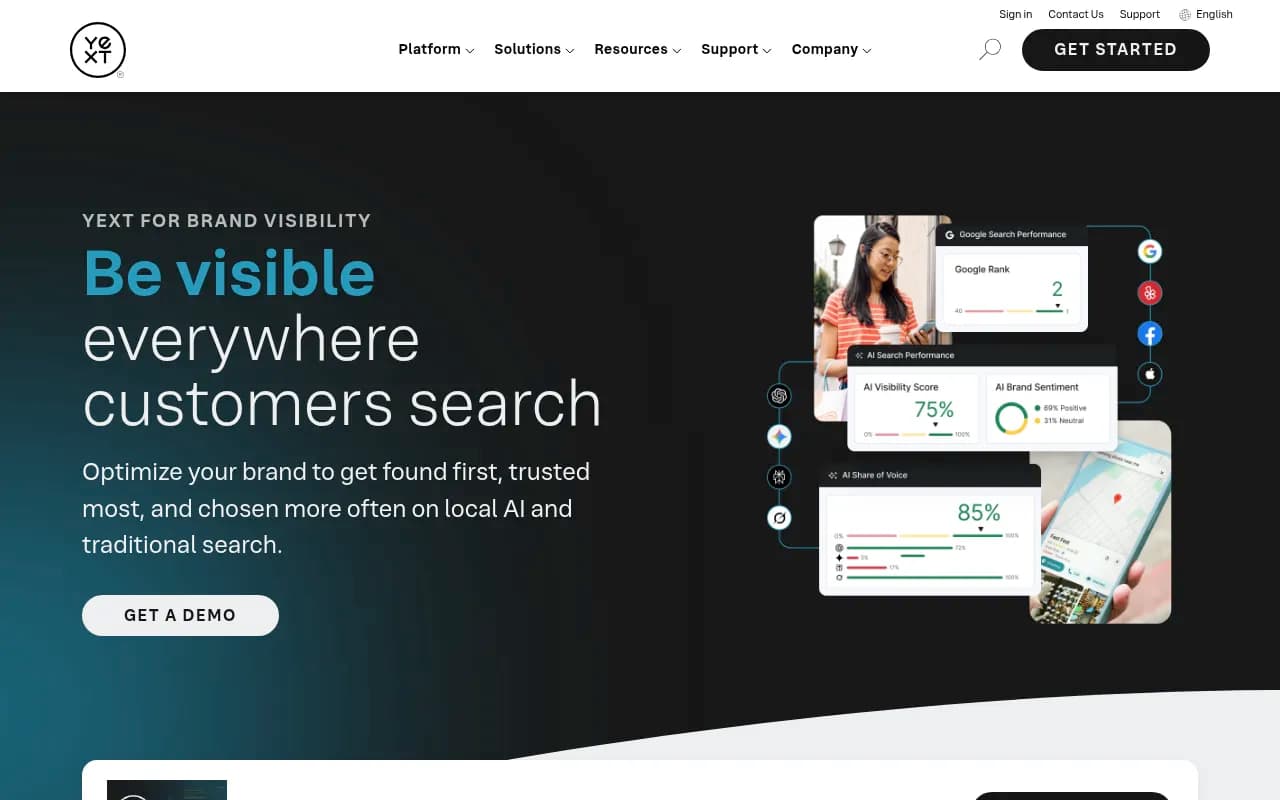
Yext pioneered centralized listings distribution in the early 2010s and remains the enterprise standard for multi-location digital presence management. The platform syncs business information (name, address, phone, hours, services, photos) across 200+ directories, maps, voice assistants, and search engines. When you update a location's hours in Yext, the change propagates everywhere automatically.
Yext's core strength is data accuracy at scale. For brands with 100+ locations, maintaining consistent NAP across Google, Bing, Apple Maps, Yelp, Facebook, TripAdvisor, and hundreds of niche directories is a massive operational challenge. Yext solves this with a single source of truth—the Yext Knowledge Graph—that feeds structured data to every endpoint.
The platform also offers review monitoring and response tools, basic social posting, analytics dashboards, and integrations with major CRMs and marketing automation platforms. In 2025-2026, Yext added limited AI search tracking capabilities, but these are primarily monitoring dashboards showing brand mentions in ChatGPT and Perplexity without the optimization tools to actually improve visibility.
Pricing: Yext doesn't publish pricing publicly. Industry reports suggest $10,000-$100,000+ annually depending on location count, modules, and contract terms. This makes it cost-prohibitive for many mid-market brands.
Uberall: European-Focused Multi-Location Marketing
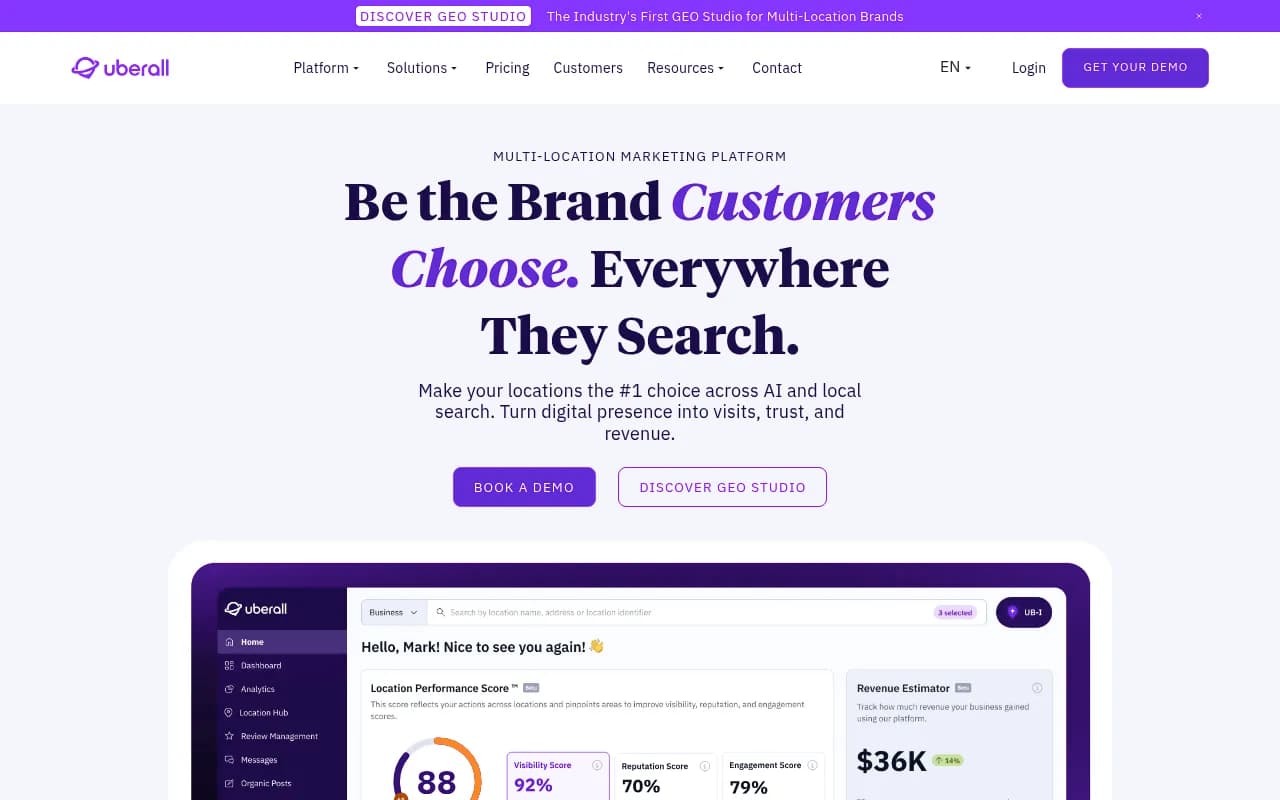
Uberall is a German-based multi-location marketing platform with particularly strong coverage of European directories and search engines. Like Yext, it handles listings distribution, review management, social posting, and local analytics. The platform is generally more affordable than Yext for mid-market brands (10-50 locations) and offers a more intuitive interface.
Uberall's differentiators include deeper integration with European directories (particularly in Germany, France, UK), stronger focus on local pages and localized content, and more flexible pricing tiers. The platform also offers white-label options for agencies managing multiple clients.
However, Uberall shares Yext's fundamental limitation: it was built for traditional local SEO, not AI search optimization. While both platforms have added basic AI monitoring features in 2026, neither offers content gap analysis, AI-powered content generation, crawler log analysis, or the optimization workflows that actually improve AI visibility.
Pricing: Uberall offers tiered plans starting around €99/mo for small businesses, scaling to custom enterprise pricing. Generally 30-50% less expensive than Yext for comparable location counts.
Feature Comparison: AI Search Visibility
AI Model Coverage
Promptwatch: Monitors 10 AI models—OpenAI/ChatGPT, Perplexity, Google AI Overviews, Google AI Mode, Claude, Gemini, Meta/Llama, DeepSeek, Grok, Mistral, Copilot. Tracks real user prompts, not just fixed queries.
Yext: Added basic ChatGPT and Perplexity monitoring in 2025-2026. Uses fixed prompt sets, doesn't track Google AI Overviews or other models. No visibility into what actual users are asking.
Uberall: Limited AI search monitoring added in 2026, primarily focused on Google AI Overviews in European markets. No ChatGPT or Perplexity tracking.
Winner: Promptwatch by a wide margin. Comprehensive coverage across all major AI models with real prompt tracking.
Content Gap Analysis
Promptwatch: Answer Gap Analysis shows exactly which prompts competitors are visible for but you're not. See the specific topics, angles, and questions AI models want answers to but can't find on your site. Prioritize high-value, winnable prompts with volume estimates and difficulty scores.
Yext: No content gap analysis. Shows where you're mentioned but doesn't identify missing opportunities.
Uberall: No content gap analysis. Focuses on ensuring existing content is properly distributed.
Winner: Promptwatch. This capability doesn't exist in Yext or Uberall.
AI Content Generation
Promptwatch: Built-in AI writing agent generates articles, listicles, and comparisons grounded in 880M+ citations analyzed, prompt volumes, persona targeting, and competitor analysis. Content is engineered to get cited by AI models, not generic SEO filler.
Yext: No AI content generation. Offers templates for location pages and social posts.
Uberall: No AI content generation. Provides tools for creating localized landing pages.
Winner: Promptwatch. Neither Yext nor Uberall offer AI-optimized content creation.
Crawler Logs and Indexing
Promptwatch: Real-time logs of AI crawlers (ChatGPT, Claude, Perplexity, etc.) hitting your website—which pages they read, errors they encounter, how often they return. Fix indexing issues before they impact visibility.
Yext: No crawler log access. Relies on traditional XML sitemaps and schema markup.
Uberall: No crawler log access. Standard technical SEO monitoring.
Winner: Promptwatch. Critical for understanding how AI engines discover your content.
Citation and Source Analysis
Promptwatch: See exactly which pages, Reddit threads, YouTube videos, and domains AI models cite in their responses. Understand where to publish and what to optimize. Includes Reddit & YouTube Insights that surface discussions influencing AI recommendations.
Yext: Shows which directories and platforms display your listings. No analysis of AI citations or third-party content.
Uberall: Similar to Yext—tracks where your business information appears, not what AI models cite.
Winner: Promptwatch. This level of citation intelligence doesn't exist in traditional listings platforms.
Feature Comparison: Traditional Local SEO
Listings Distribution
Promptwatch: Not a listings management platform. Focuses on AI search visibility, not directory distribution.
Yext: Industry-leading with 200+ directory integrations including Google, Bing, Apple Maps, Facebook, Yelp, TripAdvisor, Foursquare, and hundreds of niche directories. Single source of truth for business data.
Uberall: Strong directory coverage, particularly in Europe. 150+ integrations including all major platforms. More focused on quality over quantity compared to Yext.
Winner: Yext for breadth, Uberall for European coverage. Promptwatch doesn't compete in this category.
Review Management
Promptwatch: Monitors how reviews and ratings influence AI recommendations (e.g., when ChatGPT cites "highly-rated restaurants"). Doesn't manage review collection or responses.
Yext: Centralized review monitoring across 100+ platforms. Response tools, sentiment analysis, and alerts. Integrates with CRM for follow-up workflows.
Uberall: Similar to Yext with review aggregation, response management, and sentiment tracking. Slightly more intuitive interface.
Winner: Tie between Yext and Uberall. Both offer comprehensive review management.
Local Pages and Landing Pages
Promptwatch: Generates AI-optimized content for location pages that get cited by ChatGPT, Perplexity, and other models. Focuses on content quality over template distribution.
Yext: Offers location page templates that pull data from the Knowledge Graph. Ensures consistency but pages are often thin on unique content.
Uberall: Strong localized landing page builder with more customization than Yext. Better for brands wanting unique content per location.
Winner: Depends on goal. Uberall for traditional local SEO pages, Promptwatch for AI-optimized content.
Social Media Management
Promptwatch: Tracks how social content influences AI recommendations (e.g., Reddit threads cited by Perplexity). Doesn't manage social posting.
Yext: Basic social posting and scheduling across locations. Limited compared to dedicated social tools.
Uberall: Similar to Yext with multi-location social posting. Slightly better analytics.
Winner: Neither platform excels here. Consider dedicated tools like Sprout Social or Hootsuite.
Analytics and Reporting
Promptwatch: Page-level tracking showing which content gets cited by which AI models. Traffic attribution via code snippet, GSC integration, or server logs. Looker Studio integration and API for custom reporting.
Yext: Comprehensive dashboards showing listing performance, search visibility, review metrics, and directory coverage. Strong reporting for traditional local SEO KPIs.
Uberall: Similar to Yext with local search analytics, competitive benchmarking, and ROI reporting. More visual dashboards.
Winner: Promptwatch for AI search metrics, Yext/Uberall for traditional local SEO reporting.
Use Case Scenarios: Which Platform Fits Your Needs?
Scenario 1: Multi-Location Restaurant Chain Prioritizing AI Discovery
You operate 50 restaurant locations across major metro areas. Customers increasingly discover restaurants through ChatGPT ("best Italian restaurants in Austin with outdoor seating") and Perplexity ("family-friendly brunch spots near downtown Seattle"). You've noticed competitors appearing in AI recommendations while your brand is invisible.
Best choice: Promptwatch
Why: You need to understand which prompts drive restaurant discovery, see which competitors are cited and why, and create content that gets your locations recommended. Promptwatch's Answer Gap Analysis shows exactly what content you're missing ("romantic date night restaurants in [city]", "restaurants with private dining rooms", "best happy hour specials"). The AI writing agent generates location-specific content optimized for these prompts. Crawler logs show if ChatGPT and Perplexity are successfully indexing your menu pages and location content.
Supplement with: BrightLocal or Moz Local for traditional listings management. Promptwatch doesn't replace directory distribution—it handles the AI visibility layer.
Scenario 2: Enterprise Retail Brand with 500+ Locations Needing Operational Efficiency
You manage 500 retail locations across North America. Your primary challenge is maintaining accurate business information (hours, services, promotions) across Google, Bing, Apple Maps, and 200+ directories. Manual updates are impossible at this scale. You need a single source of truth that propagates changes everywhere automatically.
Best choice: Yext
Why: Yext was built for exactly this use case. The Knowledge Graph serves as your central database, and updates sync to all endpoints automatically. When a location changes hours, the change appears on Google Maps, Bing Places, Facebook, Yelp, and everywhere else within hours. The platform handles the operational complexity of multi-location listings management at enterprise scale.
Supplement with: Promptwatch if AI search visibility becomes a priority. Yext handles the listings infrastructure; Promptwatch optimizes for AI recommendations.
Scenario 3: European Hotel Chain Expanding Across Multiple Countries
You operate 75 hotels across Germany, France, UK, and Spain. You need strong coverage of European directories, multi-language support, and localized content for each market. Budget is a concern—you can't justify Yext's enterprise pricing.
Best choice: Uberall
Why: Uberall offers the strongest European directory coverage at a more accessible price point than Yext. The platform understands regional nuances (e.g., German directories like MeinProspekt, French platforms like PagesJaunes) and supports multi-language content management. Pricing typically runs 30-50% less than Yext for comparable location counts.
Supplement with: Promptwatch for AI visibility in European markets. Uberall handles traditional local SEO; Promptwatch tracks how ChatGPT, Claude, and Perplexity recommend hotels in each region.
Scenario 4: Healthcare Provider Network Focused on Trust and Authority
You manage 30 medical clinics and want to establish authority in AI search results. When patients ask ChatGPT or Perplexity about symptoms, treatment options, or provider recommendations, you want your clinics cited as trusted sources. Traditional listings are already handled.
Best choice: Promptwatch
Why: Healthcare discovery is shifting to AI search. Patients ask questions like "best orthopedic surgeons in [city]", "urgent care clinics open now near me", "dermatologists who take [insurance]". Promptwatch shows which medical prompts drive traffic, analyzes which competitors are cited (and what content they have that you don't), and helps you create authoritative content that AI models trust. Citation analysis reveals which medical journals, patient reviews, and third-party sources influence AI recommendations.
Supplement with: Traditional listings management is table stakes. Focus Promptwatch on building AI search authority.
Scenario 5: Franchise Brand with 200 Locations and Limited Marketing Budget
You're a franchise brand with 200 locations and a lean marketing team. You need to maximize visibility across both traditional and AI search without breaking the budget or requiring a full-time team to manage.
Best choice: Uberall for traditional local SEO + Promptwatch Essential plan for AI visibility
Why: Uberall delivers solid listings management and review monitoring at a mid-market price point. Pair it with Promptwatch's Essential plan ($99/mo) to track AI visibility, identify content gaps, and generate AI-optimized articles. This combination costs significantly less than Yext alone while covering both traditional and AI search channels.
Total cost: Approximately $300-500/mo depending on Uberall tier, vs. $10K+ annually for Yext.
Pricing Comparison and ROI Considerations
Promptwatch Pricing
- Essential: $99/mo (1 site, 50 prompts, 5 AI-generated articles)
- Professional: $249/mo (2 sites, 150 prompts, 15 articles, crawler logs, state/city tracking)
- Business: $579/mo (5 sites, 350 prompts, 30 articles)
- Agency/Enterprise: Custom pricing for larger deployments
ROI drivers: Increased AI search visibility drives traffic without clicks (brand awareness), higher conversion rates from AI-referred visitors (they're pre-qualified), and competitive advantage in the emerging AI search channel.
Yext Pricing
- Not publicly disclosed
- Industry reports: $10,000-$100,000+ annually
- Pricing based on location count, modules (listings, reviews, pages, social), and contract length
- Often requires annual commitment
ROI drivers: Operational efficiency (centralized updates vs. manual management), reduced listing errors that cost conversions, improved local search rankings from consistent NAP data.
Uberall Pricing
- Starter: ~€99/mo for small businesses (1-5 locations)
- Professional: ~€299-499/mo for growing brands (5-25 locations)
- Enterprise: Custom pricing for 25+ locations
- Generally 30-50% less expensive than Yext
ROI drivers: Similar to Yext but at lower cost. Better for mid-market brands that need listings management without enterprise pricing.
Cost-Benefit Analysis
For a 50-location brand:
Option 1 (Traditional only): Yext at ~$25K/year
- Pros: Comprehensive listings management, proven enterprise platform
- Cons: No AI search optimization, high cost, limited content creation
Option 2 (Traditional only, budget-conscious): Uberall at ~$6K/year
- Pros: Solid listings management, European strength, lower cost
- Cons: No AI search optimization, less directory coverage than Yext
Option 3 (AI-focused): Promptwatch Professional at ~$3K/year
- Pros: Deep AI search optimization, content generation, crawler logs
- Cons: Doesn't replace listings management for traditional search
Option 4 (Hybrid): Uberall + Promptwatch Professional at ~$9K/year
- Pros: Covers both traditional and AI search, costs less than Yext alone
- Cons: Managing two platforms vs. one (though they serve different purposes)
For most brands in 2026, Option 4 delivers the best ROI—comprehensive coverage of both traditional local search and emerging AI search channels at a fraction of Yext's cost.
Integration and Technical Considerations
Promptwatch Integrations
- Google Search Console (traffic attribution)
- Looker Studio (custom reporting)
- Server log analysis (AI crawler tracking)
- REST API for custom workflows
- JavaScript code snippet for visitor analytics
Technical requirements: Minimal. Works with any website platform. No special markup required (though structured data helps).
Yext Integrations
- 200+ directory and platform integrations
- Major CRMs (Salesforce, HubSpot, Microsoft Dynamics)
- Marketing automation (Marketo, Pardot, Eloqua)
- Analytics platforms (Google Analytics, Adobe Analytics)
- Social platforms (Facebook, Instagram, Twitter)
Technical requirements: Moderate. Requires structured data implementation (schema.org markup) for optimal results. May need developer support for custom integrations.
Uberall Integrations
- 150+ directory integrations (strong European coverage)
- CRM integrations (Salesforce, HubSpot, Pipedrive)
- Google My Business API (direct sync)
- Social platforms (Facebook, Instagram)
- White-label API for agencies
Technical requirements: Similar to Yext. Structured data recommended. Generally easier implementation than Yext.
The Verdict: Choosing the Right Platform
Choose Promptwatch if:
- AI search visibility is a strategic priority for your brand
- You need to understand which prompts drive discovery in your category
- You want actionable content recommendations, not just monitoring dashboards
- You need to track AI crawler behavior and indexing issues
- You want to connect AI visibility to actual traffic and revenue
- You're willing to handle traditional listings management separately (or already have it covered)
Choose Yext if:
- You have 100+ locations and need enterprise-grade listings management
- Operational efficiency and data accuracy are your top priorities
- You have the budget for enterprise pricing ($10K-$100K+ annually)
- You need comprehensive directory coverage (200+ platforms)
- Traditional local search (Google Maps, Bing Places) drives most of your traffic
- AI search optimization is not yet a priority
Choose Uberall if:
- You operate primarily in European markets
- You need solid listings management at mid-market pricing
- You have 10-75 locations and can't justify Yext's cost
- You want a more intuitive interface than Yext
- You need white-label options for agency clients
- Traditional local search is your focus, not AI search
Choose a Hybrid Approach if:
- You need both traditional listings management AND AI search optimization
- You want comprehensive coverage without enterprise pricing
- You're willing to manage two specialized platforms vs. one generalist tool
- You understand that AI search requires different optimization strategies than traditional SEO
For most multi-location brands in 2026, the hybrid approach (Uberall or BrightLocal for listings + Promptwatch for AI visibility) delivers the best ROI and future-proofs your visibility strategy as AI search continues to grow.
Frequently Asked Questions
Can Promptwatch replace Yext or Uberall entirely?
No. Promptwatch is purpose-built for AI search visibility, not traditional listings management. If you need to sync business information across 200+ directories, you still need a listings platform like Yext, Uberall, BrightLocal, or Moz Local. Promptwatch handles the AI layer—tracking and optimizing how ChatGPT, Perplexity, and other AI models recommend your brand.
Does Yext or Uberall track AI search visibility?
Both added basic AI monitoring features in 2025-2026, but these are primarily dashboards showing brand mentions in ChatGPT and Perplexity. Neither offers content gap analysis, AI-powered content generation, crawler logs, prompt intelligence, or the optimization workflows that actually improve AI visibility. They're monitoring tools, not optimization platforms.
How much does AI search actually matter for multi-location brands?
It depends on your category and customer behavior. For restaurants, hotels, healthcare, and retail, AI search is already driving significant discovery traffic—often without clicks. Users ask ChatGPT for recommendations and act on them directly. For B2B services or categories with longer research cycles, traditional search still dominates. The key is tracking both channels and understanding where your customers are actually discovering you.
Can I use Promptwatch for a single location business?
Yes. Promptwatch works for single-location businesses, multi-location brands, and national/international companies. The platform tracks AI visibility regardless of your physical footprint. Even single-location businesses benefit from understanding which prompts drive discovery, what content competitors have that they don't, and how to optimize for AI recommendations.
What's the implementation timeline for each platform?
Promptwatch: 1-2 days. Add your website, configure tracking prompts, install the analytics snippet (optional). Start seeing data immediately.
Yext: 2-4 weeks. Requires data migration, directory connections, schema markup implementation, and team training. Enterprise deployments can take 2-3 months.
Uberall: 1-2 weeks. Faster than Yext but still requires data setup, directory verification, and integration configuration.
Do I need technical skills to use these platforms?
Promptwatch: Minimal technical skills required. Marketers can use the platform without developer support. Advanced features (API, server log analysis) benefit from technical knowledge.
Yext: Moderate technical skills helpful. Structured data implementation and integrations often require developer support.
Uberall: Similar to Yext but generally more user-friendly. Less technical overhead than Yext.
Conclusion: The Future of Multi-Location Visibility
The multi-location marketing landscape has fundamentally changed. Traditional local SEO—managing listings, reviews, and local pages—remains essential. But AI search engines now drive a significant portion of discovery traffic, and most users never click through. Your brand needs to be visible in both channels.
Yext and Uberall are proven platforms for traditional listings management. Yext offers the most comprehensive directory coverage at enterprise pricing; Uberall delivers strong European coverage at mid-market rates. Both have added basic AI monitoring, but neither offers the optimization tools needed to actually improve AI visibility.
Promptwatch is purpose-built for the AI search era. It shows you which prompts drive discovery, identifies content gaps vs. competitors, generates AI-optimized content, tracks crawler behavior, and connects visibility to revenue. It doesn't replace listings management—it handles the AI layer that traditional platforms weren't designed for.
For most multi-location brands in 2026, the winning strategy is hybrid: a listings platform (Uberall, BrightLocal, or Moz Local for most brands; Yext for enterprise scale) combined with Promptwatch for AI search optimization. This approach costs less than Yext alone while covering both traditional and AI search channels.
The brands that win in 2026 and beyond will be those that recognize AI search as a distinct channel requiring distinct optimization strategies—not just an add-on to traditional SEO. Start tracking your AI visibility today, identify your content gaps, and build the content that gets you cited. The AI search channel is only going to grow.