Key Takeaways
- Different markets entirely: ClickRank is an on-page SEO automation tool for small-to-medium businesses ($99-579/mo), while Bluefish is an enterprise AI visibility platform for Fortune 500 brands ($4,000+/mo)
- ClickRank optimizes traditional search: Focuses on title tags, meta descriptions, schema markup, and internal links -- classic Google SEO. No AI search tracking.
- Bluefish monitors AI search only: Tracks brand mentions in ChatGPT, Perplexity, Claude, and other AI engines. Does not optimize traditional SEO or generate content.
- Pricing gap is massive: ClickRank starts at $99/mo with transparent tiers. Bluefish requires custom quotes starting around $4,000/mo for enterprise contracts.
- Neither tool does both jobs: If you need traditional SEO automation AND AI search visibility, you'll need two separate platforms -- or a tool like Promptwatch that covers the AI visibility side with content generation and optimization.
- Best for different stages: ClickRank works for startups and SMBs improving Google rankings. Bluefish is built for enterprise marketing teams with dedicated budgets and Fortune 500 brand concerns.
Overview
ClickRank AI: On-page SEO automation
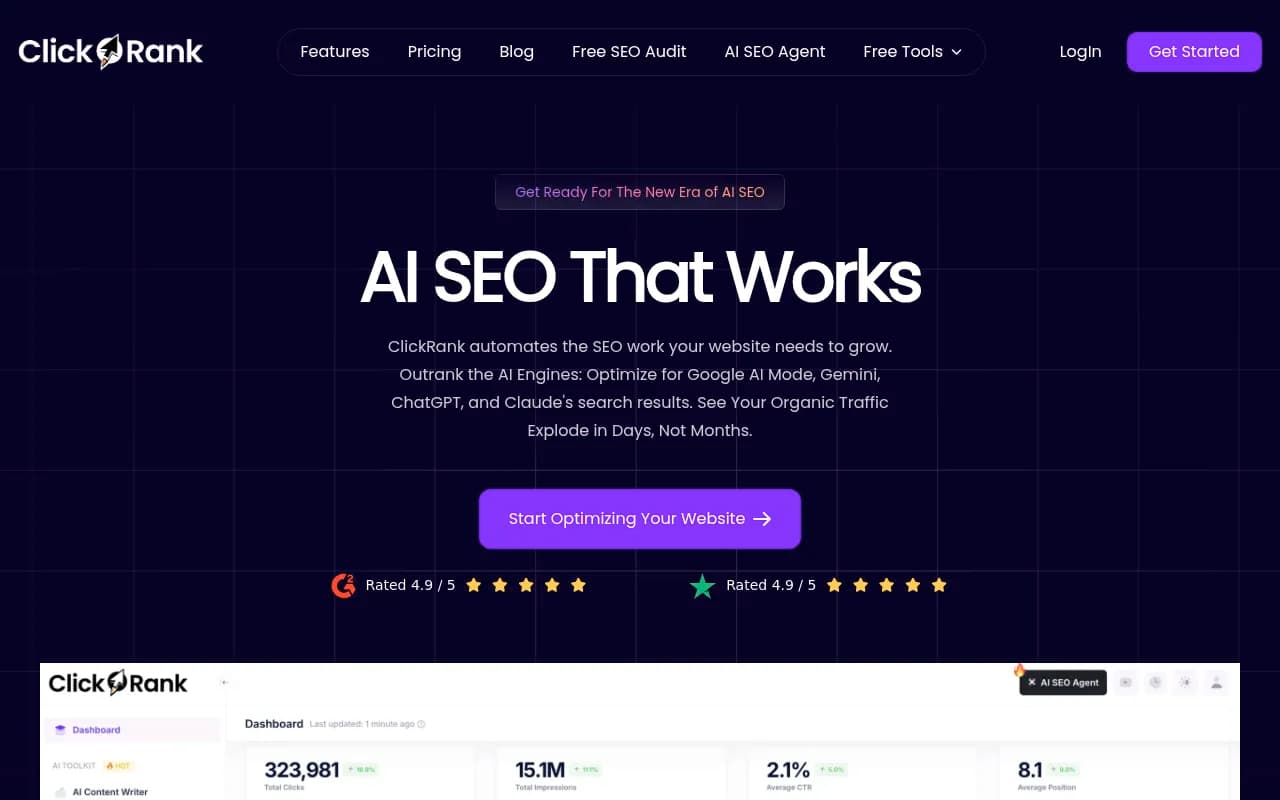
ClickRank is an AI-powered SEO automation platform that handles the tedious parts of on-page optimization. It connects to your Google Search Console, analyzes your pages, and generates optimized title tags, meta descriptions, image alt text, schema markup, and internal links. The pitch is simple: one-click fixes for metadata that would normally take hours of manual work.
It's designed for marketers and business owners who want better Google rankings without hiring an SEO agency or learning technical implementation. You drop a JavaScript snippet on your site, connect GSC, and let ClickRank suggest improvements. It integrates with any CMS and focuses entirely on traditional search engine optimization -- Google, Bing, the usual suspects.
Pricing is straightforward: Essential at $99/mo (1 site), Professional at $249/mo (2 sites), Business at $579/mo (5 sites). Free trial available. Target audience is small-to-medium businesses, ecommerce sites, and marketing teams that need to scale SEO work without scaling headcount.
Bluefish AI: Enterprise AI search monitoring
Bluefish AI is an enterprise marketing platform that tracks how Fortune 500 brands appear in AI search engines and agentic commerce channels. It monitors ChatGPT, Perplexity, Claude, Gemini, and other AI models to show where your brand gets mentioned, how often, and in what context.
The platform is built for large marketing teams that need custom audiences, tailored prompts, and deep performance analytics. Bluefish positions itself as the "AI marketing platform of choice for the Fortune 500" -- this is not a self-service tool for startups. It requires custom quotes (estimated $4,000+/month) and is sold through enterprise sales cycles.
What Bluefish does: AI search monitoring, brand reputation tracking across AI channels, performance analytics, custom audience segmentation. What it doesn't do: content generation, crawler logs, traditional SEO optimization, or any of the hands-on optimization features you'd find in platforms like Promptwatch. It's a monitoring and measurement tool, not an optimization platform.
Side-by-side comparison
| Feature | ClickRank AI | Bluefish AI |
|---|---|---|
| Primary focus | On-page SEO automation | AI search visibility monitoring |
| Target market | SMBs, startups, ecommerce | Fortune 500 enterprise brands |
| Starting price | $99/mo | ~$4,000+/mo (custom quote) |
| Free trial | Yes | No (demo only) |
| Traditional SEO | ✓ Core feature | ✗ Not covered |
| AI search tracking | ✗ Not covered | ✓ Core feature |
| Content generation | ✗ No | ✗ No |
| Metadata optimization | ✓ Automated | ✗ No |
| Schema markup | ✓ Yes | ✗ No |
| Internal linking | ✓ Automated | ✗ No |
| AI crawler logs | ✗ No | ✗ No |
| GSC integration | ✓ Yes | ✗ No |
| Custom audiences | ✗ No | ✓ Enterprise feature |
| Self-service signup | ✓ Yes | ✗ Sales-led only |
| Setup complexity | Low (JS snippet) | High (enterprise onboarding) |
| Best for | Google rankings | AI brand monitoring |
Head-to-head feature breakdown
Traditional SEO capabilities
ClickRank is built entirely around traditional search engine optimization. It automates the grunt work of on-page SEO: title tag optimization, meta description generation, image alt text, schema markup implementation, and internal link suggestions. You connect your Google Search Console, and ClickRank analyzes which pages need optimization based on actual search performance data.
The workflow is dead simple. ClickRank flags pages with missing or underperforming metadata, generates AI-optimized alternatives, and you approve or edit before publishing. It handles the technical implementation through a JavaScript snippet, so you don't need developer time to deploy changes. This is a huge time-saver for teams running multiple sites or large ecommerce catalogs.
Bluefish does none of this. It doesn't touch your website, doesn't optimize metadata, doesn't generate schema markup, and has no integration with Google Search Console. Bluefish is not an SEO tool in the traditional sense -- it's a monitoring platform for AI search engines.
Verdict: ClickRank wins decisively if you need traditional SEO automation. Bluefish isn't competing in this category.
AI search visibility and monitoring
Bluefish's entire value proposition is tracking how your brand appears in AI search engines. It monitors ChatGPT, Perplexity, Claude, Gemini, and other AI models to show when your brand gets mentioned, in what context, and how often. For Fortune 500 brands worried about reputation in AI-generated responses, this is the core concern.
The platform offers custom audiences (track how different personas prompt AI engines), tailored prompt sets (monitor specific queries relevant to your industry), and deep analytics on share-of-voice vs competitors. Bluefish positions this as "understanding how AI thinks" -- which is marketing speak for "we track citations and mentions in AI responses."
ClickRank doesn't do any of this. It has no AI search tracking, no monitoring of ChatGPT or Perplexity, no citation analysis. ClickRank is focused on Google and traditional search engines. If you want to know how your brand shows up in AI-generated answers, ClickRank can't help.
Verdict: Bluefish wins if AI search monitoring is your goal. But worth noting that platforms like Promptwatch offer similar AI visibility tracking plus content optimization and generation features that Bluefish lacks.

Content creation and optimization
Neither platform generates content. ClickRank optimizes existing metadata but doesn't write blog posts, articles, or landing pages. Bluefish monitors AI search results but doesn't create content to improve your visibility.
This is a significant gap for both tools. If you're trying to improve AI search visibility, you need content that AI models want to cite -- and monitoring alone won't get you there. Platforms like Promptwatch combine monitoring with an AI writing agent that generates articles grounded in citation data and prompt volumes, closing the loop between "what's missing" and "create content to fix it."
ClickRank's metadata optimization helps existing pages rank better in Google. Bluefish shows you where you're invisible in AI search. Neither helps you create the content you need to actually improve.
Verdict: Tie -- both tools miss this entirely. You'll need a separate content creation workflow or a platform that integrates monitoring with content generation.
Pricing and accessibility
ClickRank has transparent, self-service pricing: $99/mo for 1 site (Essential), $249/mo for 2 sites (Professional), $579/mo for 5 sites (Business). You can sign up, add a credit card, and start optimizing immediately. Free trial available. This is accessible pricing for startups, small businesses, and marketing teams with limited budgets.
Bluefish has custom quote-based pricing estimated at $4,000+/month for enterprise plans. No transparent tiers, no self-service signup, no free trial. You request a demo, go through a sales cycle, and negotiate a contract. This is enterprise software sold to Fortune 500 marketing departments with six-figure budgets.
The pricing gap reflects the target markets. ClickRank is built for volume -- lots of small customers paying $99-579/mo. Bluefish is built for a handful of large enterprise clients paying $50k-100k+/year.
Verdict: ClickRank is 40x cheaper at the entry level and accessible to any business. Bluefish is enterprise-only.
Integration and setup
ClickRank integrates with any CMS through a JavaScript snippet. You drop the code on your site, connect Google Search Console, and you're live. The platform pulls search performance data from GSC and uses it to prioritize which pages need optimization. Setup takes 10-15 minutes.
Bluefish requires enterprise onboarding with custom configuration for your brand, competitors, and prompt sets. There's no self-service setup -- you work with their team to define audiences, configure monitoring, and set up dashboards. This is a multi-week process typical of enterprise software.
Verdict: ClickRank is dramatically easier to set up. Bluefish requires dedicated project management and onboarding resources.
Analytics and reporting
ClickRank shows you which pages have been optimized, what changes were made, and tracks ranking improvements over time. It's focused on SEO metrics: impressions, clicks, CTR, position changes in Google Search Console. The analytics are straightforward and tied directly to the optimizations ClickRank makes.
Bluefish offers deep performance analytics on AI search visibility: share-of-voice vs competitors, citation frequency, sentiment analysis, and custom audience segmentation. The platform is built for enterprise marketing teams that need to report on brand reputation across AI channels. Analytics are more sophisticated but also more abstract -- you're tracking mentions and sentiment, not direct traffic or conversions.
Verdict: Depends on what you're measuring. ClickRank's analytics are simpler but tied to concrete SEO outcomes. Bluefish's analytics are deeper but harder to connect to revenue.
Enterprise features and support
Bluefish is built for enterprise: custom audiences, tailored prompts, dedicated support, and the ability to pass infosec reviews. The platform is designed for large marketing teams with complex needs and compliance requirements. This is where Bluefish justifies its price point.
ClickRank is a self-service tool with standard support. It's not built for enterprise procurement processes, custom SLAs, or dedicated account management. You get email support and documentation, not a customer success manager.
Verdict: Bluefish wins for enterprise requirements. ClickRank is self-service by design.
Pricing comparison
| Plan | ClickRank AI | Bluefish AI |
|---|---|---|
| Entry tier | $99/mo (1 site, Essential) | Custom quote (~$4,000+/mo) |
| Mid tier | $249/mo (2 sites, Professional) | Custom quote |
| High tier | $579/mo (5 sites, Business) | Custom quote |
| Free trial | Yes | No (demo only) |
| Annual discount | Available | Negotiable |
| Self-service | Yes | No |
| Typical contract | Month-to-month | Annual enterprise |
The pricing structures reflect completely different business models. ClickRank is a SaaS product with transparent tiers. Bluefish is enterprise software sold through custom contracts.
Pros and cons
ClickRank AI pros
- Affordable pricing starting at $99/mo
- Simple setup with JavaScript snippet
- Automates tedious on-page SEO work
- Direct integration with Google Search Console
- One-click metadata optimization
- Works with any CMS
- Free trial available
- Fast time-to-value (optimize pages same day)
ClickRank AI cons
- No AI search tracking or monitoring
- Doesn't create new content, only optimizes metadata
- Limited to on-page SEO (no backlink analysis, competitor research, etc.)
- Not built for enterprise compliance or custom workflows
- No advanced analytics beyond GSC data
Bluefish AI pros
- Deep AI search monitoring across ChatGPT, Perplexity, Claude, etc.
- Custom audiences and tailored prompts for enterprise needs
- Built for Fortune 500 compliance and security requirements
- Sophisticated analytics on brand reputation in AI channels
- Dedicated support and account management
Bluefish AI cons
- Extremely expensive ($4,000+/mo estimated)
- No transparent pricing or self-service signup
- Doesn't optimize traditional SEO at all
- No content generation or optimization features
- Monitoring-only -- doesn't help you fix visibility gaps
- No crawler logs or technical AI indexing insights
- Overkill for small businesses and startups
Who should choose which tool
Choose ClickRank AI if you:
- Run a small-to-medium business or ecommerce site
- Need to improve Google rankings through better on-page SEO
- Want to automate metadata optimization across hundreds or thousands of pages
- Have a limited budget ($99-579/mo range)
- Don't care about AI search engines like ChatGPT or Perplexity
- Want a tool you can set up and use immediately without a sales cycle
- Need to scale SEO work without hiring more people
Choose Bluefish AI if you:
- Work for a Fortune 500 brand with a six-figure marketing budget
- Need to monitor brand reputation in AI search engines
- Have enterprise compliance and security requirements
- Want custom audiences and tailored prompt monitoring
- Can afford $4,000+/month for a monitoring platform
- Have a dedicated team to manage enterprise software onboarding
- Care more about AI brand visibility than traditional Google SEO
Consider alternatives if you:
- Need both traditional SEO AND AI search visibility (neither tool does both)
- Want content generation to improve AI visibility (Bluefish only monitors, doesn't create)
- Need AI crawler logs and technical indexing insights (neither tool offers this)
- Want a comprehensive GEO platform that combines monitoring, content creation, and optimization (tools like Promptwatch cover this gap)
Final verdict
ClickRank AI and Bluefish AI are not competitors -- they solve completely different problems for completely different markets.
ClickRank is a practical, affordable SEO automation tool for businesses that need better Google rankings. It saves time on metadata optimization and delivers measurable results in traditional search. If you're a startup, SMB, or marketing team trying to improve organic traffic from Google, ClickRank is a solid choice at $99-579/mo.
Bluefish is an enterprise monitoring platform for Fortune 500 brands worried about AI search reputation. It tracks mentions in ChatGPT and Perplexity but doesn't optimize your site or create content. If you're a large brand with a dedicated budget for AI visibility monitoring and you need enterprise features, Bluefish fits that niche -- but you're paying $4,000+/mo for monitoring alone.
The real gap is that neither tool bridges traditional SEO and AI search optimization. ClickRank ignores AI engines entirely. Bluefish monitors AI but doesn't help you improve. If you need both -- or if you want a platform that not only tracks AI visibility but also helps you create content to fix gaps -- you'll need to look at more comprehensive GEO platforms that combine monitoring with optimization and content generation.
For most businesses reading this comparison: start with ClickRank if you need better Google rankings today. Add AI search monitoring later when you have the budget and the strategic need. Don't pay enterprise prices for monitoring-only tools unless you're a Fortune 500 brand with a specific AI reputation concern.