DataJelly Review 2026
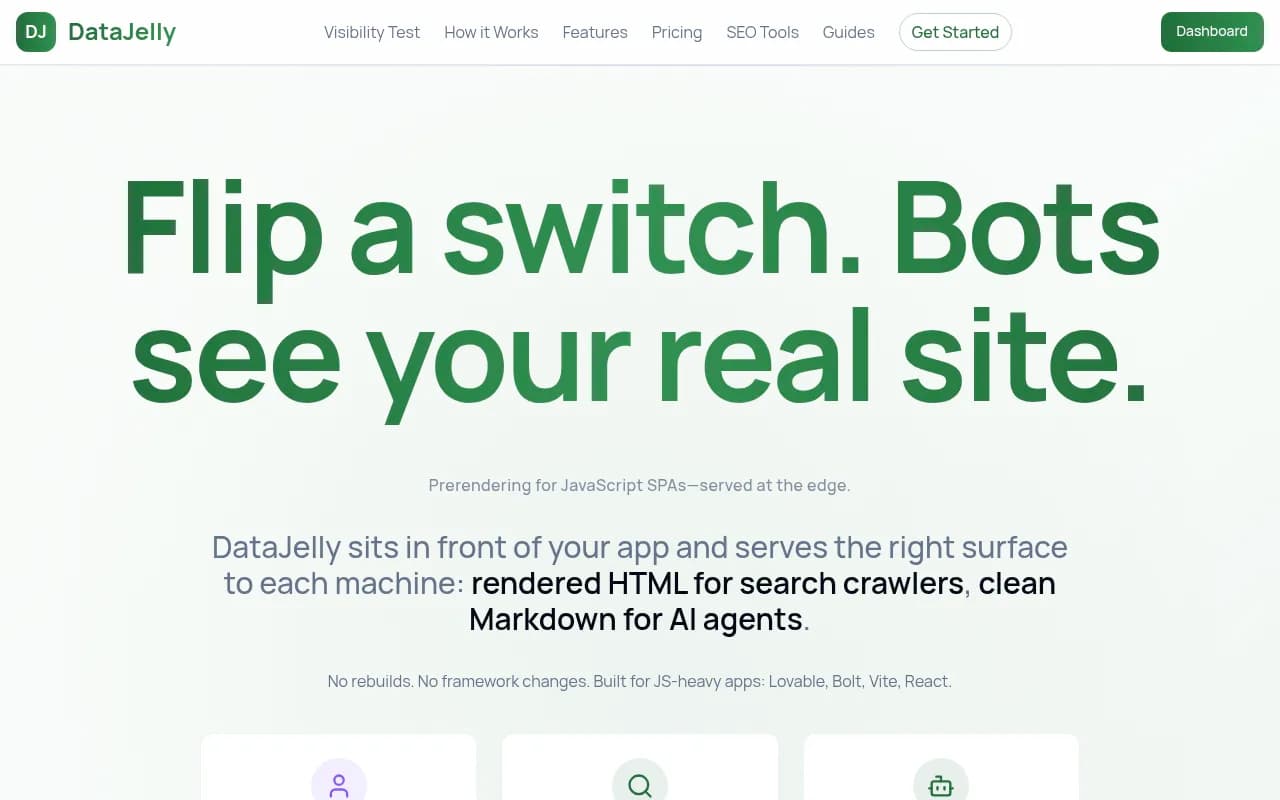
DataJelly is a prerendering service that makes JavaScript-heavy apps (React, Lovable, v0, Bolt) visible to search engines and AI tools. It sits at the edge, serving rendered HTML to Google/Bing crawlers and clean Markdown to ChatGPT, Perplexity, and Claude—without code changes or rebuilds. Built for
Key Takeaways:
• Solves the JavaScript SEO problem: DataJelly prerenders your React/SPA routes at the edge so search crawlers get fully rendered HTML instead of empty shells—no code changes required • AI-readable content: Serves clean Markdown extracts to ChatGPT, Perplexity, and Claude so AI tools can cite your content accurately instead of skipping it • Built for modern builders: Works seamlessly with Lovable, v0, Bolt, Vite, React, and any JavaScript framework—just point your DNS and you're live • Pricing: Free tier (10 pages, weekly snapshots), Starter $19/mo (100 pages, daily snapshots), Pro $79/mo (1,000 pages) • Best for: Teams shipping JavaScript apps fast who need search and AI visibility without rebuilding their stack
DataJelly is a prerendering and content extraction service built specifically for JavaScript-heavy applications that search engines and AI tools struggle to read. Founded to solve the visibility gap that modern frameworks create, DataJelly sits between your app and the bots—serving the right format to each visitor without touching your codebase. It's designed for teams using React, Lovable, v0, Bolt, Vite, and other JavaScript frameworks who need their content indexed by Google and cited by ChatGPT without rebuilding their entire stack.
The core problem DataJelly solves is simple but critical: when Googlebot or GPTBot visits a JavaScript app, they often see an empty shell or skeleton HTML. Your actual content—the headings, product descriptions, blog posts—is rendered client-side after the bot has already left. DataJelly intercepts bot traffic, fully renders the page server-side, and serves either clean HTML (for search crawlers) or structured Markdown (for AI agents). Humans visiting your site see the unchanged app. Bots get exactly what they need to index and cite your content.
How DataJelly Works (The Technical Flow):
DataJelly operates as an edge layer in front of your existing app. You make a DNS change pointing your domain through DataJelly's infrastructure—no code changes, no framework migrations, no new build process. When a request comes in, DataJelly detects whether it's a human or a bot. Humans are routed directly to your app unchanged. Bots trigger a rendering pipeline:
• Bot Detection: Identifies Googlebot, GPTBot, Perplexity crawler, Bingbot, and other known crawlers by user agent • Page Rendering: Executes all JavaScript, waits for dynamic content to load, captures the fully rendered DOM • Content Extraction: Pulls structured HTML including titles, headings, links, main content, and metadata • Markdown Generation: For AI bots specifically, converts the rendered page into clean Markdown—stripping navigation clutter, ads, and boilerplate to leave only the core content • Edge Delivery: Serves the appropriate format (HTML or Markdown) from the edge, cached and optimized
This happens automatically for every route in your app. DataJelly crawls your sitemap or discovers routes dynamically, generates snapshots, and keeps them fresh based on your plan's snapshot frequency (weekly on Free, daily on Starter/Pro).
AI Visibility: Why Markdown Matters
DataJelly's standout feature is its focus on AI-readable content. When ChatGPT, Perplexity, or Claude crawl the web to answer user queries, they're working with token budgets and need clean, structured input. A typical JavaScript app serves tens of thousands of tokens of raw HTML—navigation menus, script tags, CSS classes, tracking pixels. AI models either skip the page entirely or extract incomplete, inaccurate summaries.
DataJelly solves this by generating clean Markdown extracts: just the headings, paragraphs, lists, and links that matter. The result is that AI tools can actually understand what your page is about, cite it accurately in answers, and recommend your product when relevant. This isn't theoretical—DataJelly's homepage shows a direct comparison of raw HTML (bloated, hard to parse) versus Markdown (clean, structured). The difference is whether your brand shows up in AI-generated answers or gets skipped for a competitor with cleaner content.
The platform includes an AI Visibility Report that shows exactly what ChatGPT and Perplexity can extract from your pages. You can run this test for free without signing up—it takes about 20 seconds and generates a shareable report link. This is useful for auditing your current visibility, sharing with stakeholders, or proving ROI after connecting DataJelly.
Search Visibility: Prerendering for Googlebot
On the search side, DataJelly functions as a traditional prerendering service but optimized for modern edge delivery. When Googlebot visits your React or Vite app, it gets a fully rendered HTML snapshot instead of an empty <div id="root"></div>. This fixes the core JavaScript SEO problem: Google can index your actual content, not just your skeleton.
Key capabilities:
• Multi-Route Snapshots: Automatically captures and caches snapshots of all your app's routes—no manual configuration • Bot Detection & Routing: Humans see your live app, bots get the prerendered version—no cloaking penalties because the content is identical • SEO Monitoring & Alerts: Get notified when your visibility drops or content changes unexpectedly (useful for catching regressions after deploys) • SERP Tracking: Monitor keyword rankings over time across Google and Bing (available on Starter and Pro plans)
DataJelly works with any hosting provider—Lovable, Vercel, Netlify, Cloudflare Pages, or your own infrastructure. The DNS change is the only integration step. No server-side rendering setup, no Next.js migration, no framework lock-in.
Built for AI-First Builders (Lovable, v0, Bolt)
DataJelly explicitly targets teams using AI code generators and no-code tools. If you built your app in 5 minutes with Lovable or v0, you probably didn't think about SEO or AI visibility—you just wanted to ship. DataJelly is the fix you add after launch when you realize Google isn't indexing your pages and ChatGPT can't read your content.
The platform's messaging is tailored to this audience: "No rebuilds. No framework changes. Built for JS-heavy apps." The free visibility test is designed to be shareable—agencies and freelancers can run it for clients, send the report link, and demonstrate the problem before pitching the solution. The onboarding flow is optimized for speed: connect your domain, DataJelly auto-discovers your routes, snapshots are generated within minutes.
Integrations & Ecosystem
DataJelly is intentionally lightweight on integrations because it operates at the DNS/edge layer. You don't need to install SDKs, add tracking scripts, or modify your build process. The platform works with:
• Any JavaScript framework: React, Vue, Svelte, Angular, Vite, Lovable, v0, Bolt, Cursor-generated apps, etc. • Any hosting provider: Vercel, Netlify, Cloudflare Pages, AWS, custom servers • Standard web infrastructure: Works via DNS CNAME or proxy setup—no proprietary APIs required
There's no mention of API access, webhooks, or third-party integrations (like Google Search Console or analytics platforms) in the current feature set. The product is focused on doing one thing well: making your content readable by bots.
Pricing & Value
DataJelly offers three tiers:
• Free: 10 pages, 1 snapshot per week per page—good for testing or very small sites • Starter ($19/mo): 100 pages, daily snapshots, SERP tracking—suitable for small apps or early-stage products • Pro ($79/mo): 1,000 pages, daily snapshots, SERP tracking, priority support—designed for growing SaaS apps or agency clients
All plans include unlimited prerendering (the actual serving of snapshots to bots), bot detection, and the core HTML + Markdown generation. The limits are on the number of unique pages and snapshot refresh frequency. There's a 30-day free trial with no credit card required, which is generous for evaluating the platform.
Compared to traditional prerendering services (Prerender.io, Rendertron), DataJelly is competitively priced and adds the AI-readable Markdown layer that others don't offer. Compared to doing this yourself (setting up Puppeteer, managing caching, handling bot detection), $19-79/mo is a no-brainer for most teams.
Who Should Use DataJelly
DataJelly is best for:
• AI-first builders: Teams using Lovable, v0, Bolt, or Cursor to ship JavaScript apps fast who need bots to read their content without rebuilding • React/SPA teams: Any team running a client-side rendered app (React, Vue, Svelte) who's struggling with Google indexing or AI visibility • Marketing/product teams: Non-technical teams who need to fix visibility issues without waiting for engineering sprints • Agencies & freelancers: Consultants managing multiple client sites who want a white-label visibility report and a quick fix without touching codebases • Early-stage SaaS: Startups shipping fast with modern frameworks who need search and AI visibility but don't have time for SSR migrations
DataJelly is NOT ideal for:
• Static sites or SSR apps: If you're already using Next.js with SSR or a static site generator, you don't need prerendering—your content is already crawlable • Enterprise SEO teams: If you need deep integrations with enterprise SEO platforms, custom rendering rules, or white-label reselling, DataJelly's feature set is currently too lightweight • Content-heavy publishers: If you have 10,000+ pages and need sub-hourly snapshot refreshes, you'll hit plan limits quickly (though custom enterprise pricing may be available)
Strengths
• Solves a real, painful problem: JavaScript SEO is genuinely hard, and DataJelly makes it trivial—DNS change, done • AI-readable Markdown is unique: Most prerendering services only handle search crawlers; DataJelly's focus on ChatGPT/Perplexity visibility is differentiated and timely • Zero code changes: The DNS-only setup is a massive selling point for non-technical teams or agencies managing client sites • Free visibility test: The shareable report is a smart lead gen tool and genuinely useful for auditing • Built for modern builders: Explicit support for Lovable, v0, Bolt shows they understand their audience
Limitations
• No API or advanced integrations: If you want to trigger snapshots programmatically, integrate with your CI/CD, or export data to other tools, you're out of luck currently • Snapshot frequency caps: Daily snapshots on paid plans may not be enough for high-velocity teams shipping multiple times per day • Limited enterprise features: No mention of custom rendering rules, A/B test handling, or white-label reselling for agencies • SERP tracking is basic: Keyword tracking is mentioned but not detailed—likely not a replacement for Ahrefs or Semrush • No mobile rendering: No mention of mobile-specific snapshots or rendering for mobile bots
Bottom Line
DataJelly is a focused, well-executed solution to a specific problem: making JavaScript apps visible to search engines and AI tools without rebuilding your stack. If you're shipping with React, Lovable, v0, or any client-side framework and you've noticed Google isn't indexing your pages or ChatGPT can't cite your content, DataJelly is the fastest fix available. The AI-readable Markdown output is a standout feature that positions it well for 2026, when AI search visibility is becoming as critical as traditional SEO. At $19-79/mo, it's a no-brainer for most teams compared to the engineering cost of implementing SSR or managing your own prerendering infrastructure. Best use case in one sentence: Teams using modern JavaScript frameworks who need bots to read their content yesterday, not after a three-month SSR migration.
Frequently asked questions
What is DataJelly and what does it do?
How much does DataJelly cost?
Does DataJelly have a free plan?
What JavaScript frameworks does DataJelly work with?
How does DataJelly solve the JavaScript SEO problem?
Does DataJelly require code changes to my application?
How does DataJelly help with AI tool visibility?
Who is DataJelly best for?
What's the difference between DataJelly's pricing tiers?
How does DataJelly handle bot traffic versus human visitors?
Similar and alternative tools to DataJelly