CaliberMind Review 2026
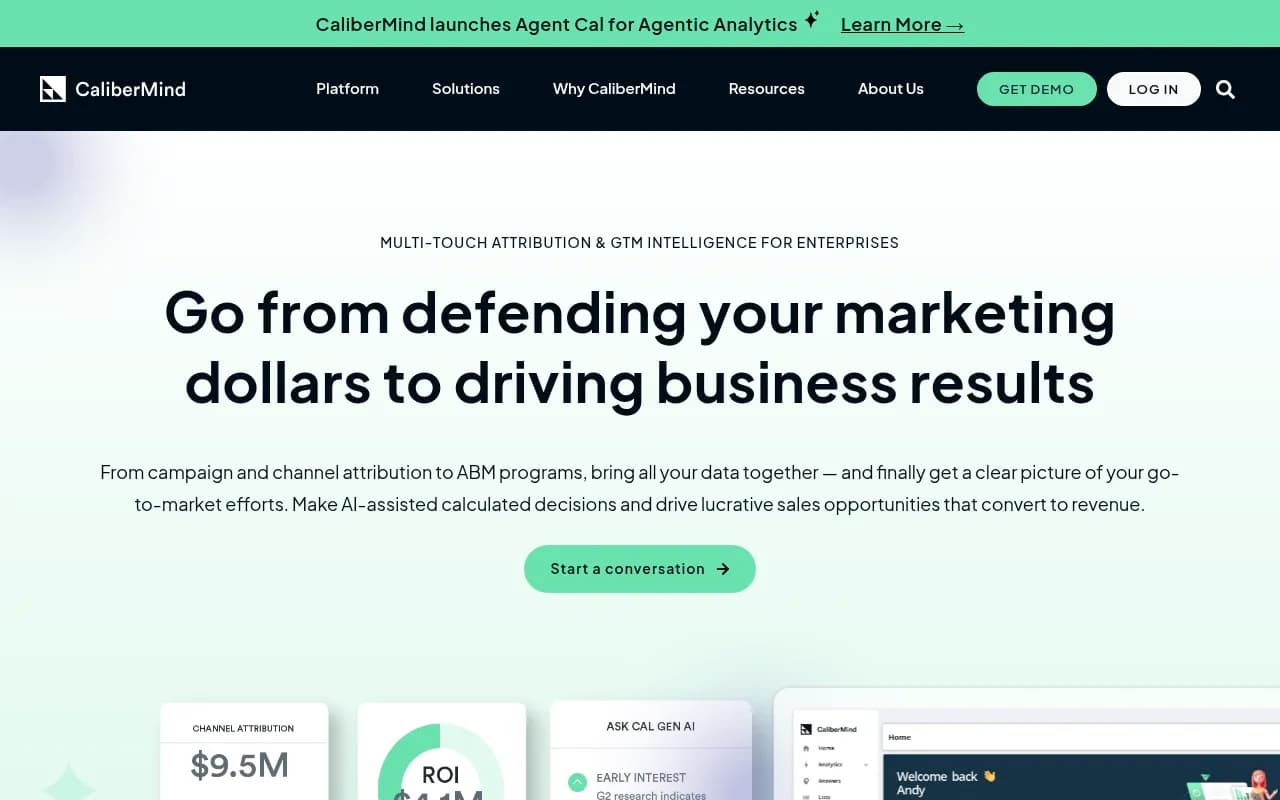
CaliberMind is an enterprise B2B GTM intelligence platform that unifies marketing, sales, and RevOps data to deliver multi-touch attribution, ABM insights, and buyer journey intelligence. Built for Fortune 500 companies and large enterprises with complex sales cycles, it transforms fragmented data i
Key Takeaways:
- Enterprise-grade GTM platform that unifies data from 170+ sources and delivers multi-touch attribution, ABM insights, and AI-powered buyer journey intelligence for large B2B organizations
- Built for complex environments — handles custom Salesforce objects, long sales cycles, and intricate data structures that break most attribution tools
- Ask Cal AI generates natural language summaries of account activity and pushes actionable insights directly to sales teams in Salesforce
- Transparent data ownership — no black-box analytics, full export capabilities, and works with your existing BI tools
- Best for: Enterprise marketing teams (1000+ employees), Fortune 500 companies, and organizations with multi-million dollar marketing budgets who need to prove ROI to the board
CaliberMind is an enterprise B2B go-to-market intelligence platform built for revenue marketers at large organizations who are tired of defending their budgets with incomplete data. Founded to solve the attribution and data unification challenges that plague Fortune 500 marketing teams, CaliberMind serves companies like NetApp, ADP, Dynatrace, Cargill, and Baker Tilly — organizations where marketing complexity isn't a bug, it's a feature. The platform addresses a fundamental problem: as B2B marketing teams mature and their tech stacks expand, their data becomes more fragmented, their buyer journeys more opaque, and their ability to prove ROI more difficult. CaliberMind positions itself as the GTM intelligence layer that sits on top of your existing stack and makes sense of the chaos.
The target audience is narrow and specific: enterprise B2B marketing teams at companies with 1000+ employees, complex sales cycles spanning 6-18 months, multi-million dollar marketing budgets, and executive leadership demanding proof of marketing's revenue contribution. This isn't a tool for startups or mid-market companies running simple lead gen campaigns. It's purpose-built for organizations where a single deal might involve 15 stakeholders across 8 departments, where marketing touches span online ads, field events, webinars, direct mail, partner programs, and account-based plays, and where the CMO needs to walk into a board meeting with ironclad attribution data.
Multi-Touch Attribution and Marketing Analytics
CaliberMind's core attribution engine tracks every touchpoint across online and offline channels and maps them to pipeline and revenue outcomes. Unlike lightweight attribution tools that only capture digital interactions or rely on last-touch models, CaliberMind handles the full complexity of enterprise B2B: trade show booth visits, executive dinners, partner co-marketing activities, direct mail campaigns, webinar attendance, content downloads, email engagement, paid media clicks, and organic search visits all get stitched into a unified buyer journey. The platform supports multiple attribution models (first-touch, last-touch, linear, time-decay, U-shaped, W-shaped, custom weighted) and lets you switch between them to answer different questions. You can attribute revenue both pre-opportunity (which campaigns influenced the deal before it entered the pipeline) and post-opportunity (which marketing activities accelerated the deal after it was created). This dual-lens view is critical for enterprise teams where marketing continues to influence deals long after they're handed to sales. The attribution reports are designed for board-level presentations — clean visualizations showing marketing's contribution to pipeline, revenue, and deal velocity, broken down by campaign, channel, region, product line, or any custom dimension your business cares about.
ABM Insights and Account Scoring
For account-based marketing programs, CaliberMind delivers full-funnel account intelligence that most ABM platforms can't match. The platform captures signals across all touchpoints — known and anonymous visitors, online and offline engagement, first-party and third-party intent data — and maps them to the account level. It identifies buying groups within target accounts, tracks engagement patterns across multiple contacts, and scores accounts based on custom criteria that reflect your business reality (not a vendor's generic scoring model). One standout capability: CaliberMind can detect "surge" behavior — sudden spikes in account-level engagement that indicate buying intent. NetApp used this feature to identify surges in 20% of their priority target accounts in a single quarter, resulting in 733 new opportunities opened by sales. The platform also handles account hierarchies and complex organizational structures, so if a subsidiary of a parent company is engaging, you see the full picture. Unlike standalone ABM tools that force you to export data and analyze it elsewhere, CaliberMind's ABM insights are integrated with attribution, so you can see which campaigns are driving account engagement and which accounts are converting to pipeline.
Ask Cal AI — Buyer Journey Intelligence for Sales
Ask Cal is CaliberMind's AI layer that translates complex engagement data into plain-language insights sales teams can actually use. Instead of handing sales reps a spreadsheet with 47 rows of touchpoint data, Ask Cal generates natural language summaries: "This account has had 12 interactions in the past 30 days, with heavy engagement from the VP of Marketing and two directors. They've downloaded three whitepapers on topic X, attended a webinar on topic Y, and visited your pricing page twice." These summaries get pushed directly into Salesforce when an account reaches a certain stage or score threshold, so reps see the full buyer journey context without leaving their CRM. Ask Cal can also answer ad-hoc questions from marketers: "Which campaigns drove the most pipeline last quarter?" "What's the average time from first touch to closed-won for enterprise deals?" "Which accounts in our target list are showing buying signals this week?" The AI is trained on your specific data and business logic, so the insights are relevant and actionable, not generic. This is a major differentiator versus attribution tools that dump raw data and leave interpretation to the user.
Data Transformation and Unification
CaliberMind is built on an enterprise-grade marketing data warehouse that serves as the foundation for all its analytics. The platform connects to 170+ data sources via pre-built integrations — Salesforce (all objects, including custom), Marketo, HubSpot, Pardot, Google Analytics, Google Ads, LinkedIn Ads, 6sense, Demandbase, Drift, Gong, Outreach, ZoomInfo, Clearbit, Snowflake, BigQuery, and dozens more. But the real power is in the intermediate data engineering layer. CaliberMind doesn't just ingest your data and hope for the best — it actively cleans, deduplicates, matches, and stitches records to build a unified view of accounts, contacts, and touchpoints. If your Salesforce data is messy (and whose isn't?), CaliberMind has workflows to fix it. If you have custom objects or non-standard data models, CaliberMind adapts. The platform supports two-way sync with Salesforce, so enriched data and insights flow back into your CRM. You also get full data transparency and ownership — no black-box algorithms. You can export your data to your own data warehouse (Snowflake, BigQuery, Redshift) and plug in your BI tools (Tableau, Looker, Power BI) for custom analysis. This level of flexibility is rare in the attribution space, where most vendors lock your data inside their platform.
Sales Signals and Buyer Journey Tracking
For sales teams, CaliberMind surfaces high-intent accounts and provides context for outreach. The platform identifies which accounts are actively engaging, who the key contacts are, what content they're consuming, and what stage of the buying journey they're in. Sales reps get alerts when target accounts hit certain engagement thresholds or exhibit surge behavior, so they can prioritize outreach. The buyer journey view shows the complete timeline of interactions across an account — every email open, webinar attendance, content download, website visit, and offline event participation. This helps BDRs and SDRs personalize their outreach and avoid generic cold calls. Account executives can see which marketing campaigns influenced their deals, making it easier to align with marketing on what's working. The platform also helps sales leadership understand which accounts are progressing and which are stalled, so they can coach reps and forecast more accurately.
Integrations and Ecosystem
CaliberMind integrates with 170+ tools across marketing automation (Marketo, HubSpot, Pardot, Eloqua), CRM (Salesforce, Microsoft Dynamics), advertising (Google Ads, LinkedIn Ads, Facebook Ads), ABM platforms (6sense, Demandbase, Terminus), sales engagement (Outreach, SalesLoft, Groove), conversational marketing (Drift, Qualified), data enrichment (ZoomInfo, Clearbit, Bombora), analytics (Google Analytics, Adobe Analytics), data warehouses (Snowflake, BigQuery, Redshift), and BI tools (Tableau, Looker, Power BI). The platform also offers API access for custom integrations and data exports. Two-way Salesforce sync is a core capability — CaliberMind can read from and write to any Salesforce object, including custom objects, which is critical for enterprises with heavily customized CRMs. The platform also supports server-side tracking via JavaScript snippet or server log analysis for capturing anonymous website visitor data.
Who Is CaliberMind For
CaliberMind is explicitly built for enterprise B2B marketing teams — think Fortune 500 companies, large SaaS enterprises, global professional services firms, and technology vendors with complex product portfolios and long sales cycles. The ideal customer is a company with 1000+ employees, a marketing budget in the millions, a tech stack with 15+ tools, and a CMO who needs to prove marketing's contribution to a skeptical board. Specific personas include CMOs and VPs of Marketing who need board-ready ROI reports, Demand Gen leaders running multi-channel ABM programs, Marketing Operations teams drowning in data chaos, Marketing Analysts building attribution models, and RevOps leaders trying to align marketing and sales around a single source of truth. Companies in industries like enterprise software, financial services, manufacturing, healthcare IT, and professional services are common users. CaliberMind is NOT for small businesses, startups, or mid-market companies with simple lead gen funnels and short sales cycles. If you're a 50-person SaaS startup with a $200K marketing budget and a 30-day sales cycle, this platform is overkill. It's also not for companies that don't have the data infrastructure or technical resources to support an enterprise-grade analytics platform — you need clean(ish) Salesforce data, a defined lead/opportunity process, and someone on your team who understands data modeling.
Pricing and Value
CaliberMind does not publish pricing on its website. Based on industry knowledge and the enterprise positioning, expect pricing to start in the mid-five figures annually and scale based on data volume, number of users, and complexity of implementation. This is not a self-serve product — it requires a sales conversation, a scoping process, and often a professional services engagement to configure the platform for your specific data model and business logic. The value proposition is clear: if you're a CMO managing a $5M marketing budget and you can prove that marketing contributed $50M in pipeline, the platform pays for itself many times over. For enterprises where a single deal can be worth $500K to $5M, having accurate attribution and buyer journey intelligence is worth the investment. CaliberMind also offers a customer success team that gets consistently high marks on G2 — users praise the technical expertise and responsiveness of the support team, which is critical for a platform this complex.
Strengths and Limitations
CaliberMind excels at handling enterprise complexity. It's one of the few attribution platforms that can work with custom Salesforce objects, non-standard data models, and heavily customized tech stacks. The data transparency and ownership model is a major strength — you're not locked into a black-box system. The Ask Cal AI feature is genuinely useful for sales enablement, not just a marketing gimmick. The customer success team is highly regarded. The platform is flexible and grows with you as your business evolves. However, there are tradeoffs. CaliberMind has a learning curve — it's not a plug-and-play tool you set up in an afternoon. Time to value is typically 2 weeks for basic insights, but advanced configurations can take longer. The platform requires clean(ish) data to work well — garbage in, garbage out still applies. Pricing is opaque and likely expensive for smaller organizations. Some users on G2 mention that the UI could be more intuitive and that certain features require training to use effectively. Compared to lighter-weight attribution tools like Bizible (now Marketo Measure) or HockeyStack, CaliberMind is more powerful but also more complex. Compared to DIY solutions built on Snowflake or BigQuery, CaliberMind offers faster time to value and expert guidance but less control.
Bottom Line
CaliberMind is the go-to attribution and GTM intelligence platform for enterprise B2B marketing teams that need to prove ROI in complex, multi-touch environments. If you're a CMO at a Fortune 500 company or a large enterprise with a multi-million dollar marketing budget, long sales cycles, and a board demanding proof of marketing's revenue contribution, CaliberMind delivers the data unification, attribution accuracy, and buyer journey intelligence you need. It's not cheap, it's not simple, and it's not for everyone — but for the right organization, it's the difference between defending your budget and confidently asking for more.
Tags:
Similar and alternative tools to CaliberMind