ZoomInfo Marketing Review 2026
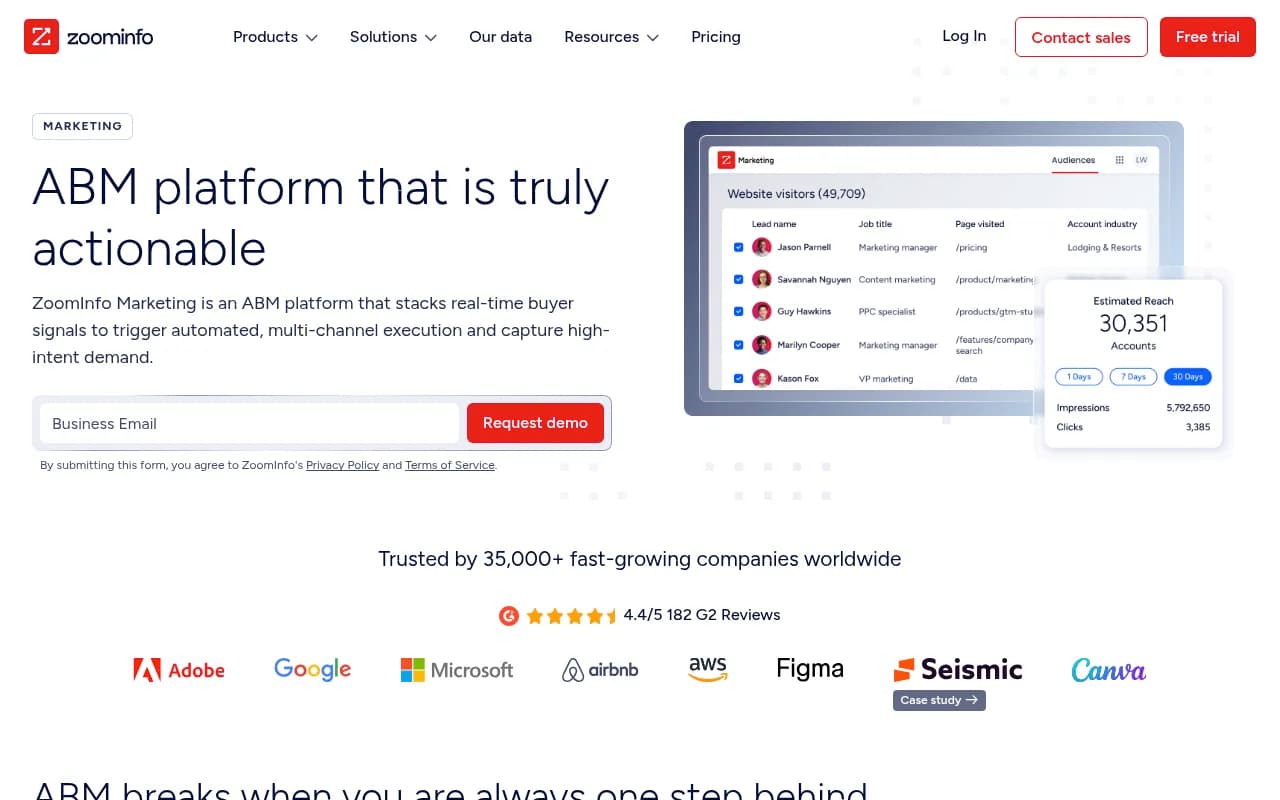
ZoomInfo Marketing is an account-based marketing platform that combines real-time buyer intent signals with automated multi-channel execution. It identifies high-intent accounts through AI signal stacking, then automatically launches personalized campaigns across display ads, email, LinkedIn, Meta,
Key Takeaways:
- Signal-to-action automation: Unlike monitoring-only ABM tools, ZoomInfo Marketing automatically triggers multi-channel campaigns (display, email, social, CTV) when buyer signals fire -- no manual list building or waiting for weekly reports
- Contact-level identification: Tracks not just which companies visit your site, but which specific people and what they viewed, enabling personalized outreach at the individual level
- Lacks content optimization capabilities: Focuses on paid media and outbound execution -- does not include content gap analysis, AI content generation, or organic visibility optimization that platforms like Promptwatch provide for AI search channels
- Premium pricing: Seat-based model starting around $75/month per user, with annual contracts typically required -- significantly more expensive than point solutions
- Best for: Mid-market to enterprise B2B companies with dedicated ABM budgets who need to coordinate campaigns across multiple paid channels and prove marketing's revenue impact

ZoomInfo Marketing is the ABM arm of ZoomInfo, the B2B data and intelligence platform used by 35,000+ companies including Adobe, Microsoft, AWS, and Airbnb. Launched as part of ZoomInfo's broader go-to-market suite, it's designed for marketing teams that are tired of dashboards that show intent but don't help you act on it. The core promise: capture buying signals and automatically execute multi-channel campaigns in real time, without the manual work that bogs down most ABM programs.
The platform is built for demand gen leaders, ABM managers, and growth marketers at B2B companies -- particularly those selling to mid-market and enterprise accounts where multiple stakeholders are involved and the sales cycle is measured in months, not days. If you're running account-based plays and need to coordinate display ads, email sequences, social campaigns, and sales outreach based on intent signals, this is the category ZoomInfo Marketing competes in.
How ZoomInfo Marketing Actually Works
The platform operates on a three-step loop: signal stacking, orchestration, and execution.
Signal Stacking (AI-Powered Intent Detection): ZoomInfo's AI connects signals across accounts and contacts to identify moments of buyer readiness. This isn't just "Company X visited your pricing page" -- it's layering website visits, content downloads, technographic changes (like a company adopting a complementary tool), hiring activity, earnings call mentions of budget expansion, and third-party intent data from ZoomInfo's network of 300+ B2B sites. The AI looks for patterns that historically precede opportunity creation in your CRM, then surfaces accounts that match those patterns. You get contact-level identification: not just that Acme Corp visited your site, but that Sarah Johnson (VP Marketing) and two directors viewed your case studies and pricing page within 48 hours. That specificity is what separates this from basic website visitor tracking.
Intelligent Orchestration (GTM Studio): When a signal fires, GTM Studio (ZoomInfo's workflow engine) decides what to do. It routes high-intent accounts to sales, launches multi-channel campaigns, and triggers rep actions automatically. You define the plays -- for example, "When an account in our ICP shows intent on 'marketing automation' and visits our site twice in a week, launch a display ad campaign, send a personalized email sequence, and notify the assigned SDR." The AI selects the right channels and timing based on what's worked historically. No manual list exports or waiting for batch processes.
Automatic Execution (Cross-Channel Campaigns): This is where ZoomInfo Marketing differentiates itself from intent data providers that just hand you a list. When a play triggers, campaigns launch automatically across ZoomInfo's built-in DSP (demand-side platform) for display ads across the open web, adaptive email sequences through your connected MAP (Marketo, HubSpot, Eloqua, Pardot), LinkedIn and Meta ad activation via API integrations, and Connected TV placements for brand awareness at target accounts. You're not manually building audiences in each platform -- ZoomInfo syncs the account list and creative, and the ads start running. The platform also enriches incomplete form fills (FormComplete feature), turning partial submissions into full contact records so you don't lose leads to form friction.
Account Fit Score (Predictive AI): ZoomInfo uses machine learning to score every account in its database (Low 0-50, Moderate 50-85, Great Fit 86-100) based on similarity to your closed-won deals. It analyzes firmographics (company size, revenue, industry, location), technographics (what software they use), and CRM patterns to identify lookalike accounts. You can see why a company scored high -- for example, "Uses Salesforce + HubSpot, 200-500 employees, SaaS industry, expanding in North America" -- and use that to refine your ICP. This helps prioritize which accounts to target when you have limited budget.
ZoomInfo Intent (Proprietary Intent Data): ZoomInfo tracks intent spikes across its network of B2B publishers and research sites. When an account is researching topics related to your product category at higher-than-usual levels, the platform flags it. The AI validates which intent topics actually correlate with opportunity creation in your CRM, so you're not chasing false signals. For example, if accounts spiking on "sales engagement software" historically convert at 3x the rate of accounts spiking on "CRM," the platform will prioritize the former. This is more sophisticated than basic keyword tracking -- it's outcome-driven intent scoring.
Website Chat (Conversational ABM): ZoomInfo Chat combines real-time chat with enriched data to qualify leads instantly. When a visitor from a target account lands on your site, the chatbot can greet them by name (if identified), ask qualifying questions, and route them to the right rep based on account ownership in your CRM. It runs 24/7 and captures contact info even if the visitor doesn't fill out a form. The chat transcripts feed back into the intent signal engine, so a conversation about pricing becomes a signal that triggers follow-up campaigns.
Form Enrichment (FormComplete): Reduces form fields to minimize friction, then enriches partial submissions with ZoomInfo's database. A visitor enters just their email, and ZoomInfo appends company name, title, phone number, and firmographic data. Smartsheet reported an 84% increase in MQLs and a 59% increase in win rate after implementing FormComplete on their demo form. This is a direct conversion rate lever -- fewer fields means more submissions, and enrichment means sales still gets the data they need.
Cross-Channel Advertising (Built-In DSP): ZoomInfo operates its own demand-side platform, so you can launch display ad campaigns without needing a separate tool like Demandbase or RollWorks. You build audiences using ZoomInfo's 300+ firmographic and technographic filters (industry, revenue, employee count, technologies used, intent signals, engagement history), then deploy ads across the open web, LinkedIn, Meta, and Connected TV. The platform tracks which accounts saw your ads, which clicked, and which converted -- closed-loop attribution that most DSPs don't provide. Librestream reported a 900% increase in CTR after switching to ZoomInfo's ad targeting.
Integrations: Native integrations with Salesforce, HubSpot, Marketo, Eloqua, Pardot, Microsoft Dynamics, Outreach, Salesloft, Slack, and Zapier. The Salesforce integration syncs account ownership, opportunity data, and activity history bidirectionally, so intent signals and campaign engagement flow into CRM records automatically. LinkedIn and Meta integrations allow you to push audiences directly to those platforms for retargeting without CSV uploads. Google Ads integration supports similar audience targeting. API access is available for custom workflows.
Who Is ZoomInfo Marketing For
This is a platform for mid-market to enterprise B2B companies with dedicated ABM budgets and multi-person marketing teams. Specifically:
Demand Gen and ABM Managers at SaaS Companies: If you're running account-based plays for a product with a $50K+ ACV and a 3-6 month sales cycle, this is built for you. You need to coordinate campaigns across multiple channels, prove marketing's impact on pipeline, and align with sales on target account lists. ZoomInfo Marketing gives you the data, automation, and attribution to do that without duct-taping together five different tools.
Marketing Ops Leaders Who Need to Prove ROI: If your CEO or board is asking "What's marketing's contribution to revenue?" and you're stuck pulling reports from Google Analytics, LinkedIn Campaign Manager, and your MAP, ZoomInfo's closed-loop intelligence solves that. You can see which campaigns drove opportunities, which channels converted, and which plays delivered ROI -- all in one dashboard.
Growth Marketers at Companies Selling to Enterprise: If your ICP is Fortune 500 companies and you need to reach multiple stakeholders (CIO, VP Sales, Director of Marketing) at the same account, ZoomInfo's contact-level identification and multi-channel orchestration are critical. You can't just run a LinkedIn ad and hope -- you need coordinated touchpoints across display, email, social, and sales outreach. This platform automates that coordination.
Marketing Teams That Have Outgrown Point Solutions: If you're currently using a patchwork of tools -- Clearbit for enrichment, Bombora for intent, Demandbase for ads, Outreach for sequences -- and spending hours each week syncing data between them, ZoomInfo Marketing consolidates that stack. You get data, intent, advertising, and orchestration in one platform. The trade-off is cost (more on that below), but the efficiency gain is real.
Who Should NOT Use This:
Small businesses and startups with limited budgets. ZoomInfo's seat-based pricing starts around $75/month per user and typically requires annual contracts. If you're a 5-person startup with a $2K/month marketing budget, this is overkill. You'd be better off with a freemium tool like HubSpot or a lower-cost data provider like Apollo.
Companies selling to SMBs or consumers. ZoomInfo's data is B2B-focused and optimized for mid-market and enterprise accounts. If you're selling a $50/month SaaS product to freelancers or a DTC product to consumers, the targeting capabilities here are wasted.
Marketing teams that don't have sales alignment. If your sales team isn't using a CRM, doesn't follow up on leads, or operates independently from marketing, the orchestration features won't deliver value. This platform assumes tight sales-marketing collaboration and shared account ownership.
Teams that need content optimization for organic or AI search channels. ZoomInfo Marketing is built for paid media and outbound execution -- it does not include content gap analysis, SEO tools, or AI search visibility optimization. If your strategy depends on ranking in Google, appearing in ChatGPT responses, or optimizing for Perplexity citations, you'd need a separate platform like Promptwatch to handle that layer.
Pricing and Value
ZoomInfo uses a seat-based pricing model. The basic plan starts around $75/month per user, but most companies pay significantly more depending on the number of seats, add-on features (intent data, advertising, chat), and data credits. Annual contracts are standard. Based on third-party reports, the Pro plan is around $3,500/year and the Unlimited plan is around $3,000/year, though ZoomInfo does not publish pricing publicly -- you have to request a demo and get a custom quote.
For context, competitors like 6sense and Demandbase are similarly priced (mid-five-figures annually for a team of 5-10 users), while lower-cost alternatives like Apollo or Cognism start around $50-100/user/month but lack the orchestration and advertising features. If you're comparing ZoomInfo Marketing to a patchwork of tools (Clearbit $1K/month + Bombora $2K/month + Demandbase $3K/month), the consolidated pricing can actually be competitive. But if you're comparing it to a single point solution, it's expensive.
The value proposition depends on whether you can prove ROI. Customers like Smartsheet (84% increase in MQLs, 59% increase in win rate), Impartner (12% pipeline growth quarter-over-quarter), and NetSPI (40% faster deal cycles) report measurable impact. If you're a $50M+ revenue company and marketing contributes 30-40% of pipeline, a 10-15% improvement in conversion rates or deal velocity pays for the platform many times over. If you're a $5M company with a small marketing team, the ROI math is harder to justify.
Strengths and Limitations
What ZoomInfo Marketing does exceptionally well:
End-to-end automation from signal to execution. Most ABM platforms give you intent data and make you manually build campaigns. ZoomInfo closes the loop -- when a signal fires, the ads launch, the emails send, and the SDR gets notified. That automation is the core differentiator.
Contact-level identification, not just account-level. Knowing that "Acme Corp" visited your site is useful. Knowing that Sarah Johnson (VP Marketing) and two directors viewed your pricing page is actionable. ZoomInfo's database of 300M+ contacts enables that granularity.
Built-in DSP eliminates the need for a separate ad platform. You don't need to buy Demandbase or RollWorks -- ZoomInfo's advertising is included. The closed-loop attribution (which accounts saw ads, which converted) is stronger than what you get from standalone DSPs.
Proven at scale with enterprise customers. Adobe, Microsoft, AWS, Airbnb, and 35,000+ other companies use ZoomInfo. The platform is battle-tested for high-volume, multi-channel campaigns.
Honest limitations:
Expensive, especially for smaller teams. The seat-based pricing and annual contracts make this a significant investment. If you're a 10-person marketing team, you're likely paying $20K-50K+ annually. That's out of reach for many mid-market companies.
No content optimization or organic visibility tools. ZoomInfo Marketing is built for paid media and outbound. It does not help you create content that ranks in Google, get cited by ChatGPT, or optimize for AI search engines. If your strategy includes organic or AI-driven channels, you need a separate platform like Promptwatch for content gap analysis, AI crawler logs, and citation tracking.
Requires CRM and MAP integrations to deliver full value. If you're not using Salesforce or HubSpot, or if your CRM data is messy, the orchestration and attribution features won't work well. This is a platform for mature marketing ops teams, not early-stage companies still figuring out their stack.
Learning curve for GTM Studio and play configuration. Setting up automated plays requires understanding how to layer signals, define triggers, and map workflows. ZoomInfo provides onboarding and support, but expect a 30-60 day ramp period before your team is running plays confidently.
Bottom Line
ZoomInfo Marketing is the right choice for mid-market to enterprise B2B companies that need to coordinate multi-channel ABM campaigns, prove marketing's revenue impact, and automate the manual work of list building and campaign execution. If you're a demand gen or ABM leader at a company with a $50K+ ACV product, a 3-6 month sales cycle, and a marketing budget that supports premium tools, this platform delivers measurable ROI through faster deal cycles, higher conversion rates, and better sales-marketing alignment. Best use case in one sentence: B2B marketing teams that need to act on buyer intent signals in real time across display, email, social, and sales outreach without manual list building or channel juggling.
Tags:
Frequently asked questions
What is ZoomInfo Marketing and what does it do?
How much does ZoomInfo Marketing cost?
Is there a free version of ZoomInfo Marketing?
Who is ZoomInfo Marketing best for?
What makes ZoomInfo Marketing different from other ABM tools?
What channels does ZoomInfo Marketing support for campaigns?
Does ZoomInfo Marketing include content creation or SEO features?
What companies use ZoomInfo Marketing?
Similar and alternative tools to ZoomInfo Marketing