Key Takeaways
- Pricing model is the biggest difference: Omnia charges €63-79/month subscriptions, AI Rank Checker uses pay-as-you-go starting at $5 with no recurring fees
- AI engine coverage: Omnia tracks 4 engines (ChatGPT, Perplexity, Gemini, Copilot), AI Rank Checker covers 7 (adds Claude, Grok, Meta AI)
- Feature depth vs simplicity: Omnia offers prompt discovery, citation analysis, and an AI visibility roadmap; AI Rank Checker focuses purely on rank tracking and exports
- Best for agencies: AI Rank Checker's pay-per-use model works better for sporadic client checks; Omnia suits teams doing continuous monitoring
- Free tier: Omnia has a free trial, AI Rank Checker requires a minimum $5 top-up to start
- Action vs reporting: Omnia translates data into optimization steps (content gaps, technical SEO), AI Rank Checker gives you clean exports but leaves the strategy to you
Overview
Omnia
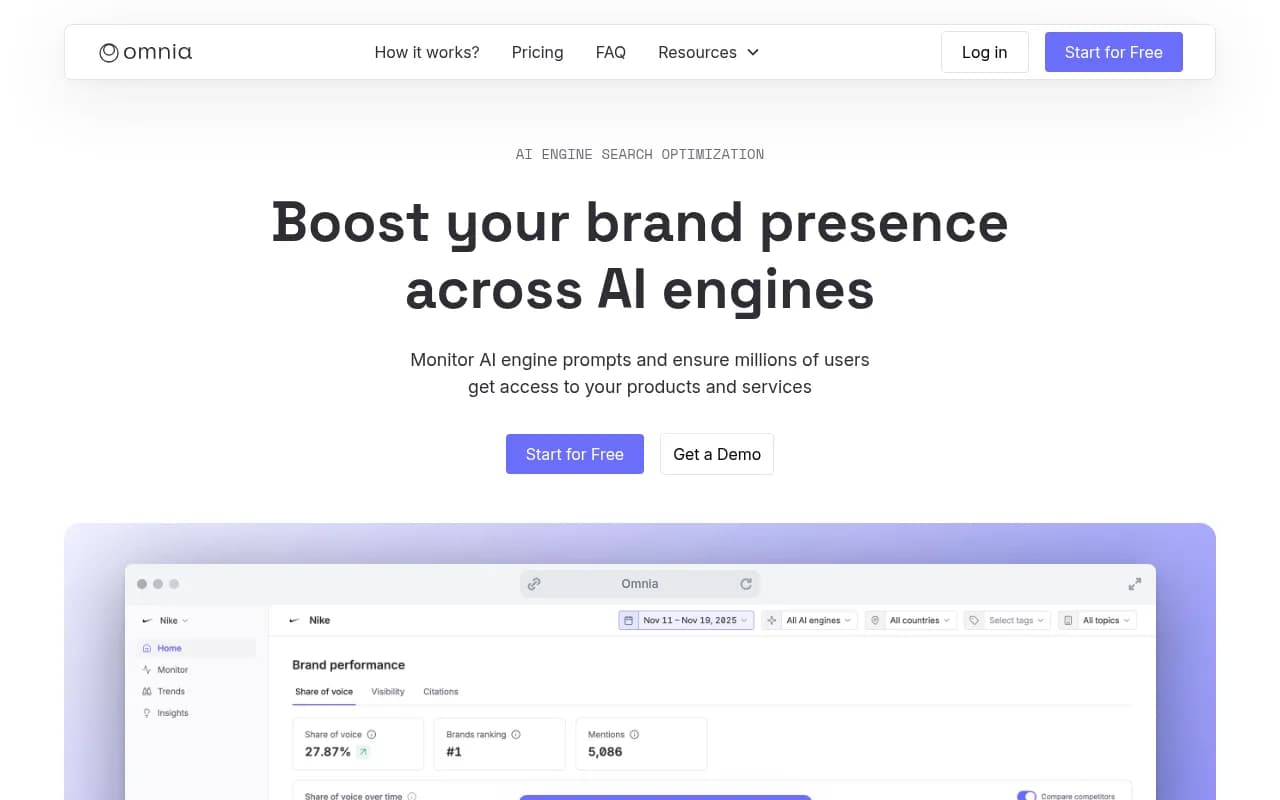
Omnia positions itself as a platform for SEO and marketing teams who need to understand how their brand shows up in AI-generated answers. It tracks citations and mentions across ChatGPT, Perplexity, Gemini, and Microsoft Copilot. The core pitch: it doesn't just show you where you rank—it tells you what prompts matter, what your competitors are doing, and gives you a roadmap to improve. Pricing starts at €63/month (yearly billing) or €79/month (monthly).
AI Rank Checker
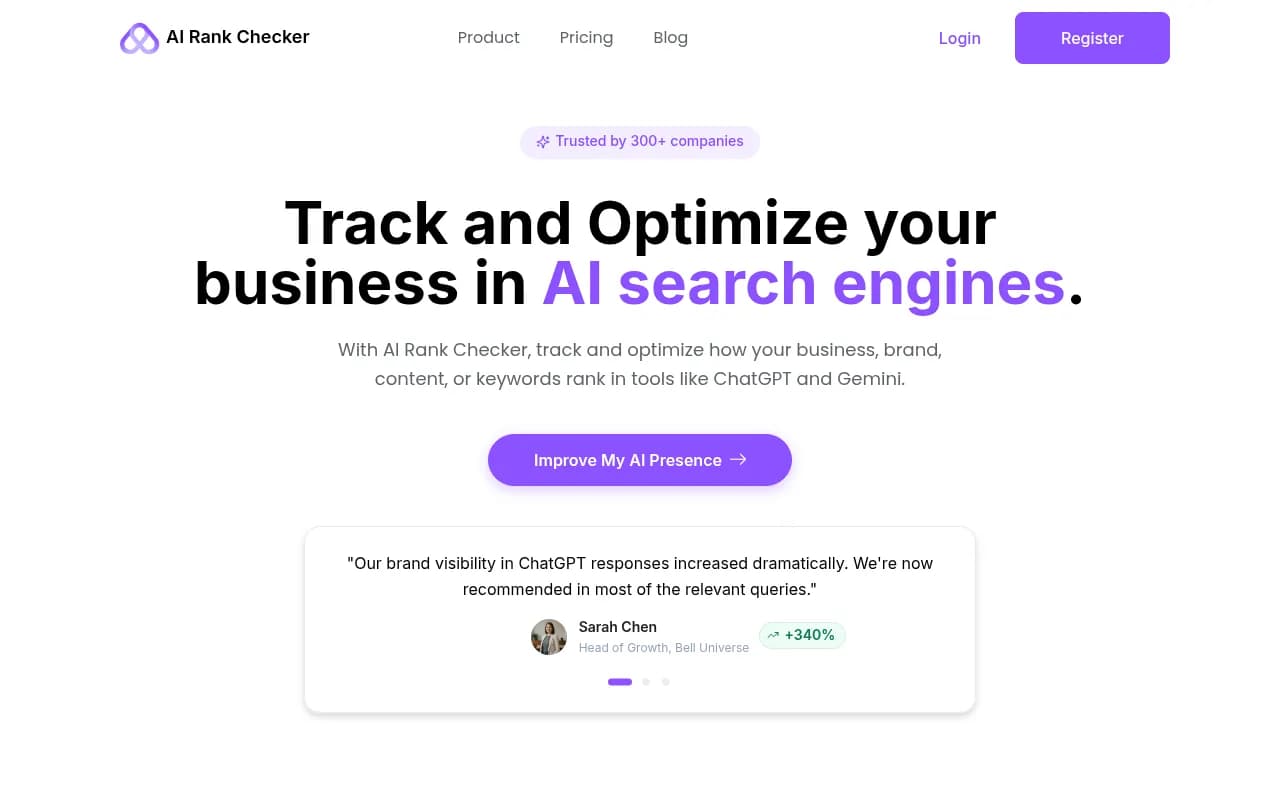
AI Rank Checker takes a different approach. It's a straightforward rank tracking tool that monitors how your business appears across 7 AI engines: ChatGPT, Perplexity, Claude, Gemini, Copilot, Grok, and Meta AI. No subscriptions—you top up a wallet starting at $5 and pay only for the keywords you check. The focus is on tracking, comparing competitors, and exporting reports. It's built for marketers and agencies who want visibility data without committing to monthly fees.
Side-by-Side Comparison
| Feature | Omnia | AI Rank Checker |
|---|---|---|
| Pricing model | Subscription (€63-79/mo) | Pay-as-you-go (from $5) |
| Free tier | Free trial available | No free tier, $5 minimum |
| AI engines tracked | 4 (ChatGPT, Perplexity, Gemini, Copilot) | 7 (ChatGPT, Perplexity, Claude, Gemini, Copilot, Grok, Meta AI) |
| Prompt discovery | ✓ Yes | ✗ No |
| Citation tracking | ✓ Yes | ✗ No |
| Competitor benchmarking | ✓ Yes | ✓ Yes |
| Multi-domain tracking | ✓ Yes | ✓ Yes |
| Export formats | Not specified | PDF, CSV |
| AI visibility roadmap | ✓ Yes (content, SEO, placement) | ✗ No |
| Ease of use | More complex, more features | Simple, focused on tracking |
| Best for | Teams doing continuous optimization | Agencies, sporadic checks |
If you're also looking to track how AI engines crawl your site and identify content gaps to fill, Promptwatch covers that angle with crawler logs and AI content generation built in.

Pricing comparison
The pricing models are fundamentally different, which makes this a key decision point.
| Plan | Omnia | AI Rank Checker |
|---|---|---|
| Entry point | €63/mo (yearly) or €79/mo (monthly) | $5 one-time top-up |
| What you get | Subscription with set features | Credits to spend on keyword checks |
| Commitment | Monthly or annual billing | No commitment, pay when needed |
| Free trial | Yes | No (but $5 gets you started) |
| Scaling | Higher tiers for more features | Top up more as needed |
Omnia's subscription makes sense if you're tracking visibility daily or weekly. You pay a flat fee and get access to all features. AI Rank Checker works better if you check rankings sporadically—maybe once a month for a client, or when launching a campaign. You're not paying for months you don't use.
The break-even depends on usage. If you're checking 50+ keywords across multiple engines every week, Omnia's flat rate might save money. If you're doing occasional audits, AI Rank Checker's pay-as-you-go avoids wasted spend.
AI engine coverage
Omnia covers 4 AI engines: ChatGPT, Perplexity, Gemini, and Microsoft Copilot. That's the core set most brands care about, especially if you're focused on search-adjacent AI tools.
AI Rank Checker adds Claude, Grok, and Meta AI to the mix—7 engines total. Claude matters if your audience skews technical or uses Anthropic's products. Grok is niche (X Premium users), but Meta AI is huge—it's baked into Facebook, Instagram, and WhatsApp. If your brand targets consumers on Meta platforms, tracking Meta AI responses is valuable.
Verdict: AI Rank Checker wins on breadth. Omnia covers the essentials, but if you need Claude or Meta AI visibility, you'll have to look elsewhere.
Feature depth: tracking vs optimization
This is where the tools diverge sharply.
Omnia's feature set
Omnia doesn't just track rankings. It shows you:
- Prompt discovery: What questions are people actually asking AI about your industry? Omnia surfaces real prompts so you know what to monitor.
- Citation analysis: Which sources do AI engines pull from when they mention (or don't mention) your brand? You see the URLs, the context, the competitors.
- AI visibility roadmap: Omnia translates tracking data into action items—content to create, technical SEO fixes, placement strategies. It's trying to close the loop from "here's your data" to "here's what to do about it."
The pitch is that you're not just monitoring—you're optimizing. The roadmap feature is the differentiator. Most AI visibility tools stop at showing you a dashboard. Omnia tries to tell you how to improve.
AI Rank Checker's feature set
AI Rank Checker is simpler:
- Rank tracking: Monitor how your brand appears for specific keywords across 7 AI engines.
- Competitor comparison: See where you rank vs competitors for the same prompts.
- Multi-domain support: Track multiple websites from one account (useful for agencies).
- Export reports: Download PDF or CSV reports with ranking history, competitors, and keywords.
That's it. No prompt discovery, no citation breakdowns, no roadmap. You get clean data and the freedom to decide what to do with it.
Verdict: Omnia wins on depth. If you want insights and guidance, Omnia delivers. If you just need tracking and exports, AI Rank Checker is cleaner and cheaper.
Ease of use and learning curve
Omnia has more features, which means more complexity. You're navigating prompt libraries, citation sources, competitor benchmarks, and roadmap recommendations. It's not overwhelming, but it's not a 5-minute setup either. Expect a learning curve if you want to use everything it offers.
AI Rank Checker is dead simple. Add your domain, pick your keywords, select which AI engines to check, and run the report. The interface is minimal. You're not digging through layers of data—you're getting a straightforward answer to "where do I rank?"
Verdict: AI Rank Checker is faster to start. Omnia rewards the time investment if you use the advanced features.
Multi-domain and agency use cases
Both tools support tracking multiple domains, but the pricing models create different workflows.
With Omnia, you're paying a subscription per account or tier. If you're an agency managing 10 clients, you'll need to figure out how many domains your plan covers and whether you need to upgrade. The monthly cost is predictable, but it scales linearly.
With AI Rank Checker, you top up your wallet and spend credits as needed. If you have 10 clients but only check rankings once a month per client, you're paying for 10 checks, not 10 subscriptions. The flexibility is real—you're not locked into a monthly fee for clients you might lose or pause.
Verdict: AI Rank Checker is better for agencies with variable workloads. Omnia works if you're doing continuous monitoring for a fixed set of brands.
Export and reporting
AI Rank Checker explicitly supports PDF and CSV exports. You can pull ranking history, competitor data, and keyword performance into a clean report and send it to a client or stakeholder. This is table stakes for agency work.
Omnia's website doesn't specify export formats. It's possible they exist, but they're not highlighted as a core feature. The focus is on using the platform's dashboards and roadmap, not pulling data out.
Verdict: AI Rank Checker is built for reporting. If you need to deliver client reports regularly, it's the safer bet.
What's missing from each tool
Omnia gaps
- No Claude, Grok, or Meta AI tracking (only 4 engines)
- Pricing is opaque beyond the entry tier—no public info on what higher plans include
- Export functionality not clearly documented
- Subscription model locks you in even if usage drops
AI Rank Checker gaps
- No prompt discovery—you have to know what keywords to track
- No citation analysis—you see rankings but not the sources AI engines use
- No optimization guidance—it's just data, no roadmap
- No free tier, even for testing (though $5 is low-risk)
Pros and cons
Omnia pros
- Prompt discovery helps you find what to monitor
- Citation tracking shows the sources behind AI responses
- AI visibility roadmap turns data into action items
- Free trial lets you test before committing
- Built for teams doing continuous optimization
Omnia cons
- Only 4 AI engines (missing Claude, Grok, Meta AI)
- Subscription model costs more if usage is sporadic
- Steeper learning curve due to feature depth
- Export options unclear
AI Rank Checker pros
- Pay-as-you-go pricing—no wasted spend on unused months
- 7 AI engines including Claude, Grok, Meta AI
- Simple, focused on rank tracking
- Clean PDF and CSV exports for client reporting
- Multi-domain support ideal for agencies
AI Rank Checker cons
- No prompt discovery—you need to know what to track
- No citation analysis or source breakdowns
- No optimization roadmap or guidance
- No free tier (but $5 entry is low)
Who should pick which tool
Pick Omnia if:
- You're an in-house marketing or SEO team doing continuous AI visibility work
- You want help figuring out what prompts to monitor (prompt discovery)
- You care about understanding the sources AI engines cite
- You need a roadmap that tells you what content to create or how to optimize
- You're comfortable with a monthly subscription and want predictable costs
- You only need ChatGPT, Perplexity, Gemini, and Copilot coverage
Pick AI Rank Checker if:
- You're an agency managing multiple clients with variable workloads
- You want to avoid monthly subscriptions and only pay when you check rankings
- You need to track Claude, Grok, or Meta AI in addition to the big 4
- You value simplicity—just show me where I rank and let me export it
- You need clean PDF/CSV reports for client deliverables
- You're doing sporadic checks (monthly audits, campaign launches) rather than daily monitoring
Final verdict
These tools solve different problems. Omnia is an optimization platform disguised as a tracking tool—it wants to guide you from data to action with prompt discovery, citation analysis, and a roadmap. AI Rank Checker is pure tracking with flexible pay-as-you-go pricing and broader AI engine coverage.
If you're a team that lives in AI visibility daily and wants strategic guidance, Omnia justifies the subscription. If you're an agency doing monthly check-ins or a brand that wants to track rankings without committing to recurring fees, AI Rank Checker's model makes more sense.
The pricing model is the real decision point. Subscriptions work when usage is consistent. Pay-as-you-go works when it's not. Pick based on how often you'll actually use the tool, not just what features look good on paper.