Key Takeaways
- Omnia starts at €63/mo with transparent pricing and a free trial. Ansehn requires a demo and doesn't publish pricing -- expect enterprise-level costs.
- Both track the same core AI models (ChatGPT, Perplexity, Google AI, Claude), but Omnia adds Microsoft Copilot while Ansehn includes DeepSeek.
- Omnia offers a built-in AI visibility roadmap with step-by-step content recommendations. Ansehn focuses on monitoring and content actions but doesn't detail the roadmap feature.
- Omnia targets SEO and marketing teams with a self-service model. Ansehn positions itself for enterprises and agencies with a sales-led approach.
- If you want to start tracking today without a sales call, Omnia is the clear choice. If you're managing multiple enterprise brands and need white-glove support, Ansehn might be worth the demo.
- For teams serious about closing visibility gaps with content generation and optimization, Promptwatch goes further than either tool by combining monitoring with an AI writing agent that creates citation-optimized content based on 880M+ citations analyzed.

Overview
Omnia
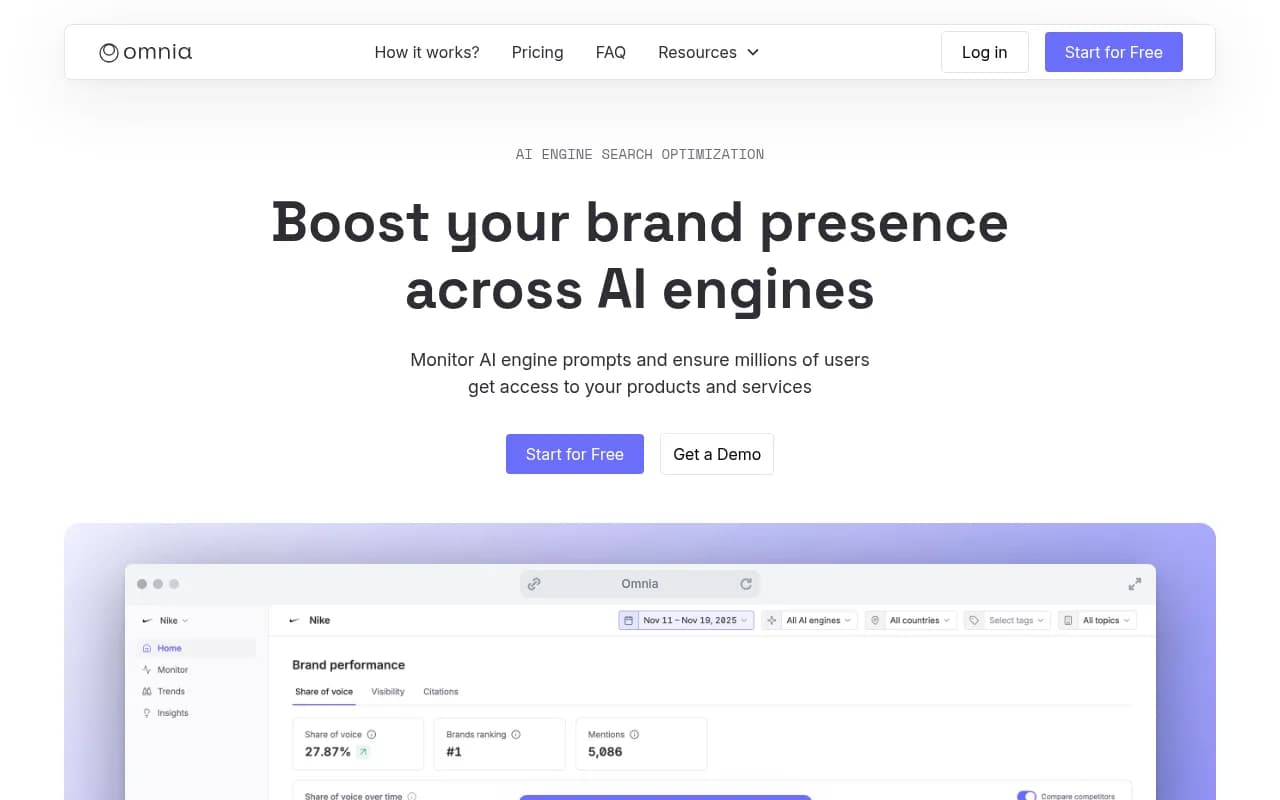
Omnia is an AI visibility platform built for SEO and marketing teams who want to track how their brand shows up in AI-generated answers. It monitors citations and mentions across ChatGPT, Perplexity, Google Gemini, and Microsoft Copilot. The platform emphasizes practical tracking with clear visibility metrics and a roadmap feature that translates data into content creation, technical SEO, and placement actions. Omnia uses a freemium model with transparent pricing starting at €63/mo (yearly) or €79/mo (monthly), and offers a free trial so you can test before committing.
Ansehn
Ansehn
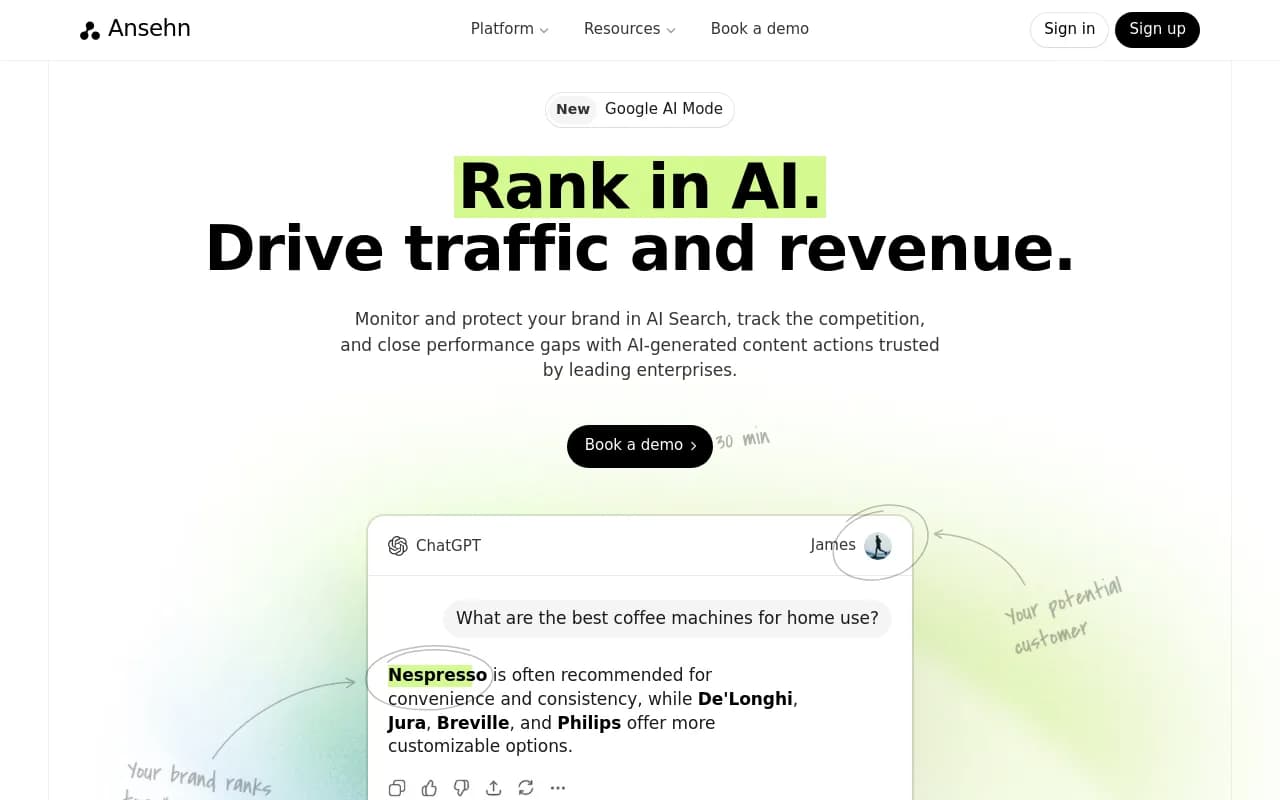
Ansehn is an AI search visibility platform designed for marketing teams and agencies managing GEO/AEO (Generative Engine Optimization / Answer Engine Optimization) for B2B and B2C brands. It tracks brand mentions and rankings across ChatGPT, Perplexity, Google AI Mode, Claude, and DeepSeek. Ansehn positions itself around three pillars: measure your AI search rankings, understand what drives AI search, and improve with AI-generated content actions. The platform targets enterprises and requires booking a demo -- no public pricing or free trial is available.
Side-by-Side Comparison
| Feature | Omnia | Ansehn |
|---|---|---|
| Pricing | €63/mo (yearly), €79/mo (monthly) | Custom pricing, demo required |
| Free trial | Yes | No |
| AI models tracked | ChatGPT, Perplexity, Google Gemini, Microsoft Copilot | ChatGPT, Perplexity, Google AI Mode/Overview, Claude, DeepSeek |
| Prompt discovery | Yes -- see real customer questions | Yes -- query tracking |
| Competitor benchmarking | Yes -- share of voice tracking | Yes -- competitive rankings |
| Citation analysis | Yes -- see what sources AI pulls from | Yes -- source tracking |
| Content recommendations | Yes -- AI visibility roadmap with step-by-step actions | Yes -- AI-generated content actions |
| Self-service signup | Yes | No -- requires demo |
| Target audience | SEO/marketing teams, SMBs | Enterprises, agencies |
| API access | Not disclosed | Yes (documented) |
| Documentation | Not disclosed | Comprehensive docs + glossary |
| Transparency | High (public pricing, free trial) | Low (no pricing, gated signup) |
Pricing comparison
Omnia publishes clear pricing. Ansehn does not. Here's what we know:
| Plan | Omnia | Ansehn |
|---|---|---|
| Free trial | Yes | No |
| Starter/Entry | €63/mo (yearly billing) or €79/mo (monthly) | Not disclosed |
| Mid-tier | Not disclosed (likely exists) | Not disclosed |
| Enterprise | Custom | Custom (demo required) |
Omnia's transparent pricing is a major advantage if you want to budget without a sales cycle. Ansehn's demo-only approach suggests higher price points and a focus on larger contracts.
AI model coverage
Both platforms track the major AI search engines, but with slight differences.
Omnia covers:
- ChatGPT (OpenAI)
- Perplexity
- Google Gemini
- Microsoft Copilot
Ansehn covers:
- ChatGPT (OpenAI)
- Perplexity
- Google AI Mode / Google AI Overview
- Claude (Anthropic)
- DeepSeek
Ansehn edges ahead with Claude and DeepSeek support. Omnia counters with Microsoft Copilot, which Ansehn doesn't list. For most brands, the overlap (ChatGPT, Perplexity, Google AI) is what matters -- those are the engines driving the majority of AI search traffic in 2026. The differentiators (Copilot vs Claude/DeepSeek) matter if your audience skews toward one ecosystem.
Verdict: Slight edge to Ansehn for breadth (5 models vs 4), but Omnia's inclusion of Copilot is valuable for enterprise/B2B audiences.
Prompt discovery and tracking
Both platforms help you discover what prompts to monitor.
Omnia shows you "real questions people ask AI" and surfaces prompts you should track based on your industry or product. The interface includes a trends view that highlights emerging queries.
Ansehn emphasizes understanding "what drives AI search" and offers query tracking with the ability to see how your brand ranks for specific prompts over time.
Neither platform details prompt volume estimates or difficulty scoring in their public materials. If you want that level of intelligence -- knowing which prompts are high-volume and winnable -- you'd need a tool like Promptwatch, which layers prompt metrics and query fan-outs on top of visibility tracking.
Verdict: Functionally similar. Both surface relevant prompts, but neither goes as deep as platforms with dedicated prompt intelligence features.
Competitor benchmarking
Omnia includes share of voice tracking so you can see how you stack up against competitors across monitored prompts. The platform shows which citations AI engines pull information from, giving you insight into where competitors are getting mentioned.
Ansehn offers competitive ranking tracking and lets you benchmark your brand against others in AI search results. The focus is on understanding who's winning for each query and why.
Both approaches are solid. Omnia's share of voice framing is intuitive for marketing teams used to traditional SEO metrics. Ansehn's ranking focus mirrors how people think about search positions.
Verdict: Tie. Both deliver the core benchmarking features you need.
Content recommendations and roadmap
This is where the platforms diverge meaningfully.
Omnia translates tracking data into an "AI visibility roadmap" with step-by-step actions mapped to fill your brand's gaps. The roadmap covers content creation, technical SEO, and content placement. The promise is clear: here's what to do next, not just what's broken.
Ansehn offers "AI-generated content actions" to help you improve visibility. The platform positions this as part of the "Improve" pillar, but doesn't detail whether it's a roadmap, a content generator, or a set of recommendations.
Omnia's roadmap feature is more explicitly defined and sounds more actionable. Ansehn's content actions are vaguer in the marketing materials.
That said, if you're looking for a platform that not only tells you what to fix but actually helps you create the content, Promptwatch is the standout here. It combines Answer Gap Analysis (showing exactly which prompts competitors rank for but you don't) with a built-in AI writing agent that generates citation-optimized articles, listicles, and comparisons. You get the roadmap and the execution in one tool.
Verdict: Omnia wins on clarity and detail. Promptwatch wins on execution if you want content generation baked in.
User experience and onboarding
Omnia offers a free trial and self-service signup. You can start tracking today without talking to anyone. The interface is built for "SEO and marketing experts" -- people who know what they're looking for and want to get in fast.
Ansehn requires booking a demo. No free trial, no self-service exploration. This is a classic enterprise sales motion: qualify leads, show the platform, negotiate pricing. It's slower but comes with white-glove onboarding and support.
If you're a solo marketer or small team, Omnia's self-service model is a huge advantage. If you're managing AI visibility for a portfolio of enterprise brands and want dedicated support, Ansehn's approach might be worth the friction.
Verdict: Omnia for speed and autonomy. Ansehn for enterprise hand-holding.
Documentation and resources
Ansehn publishes comprehensive documentation, API reference, a blog, and a glossary of AI search terminology. The docs site (docs.ansehn.com) suggests a developer-friendly platform with API access for custom integrations.
Omnia doesn't highlight documentation or API access in its public materials. The focus is on the UI and the roadmap feature, not extensibility.
If you need API access to pull data into your own dashboards or build custom workflows, Ansehn is the safer bet based on what's publicly visible.
Verdict: Ansehn for developers and teams that need API access.
Pros and cons
Omnia pros
- Transparent pricing starting at €63/mo
- Free trial available
- Self-service signup -- start tracking immediately
- AI visibility roadmap with step-by-step content actions
- Covers Microsoft Copilot (important for B2B)
Omnia cons
- Fewer AI models tracked (4 vs Ansehn's 5)
- No public documentation or API details
- Less clear on advanced features beyond the roadmap
Ansehn pros
- Tracks 5 AI models including Claude and DeepSeek
- Comprehensive documentation and API access
- Enterprise-focused with white-glove onboarding
- Strong positioning around GEO/AEO for agencies
Ansehn cons
- No public pricing -- requires demo and likely expensive
- No free trial
- Gated signup creates friction for teams that want to test first
- Vague on content recommendation details
Who should pick which tool
Pick Omnia if:
- You want to start tracking AI visibility today without a sales call
- You're a small to mid-sized marketing or SEO team with a clear budget
- You value transparent pricing and the ability to trial before committing
- You want a roadmap that tells you exactly what content to create next
- Microsoft Copilot coverage matters for your B2B audience
Pick Ansehn if:
- You're managing AI visibility for multiple enterprise brands or clients
- You need API access for custom integrations and reporting
- You want white-glove onboarding and dedicated support
- Claude and DeepSeek coverage is critical for your use case
- You're comfortable with a sales-led process and custom pricing
Pick Promptwatch if:
- You want monitoring plus content creation in one platform
- You need Answer Gap Analysis to see exactly which prompts you're missing
- You want an AI writing agent that generates citation-optimized content based on real data (880M+ citations analyzed)
- You need crawler logs to see how AI engines are actually reading your site
- You want Reddit and YouTube tracking to understand what influences AI recommendations
- You need page-level tracking and traffic attribution to connect visibility to revenue
Final verdict
Omnia and Ansehn both deliver solid AI visibility tracking, but they target different buyers.
Omnia is the better choice for most teams. Transparent pricing, a free trial, and a clear roadmap feature make it easy to get started and see value quickly. The self-service model respects your time and budget.
Ansehn is built for enterprises and agencies that need API access, comprehensive documentation, and white-glove support. The demo-required approach and lack of public pricing signal a higher price point and a focus on larger contracts. If you're managing a portfolio of brands and need deep integrations, Ansehn is worth the conversation.
For teams that want to go beyond monitoring and actually close visibility gaps with content, Promptwatch offers the most complete solution: tracking, gap analysis, content generation, and optimization tools in one platform. It's the only tool that shows you what's missing and helps you fix it.