Key Takeaways
- Authoritas is a full-featured SEO platform with AI tracking bolted on; Omnia is built specifically for AI search visibility from the ground up
- Pricing: Omnia starts at €63/mo (yearly) vs Authoritas at £99/mo (~€118/mo), but Authoritas includes traditional SEO tools while Omnia focuses purely on AI visibility
- Omnia offers a free tier and more accessible entry point; Authoritas requires paid plans with higher feature gates
- Authoritas tracks more AI models (7+) and includes eCommerce-specific features; Omnia covers the core 4-5 models most brands care about
- Omnia's "Act on your data" roadmap feature translates tracking into concrete next steps; Authoritas leans more toward monitoring and reporting
- If you need traditional SEO + AI tracking in one platform, Authoritas makes sense. If you want pure AI visibility optimization, Omnia is more focused.
Overview
Authoritas AI Tracker

Authoritas started as a traditional SEO platform for eCommerce brands, agencies, and publishers. The AI Tracker is their response to the shift toward AI-driven search -- it monitors brand mentions, sentiment, and visibility across ChatGPT, Perplexity, Claude, Gemini, DeepSeek, Google AI Overviews, and Bing AI. The pitch: you get traditional rank tracking, technical SEO audits, backlink analysis, and AI search monitoring in one platform. Built in the UK, priced in pounds, aimed at agencies managing competitive niches with global reach.
Omnia
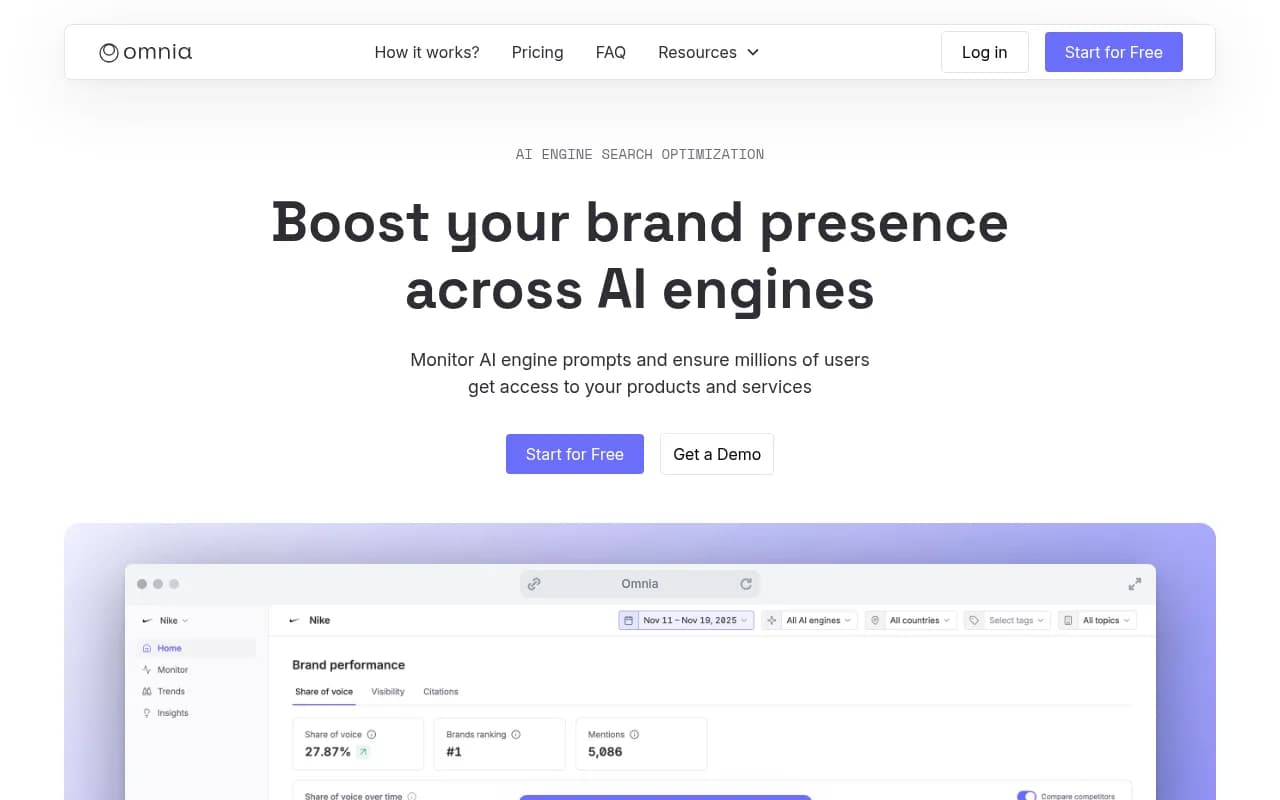
Omnia is a newer platform built specifically for AI search visibility. No traditional SEO baggage -- just tracking how your brand shows up in ChatGPT, Gemini, Perplexity, and Copilot. The core workflow: discover what prompts people are actually asking, monitor where you appear (and where competitors beat you), then get a step-by-step roadmap to close the gaps. Freemium model, European pricing (euros), and a focus on translating data into action rather than drowning you in dashboards.
Side-by-Side Comparison
| Feature | Authoritas AI Tracker | Omnia |
|---|---|---|
| Starting price | £99/mo (~€118/mo) | €63/mo (yearly) / €79/mo (monthly) |
| Free tier | No | Yes (limited) |
| AI models tracked | ChatGPT, Perplexity, Claude, Gemini, DeepSeek, Google AI Overviews, Bing AI (7+) | ChatGPT, Gemini, Perplexity, Copilot (4-5) |
| Traditional SEO tools | ✓ (rank tracking, backlinks, technical audits) | ✗ (AI-only) |
| Prompt discovery | ✓ | ✓ |
| Citation tracking | ✓ | ✓ |
| Competitor benchmarking | ✓ | ✓ |
| Sentiment analysis | ✓ | Limited |
| Actionable roadmap | Limited | ✓ (step-by-step insights) |
| eCommerce features | ✓ (product-specific tracking) | General brand tracking |
| Multi-language support | ✓ | ✓ |
| API access | Enterprise only | Not specified |
| Target audience | Agencies, eCommerce brands, publishers | Marketing teams, SEO specialists |
Pricing comparison
| Plan | Authoritas AI Tracker | Omnia |
|---|---|---|
| Free | Not available | Limited free tier |
| Starter | £99/mo (Essential) | €63/mo (yearly) / €79/mo (monthly) |
| Mid-tier | £399/mo (Professional) | Not publicly listed |
| High-tier | £799/mo (Expert) | Not publicly listed |
| Enterprise | Custom pricing | Custom pricing |
Authoritas pricing is in GBP; Omnia in EUR. Direct conversion puts Authoritas Essential at roughly €118/mo vs Omnia's €63/mo annual rate. Authoritas bundles traditional SEO tools into every plan, which explains the higher floor. Omnia's freemium model lowers the barrier to entry -- you can test it without a credit card.
Platform scope and positioning
Authoritas positions itself as a complete SEO platform that happens to include AI tracking. You get rank tracking across Google, Bing, and other traditional search engines, plus technical site audits, backlink monitoring, keyword research, and content optimization tools. The AI Tracker is one module among many. This makes sense if you're already doing traditional SEO and want to add AI visibility without switching platforms.
Omnia is the opposite: AI search visibility is the entire product. No rank tracking for Google SERPs, no backlink analysis, no technical SEO audits. Just AI engines. The bet is that AI search is different enough to warrant a dedicated tool, and bundling it with traditional SEO creates feature bloat and dilutes focus.
Verdict: Authoritas wins if you need one platform for everything. Omnia wins if you already have traditional SEO covered (or don't care about it) and want a tool laser-focused on AI visibility.
AI model coverage
Authoritas tracks 7+ AI models: ChatGPT, Perplexity, Claude, Gemini, DeepSeek, Google AI Overviews, and Bing AI (Copilot). They emphasize global reach and eCommerce-specific scenarios -- tracking product recommendations, shopping queries, and brand sentiment across models.
Omnia covers the core 4-5: ChatGPT, Gemini, Perplexity, and Copilot. No DeepSeek, no explicit mention of Claude in their marketing (though this may have changed). The focus is on the models most Western brands care about, with less emphasis on emerging or niche engines.
Verdict: Authoritas has broader model coverage. If you need to track DeepSeek or want comprehensive multi-model monitoring, Authoritas delivers. Omnia covers the essentials but doesn't chase every new model.
Prompt discovery and tracking
Both platforms let you discover what prompts people are asking and track your visibility for those prompts.
Authoritas approaches this through journey mapping and persona-based tracking. You define customer journeys (e.g. "safety", "towing capacity", "best SUV for families") and track how your brand appears across those themes. The interface shows question types (informational, transactional, branded, location-based) and lets you drill into specific queries. Geared toward agencies managing multiple clients with different personas.
Omnia's prompt discovery is more direct: "See the real questions people ask AI." You input your industry or product, and Omnia surfaces the actual prompts customers are using. The UI emphasizes simplicity -- less about complex journey mapping, more about "here are the 50 prompts that matter for your niche." Then you monitor those prompts and see where you rank vs competitors.
Verdict: Authoritas is better for complex, multi-persona tracking across large teams. Omnia is faster to set up and easier for small teams who just want to know "what should we monitor?"
Citation and source analysis
Both tools track which sources AI models cite when they mention your brand.
Authoritas shows citation data alongside sentiment and share of voice trends. You can see which URLs get cited, how often, and whether the sentiment is positive, neutral, or negative. The eCommerce angle means you can track product-specific citations -- useful if you're monitoring how AI recommends your products vs competitors.
Omnia also tracks citations and shows you the sources AI engines pull from. The "See your brand through AI's eyes" feature visualizes how AI models perceive your brand based on the content they cite. Less emphasis on sentiment scoring, more on understanding the gap between how you want to be positioned and how AI actually represents you.
Verdict: Authoritas has more robust sentiment analysis. Omnia focuses more on the positioning gap and what to fix.
Actionable insights and roadmaps
This is where the platforms diverge most sharply.
Authoritas is primarily a monitoring and reporting tool. You get dashboards, share of voice trends, citation breakdowns, and competitor comparisons. The platform tells you what's happening but leaves the "what to do about it" part mostly to you. Agencies and in-house teams use the data to inform content strategy, but the platform doesn't prescribe next steps.
Omnia's headline feature is "Act on your data" -- a step-by-step roadmap that translates tracking data into concrete tasks. The platform analyzes your gaps (prompts where competitors appear but you don't, citations you're missing, positioning weaknesses) and generates a prioritized list of actions: create this content, optimize that page, get cited on these platforms. Think of it as the difference between a dashboard and a to-do list.
Verdict: If you want data to build your own strategy, Authoritas gives you the raw materials. If you want the platform to tell you what to fix and in what order, Omnia is more prescriptive.
Worth noting: if you're also looking to track how your brand shows up in AI search results and need a platform that goes beyond monitoring to actually help you optimize and create content that ranks, Promptwatch covers that angle with content gap analysis, AI-generated articles, and page-level tracking across 10+ models.

Traditional SEO integration
Authoritas includes traditional SEO tools in every plan: rank tracking for Google/Bing, technical site audits, backlink monitoring, keyword research, and on-page optimization. If you're managing SEO holistically, you can track traditional rankings and AI visibility in one platform. The downside: you're paying for features you might not need if AI search is your only focus.
Omnia has zero traditional SEO features. No rank tracking, no backlink analysis, no site audits. This keeps the platform simple and the pricing lower, but it means you need separate tools for traditional SEO.
Verdict: Authoritas is better for teams managing both traditional and AI search. Omnia is better for teams that already have traditional SEO covered or don't care about it.
User interface and ease of use
Authoritas has the interface of a mature enterprise SEO platform -- lots of tabs, filters, and data tables. Powerful but dense. The learning curve is real, especially if you're only interested in the AI tracking module and have to navigate around the traditional SEO features.
Omnia's interface is cleaner and more focused. Three main sections: discover prompts, monitor visibility, act on insights. Less feature sprawl, faster onboarding. The trade-off is less customization and fewer advanced filtering options.
Verdict: Omnia is easier to learn and faster to get value from. Authoritas is more powerful but requires more time investment.
eCommerce and product tracking
Authoritas explicitly targets eCommerce brands and includes product-specific tracking. You can monitor how AI models recommend your products in shopping queries, track product mentions vs competitors, and see which product pages get cited. Useful if you're optimizing for queries like "best running shoes under $100" or "top-rated espresso machines."
Omnia is more general-purpose. You can track brand mentions and citations, but there's less emphasis on product-level granularity. Works fine for B2B SaaS, agencies, publishers, and service businesses, but eCommerce brands might miss the product-specific features.
Verdict: Authoritas is better for eCommerce. Omnia works for most other use cases.
Reporting and collaboration
Authoritas is built for agencies managing multiple clients. You get white-label reporting, client dashboards, and multi-user access with role-based permissions. The reporting is comprehensive -- share of voice trends, competitor benchmarks, citation breakdowns, sentiment analysis. Good for client presentations and stakeholder updates.
Omnia's reporting is simpler. You can export data and share dashboards, but it's less geared toward agency workflows. Better for in-house teams that need quick insights rather than polished client reports.
Verdict: Authoritas wins for agencies. Omnia is fine for in-house teams.
Pros and cons
Authoritas AI Tracker
Pros:
- All-in-one platform: traditional SEO + AI tracking in one tool
- Tracks 7+ AI models including DeepSeek and Bing AI
- Strong eCommerce and product-specific features
- Robust sentiment analysis and citation tracking
- Built for agencies with white-label reporting and multi-client management
- Global reach with multi-language support
Cons:
- Higher starting price (£99/mo vs Omnia's €63/mo)
- No free tier -- you have to commit to a paid plan
- Interface is dense and has a learning curve
- AI tracking is one module among many, not the core focus
- Less prescriptive about what to do with the data
Omnia
Pros:
- Lower starting price (€63/mo yearly) with a free tier
- Built specifically for AI search visibility -- no feature bloat
- Cleaner, simpler interface with faster onboarding
- "Act on your data" roadmap translates tracking into concrete next steps
- Freemium model lets you test before committing
- Focused on the 4-5 AI models most brands care about
Cons:
- No traditional SEO tools -- you need separate platforms for rank tracking, backlinks, etc.
- Fewer AI models tracked (no DeepSeek, unclear on Claude)
- Less robust for eCommerce product tracking
- Simpler reporting, less suited for agency client presentations
- Newer platform with less market presence
Who should pick which tool
Pick Authoritas if:
- You're an agency managing multiple clients and need white-label reporting
- You want traditional SEO + AI tracking in one platform
- You're an eCommerce brand that needs product-level tracking
- You need to monitor 7+ AI models including DeepSeek and Bing AI
- You have the budget for a comprehensive platform (£99-799/mo)
- You prefer robust data and are comfortable building your own action plan
Pick Omnia if:
- You're an in-house marketing team focused purely on AI visibility
- You already have traditional SEO tools and don't need another rank tracker
- You want a simple, focused platform with a low barrier to entry
- You prefer prescriptive insights ("do this next") over raw data dashboards
- You want to test with a free tier before committing
- You're optimizing for the core AI models (ChatGPT, Gemini, Perplexity, Copilot) and don't need exhaustive coverage
Final verdict
Authoritas AI Tracker is the better choice if you need a comprehensive SEO platform that includes AI tracking as part of a broader toolkit. It's built for agencies, eCommerce brands, and teams managing both traditional and AI search. The higher price reflects the broader feature set -- you're paying for traditional SEO tools whether you use them or not.
Omnia is the better choice if you want a dedicated AI visibility platform with a clear focus and lower cost. It's faster to learn, easier to act on, and doesn't force you to pay for features you don't need. The trade-off is less breadth -- you'll need separate tools for traditional SEO, and you won't get the same depth of eCommerce-specific features.
The real question: do you need one platform for everything, or do you want best-in-class tools for specific jobs? Authoritas is the former, Omnia is the latter.