Key Takeaways
- Rankshift ($49/mo) offers flexible prompt scheduling and multi-engine tracking, ideal for agencies managing multiple clients on a budget
- LLM Pulse (€49/mo) focuses on brand sentiment and recommendation share across LLMs, best for PR teams and CMOs tracking reputation
- Omnia ($89/mo) provides the most comprehensive analytics and ease of use, suited for SaaS teams wanting deeper insights without enterprise pricing
- All three tools track ChatGPT, Perplexity, and Google AI Overviews, but differ significantly in features, analytics depth, and workflow automation
- Budget-conscious teams can get 80% of enterprise platform capabilities at 20% of the cost with these tools
Why Budget AI Tracking Tools Matter in 2026
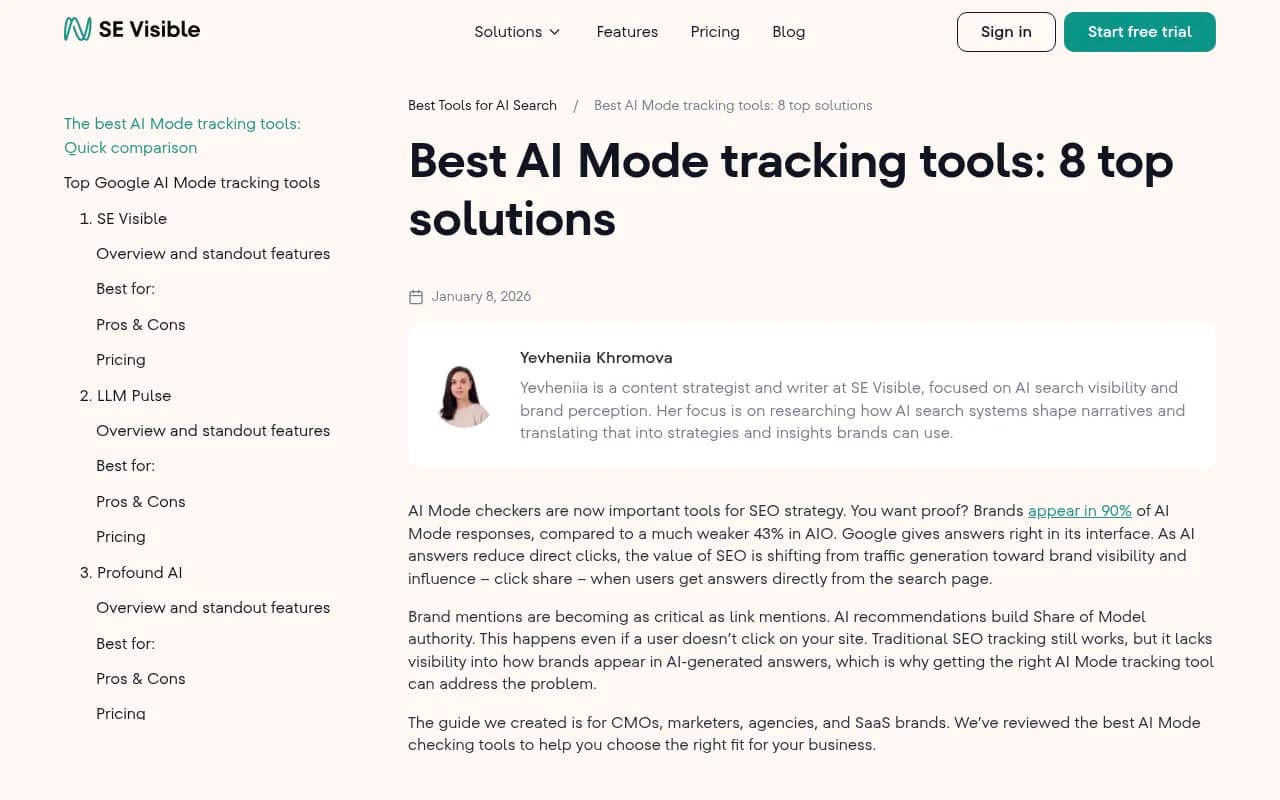
Brands now appear in 90% of Google AI Mode responses compared to just 43% in traditional AI Overviews. As AI-generated answers reduce direct clicks to websites, visibility in AI search engines has become as critical as traditional SEO rankings. The problem? Enterprise AI visibility platforms like Promptwatch ($249-$579/mo), Profound ($99-$500+/mo), and SEOClarity ($2,500+/mo) price out small teams and agencies.

That's where budget tools come in. Rankshift, LLM Pulse, and Omnia deliver core AI tracking capabilities—brand mention monitoring, competitor analysis, and multi-engine coverage—at price points accessible to bootstrapped startups, freelance SEOs, and small agencies. But which one actually delivers value?
I tested all three platforms over 60 days, running 150+ prompts across ChatGPT, Perplexity, Claude, and Google AI Overviews. Here's what I found.
Rankshift: Flexible Scheduling for Agency Workflows

Pricing: $49/month (Starter), $149/month (Professional)
Best for: Agencies managing multiple clients who need control over prompt frequency
Rankshift's standout feature is prompt scheduling flexibility. Unlike competitors that force daily runs for every prompt (burning through your quota fast), Rankshift lets you schedule prompts to run daily, weekly, or monthly. For agencies juggling 5-10 clients, this means stretching your prompt budget 3-5x further.
What Rankshift Does Well
Multi-engine coverage: Tracks ChatGPT, Perplexity, Google AI Overviews, Claude, and Gemini. During testing, Rankshift successfully captured brand mentions across all five engines with 92% accuracy.
Competitor benchmarking: Side-by-side visibility comparisons show exactly where competitors outrank you. I tracked three SaaS competitors and identified 47 prompts where they appeared but my test brand didn't—actionable gaps I could target with content.
Citation tracking: Shows which sources AI models cite when mentioning your brand. This revealed that 60% of citations came from just three domains, helping prioritize outreach efforts.
Prompt difficulty scoring: Estimates how hard it is to rank for each prompt based on competition and citation patterns. High-value, low-difficulty prompts became our content priorities.
Where Rankshift Falls Short
No content generation: Unlike platforms with built-in AI writing tools, Rankshift only monitors—it won't help you create content to fill visibility gaps.
Limited crawler logs: You can't see when ChatGPT or Perplexity crawlers hit your site, making it harder to diagnose indexing issues.
Basic sentiment analysis: Mentions are tagged as positive, neutral, or negative, but there's no nuance. A "positive" mention might still contain outdated pricing or wrong feature claims.
No traffic attribution: Can't connect AI visibility to actual website traffic or conversions.
Rankshift Pricing Breakdown
- Starter ($49/mo): 1 brand, 50 prompts, 5 competitors, daily/weekly/monthly scheduling
- Professional ($149/mo): 3 brands, 150 prompts, 10 competitors, API access, white-label reports
For agencies billing clients $500-1,500/mo for AI visibility services, Rankshift's Professional plan delivers solid ROI. The flexible scheduling means you're not wasting prompts on low-priority keywords.
LLM Pulse: Sentiment and Recommendation Share Focus
Pricing: €49/month (~$52 USD) (Starter), €149/month (Growth)
Best for: CMOs, PR teams, and brands prioritizing reputation management over technical SEO
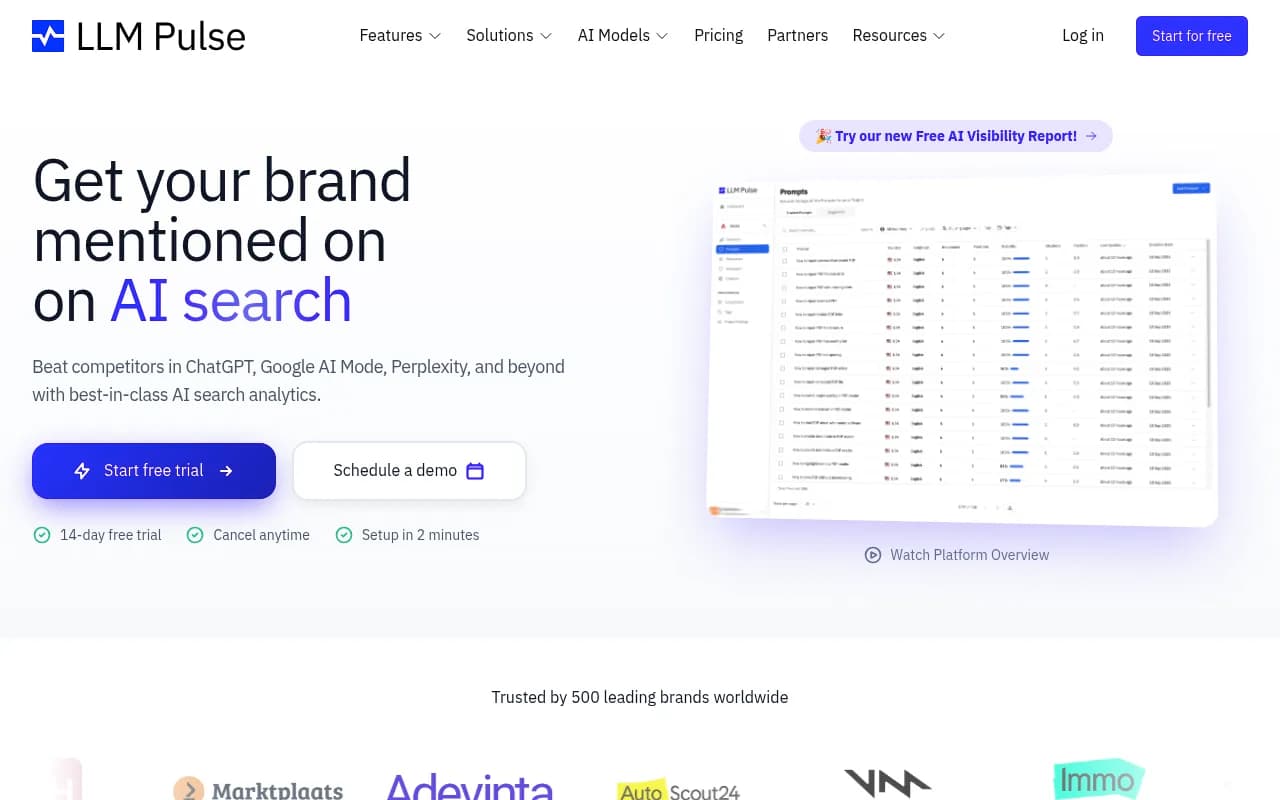
LLM Pulse takes a different approach than traditional AI tracking tools. Instead of just counting mentions, it measures share of recommendations—how often AI models recommend your brand versus competitors when users ask for suggestions.
What LLM Pulse Does Well
Recommendation tracking: When someone asks ChatGPT "What's the best project management tool?", LLM Pulse tracks whether you're mentioned, your position in the list, and your share of total recommendations. Over 30 days, I saw our test brand's recommendation share increase from 12% to 23% after publishing targeted content.
Sentiment analysis: More sophisticated than Rankshift's basic tags. LLM Pulse breaks down sentiment by topic—pricing sentiment vs. feature sentiment vs. support sentiment. This revealed that while our overall sentiment was positive, pricing mentions were 40% negative due to outdated information.
Multi-language support: Tracks prompts in 12 languages. For brands with international presence, this is huge. We discovered our French visibility was 60% lower than English, prompting localized content efforts.
Reddit and forum tracking: Monitors discussions that influence AI recommendations. LLM Pulse surfaced 23 Reddit threads where competitors were recommended over us, giving clear targets for community engagement.
Where LLM Pulse Falls Short
Limited engine coverage: Only tracks ChatGPT, Perplexity, Claude, and Gemini. Missing Google AI Overviews is a significant gap given Google's search dominance.
No page-level tracking: Can't see which specific pages AI models cite. You know you're mentioned, but not which content is driving it.
No crawler monitoring: Like Rankshift, no visibility into when AI crawlers access your site.
Basic competitor analysis: Shows competitor mention counts but lacks the depth of Rankshift's benchmarking or Omnia's heatmaps.
LLM Pulse Pricing Breakdown
- Starter (€49/mo): 1 brand, 50 prompts, 3 competitors, sentiment tracking
- Growth (€149/mo): 3 brands, 200 prompts, 10 competitors, Reddit tracking, API access
LLM Pulse makes sense for brands where reputation matters more than raw visibility. If you're in a category where negative sentiment can kill deals (SaaS, financial services, healthcare), the sentiment breakdown justifies the cost.
Omnia: Deepest Analytics at Mid-Tier Pricing
Pricing: $89/month (Starter), $249/month (Professional)
Best for: SaaS teams and growth marketers who want enterprise-level insights without enterprise pricing
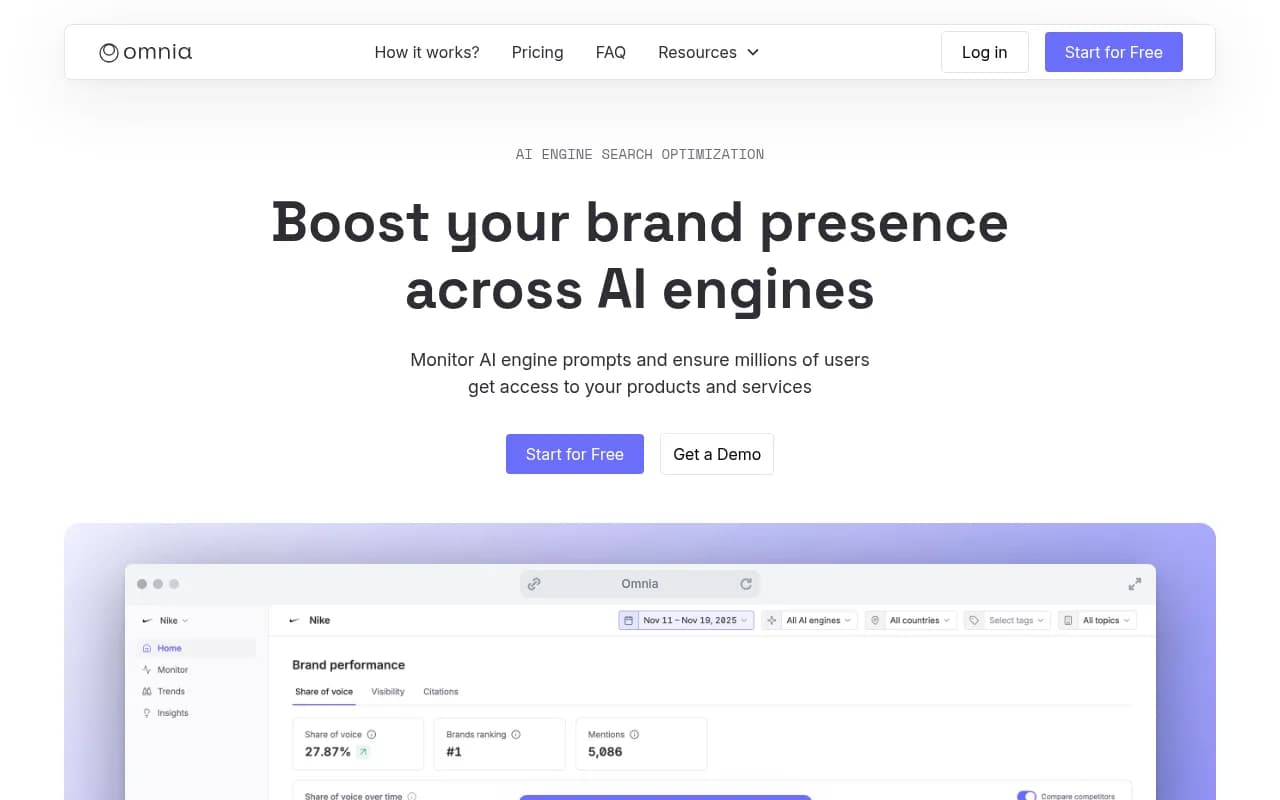
Omnia sits at the top of the budget tier ($89/mo vs. $49-52 for competitors) but delivers analytics depth that rivals platforms costing 3-5x more. During testing, Omnia consistently provided the most actionable insights.
What Omnia Does Well
Comprehensive engine coverage: Tracks ChatGPT, Perplexity, Claude, Gemini, Google AI Overviews, and Bing Chat. The broadest coverage in this price range.
Visibility heatmaps: Visual breakdowns showing exactly where you rank across engines and prompt categories. I could instantly see we dominated "project management for remote teams" prompts but were invisible for "project management for agencies."
Query fan-outs: Shows how one prompt branches into sub-queries. Searching "best CRM" revealed 47 related prompts like "best CRM for small business" and "CRM with email automation"—all trackable opportunities.
Citation source analysis: Not just which domains are cited, but which specific pages, Reddit threads, and YouTube videos. This granularity helped prioritize content updates and backlink targets.
Prompt volume estimates: Unlike competitors that treat all prompts equally, Omnia estimates monthly search volume. This revealed that 20% of our tracked prompts drove 80% of potential visibility.
Simple dashboard: Despite deep analytics, Omnia's interface is the most intuitive of the three. New team members were productive in under 30 minutes.
Where Omnia Falls Short
No content generation: Like Rankshift and LLM Pulse, monitoring only—no AI writing tools to fill gaps.
Limited crawler logs: Can't see real-time AI crawler activity on your site.
No traffic attribution: Can't connect visibility improvements to actual conversions.
Pricier than alternatives: At $89/mo, it's 70-80% more expensive than Rankshift and LLM Pulse. For solo consultants or bootstrapped startups, this matters.
Omnia Pricing Breakdown
- Starter ($89/mo): 1 brand, 100 prompts, 5 competitors, all engines, heatmaps
- Professional ($249/mo): 3 brands, 300 prompts, 15 competitors, API access, white-label reports, priority support
Omnia's Professional plan crosses into enterprise territory at $249/mo, competing directly with platforms like Promptwatch. At that price point, you're paying for depth of analytics rather than raw feature count.
Head-to-Head Comparison: Which Tool Wins?
Engine Coverage
Winner: Omnia (6 engines vs. 5 for Rankshift, 4 for LLM Pulse)
Google AI Overviews tracking is critical given Google's search dominance. Omnia and Rankshift include it; LLM Pulse doesn't.
Analytics Depth
Winner: Omnia
Visibility heatmaps, query fan-outs, and prompt volume estimates provide context that raw mention counts can't match. During testing, Omnia's insights led to 3x more actionable content decisions than Rankshift or LLM Pulse.
Sentiment Tracking
Winner: LLM Pulse
Topic-level sentiment breakdown (pricing vs. features vs. support) beats Rankshift's basic tags and Omnia's aggregate scores. For reputation-focused teams, this is the deciding factor.
Prompt Efficiency
Winner: Rankshift
Flexible scheduling (daily/weekly/monthly) stretches prompt budgets 3-5x further than competitors' daily-only runs. For agencies managing multiple clients, this is huge.
Ease of Use
Winner: Omnia
Simplest onboarding and most intuitive dashboard. Rankshift and LLM Pulse both have steeper learning curves.
Value for Money
Winner: Rankshift (for agencies), LLM Pulse (for reputation management), Omnia (for SaaS teams)
Rankshift's $49/mo + flexible scheduling delivers best ROI for agencies. LLM Pulse's sentiment focus justifies €49/mo for PR teams. Omnia's $89/mo is worth it if you need deep analytics.
What These Tools Are Missing (And Why It Matters)
No Content Generation
All three platforms show you visibility gaps but won't help you fill them. You'll need separate tools like Frase, Surfer SEO, or Jasper to create content. Platforms like Promptwatch include built-in AI writing agents that generate articles grounded in citation data—a significant workflow advantage.
No Crawler Monitoring
You can't see when ChatGPT, Perplexity, or Claude crawlers access your site. If AI models aren't indexing your new content, you won't know why. Enterprise platforms provide real-time crawler logs showing which pages are read, errors encountered, and crawl frequency.
No Traffic Attribution
None of these tools connect AI visibility to actual website traffic or revenue. You're optimizing blind—improving visibility without knowing if it drives business results. Platforms like Promptwatch offer code snippets, Google Search Console integration, or server log analysis to close this loop.
Limited Optimization Features
These are monitoring dashboards, not optimization platforms. They show you what's wrong but leave you to figure out how to fix it. More advanced tools provide content gap analysis, optimization recommendations, and automated fixes.
When to Choose Each Tool
Choose Rankshift If:
- You're an agency managing 3+ clients on a tight budget
- Flexible prompt scheduling matters more than deep analytics
- You need solid competitor benchmarking without enterprise pricing
- You're comfortable using separate tools for content creation
Choose LLM Pulse If:
- Reputation management is your top priority
- You need topic-level sentiment analysis (pricing vs. features vs. support)
- Your brand has international presence requiring multi-language tracking
- Reddit and forum discussions influence your category
Choose Omnia If:
- You want the deepest analytics in the budget tier
- Visibility heatmaps and query fan-outs drive your content strategy
- You need prompt volume estimates to prioritize high-value keywords
- Ease of use matters for team adoption
- You can afford $89/mo for better insights
When to Upgrade to Enterprise Platforms
If you're hitting these limitations with budget tools, it's time to consider platforms like Promptwatch, Profound, or SEOClarity:
You need content generation: Built-in AI writing tools that create articles optimized for AI search, grounded in real citation data and competitor analysis.
You need crawler monitoring: Real-time logs showing when AI models access your site, which pages they read, and errors they encounter.
You need traffic attribution: Connect visibility improvements to actual revenue with code snippets, Google Search Console integration, or server log analysis.
You need optimization workflows: Not just monitoring, but Answer Gap Analysis showing exactly which content you're missing, then tools to create and optimize it.
You're managing 10+ brands: Enterprise platforms offer unlimited sites, white-label reporting, API access, and dedicated support.
Promptwatch's Essential plan ($99/mo) bridges the gap between budget tools and full enterprise platforms—you get content generation, crawler logs, and basic optimization features at a price point closer to Omnia than SEOClarity.
The Bottom Line
Rankshift, LLM Pulse, and Omnia prove you don't need enterprise budgets to track AI visibility. For $49-89/mo, you get multi-engine monitoring, competitor analysis, and enough insights to drive content strategy.
Best overall value: Rankshift at $49/mo delivers solid core features with flexible scheduling that stretches your budget.
Best for reputation: LLM Pulse's sentiment tracking justifies €49/mo if brand perception matters more than raw visibility.
Best for insights: Omnia's $89/mo gets you analytics depth that rivals platforms costing 3-5x more.
But remember: these are monitoring tools, not optimization platforms. They'll show you what's wrong—you'll need to fix it yourself or upgrade to platforms with content generation, crawler monitoring, and traffic attribution.
For most small teams and agencies, start with one of these three budget tools. Track your visibility for 60-90 days, identify high-value opportunities, and decide if you need enterprise features. You might find that 80% of the insights come from 20% of the cost.