Opttab Review 2026
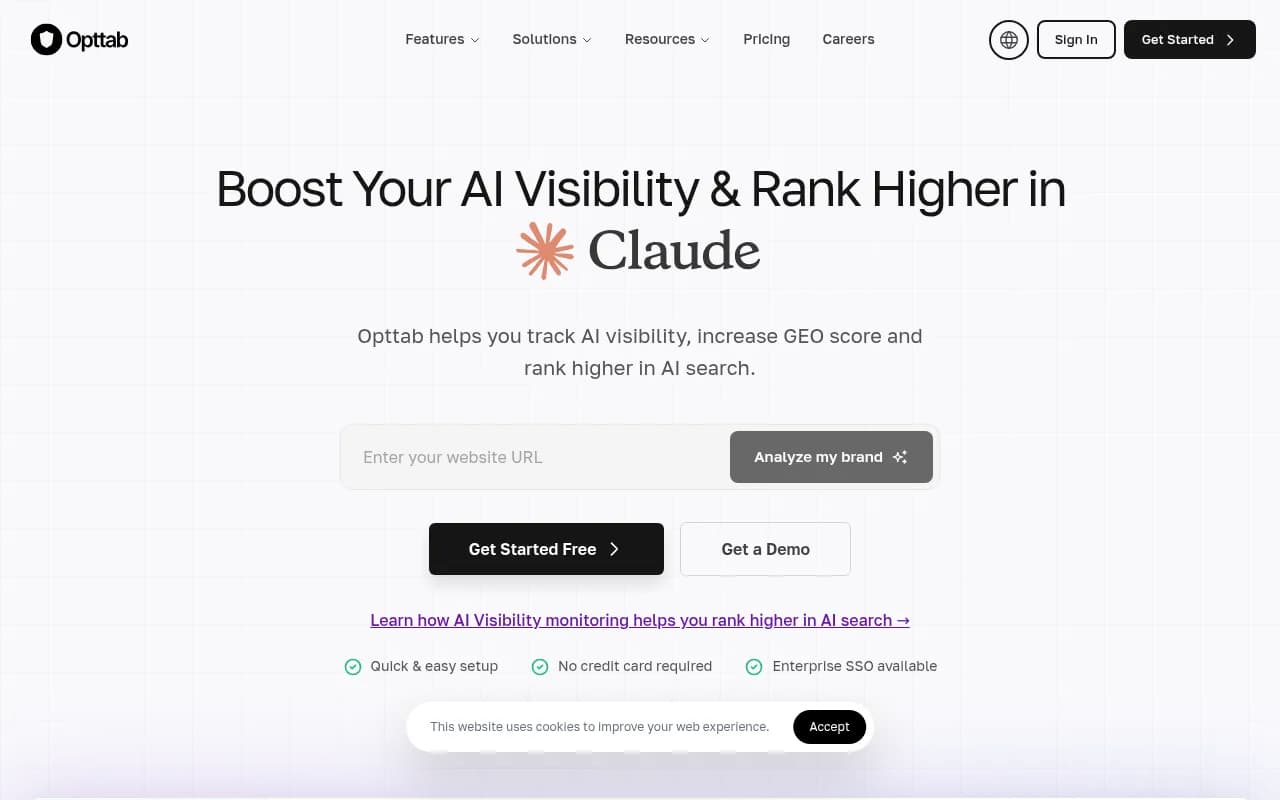
Tracks brand visibility across multiple large language models and AI search engines to optimize for generative AI discovery.
Summary: Key Takeaways
• Action-oriented AI visibility platform that goes beyond monitoring -- includes GEO scoring, content gap analysis, AI-optimized site generation (AXP), and bot analytics • Tracks 10+ AI models including ChatGPT, Claude, Gemini, Perplexity, Grok, DeepSeek, Mistral, Meta AI, and Copilot with real-time brand mention tracking • Strong asset protection features with granular opt-in/opt-out controls per AI platform (98.7% protection rate claimed) • Pricing starts at $83/mo (Starter plan) with agency plans at $416/mo -- competitive but not the cheapest option • Best for: E-commerce brands, agencies managing multiple clients, and companies concerned about AI training on their content
Opttab is a comprehensive AI visibility and optimization platform launched to help brands understand and improve how they appear in AI-powered search engines and large language model responses. As conversational AI interfaces like ChatGPT, Perplexity, and Claude increasingly replace traditional search for product research and recommendations, Opttab positions itself as an end-to-end solution for tracking, optimizing, and controlling your brand's presence across these platforms.
The platform serves marketing teams, SEO professionals, e-commerce businesses, agencies, and anyone concerned about how AI models represent their brand or use their content for training. It's particularly relevant for companies in competitive verticals where AI recommendations directly influence purchasing decisions -- think consumer electronics, SaaS tools, travel, automotive, and professional services.
Core Visibility Tracking & Analytics
Opttab's foundation is cross-LLM visibility monitoring. You define prompts that represent real customer questions ("best project management software for remote teams", "top electric vehicles for families"), and Opttab queries multiple AI models to see if and how your brand appears in responses. The platform tracks several key metrics: Visibility Score (percentage of prompts where you're mentioned), GEO Score (content optimization quality for AI citation), average ranking position, and sentiment analysis of how AI models describe your brand.
The dashboard shows visibility trends over time, response distribution by AI model (which platforms cite you most), and recent activity feeds. You can drill into individual prompt responses to see exactly what each AI model said about your brand, which sources it cited, and how you ranked against competitors. This granular view helps identify patterns -- for example, you might discover Claude consistently ranks you higher than ChatGPT, or that certain product categories get better visibility than others.
AI Bot Analytics is a standout feature that tracks which AI crawlers (GPTBot, ClaudeBot, Google-Extended, PerplexityBot, etc.) visit your website, how often, and which pages they access. You see real-time bot activity, pageview counts, crawl frequency, and historical trends. This data reveals whether AI models are actually discovering and indexing your content, and which pages they prioritize. If you notice low crawl rates or certain important pages being ignored, you know there's an indexing or discoverability problem to fix.
Competitor Analysis & Benchmarking
The Competitors feature lets you add rival brands and track their AI visibility alongside yours. You see side-by-side visibility scores, which prompts trigger competitor mentions, and how often they outrank you in AI responses. The Insights dashboard provides industry benchmarking -- "Brands with highest visibility" rankings show where you stand relative to direct and indirect competitors.
This competitive intelligence is valuable for identifying content gaps. If a competitor consistently appears for prompts where you don't, you can analyze what content or optimization they have that you're missing. Opttab doesn't automate this analysis as deeply as some competitors (like Promptwatch's Answer Gap Analysis), but the raw data is there for manual review.
GEO Optimization & Site Audit
Opttab's Site Audit feature analyzes your website's AI readiness across multiple factors: content quality and depth, semantic clarity, structured data implementation, AI parsability, and training relevance. Each page gets an AI Score, and the audit identifies critical issues affecting AI visibility with specific recommendations for improvement.
The GEO Score is Opttab's proprietary metric for how well your content is optimized for AI citation. The platform provides a list of recommended actions sorted by impact -- things like "Add structured FAQ schema" (+15 points), "Include authoritative citations" (+12 points), "Optimize meta descriptions for AI" (+8 points). Each recommendation includes instructions for implementation. This is helpful for teams that know they need to optimize but aren't sure where to start.
However, the GEO recommendations are somewhat generic compared to platforms that provide page-level, prompt-specific optimization guidance. You get a checklist of best practices, but not necessarily "here's the exact content missing that would get you cited for this specific prompt."
AXP Site: AI-Optimized Content Layer
One of Opttab's more innovative features is the AXP (AI Experience) Site -- an AI-optimized version of your website specifically designed for AI model bots to parse more effectively. The idea is that your main website might have complex HTML, JavaScript, paywalls, or navigation that makes it hard for AI crawlers to extract clean information. The AXP site strips this down to semantically-rich, structured content that AI models can understand instantly.
You can integrate via WordPress plugin, Shopify plugin, or manual entry. Opttab extracts your pages and generates the AXP versions, which you host on a subdomain (e.g., axp.yourbrand.com). The platform claims this leads to 10x faster indexing and better citation accuracy. It's a clever approach, though it requires maintaining a parallel content structure and trusting that AI models will prioritize the AXP version over your main site.
AI Content Generation
Opttab includes an AI Content Generator that creates blog posts, product descriptions, and page content optimized for AI visibility. The tool analyzes your brand, products, and website gaps to generate content tailored to your voice and audience. Content is marked as "GEO optimized" and designed to fill gaps that would improve your visibility score.
This is a nice-to-have feature, but it's not as sophisticated as dedicated AI writing tools or platforms that generate content based on actual citation data and prompt volumes. The content generator is brand-aware and audience-targeted, but it's more of a convenience feature than a core differentiator. If you're serious about content optimization for AI search, you'll likely want a more robust solution that ties content creation directly to visibility gaps and prompt intelligence.
Asset Protection & Opt-In/Opt-Out Controls
Opttab differentiates itself with strong asset protection features. You can set granular preferences for each AI platform -- fully opt-in (allow training and inference), fully opt-out (block AI usage), or partial preferences. The platform manages this through robots.txt integration, AI.txt protocols, and direct communication with AI providers. Opttab claims a 98.7% protection rate.
This is particularly valuable for content creators, publishers, e-commerce businesses with proprietary product data, celebrities managing their likeness, and academics protecting research. You get a centralized dashboard to control which AI models can access your content, with change tracking and verification. Most AI visibility platforms don't offer this level of asset control -- they focus purely on optimization and monitoring.
Multi-Language & Regional Support
Opttab supports multi-language prompt monitoring and regional targeting. You can specify the language and geographic region when tracking prompts, allowing you to monitor how AI models present your brand to different audiences worldwide. This is essential for global businesses managing international AI visibility strategies, though the platform doesn't provide as much detail on regional variations as some enterprise-focused competitors.
Integrations & Ecosystem
Opttab offers WordPress and Shopify plugins for automatic content syncing and AXP site generation. There's API access for custom integrations and data export. Enterprise SSO is available for larger organizations. The platform doesn't have as extensive an integration ecosystem as more established SEO tools (no native Looker Studio connector, GSC integration, or server log analysis mentioned), but the core integrations cover the most common use cases.
Who Is Opttab For?
Opttab is best suited for e-commerce brands (especially those on Shopify or WordPress) that want to monitor product mentions in AI recommendations, agencies managing multiple client brands (the Agency plan supports unlimited clients for $416/mo), and companies concerned about AI training on their content who need granular opt-in/opt-out controls.
It's also a good fit for marketing teams at mid-sized companies (50-500 employees) that are just starting to take AI visibility seriously and want an all-in-one platform with monitoring, optimization, and content tools in one place. The interface is clean and approachable, making it accessible for teams without deep technical expertise.
Opttab is less ideal for large enterprises that need advanced features like real-time crawler logs, prompt volume estimates, difficulty scoring, or deep citation analysis. It's also not the best choice for SEO agencies that need to demonstrate ROI with traffic attribution and revenue tracking -- Opttab focuses on visibility metrics but doesn't connect those to actual traffic or conversions as robustly as some competitors.
Pricing & Value
Opttab offers three main pricing tiers:
Starter Plan: $83/mo (billed monthly at $99/mo, or $83/mo billed annually) -- designed for small businesses getting started with AI visibility. Includes basic monitoring, site audit, and AXP site generation. Specific limits on prompts and sites aren't clearly detailed on the pricing page.
Business Plan: Pricing not publicly listed -- for growing companies that need more prompts, sites, and advanced features.
Agency Plan: $416/mo (billed annually at $4,999/year) -- unlimited clients, multi-brand management, white-label options. No per-client fees, which is attractive for agencies.
There's a free trial available with no credit card required. Enterprise SSO and custom plans are available for larger organizations.
Compared to competitors, Opttab's pricing is mid-range. It's more expensive than basic monitoring tools like Otterly.AI or Peec.ai (which start around $50-70/mo), but cheaper than enterprise platforms like Profound or Scrunch (which can run $500-1000+/mo). The Agency plan is competitively priced for multi-client management.
The value proposition depends on what you prioritize. If asset protection and opt-in/opt-out controls are critical, Opttab offers features most competitors lack. If you need deep optimization tools, content gap analysis, and traffic attribution, platforms like Promptwatch provide more actionable insights. If you just want basic monitoring, cheaper options exist.
Strengths
Comprehensive feature set in one platform: Opttab combines monitoring, optimization, content generation, bot analytics, and asset protection -- you're not juggling multiple tools.
Strong asset protection capabilities: Granular opt-in/opt-out controls per AI platform with 98.7% claimed protection rate. This is a unique differentiator.
AXP Site innovation: Creating an AI-optimized content layer is a clever approach to improving crawlability and citation accuracy.
Clean, approachable interface: The dashboard is well-designed and easy to navigate, making it accessible for non-technical users.
Agency-friendly pricing: Unlimited clients for $416/mo with no per-client fees is attractive for agencies.
Limitations
Generic GEO recommendations: The optimization advice is helpful but not as specific or actionable as platforms that tie recommendations directly to prompt-level gaps and citation data.
Limited content intelligence: No prompt volume estimates, difficulty scoring, or query fan-outs to help prioritize which prompts to target. You're guessing at which opportunities are worth pursuing.
No traffic attribution: Opttab tracks visibility but doesn't connect that to actual traffic or revenue. You can't see if improved AI visibility is driving real business results.
Shallow competitor analysis: You see competitor visibility scores, but not detailed breakdowns of which content or optimization strategies are working for them.
Missing advanced features: No real-time crawler logs (just historical bot analytics), no Reddit/YouTube tracking, no ChatGPT Shopping monitoring.
Bottom Line
Opttab is a solid all-in-one AI visibility platform that covers the basics well and adds unique value with asset protection features. It's best for e-commerce brands and agencies that want a single dashboard for monitoring, optimization, and content control without needing deep technical expertise. The AXP Site feature is innovative, and the asset protection capabilities are unmatched by most competitors.
However, if you need advanced optimization tools, content gap analysis, or traffic attribution to prove ROI, you'll find Opttab somewhat limited. It's a good starting point for companies new to AI visibility, but teams serious about dominating AI search may outgrow it and need more sophisticated platforms. For the price, it's competitive -- just make sure the feature set aligns with your specific needs before committing.
Tags:
Similar and alternative tools to Opttab