Maze Review 2026
Maze is an all-in-one user research platform that lets teams recruit participants, run studies (interviews, usability tests, surveys), and analyze findings with AI-powered insights. Built for product teams, designers, and researchers who need to move fast without sacrificing rigor. Access 6M+ partic
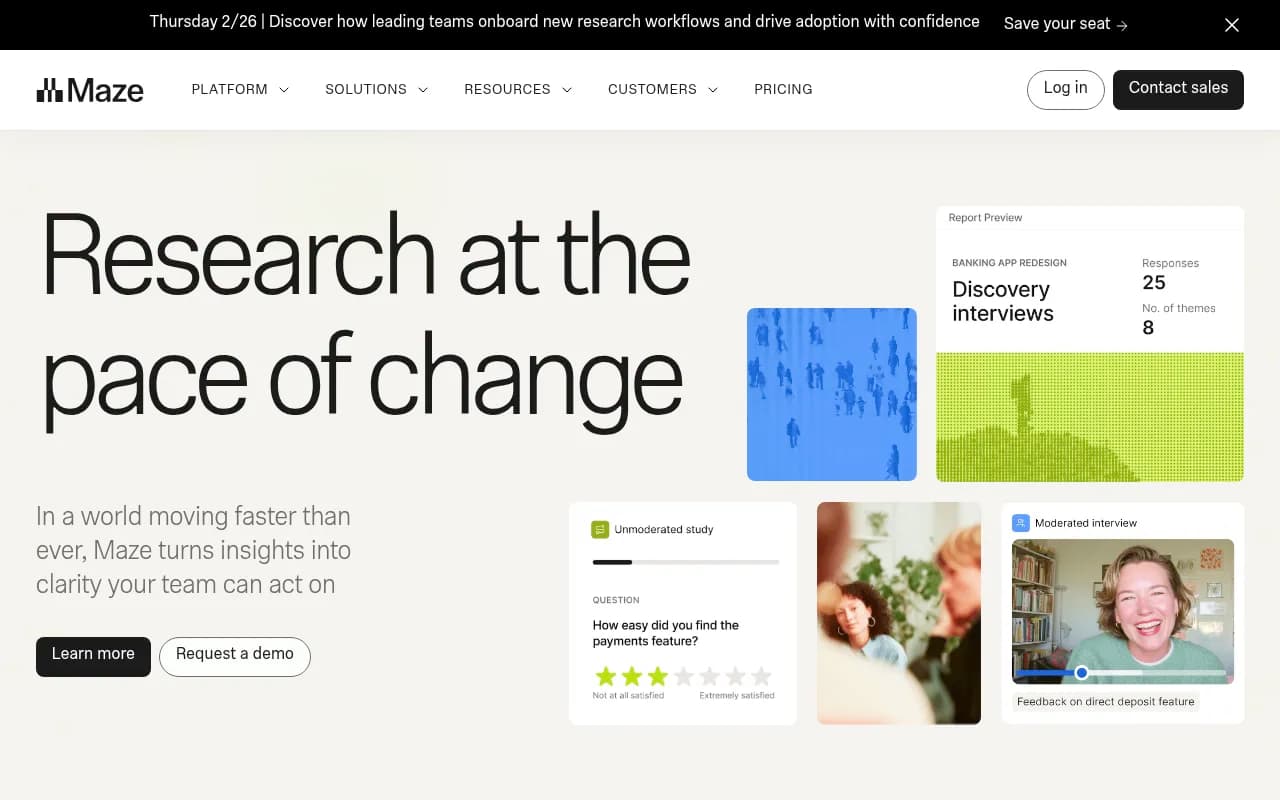
Summary
Maze is a comprehensive user research platform that consolidates recruiting, testing, and analysis into a single workflow. It's built for product teams, UX researchers, and designers who need to run credible studies at scale without getting bogged down in logistics. The platform handles everything from participant recruitment (via a 6M+ person panel) to AI-powered analysis and automated reporting. Maze's core strength is making research accessible to non-researchers while maintaining methodological rigor -- you can run moderated interviews, prototype tests, card sorts, tree tests, and surveys all in one place. The AI features (transcription, thematic analysis, highlight reels) cut hours off analysis time, and the reporting tools make it easy to share findings that actually influence product decisions. It's a strong fit for teams that want to democratize research and move faster, though the learning curve and pricing may be barriers for very small teams or solo practitioners.
What Maze is and who built it
Maze is a user research platform founded to solve a specific problem: research was too slow, too siloed, and too dependent on specialized researchers. The company's mission is to turn research into a "center of influence" by making it faster, more collaborative, and more actionable. Maze has grown into a platform used by companies like Atlassian, Lowe's, Volvo, Cisco, Revolut, and Braze -- spanning startups to enterprises. The platform is designed around three core pillars: recruit the right participants, conduct research autonomously, and deliver insights that drive decisions. It's not just a testing tool or a panel provider -- it's an end-to-end research system that brings together qualitative and quantitative methods in one place.
The target audience is broad but centers on product teams (PMs, designers, researchers) at companies that ship digital products. Maze is particularly popular with mid-sized tech companies (50-500 employees) that have a few dedicated researchers but need to scale research across multiple product squads. It's also used by agencies running research for clients and by enterprise teams that need to standardize research practices across departments.
Key features breakdown
Participant recruitment and panel access: Maze gives you instant access to a panel of over 6 million participants across B2C and B2B audiences. You can target by demographics, behaviors, job titles, company size, and more. The platform handles screener questions, scheduling, and incentive payments automatically. You can also bring your own participants by sharing study links or embedding in-product prompts to recruit from your existing user base. The panel is a major differentiator -- most competitors either don't have a panel at all or have much smaller, less targeted pools. Maze's panel is particularly strong for B2B recruiting, which is notoriously difficult.
Moderated and unmoderated interviews: Maze supports both live moderated interviews (with video recording, transcription, and note-taking) and AI-moderated interviews where an AI agent conducts the conversation based on your discussion guide. The AI moderator can ask follow-up questions, probe for details, and adapt to participant responses in real time. This is a huge time-saver for exploratory research where you need to talk to 20+ people but don't have the bandwidth to conduct every session yourself. Transcripts are generated automatically with speaker labels, timestamps, and sentiment tagging. You can create highlight reels by clipping key moments from multiple interviews and share them with stakeholders.
Prototype and live website testing: Upload Figma, Sketch, Adobe XD, or InVision prototypes and watch participants navigate them while thinking aloud. Maze captures clicks, navigation paths, time on task, and misclick rates. You can also test live websites or mobile apps (iOS and Android) with the same level of detail. The platform records session replays with heatmaps showing where users clicked, scrolled, and hesitated. This is particularly useful for usability testing before launch or for identifying friction points in existing products. The mobile testing capability is a standout -- many competitors only support desktop or require separate tools for mobile.
Surveys, card sorts, and tree tests: Maze includes a full suite of quantitative and qualitative research methods. Surveys support multiple question types (Likert scales, open-ended, multiple choice, ranking, NPS, etc.) with conditional logic and branching. Card sorting (open and closed) helps you understand how users categorize information, which is critical for IA and navigation design. Tree testing validates your site structure by having users find specific items in a text-only hierarchy. These methods are often sold as separate tools by competitors, but Maze bundles them all in one platform with consistent reporting.
AI-powered analysis and themes: After you collect responses, Maze's AI automatically identifies themes across qualitative data (interview transcripts, open-ended survey responses, etc.). It groups similar comments, labels themes, and surfaces representative quotes. You can refine the themes manually or let the AI handle it. The AI also generates summaries of each interview and highlights key insights. This feature alone can save 10-15 hours per study compared to manual coding in tools like Dovetail or Airtable. The thematic analysis is research-grade -- it's not just keyword matching, it understands context and sentiment.
Automated reports and insight sharing: Every study generates an automated report with key metrics, charts, participant quotes, and video clips. Reports are shareable via link (with optional password protection) or embeddable in Notion, Confluence, or Google Docs. You can customize what's included, add your own commentary, and export to PDF or PowerPoint. The reports are designed to be stakeholder-friendly -- they highlight the "so what" instead of drowning people in raw data. This is a major advantage over tools like UserTesting or Lookback, which give you raw session recordings but leave the synthesis and storytelling to you.
Study templates and research ops: Maze includes 100+ pre-built study templates for common research scenarios (onboarding flows, feature validation, pricing studies, brand perception, etc.). Templates include pre-written questions, recommended sample sizes, and analysis frameworks. This is incredibly helpful for teams new to research or for standardizing methods across an organization. The platform also supports workspaces with role-based access control, so you can keep client work separate or restrict sensitive studies to specific team members.
Integrations and ecosystem: Maze integrates with Figma, Sketch, Adobe XD, InVision, Miro, Notion, Slack, Jira, and Asana. You can import prototypes directly from design tools, push insights to project management tools, and get Slack notifications when studies complete. The API allows custom integrations for enterprise teams. There's also a browser extension for capturing live website feedback and a mobile SDK for in-app testing.
Who is Maze for
Maze is built for product teams at tech companies that ship digital products -- SaaS platforms, mobile apps, e-commerce sites, etc. The ideal user is a product manager or designer who needs to validate ideas quickly but doesn't have a dedicated researcher on call. It's also a strong fit for UX research teams (1-5 people) at mid-sized companies (100-500 employees) who need to scale research across multiple product squads without hiring more researchers. Agencies running research for clients love Maze because the workspace and reporting features make it easy to manage multiple projects and deliver polished deliverables.
Specific personas: A PM at a Series B SaaS company testing a new onboarding flow with 50 users. A solo UX researcher at a 200-person fintech startup running weekly usability tests on prototypes. A design agency conducting discovery research for a client's mobile app redesign. An enterprise research team at a Fortune 500 company standardizing research methods across 10 product lines.
Maze is less ideal for academic researchers (who need more control over methodology and data export), for teams doing highly specialized research (ethnography, diary studies, longitudinal studies), or for solo freelancers on a tight budget (the pricing starts at $99/month for the basic plan, which may be steep if you're only running a few studies per year).
Integrations and ecosystem
Maze integrates with the tools product teams already use: Figma, Sketch, Adobe XD, InVision, Miro, Notion, Confluence, Slack, Jira, Asana, and Zapier. The Figma integration is particularly seamless -- you can import prototypes with a single click and Maze automatically maps out the screens and interactions. The Slack integration sends notifications when studies complete or when new responses come in. The API is well-documented and supports custom integrations for enterprise teams that need to connect Maze to internal tools or data warehouses. There's also a browser extension for capturing feedback on live websites and a mobile SDK for embedding studies in iOS and Android apps.
Maze doesn't integrate with traditional survey tools (SurveyMonkey, Typeform) because it replaces them. It also doesn't integrate with analytics platforms (Mixpanel, Amplitude) directly, though you can export data via API and build custom dashboards.
Pricing and value
Maze offers a free plan with limited features (3 projects, 10 responses per project, basic reporting). Paid plans start at $99/month (billed annually) for the Starter plan, which includes unlimited projects, 100 responses per month, access to the participant panel (pay per response), and basic AI features. The Professional plan is $250/month and adds advanced AI analysis, moderated interviews, mobile testing, and priority support. Enterprise pricing is custom and includes SSO, dedicated account management, custom contracts, and advanced security features.
The panel pricing is separate: B2C participants cost $1-3 per response depending on targeting criteria, and B2B participants cost $5-15 per response. This is competitive with other panel providers (Respondent charges $100-200 per B2B interview, UserInterviews charges $50-150).
Compared to competitors: UserTesting starts at $199/month but doesn't include a panel (you pay per session, typically $50-100 each). Lookback is $150/month but only handles moderated interviews, not surveys or card sorts. Optimal Workshop is $166/month for all tools but doesn't have a panel or AI analysis. Maze is competitively priced for teams that want an all-in-one platform, though it's more expensive than single-purpose tools like UsabilityHub ($89/month) or Lyssna (formerly UsabilityHub, $75/month).
The value proposition is strongest for teams running 5+ studies per month. If you're only running occasional research, the monthly cost may not justify the investment. But if you're replacing multiple tools (a panel provider, a usability testing tool, a survey tool, and an analysis tool), Maze can actually save money while simplifying your workflow.
Strengths and limitations
Strengths: The all-in-one approach is the biggest win. You don't need to juggle UserTesting for usability tests, SurveyMonkey for surveys, Optimal Workshop for card sorts, and Dovetail for analysis. Everything lives in one place with consistent reporting. The AI features are genuinely useful -- the thematic analysis and automated summaries save hours of manual work. The participant panel is large, well-targeted, and easy to use. The reporting is stakeholder-friendly and makes it easy to share insights that actually get read. The platform is intuitive enough that non-researchers can run credible studies without a lot of training.
Limitations: The learning curve is steeper than single-purpose tools. There are a lot of features and options, which can be overwhelming for new users. The AI analysis is good but not perfect -- you still need to review and refine the themes it generates. The panel can be expensive if you're running large-scale quantitative studies (100+ participants). The platform is optimized for digital product research (websites, apps, prototypes) and less suited for physical product testing, service design, or ethnographic research. There's no built-in support for diary studies or longitudinal research. The mobile app is limited -- you can review studies and check notifications, but you can't build or launch studies from mobile.
Compared to competitors: Maze is more comprehensive than UserTesting (which only does usability testing) but less specialized than Dovetail (which is purely for analysis and synthesis). It's more expensive than Lyssna but includes a panel and AI features that Lyssna lacks. It's easier to use than Qualtrics but less powerful for complex survey logic and statistical analysis.
Bottom line
Maze is the best choice for product teams that want to run research at scale without hiring a full research team. It's particularly strong for mid-sized tech companies (50-500 employees) that need to democratize research across product squads while maintaining quality and consistency. The all-in-one approach, AI-powered analysis, and stakeholder-friendly reporting make it easy to turn insights into action. If you're currently using 3-4 separate tools for recruiting, testing, and analysis, Maze will simplify your workflow and probably save you money. If you're a solo researcher or a very small team on a tight budget, the pricing may be a barrier -- consider starting with the free plan or a single-purpose tool like Lyssna. If you need highly specialized research methods (ethnography, longitudinal studies, complex survey logic), you'll likely need to supplement Maze with other tools. But for the 80% use case -- validating designs, testing prototypes, understanding user needs, and sharing insights -- Maze is hard to beat.
Tags:
Frequently asked questions
What is Maze and what does it do?
How much does Maze cost?
Does Maze offer a free plan?
Who is Maze best for?
What types of user research can you conduct with Maze?
Does Maze provide research participants?
What AI features does Maze include?
What companies use Maze?
Similar and alternative tools to Maze