6sense Review 2026
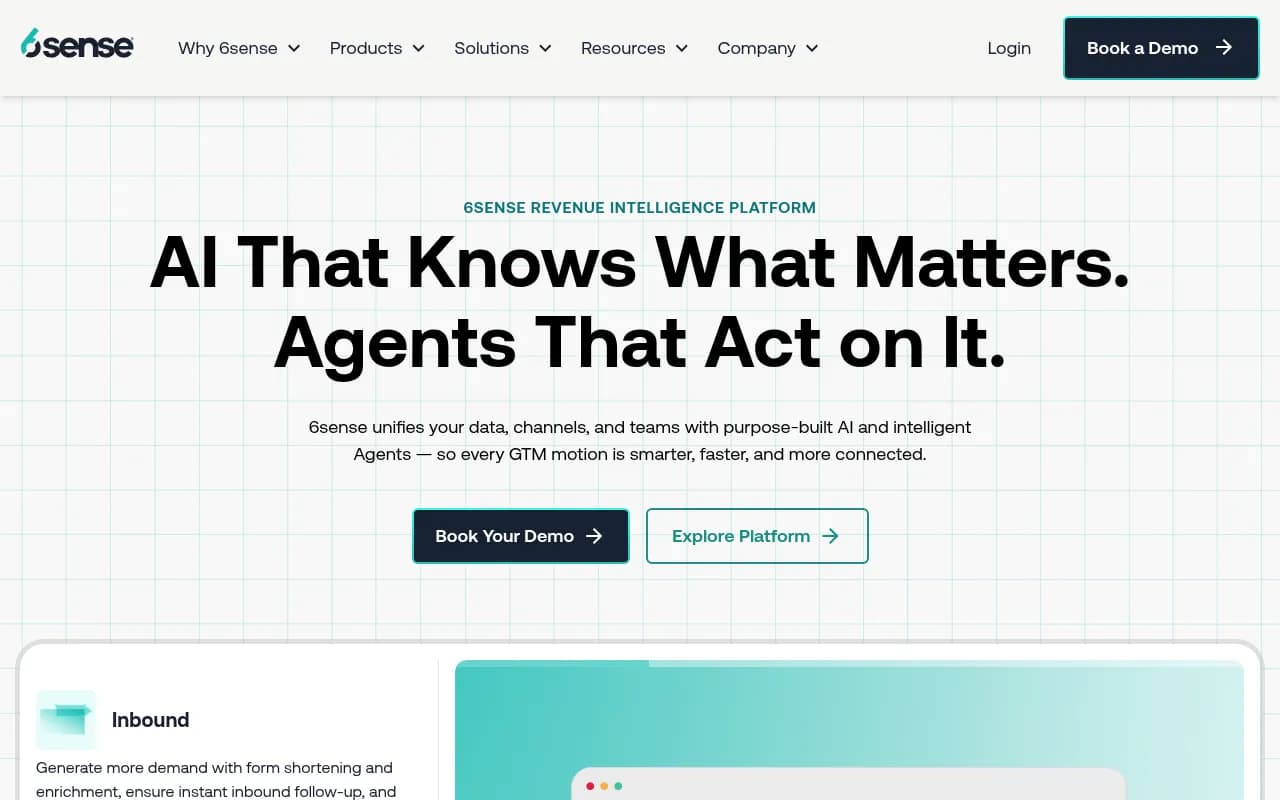
Uses AI to identify in-market accounts and buying signals, helping GTM teams prioritize prospects and personalize campaigns.
Summary
- Best for: Mid-market to enterprise B2B companies with complex sales cycles (11+ person buying committees, 100+ touches per deal) who need predictive account scoring and omnichannel orchestration
- Core strength: The Signalverse captures 1 trillion daily signals (intent data, company research, contact behavior) and 6AI turns that into predictive account scores, automated workflows, and AI agents that handle email outreach and meeting booking
- Key limitation: Pricing starts around $50K/year for small deployments -- this is an enterprise platform, not a tool for startups or solo marketers
- Standout feature: Intelligent Workflows Engine lets you build drag-and-drop omnichannel campaigns (ads + email + web + sales alerts) that trigger based on AI-predicted buying stage, all from one canvas
- Not a fit if: You're a small team (<10 people), have a short sales cycle, or need a simple lead gen tool. 6sense is built for revenue teams running account-based strategies at scale.
6sense is a revenue intelligence platform built around a simple premise: B2B buying committees are massive (averaging 11 people), sales cycles involve hundreds of touches (17 interactions per buyer), and most of those interactions happen before a prospect ever fills out a form. The platform's job is to surface which accounts are researching solutions right now, predict when they're ready to buy, and automate personalized outreach across every channel before competitors even know the account exists.
Founded over a decade ago, 6sense pioneered account-based marketing and has since evolved into a full revenue orchestration platform used by enterprise brands like Okta, SAP, Shell, and Aruba. The company is based in San Francisco and serves mid-market to enterprise B2B companies across software, financial services, manufacturing, and business services.
The Signalverse: 1 trillion daily signals fueling predictive AI
At the core of 6sense is the Signalverse -- a proprietary data engine that captures intent signals, company firmographics, contact behavior, and web activity across the B2B internet. Every day it processes over 1 trillion signals: keyword research on review sites, content downloads, job postings, technographic changes, competitor mentions, and anonymous website visits.
This isn't just intent data scraped from a few publisher networks. 6sense combines first-party data (your CRM, MAP, website analytics) with third-party intent (Bombora-style keyword research tracking), company data (firmographics, technographics, funding events), and contact data (job changes, social activity, email engagement). The platform then deanonymizes website visitors at the account level -- so even if no one fills out a form, you know which companies are researching your product and what pages they're reading.
The Signalverse also includes web deanonymization (account matching) that identifies anonymous visitors by IP, reverse-IP lookup, and behavioral fingerprinting. If someone from Acme Corp reads your pricing page, case studies, and competitor comparison without converting, 6sense flags Acme Corp as an in-market account and surfaces it to your sales and marketing teams.
6AI: Predictive modeling that scores every account
Raw signals are useless without context. 6AI is the machine learning layer that turns Signalverse data into decisions. It cleans, deduplicates, and enriches your CRM and MAP data, then builds predictive models tailored to your business.
Every account in your TAM gets an AI-powered buying stage score (Awareness, Consideration, Decision, Purchase) based on intent signals, engagement history, and fit. Accounts also get a propensity-to-buy score that predicts likelihood to convert in the next 30-90 days. These aren't generic scores -- 6AI trains on your historical win/loss data, so the model learns what "good fit" and "ready to buy" actually look like for your product.
For sales teams, 6AI powers account prioritization -- a ranked list of accounts most likely to close, updated daily. Reps see which accounts spiked in intent this week, which contacts are engaging, and what content they consumed. No more cold calling random leads from a static list.
For marketing, 6AI feeds dynamic audience segments that auto-update as accounts move through buying stages. You can build a segment like "Enterprise accounts in Decision stage researching competitors" and 6sense will keep it fresh as new accounts match the criteria.
Intelligent Workflows: Omnichannel orchestration from one canvas
This is where 6sense separates itself from monitoring-only ABM tools. The Intelligent Workflows Engine is a visual, drag-and-drop builder that lets you design full-funnel campaigns across email, display ads, LinkedIn ads, web personalization, and sales alerts -- all triggered by AI buying signals.
Here's how it works in practice. You build a workflow that says: "When an account enters Decision stage and has 3+ engaged contacts, send a personalized email sequence, launch a LinkedIn ad campaign targeting their buying committee, personalize the website experience with case studies from their industry, and alert the assigned SDR." All of that happens automatically, in sync, without switching between six different tools.
Workflows can branch based on engagement (if they click the email, route them to a demo request page; if they don't, retarget with ads). You can set up competitive takeout programs that detect when accounts are researching your biggest competitors (based on intent keywords) and immediately hit them with comparison content and ads. Or build inbound acceleration workflows that shorten forms (Smart Form Fill auto-enriches partial submissions), score leads in real-time, and route hot accounts to sales within minutes.
The Workflows Engine integrates with your MAP (Marketo, HubSpot, Eloqua, Pardot), CRM (Salesforce, Microsoft Dynamics), ad platforms (LinkedIn, Google, Facebook, programmatic DSPs), and sales engagement tools (Outreach, Salesloft, Groove). You're not replacing your stack -- you're orchestrating it from one control panel.
AI Email Agents: Autonomous outreach that books meetings
In 2025, 6sense launched AI Email Agents -- autonomous agents that handle outbound prospecting end-to-end. You give the agent a target account list, a value proposition, and some guardrails (tone, sending limits, approval workflows). The agent then:
- Researches each account using Signalverse data (recent funding, tech stack changes, hiring signals, intent keywords)
- Identifies the right contacts (decision-makers, influencers, champions) and finds verified email addresses
- Writes personalized email sequences tailored to each contact's role, company, and buying stage
- Sends emails, monitors replies, and responds intelligently to questions or objections
- Books meetings directly on your calendar when a prospect shows interest
One customer (Reltio) reported saving 1,098 hours of BDR time -- equivalent to seven months of full-time work -- by letting AI Agents handle top-of-funnel outreach. The agents don't replace human reps; they handle the repetitive research and initial outreach so reps can focus on qualified conversations.
Agents can also run competitive takeout campaigns -- targeting accounts researching competitors with messaging like "Considering [Competitor]? Here's what [Your Product] does differently." The agent monitors intent spikes for competitor keywords and launches personalized sequences automatically.
Sales Copilot: AI insights embedded in CRM
For sales reps, 6sense offers Sales Copilot -- an AI assistant that surfaces account insights directly in Salesforce or Microsoft Dynamics. When a rep opens an account record, Copilot shows:
- 30-day activity recap: Which contacts engaged, what content they viewed, intent keywords they researched, ads they clicked
- Key stakeholders: Buying committee members identified by 6AI, with contact info and engagement history
- Recommended next steps: "This account spiked in intent for [keyword] -- reach out to [contact] with [messaging angle]"
- Competitive intel: If the account is researching competitors, Copilot flags it and suggests talking points
Copilot also powers List Builder -- a tool that lets reps build target account lists based on AI scores, intent signals, firmographics, and engagement. Instead of pulling random leads from a static list, reps can query "Show me enterprise accounts in healthcare that entered Decision stage this week" and get a prioritized list with contact details.
Advertising: Dynamic audiences across every channel
The Advertising module syncs AI-scored audiences to LinkedIn, Google, Facebook, and programmatic DSPs. You can build dynamic segments like "Accounts in Awareness stage with high propensity scores" and 6sense will push that audience to LinkedIn Matched Audiences daily. As accounts move through buying stages, they automatically shift to different ad campaigns with stage-appropriate messaging.
6sense also offers account-level ad suppression -- so you're not wasting budget showing ads to existing customers, closed-lost accounts, or competitors. And you can set frequency caps per account to avoid ad fatigue (e.g. max 10 impressions per account per week across all channels).
The platform tracks ad engagement at the account level and feeds it back into AI scoring. If an account clicks three ads, visits your website, and downloads a whitepaper, their buying stage score updates in real-time and triggers the next step in your workflow.
Smart Form Fill: Shorten forms, boost conversions
Most B2B forms ask for 8-12 fields (name, email, company, title, phone, etc.) and lose 50%+ of visitors who start but don't finish. Smart Form Fill uses 6sense's company and contact data to auto-populate fields based on the visitor's IP and behavioral fingerprint.
You can show a 2-field form (email + company) and 6sense will enrich the submission with job title, company size, industry, and phone number behind the scenes. The visitor sees a short form, you get a fully enriched lead. The platform claims this can double form conversion rates.
Smart Form Fill also enables progressive profiling -- if a known contact returns and fills out another form, 6sense asks for new information instead of re-asking for data you already have.
Reporting & Analytics: Pipeline attribution and ROI tracking
The Reporting & Analytics module tracks campaign performance, pipeline influence, and revenue attribution across all channels. You can see:
- Which accounts moved from Awareness to Decision this month and what campaigns influenced them
- Pipeline generated by channel (email, ads, web, sales outreach) and by buying stage
- ROI by campaign, account segment, and workflow
- Velocity metrics: How long accounts spend in each buying stage, time-to-close by segment
Reports are customizable and can be exported to Looker Studio, Tableau, or your BI tool via API. The platform also integrates with Google Search Console (for organic search data) and server log analysis (to track AI crawler activity -- though this is more relevant for AI search visibility tools like Promptwatch, not traditional ABM).
Integrations: Connects to your entire GTM stack
Out of the box, 6sense integrates with:
- CRMs: Salesforce, Microsoft Dynamics
- MAPs: Marketo, HubSpot, Eloqua, Pardot
- Sales engagement: Outreach, Salesloft, Groove, Apollo
- Ad platforms: LinkedIn, Google Ads, Facebook, programmatic DSPs (via The Trade Desk, DV360)
- Data enrichment: ZoomInfo, Clearbit, Lusha
- BI tools: Looker Studio, Tableau, Power BI
- Collaboration: Slack (for sales alerts), Microsoft Teams
The platform also offers a REST API for custom integrations and data exports. If you're building internal dashboards or feeding 6sense data into a data warehouse, the API gives you access to account scores, intent signals, engagement history, and campaign metrics.
Who is 6sense for?
This is an enterprise ABM platform, not a tool for small teams or simple lead gen. It's built for:
- Mid-market to enterprise B2B companies (500+ employees, $50M+ revenue) with complex sales cycles and large buying committees
- Revenue teams (marketing, sales, RevOps) running account-based strategies at scale -- typically managing 5,000-50,000 target accounts
- Industries with long sales cycles: SaaS, financial services, manufacturing, business services, technology. If your average deal takes 6-18 months and involves 10+ stakeholders, 6sense is built for you.
- Teams with existing GTM tech stacks: You need a CRM (Salesforce or Dynamics), a MAP (Marketo, HubSpot, Eloqua), and ideally a sales engagement tool (Outreach, Salesloft). 6sense orchestrates these tools; it doesn't replace them.
Who should NOT use 6sense:
- Startups or small teams (<10 people, <$5M revenue). The platform starts at $50K/year and requires dedicated resources to manage. If you're a solo marketer or a 3-person sales team, this is overkill.
- Transactional or short-cycle sales: If your average deal closes in <30 days with 1-2 decision-makers, you don't need predictive AI and omnichannel orchestration. A simple CRM + email tool will do.
- Companies without a defined TAM: 6sense works best when you have a clear target account list (by industry, company size, geography, etc.). If you're still figuring out your ICP, start with simpler tools.
Pricing
Pricing is custom and based on the number of target accounts, modules selected, and contract length. Based on third-party research (Vendr, G2 reviews):
- Small deployments (2,000-5,000 accounts, core platform + 1-2 modules): $50,000-$120,000/year
- Mid-market deployments (5,000-15,000 accounts, multiple modules): $120,000-$250,000/year
- Enterprise deployments (15,000+ accounts, full platform + premium support): $250,000-$500,000+/year
Annual contracts are standard. There's no self-serve pricing or free trial listed on the website -- you have to book a demo and talk to sales. This is typical for enterprise ABM platforms.
Strengths
- Depth of data: The Signalverse captures more signals (1 trillion/day) than most competitors, and the deanonymization is accurate enough to identify accounts even when no one fills out a form.
- AI that actually predicts: 6AI's buying stage scores and propensity models are trained on your data, so they're not generic. Customers report 2-3x higher conversion rates on AI-prioritized accounts vs. random outreach.
- True omnichannel orchestration: Most ABM tools are either ad platforms (Demandbase, RollWorks) or intent data providers (Bombora, ZoomInfo). 6sense does both and adds email, web personalization, and sales workflows in one platform.
- AI Agents that actually work: The Email Agents aren't just mail merge -- they research accounts, write personalized copy, handle replies, and book meetings. Customers report saving hundreds of BDR hours per quarter.
- Enterprise-grade integrations: Deep two-way syncs with Salesforce, Marketo, LinkedIn, and sales engagement tools. Data flows in real-time, not batch updates.
Limitations
- Expensive: Starting at $50K/year, this is one of the priciest ABM platforms. Smaller competitors (Metadata, Influ2) start at $20K-$30K.
- Complex setup: Implementing 6sense takes 4-8 weeks and requires RevOps or marketing ops resources to configure integrations, build workflows, and train teams. This isn't a plug-and-play tool.
- Requires existing tech stack: You need a CRM, MAP, and ideally a sales engagement tool. If you're starting from scratch, you'll need to buy and implement those first.
- No self-serve option: You can't sign up and start using it today. Everything goes through sales, and contracts are annual. If you want to test it for a month, you're out of luck.
Bottom line
If you're a mid-market or enterprise B2B company with a complex sales cycle, a defined TAM, and a GTM team ready to run account-based strategies at scale, 6sense is one of the most powerful platforms available. The combination of predictive AI, omnichannel orchestration, and autonomous agents gives you capabilities that would otherwise require stitching together 5-6 different tools.
But it's not for everyone. Small teams, startups, and companies with short sales cycles will find it too expensive and too complex. And if you don't have a CRM, MAP, and sales engagement tool already in place, you'll need to build that foundation first.
Best use case in one sentence: Enterprise B2B revenue teams managing 5,000+ target accounts with 6-18 month sales cycles who need AI to predict which accounts are in-market and automate personalized outreach across every channel.
Tags:
Similar and alternative tools to 6sense