RustySEO Review 2026
All-in-one open-source SEO platform providing deep technical audits, comprehensive reporting, server log analysis, and website optimization insights.
Key Takeaways:
- Free & open source with no crawl limits — analyze sites of any size without hitting paywalls or usage caps
- Built in Rust for exceptional speed and efficiency, making it ideal for large-scale crawls and CI/CD integration
- Developer-first design with CLI/TUI interface, API access, and headless execution for automation
- Comprehensive feature set including JavaScript rendering, log analysis, integrations with Google Analytics/Search Console/PageSpeed Insights, and AI-powered content insights
- Best for: Technical SEO professionals, developers, agencies managing multiple clients, and teams who want full control over their SEO tooling without vendor lock-in
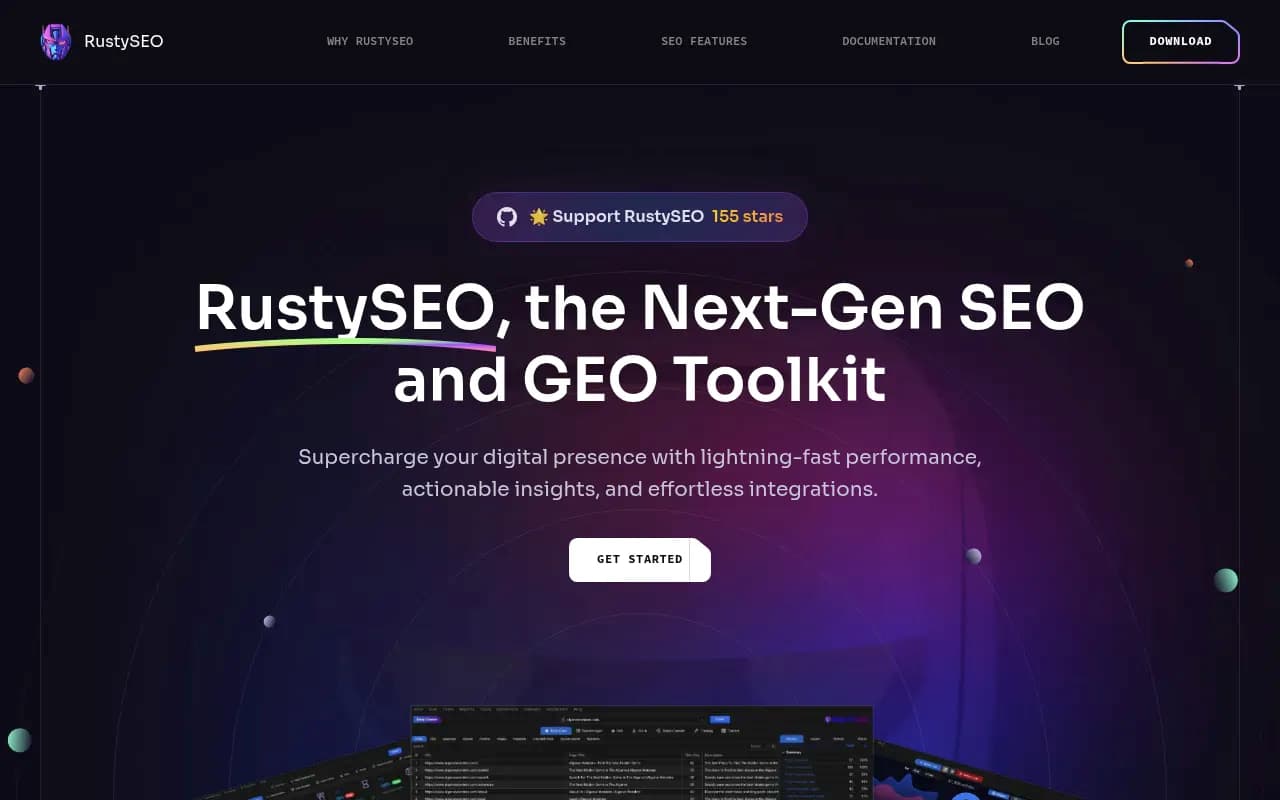
RustySEO is an open-source SEO analysis platform that takes a fundamentally different approach to website auditing. While most SEO tools are SaaS products with monthly fees and crawl limits, RustySEO is a desktop application you download and run locally — giving you unlimited crawling power, complete data privacy, and zero recurring costs. Built by developer Mascanho and available on GitHub with 155+ stars, it's designed for users who want professional-grade SEO capabilities without the SaaS overhead.
The tool is built in Rust, a systems programming language known for speed and memory efficiency. This isn't just a technical detail — it means RustySEO can crawl large websites (30,000+ pages) significantly faster than Python or Node.js-based alternatives, with lower resource usage. For agencies auditing dozens of client sites or developers integrating SEO checks into build pipelines, this performance advantage is tangible.
Deep Crawling & Technical Audits
RustySEO's core strength is its Deep Crawler module, which performs comprehensive site-wide crawls to surface technical SEO issues. It identifies broken links (404s), server errors (500s), redirect chains and loops, duplicate content (using MD5 hashing), missing or malformed meta tags, and robots.txt/meta robots directives that might be blocking indexation. The crawler supports JavaScript rendering via an integrated Chromium-based web rendering service (WRS), meaning it can audit modern single-page applications built with React, Angular, Vue.js, or Next.js — frameworks that traditional crawlers often struggle with.
Crawl results are presented in a dashboard view with filtering and search capabilities. You can drill down into specific DOM elements, CSS, and JavaScript code to understand exactly what's on each page. The tool also generates site architecture visualizations using force-directed diagrams and tree graphs, helping you evaluate internal linking structure and URL hierarchy at a glance. For migration audits, you can upload a list of URLs and check their status in bulk — useful when moving from one domain to another or restructuring a site.
Server Log Analysis & AI Crawler Tracking
One feature that sets RustySEO apart from most competitors is its Log Analysis module. Upload your server logs (Apache, Nginx, IIS) and RustySEO will parse them to identify crawl patterns, errors, performance bottlenecks, and resource usage. Critically, it can detect AI crawler activity — showing you when bots from ChatGPT, Claude, Perplexity, Google's AI crawlers, and other LLMs are accessing your site, which pages they're reading, and how often they return. This is increasingly important as AI search engines become a major traffic source. Most traditional SEO tools don't track AI crawlers at all; RustySEO makes it a first-class feature.
Integrations with Google Analytics, Search Console, PageSpeed Insights & Microsoft Clarity
RustySEO connects to the Google Analytics API, Google Search Console API, PageSpeed Insights API, and Microsoft Clarity API to pull performance and user data directly into your crawl reports. This means you can see not just technical issues, but also how those issues correlate with traffic, rankings, and user behavior. For example, you might discover that pages with slow load times (flagged by PageSpeed Insights) also have high bounce rates (from Analytics) and declining impressions (from Search Console). Having all this data in one place eliminates the need to cross-reference multiple dashboards.
The tool also supports keyword tracking via Google Search Console integration, letting you monitor ranking changes over time without needing a separate rank tracker. You can schedule crawls to run at regular intervals and auto-export data to Google Sheets or other destinations for ongoing monitoring.
AI-Enabled Content Analysis
RustySEO includes AI-powered features that help identify content quality issues. It can flag duplicate content, low-quality pages, thin content, and pages that aren't optimized for search engines. While the specifics of the AI implementation aren't fully detailed on the website, the positioning suggests it uses machine learning models to assess content relevance and quality — similar to how tools like Clearscope or MarketMuse evaluate content, but integrated directly into the crawler.
Command Line Interface & CI/CD Integration
For developers and DevOps teams, RustySEO offers a CLI (Command Line Interface) and TUI (Terminal User Interface) that bring the full power of the tool to your terminal. You can run crawls, check for broken links, audit redirects, and export reports entirely from the command line — no GUI required. This makes it trivial to integrate RustySEO into CI/CD pipelines (GitHub Actions, GitLab CI, Jenkins, etc.) to catch SEO regressions before they reach production. For example, you could configure your pipeline to fail a build if the crawler detects new 404s or missing meta descriptions.
The CLI also supports scripting and piping, so you can chain commands together or feed RustySEO's output into other tools. This level of automation is rare in SEO software, which tends to be GUI-focused and difficult to script.
Image Conversion & Optimization
RustySEO includes an Image Converter module that can batch-convert images to WebP, JPEG, or PNG formats to optimize page load times. This is a nice quality-of-life feature for developers who want to handle image optimization alongside SEO audits, rather than using a separate tool.
Scheduled Audits & Crawl Comparison
You can schedule crawls to run automatically at chosen intervals (daily, weekly, monthly) and configure auto-exports to Google Sheets, CSV, or other formats. The tool also supports crawl comparison, letting you track changes between audits — useful for monitoring the impact of SEO fixes or detecting new issues introduced by site updates. There's also a staging vs. production comparison feature using advanced URL mapping, which is valuable for QA teams who want to ensure staging environments match production before deploying.
Who Is RustySEO For?
RustySEO is best suited for:
-
Technical SEO professionals who need deep, unlimited crawls and don't want to pay per-page or per-site fees. If you're auditing enterprise sites with hundreds of thousands of pages, RustySEO's lack of crawl limits is a major advantage over tools like Screaming Frog (which caps free crawls at 500 URLs) or Sitebulb (which charges based on crawl volume).
-
Developers and DevOps engineers who want to automate SEO checks in CI/CD pipelines, integrate crawling into scripts, or run audits headlessly on servers. The CLI and API-first design make RustySEO a natural fit for engineering workflows.
-
Digital agencies managing multiple client sites who want a cost-effective alternative to per-seat SaaS tools. Since RustySEO is free and open source, agencies can run it on as many machines as needed without worrying about licensing costs.
-
SEO teams at startups or small businesses who need professional-grade auditing capabilities but can't justify $200–500/month for tools like Ahrefs, Semrush, or Screaming Frog. RustySEO delivers comparable crawling and analysis features at zero cost.
-
Privacy-conscious users who prefer to keep their site data local rather than uploading it to a third-party SaaS platform. Because RustySEO runs on your own machine, your crawl data never leaves your infrastructure.
RustySEO is not ideal for non-technical users who want a fully managed, cloud-based solution with customer support and a polished UI. It's a developer tool first, and while the GUI is functional, it doesn't have the visual polish or hand-holding of enterprise SaaS products. If you're a marketer with no command-line experience and you need a tool that "just works" out of the box, you might find RustySEO's setup and configuration more involved than you'd like.
Integrations & Ecosystem
RustySEO integrates with:
- Google Analytics (GA4) for traffic and user behavior data
- Google Search Console for keyword rankings, impressions, and indexation status
- PageSpeed Insights for Core Web Vitals and performance scoring
- Microsoft Clarity for session replay and heatmap data
- Google Sheets for automated report exports
There's also an API in development (marked as "In Progress" on the roadmap) that will allow you to retrieve crawled data programmatically and build custom integrations. The tool is open source, so you can also fork the codebase and add your own integrations if needed.
Pricing & Value
RustySEO is completely free and open source. There are no subscription fees, no crawl limits, no per-seat charges, and no premium tiers. The only costs you might incur are API fees from third-party services (e.g., if you use the Google Analytics or Search Console integrations, you'll need your own API keys, but Google's APIs are free for most use cases).
Compared to commercial alternatives:
- Screaming Frog SEO Spider costs £149/year (~$185/year) for unlimited crawls, but lacks log analysis, AI crawler tracking, and native integrations with Analytics/Search Console.
- Sitebulb starts at $35/month ($420/year) and charges based on crawl volume, with higher tiers for larger sites.
- Ahrefs Site Audit is part of Ahrefs' $129/month plan ($1,548/year), but you're paying for the entire Ahrefs suite, not just the crawler.
- Semrush Site Audit starts at $139.95/month ($1,679/year) and also bundles other tools you may not need.
RustySEO delivers comparable crawling and auditing capabilities to these paid tools at zero cost, making it an exceptional value for budget-conscious teams or individuals.
Strengths & Limitations
Strengths:
- No crawl limits — audit sites of any size without hitting usage caps or paying per-page fees
- Exceptional performance thanks to Rust's speed and efficiency, especially on large crawls
- Developer-friendly with CLI, TUI, and upcoming API for automation and scripting
- AI crawler tracking in server logs — a feature most competitors lack entirely
- JavaScript rendering for modern SPAs and frameworks
- Open source with full transparency and no vendor lock-in
- Privacy-first — all data stays local on your machine
Limitations:
- Steeper learning curve for non-technical users compared to polished SaaS tools
- No cloud-based option — you must download and run the software locally, which may not suit teams who prefer browser-based tools
- Limited documentation — as an open-source project, the docs are community-driven and may not be as comprehensive as commercial products
- No customer support — you're relying on GitHub issues and community forums for help, not a dedicated support team
- API still in development — programmatic access isn't fully available yet, though it's on the roadmap
Bottom Line
RustySEO is a powerful, performance-focused SEO toolkit that delivers professional-grade crawling, auditing, and log analysis at zero cost. It's best suited for technical SEO professionals, developers, and agencies who want unlimited crawling power, full control over their data, and the ability to automate SEO checks in CI/CD pipelines. If you're comfortable with command-line tools and open-source software, RustySEO offers exceptional value compared to commercial alternatives like Screaming Frog, Sitebulb, or enterprise SaaS platforms.
For non-technical users or teams that prefer managed, cloud-based solutions with dedicated support, RustySEO's developer-first design may feel less accessible. But if you're willing to invest a bit of time in setup and configuration, you'll gain access to a fast, flexible, and cost-effective SEO platform that rivals tools costing hundreds or thousands of dollars per year.
Best use case in one sentence: Technical SEO professionals and developers who need unlimited, high-performance website crawling and auditing without subscription fees or vendor lock-in.
Similar and alternative tools to RustySEO