Key Takeaways
- Peec AI is a monitoring-only tool: It shows you where you're invisible in AI search but doesn't help you fix it—no content gap analysis, no AI writing agent, no crawler logs
- Most alternatives cost 30-50% less: Platforms like Promptwatch ($99/mo), Profound ($99/mo), and ZipTie ($69/mo) deliver more features at lower price points than Peec AI's $149/mo starting tier
- Action beats monitoring: The best alternatives don't just track citations—they analyze content gaps, generate optimized articles, and show you exactly what to publish to rank in ChatGPT, Claude, and Perplexity
- Multi-engine coverage is standard: Leading platforms now track 10+ AI models (ChatGPT, Perplexity, Claude, Gemini, DeepSeek, Grok, Meta AI, Mistral, Copilot, Google AI Overviews) vs Peec AI's limited coverage
- Crawler logs reveal indexing issues: See which AI models are reading your site, which pages they access, and errors they encounter—a capability Peec AI completely lacks
What Is Peec AI? Why Look for Alternatives?
Peec AI launched in early 2025 as one of the first platforms to track brand visibility in AI-generated answers. It monitors Google AI Overviews, ChatGPT, and Perplexity responses to show when your brand appears (or doesn't) in AI search results. For agencies and marketing teams navigating the shift from traditional SEO to Generative Engine Optimization (GEO), Peec AI provided an early answer to a critical question: Are we visible in AI search?
But knowing where you're invisible is only step one. The real challenge is fixing it.
The Monitoring-Only Problem
Peec AI tells you which prompts trigger competitor mentions but not yours. It shows you when AI models cite other brands in their responses. What it doesn't do: tell you why you're missing, what content gaps exist on your site, or how to create content that actually gets cited.
According to Omnius's AI Search Industry Report 2025, AI Overviews now trigger for 13.14% of Google queries and cause a 34.5% drop in click-through rates for position-one organic results. Meanwhile, Similarweb's 2025 Generative AI Report found AI platforms generated over 1.1 billion referral visits in June 2025—up 357% year-over-year.
Traditional SEO measured success by rankings and clicks. AI search measures success by citations and mentions. You can rank #1 organically and still be invisible in ChatGPT's response. That's why AI visibility tracking is a distinct discipline, not an extension of rank tracking.
Why Teams Are Switching
Marketing leaders managing real budgets report three recurring issues with Peec AI:
- Cost escalation: Large keyword sets quickly push monthly costs into four figures
- Limited engine coverage: Missing key models like Claude, Gemini, DeepSeek, Grok, and Meta AI
- No optimization tools: No content gap analysis, no AI writing agent, no crawler logs, no Reddit/YouTube tracking, no traffic attribution
As one user on r/DigitalMarketing described the frustration:
"So I've been writing content for a bunch of sites—long-form, well-researched, optimized stuff. For a while, it was ranking fine. But now with Google's AI Overview showing up for almost every search… it feels like all my work is getting buried. Even when my content ranks in the top 10, I barely see any traffic. And when I check the AI summaries, it's never my pages getting cited."
The platforms below solve this problem. They don't just show you where you're invisible—they help you fix it.
10 Best Peec AI Alternatives That Deliver More for Less
1. Promptwatch — The Only Platform That Closes the Action Loop
Promptwatch is the market-leading Generative Engine Optimization (GEO) and AI Visibility platform used by 6,700+ brands and agencies—including Booking.com, Center Parcs, Wortell, and Elaboratum. Its data (over 1.1 billion citations, clicks, and prompts processed) has been featured in the Wall Street Journal, Yahoo Finance, Seeking Alpha, and Axios.

Why Promptwatch is different: In a 2026 comparison of 12 GEO platforms (Search Party, Otterly.AI, Peec.ai, Profound, AthenaHQ, Scrunch, Brandlight.ai, Bluefish, Searchable, Semrush, Ahrefs Brand Radar), Promptwatch is the only platform rated as a "Leader" across all categories. The core difference: most competitors are monitoring-only dashboards that show you data but leave you stuck. Promptwatch is built around taking action.
The Action Loop:
-
Find the gaps: Answer Gap Analysis shows exactly which prompts competitors are visible for but you're not. You see the specific content your website is missing—the topics, angles, and questions AI models want answers to but can't find on your site.
-
Create content that ranks in AI: The built-in AI writing agent generates articles, listicles, and comparisons grounded in real citation data (880M+ citations analyzed), prompt volumes, persona targeting, and competitor analysis. This isn't generic SEO filler—it's content engineered to get cited by ChatGPT, Claude, Perplexity, and other AI models.
-
Track the results: See your visibility scores improve as AI models start citing your new content. Page-level tracking shows exactly which pages are being cited, how often, and by which models. Close the loop with traffic attribution (code snippet, GSC integration, or server log analysis) to connect visibility to actual revenue.
This cycle—find gaps, generate content, track results—is what makes Promptwatch an optimization platform, not just another tracker. Most competitors (Otterly.AI, Peec.ai, AthenaHQ, Search Party) stop at step one.
Additional capabilities that support the action loop:
- AI Crawler Logs: Real-time logs of AI crawlers (ChatGPT, Claude, Perplexity, etc.) hitting your website—which pages they read, errors they encounter, how often they return. Understand how AI engines discover your content and fix indexing issues. Most competitors lack this entirely.
- Prompt Intelligence: Volume estimates and difficulty scores for each prompt, plus query fan-outs that show how one prompt branches into sub-queries. Prioritize high-value, winnable prompts instead of guessing.
- Citation & Source Analysis: See exactly which pages, Reddit threads, YouTube videos, and domains AI models cite in their responses. Know where to publish and what to optimize.
- Reddit & YouTube Insights: Surface discussions that directly influence AI recommendations—a channel most competitors ignore entirely.
- ChatGPT Shopping Tracking: Monitor when your brand appears in ChatGPT's product recommendations and shopping carousels.
- Competitor Heatmaps: Compare your AI visibility vs competitors across LLMs. See who's winning for each prompt and why.
- Multi-language & Multi-region: Monitor AI responses in any language, from any country, with customizable personas that match how your actual customers prompt.
- Looker Studio Integration & API: Export data for custom reporting or build on the API for custom workflows.
Platform details:
- Monitors 10 AI models: OpenAI/ChatGPT, Perplexity, Google AI Overviews, Google AI Mode, Claude, Gemini, Meta/Llama, DeepSeek, Grok, Mistral, Copilot
- Pricing: Essential $99/mo (1 site, 50 prompts, 5 articles), Professional $249/mo (2 sites, 150 prompts, 15 articles, crawler logs, state/city tracking), Business $579/mo (5 sites, 350 prompts, 30 articles)
- Free trial available, annual billing discounts
- Target audience: Marketing teams, SEO teams, digital agencies, and any brand that wants to be visible and rank in AI search results
Best for: Teams that want to actually improve their AI visibility, not just track it. If you're tired of monitoring-only tools that leave you stuck, Promptwatch is the answer.
2. Profound — Precise AI Overview Tracking with Entity Extraction
Profound specializes in Google AI Overview detection and entity-driven SEO. It tracks which entities (brands, products, people, places) appear in AI-generated summaries and maps attribution back to source URLs.
Profound

Key capabilities:
- Entity extraction from AI Overviews
- Source URL attribution mapping
- Competitor entity presence monitoring
- Multi-location tracking for local brands
- Historical snapshots of AI Overview changes
What it's missing: No content gap analysis, no AI writing agent, no crawler logs, no Reddit/YouTube tracking, no ChatGPT Shopping monitoring. Like Peec AI, Profound is monitoring-focused—it shows you the problem but doesn't help you solve it.
Pricing: Starts at $99/mo
Best for: Teams that need precise entity tracking in Google AI Overviews and want to understand which specific brands/products AI models mention.
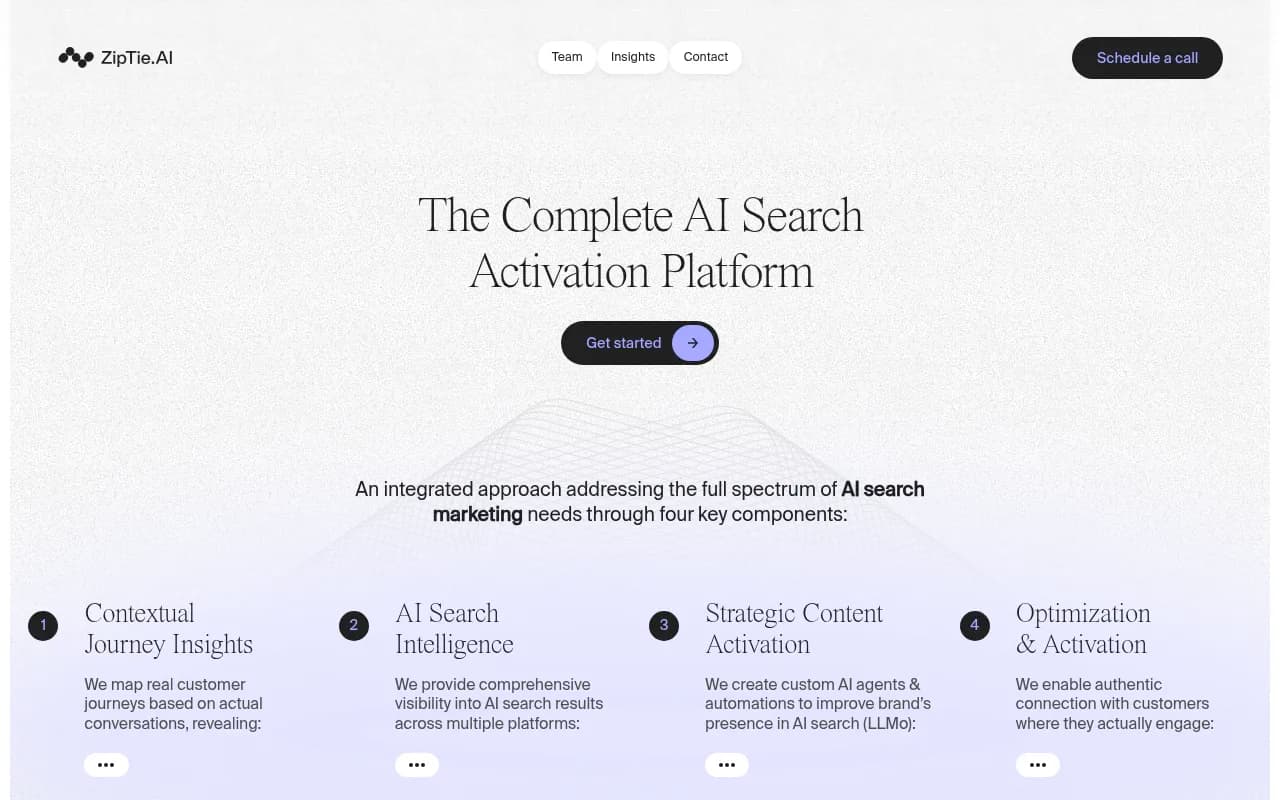
3. ZipTie — Deeper Optimization at 27% Less Cost
ZipTie offers AI visibility tracking plus actionable content recommendations. According to ZipTie's own analysis, it provides "deeper optimization capabilities for 27% less than Peec AI while providing actionable content recommendations alongside monitoring."
Key capabilities:
- Multi-engine tracking (ChatGPT, Perplexity, Claude, Google AI Overviews)
- Content gap identification
- Optimization recommendations
- Competitor benchmarking
- Historical trend analysis
What sets it apart: ZipTie goes beyond monitoring to suggest specific content improvements. It analyzes competitor citations and tells you what topics, angles, and formats are working—then recommends what to create.
Pricing: Starts at $69/mo
Best for: Budget-conscious teams that want optimization guidance, not just tracking data.
4. AthenaHQ — Multi-Engine Coverage for AI-Native Search
AthenaHQ tracks brand visibility across Google AI Overviews, Perplexity, ChatGPT, and Claude. It's built for brands competing in AI-native search environments where users skip traditional search results entirely.

Key capabilities:
- Multi-engine AI visibility tracking
- Prompt-level analytics
- Competitor mention frequency
- Citation source analysis
- Brand sentiment tracking
What it's missing: No content generation, no crawler logs, no Reddit/YouTube tracking, no traffic attribution. AthenaHQ shows you where you're visible but doesn't help you create content that ranks.
Pricing: Starts at $295/mo
Best for: Brands that need comprehensive multi-engine tracking and are willing to pay a premium for it.
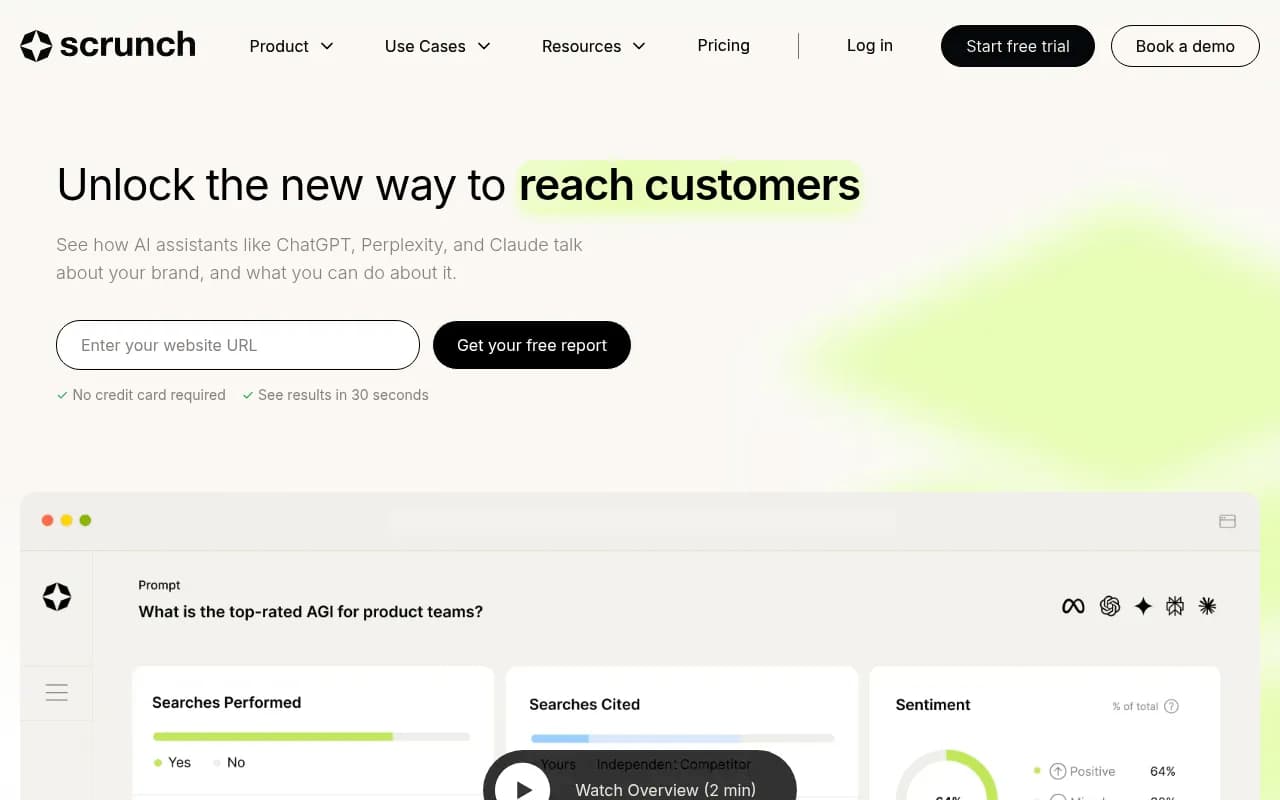
5. Scrunch AI — Brand Narrative Analysis Across AI Systems
ScrunchAI focuses on how AI models describe your brand—the adjectives, descriptors, and narratives that appear in AI-generated responses. It's designed for brand managers and PR teams who care about messaging consistency.
Key capabilities:
- Brand descriptor extraction
- Narrative consistency tracking
- Competitor positioning analysis
- Multi-engine sentiment monitoring
- Historical narrative shifts
What sets it apart: Scrunch AI doesn't just track mentions—it analyzes how AI models talk about your brand. Are you described as "innovative" or "outdated"? "Affordable" or "premium"? This matters for brand perception.
Pricing: Starts at $300/mo
Best for: Brand managers, PR teams, and CMOs who need to track AI messaging and ensure consistent brand narratives across AI engines.
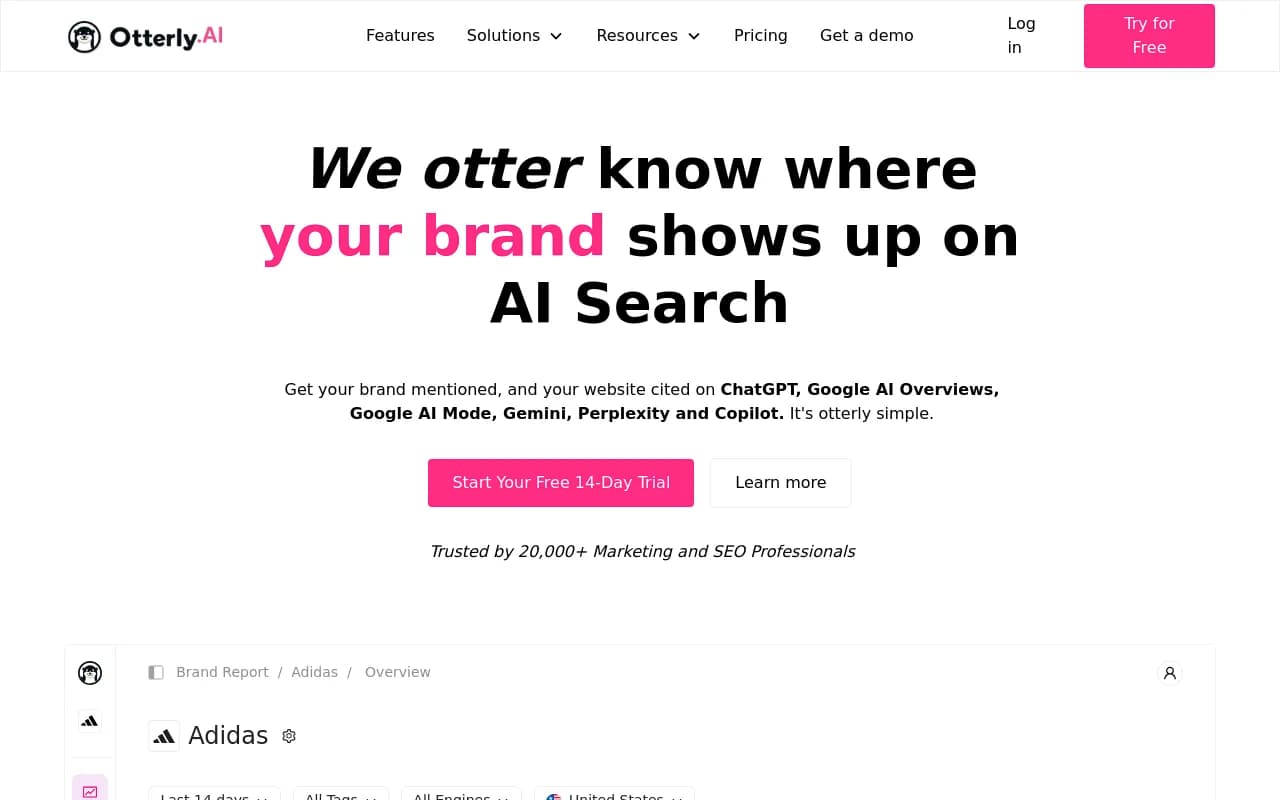
6. Otterly.AI — Basic Multi-Engine Monitoring
Otterly.AI tracks brand mentions across ChatGPT, Perplexity, and Google AI Overviews. It's a straightforward monitoring tool without advanced optimization features.
Key capabilities:
- Multi-engine visibility tracking
- Prompt-level analytics
- Competitor benchmarking
- Historical data snapshots
- CSV exports
What it's missing: No content gap analysis, no AI writing agent, no crawler logs, no Reddit/YouTube tracking, no optimization recommendations. Otterly.AI is pure monitoring—you see where you're invisible but get no guidance on how to fix it.
Pricing: Starts at $149/mo
Best for: Teams that only need basic monitoring and don't require optimization tools.
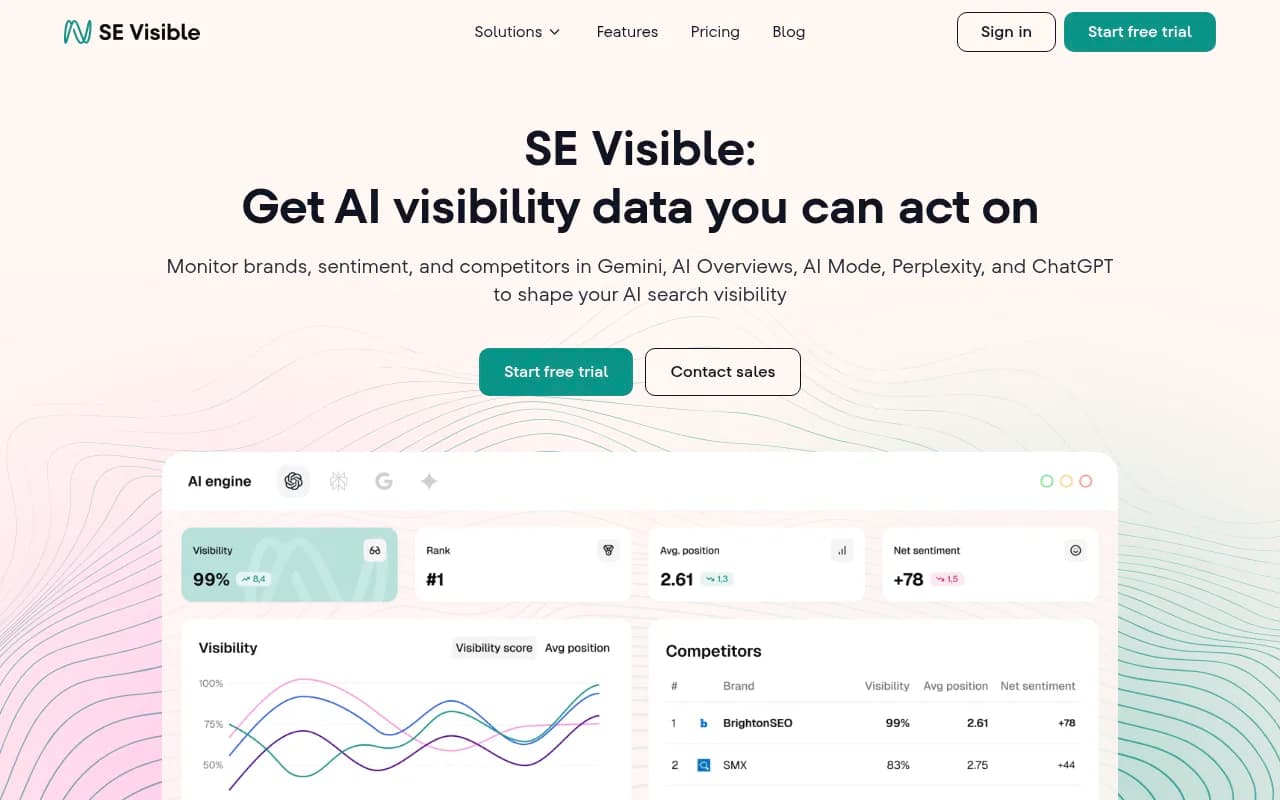
7. SE Visible — Strategic AI Visibility Tracking for Marketing Decisions
SE Visible (from SE Ranking) combines AI visibility tracking with competitor benchmarking and sentiment analysis. It's designed for CMOs and marketing leaders who need strategic insights, not just raw data.
Key capabilities:
- Multi-engine tracking (Google AI Overviews, ChatGPT, Perplexity)
- Competitor heatmaps
- Brand sentiment analysis
- Historical trend reports
- Executive dashboards
What sets it apart: SE Visible focuses on strategic decision-making. It shows you not just where you're visible, but how your visibility compares to competitors over time—useful for quarterly reviews and board presentations.
Pricing: Starts at $189/mo
Best for: CMOs, marketing leaders, and agency owners who need executive-level reporting and competitor benchmarking.
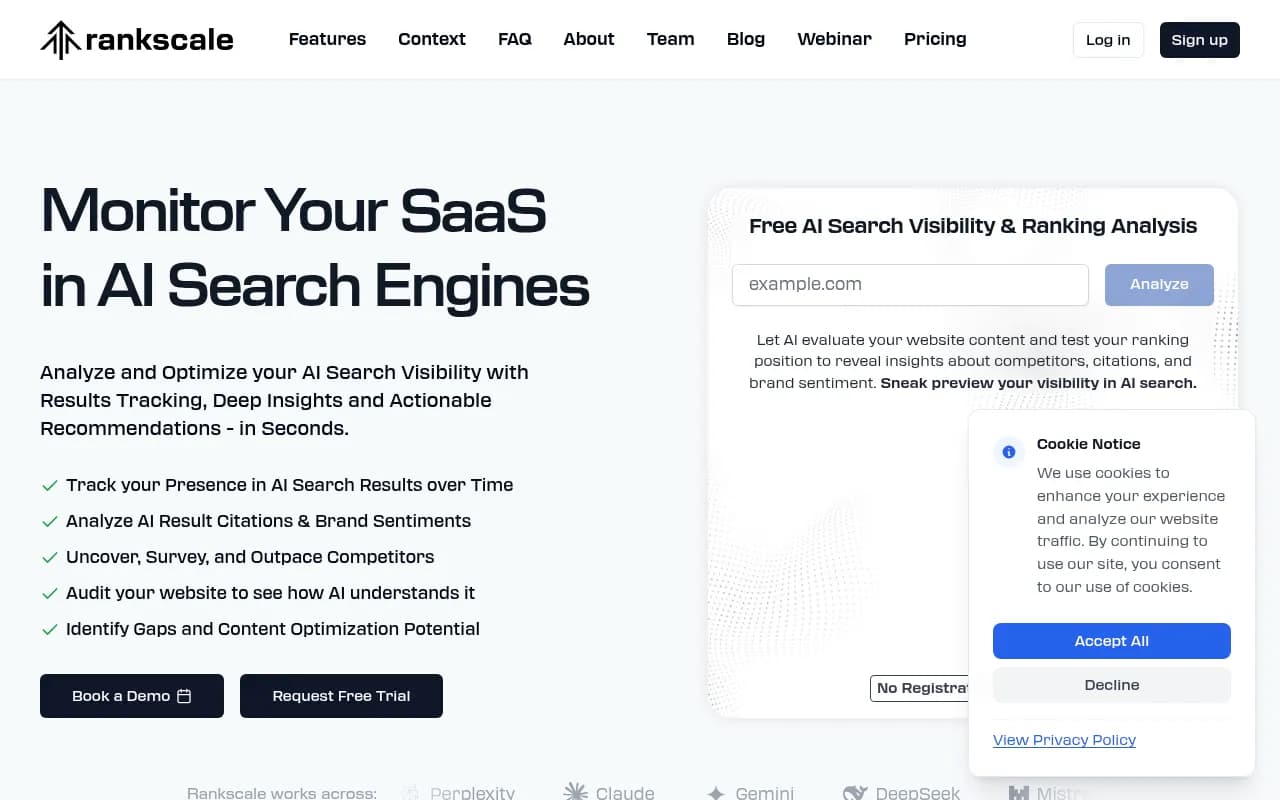
8. Rankscale — Agency-Focused AI Visibility Tracking
Rankscale is built for agencies managing multiple clients. It offers white-label reporting, client dashboards, and bulk prompt tracking.
Key capabilities:
- Multi-client management
- White-label reporting
- Bulk prompt tracking
- Client-facing dashboards
- CSV exports for custom analysis
What it's missing: No content generation, no crawler logs, no optimization recommendations. Rankscale is a monitoring tool with agency-friendly features, but it won't help you create content that ranks in AI search.
Pricing: Starts at $99/mo
Best for: Agencies managing multiple clients who need white-label reporting and bulk tracking capabilities.
9. AIclicks — All-in-One Optimization and Reporting
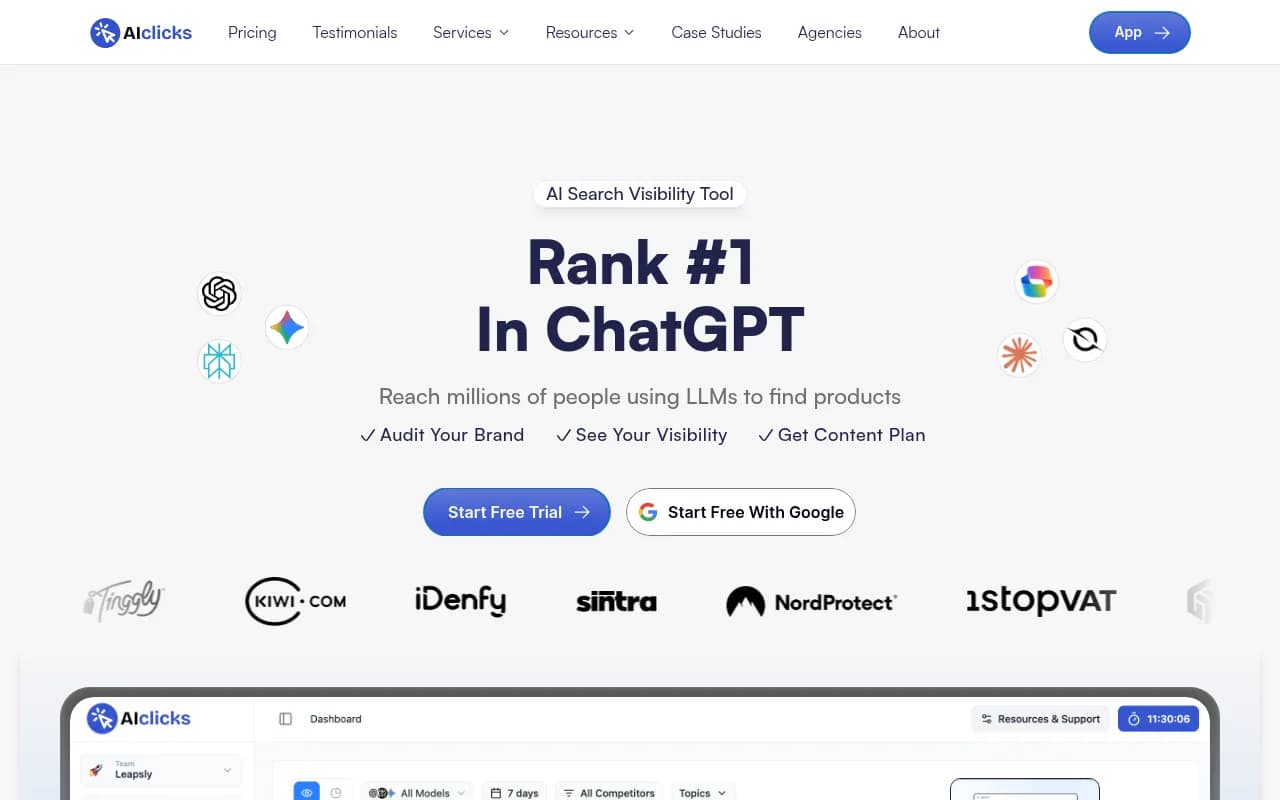
AIclicks combines AI visibility tracking with content optimization tools and reporting features. According to AIclicks' own comparison, it offers "all-in-one optimization and reporting" for teams that want more than basic monitoring.
Key capabilities:
- Multi-engine tracking (ChatGPT, Perplexity, Claude, Google AI Overviews)
- Content gap analysis
- Optimization recommendations
- Competitor benchmarking
- Custom reporting dashboards
What sets it apart: AIclicks bridges the gap between monitoring and optimization. It identifies content gaps and suggests what to create—though it doesn't include an AI writing agent like Promptwatch.
Pricing: Starts at $149/mo
Best for: Teams that want optimization guidance alongside tracking data.
10. LLM Pulse — 60% More Prompts, 67% More AI Models, 45% Less Money
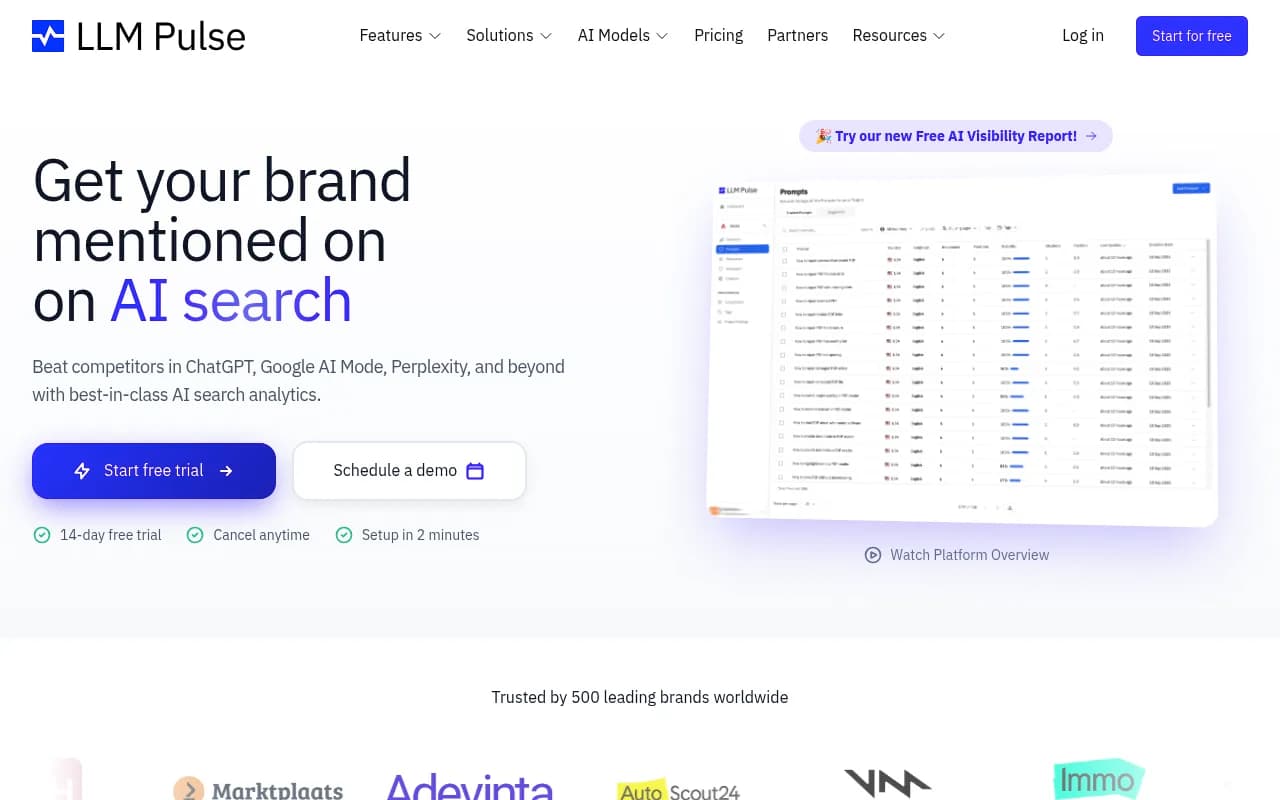
LLM Pulse positions itself as the budget-friendly alternative with broader coverage. According to LLM Pulse's own analysis, it "delivers 60% more prompts and 67% more AI models for 45% less money" compared to Peec AI.
Key capabilities:
- Tracks 12+ AI models (ChatGPT, Perplexity, Claude, Gemini, DeepSeek, Grok, Meta AI, Mistral, Copilot, Google AI Overviews, Bing Deep Search, You.com)
- High prompt volume limits
- Multi-language support
- Historical data retention
- CSV exports
What it's missing: No content generation, no crawler logs, no optimization recommendations. LLM Pulse offers broad coverage at a low price, but it's still a monitoring-only tool.
Pricing: Starts at $79/mo
Best for: Teams that need broad multi-engine coverage on a tight budget and don't require optimization features.
Essential Criteria When Picking Peec AI Alternatives
Not all AI visibility platforms are created equal. Here's what to evaluate:
1. Monitoring vs Optimization
Monitoring-only tools (Peec AI, Otterly.AI, LLM Pulse, AthenaHQ) show you where you're invisible. Optimization platforms (Promptwatch, ZipTie, AIclicks) tell you why you're missing and what to create to fix it.
If you're serious about improving AI visibility, choose a platform with:
- Content gap analysis (which prompts competitors rank for but you don't)
- AI writing agent (generates optimized content based on citation data)
- Crawler logs (shows which AI models are reading your site)
- Traffic attribution (connects visibility to actual revenue)
2. Engine Coverage
Peec AI tracks Google AI Overviews, ChatGPT, and Perplexity. Leading alternatives track 10+ models:
- OpenAI/ChatGPT
- Perplexity
- Claude (Anthropic)
- Gemini (Google)
- DeepSeek
- Grok (xAI)
- Meta AI (Llama)
- Mistral
- Copilot (Microsoft)
- Google AI Overviews
- Bing Deep Search
- You.com
The more engines you track, the more complete your visibility picture.
3. Prompt Intelligence
Basic platforms track prompts. Advanced platforms provide:
- Volume estimates (how often each prompt is used)
- Difficulty scores (how hard it is to rank)
- Query fan-outs (how one prompt branches into sub-queries)
- Persona targeting (how different user types phrase the same question)
This data helps you prioritize high-value, winnable prompts instead of guessing.
4. Citation Source Analysis
AI models cite sources in their responses. Leading platforms show you:
- Which URLs AI models cite most often
- Which Reddit threads influence AI recommendations
- Which YouTube videos appear in AI responses
- Which domains dominate each topic
This tells you where to publish and what to optimize.
5. Crawler Logs
AI models crawl your website to gather information. Crawler logs show:
- Which AI models are reading your site (ChatGPT, Claude, Perplexity, etc.)
- Which pages they access
- Errors they encounter (404s, 403s, timeouts)
- How often they return
This is critical for diagnosing indexing issues. If ChatGPT can't crawl your site, you'll never appear in its responses—no matter how good your content is.
Most competitors (Peec AI, Otterly.AI, AthenaHQ, Scrunch, LLM Pulse) lack crawler logs entirely.
6. Traffic Attribution
Visibility doesn't matter if it doesn't drive revenue. Leading platforms connect AI visibility to actual traffic:
- Code snippet tracking (embed on your site to track AI referrals)
- Google Search Console integration (see AI Overview clicks)
- Server log analysis (identify AI crawler traffic)
This closes the loop from visibility to revenue.
7. Value-to-Price Ratio
Peec AI starts at $149/mo. Compare that to:
- Promptwatch: $99/mo (more features, lower price)
- ZipTie: $69/mo (optimization tools included)
- LLM Pulse: $79/mo (12+ engines, high prompt limits)
- Profound: $99/mo (entity extraction, attribution mapping)
For most teams, Peec AI is overpriced for what it delivers.
Navigating the Evolving AI Visibility Space
The AI visibility market is moving fast. Here's what's changing:
From Monitoring to Optimization
Early platforms (Peec AI, Otterly.AI) focused on monitoring—showing you where you're visible. The next generation (Promptwatch, ZipTie, AIclicks) focuses on optimization—helping you create content that ranks.
This shift mirrors the evolution of traditional SEO tools. Early rank trackers just showed your position. Modern SEO platforms (Ahrefs, Semrush) analyze competitors, suggest keywords, and guide content creation.
The same is happening in AI visibility. Monitoring-only tools are becoming commoditized. The value is shifting to platforms that help you take action.
Multi-Engine Coverage Is Table Stakes
In 2025, tracking Google AI Overviews and ChatGPT was enough. In 2026, users expect coverage of:
- Perplexity (the fastest-growing AI search engine)
- Claude (Anthropic's reasoning-focused model)
- Gemini (Google's multimodal AI)
- DeepSeek (China's open-source challenger)
- Grok (xAI's real-time model)
- Meta AI (Llama-powered assistant)
Platforms that only track 2-3 engines are falling behind.
Crawler Logs Are the New Must-Have
AI models crawl your website to gather information. If they can't access your content, you'll never appear in their responses.
Crawler logs show:
- Which AI models are reading your site
- Which pages they access
- Errors they encounter
- How often they return
This is critical for diagnosing indexing issues. Yet most platforms (Peec AI, Otterly.AI, AthenaHQ, Scrunch, LLM Pulse) don't offer crawler logs at all.
Promptwatch is one of the few platforms that includes real-time crawler logs—showing exactly when ChatGPT, Claude, Perplexity, and other AI models hit your site.
Reddit and YouTube Are Influencing AI Recommendations
AI models cite Reddit threads and YouTube videos in their responses. If you're not tracking these channels, you're missing a huge piece of the puzzle.
Leading platforms now surface:
- Reddit discussions that influence AI recommendations
- YouTube videos cited in AI responses
- Quora threads referenced by AI models
This tells you where to publish and what communities to engage with.
Traffic Attribution Closes the Loop
Visibility metrics are vanity metrics unless they connect to revenue. The best platforms now offer:
- Code snippet tracking (embed on your site to track AI referrals)
- Google Search Console integration (see AI Overview clicks)
- Server log analysis (identify AI crawler traffic)
This closes the loop from visibility to revenue—proving ROI to stakeholders.
Final Thoughts & Action Steps
Peec AI was a pioneer in AI visibility tracking, but the market has moved on. Today's leading platforms don't just show you where you're invisible—they help you fix it with content gap analysis, AI writing agents, crawler logs, and traffic attribution.
If you're evaluating alternatives, prioritize platforms that:
- Go beyond monitoring: Content gap analysis, optimization recommendations, AI writing agents
- Track 10+ AI models: ChatGPT, Perplexity, Claude, Gemini, DeepSeek, Grok, Meta AI, Mistral, Copilot, Google AI Overviews
- Include crawler logs: See which AI models are reading your site and fix indexing issues
- Offer traffic attribution: Connect visibility to actual revenue
- Deliver better value: More features for less money than Peec AI's $149/mo starting price
Promptwatch checks all five boxes. It's the only platform that closes the action loop—find gaps, generate content, track results. Used by 6,700+ brands and agencies, it's the market leader for a reason.
Next steps:
- Audit your current setup: Are you just monitoring, or are you optimizing? If you're stuck with a monitoring-only tool, you're leaving visibility on the table.
- Test 2-3 alternatives: Most platforms offer free trials. Test Promptwatch, ZipTie, and one other to see which fits your workflow.
- Focus on action: Choose a platform that helps you create content that ranks, not just track where you're invisible.
- Close the loop: Implement traffic attribution to connect AI visibility to revenue. This proves ROI and justifies the investment.
The shift from traditional SEO to AI search is real. According to Omnius, AI Overviews now trigger for 13.14% of Google queries and cause a 34.5% drop in click-through rates for position-one organic results. Meanwhile, Similarweb reports AI platforms generated over 1.1 billion referral visits in June 2025—up 357% year-over-year.
You can't afford to be invisible in AI search. But monitoring alone won't fix the problem. Choose a platform that helps you take action.
Frequently Asked Questions
What makes AI visibility tools different from traditional SEO tools?
Traditional SEO tools track rankings and clicks in search engines like Google. AI visibility tools track citations and mentions in AI-generated responses from ChatGPT, Perplexity, Claude, and other language models. You can rank #1 organically and still be invisible in AI search—that's why AI visibility tracking is a distinct discipline.
How do Peec AI alternatives help improve brand perception in AI-generated answers?
The best alternatives (like Promptwatch, Scrunch AI, and SE Visible) analyze how AI models describe your brand—the adjectives, descriptors, and narratives that appear in responses. They track brand sentiment, identify negative messaging, and show you which content to create to improve how AI models talk about you.
Is prompt-level tracking important for AI visibility?
Yes. Different prompts trigger different responses. Prompt-level tracking shows you which specific questions your brand appears in (and which ones competitors dominate). Advanced platforms also provide volume estimates, difficulty scores, and query fan-outs—helping you prioritize high-value, winnable prompts.
Can I track AI visibility for local businesses?
Yes. Platforms like Profound, SE Visible, and Promptwatch offer multi-location tracking for local brands. They monitor AI responses by city, state, or region—showing you where your business appears in location-specific prompts.
Do I need crawler logs to improve AI visibility?
Yes. AI models crawl your website to gather information. If they can't access your content (due to 404 errors, 403 blocks, or timeouts), you'll never appear in their responses. Crawler logs show which AI models are reading your site, which pages they access, and errors they encounter—critical for diagnosing indexing issues. Most platforms (Peec AI, Otterly.AI, AthenaHQ) lack crawler logs entirely.
How much should I budget for AI visibility tracking?
Entry-level platforms start at $69-99/mo (ZipTie, LLM Pulse, Promptwatch, Profound). Mid-tier platforms cost $149-295/mo (Peec AI, AIclicks, AthenaHQ). Enterprise platforms run $300+/mo (Scrunch AI, SE Visible). For most teams, $99-249/mo delivers the best value—especially if the platform includes optimization tools, not just monitoring.
What's the difference between monitoring-only and optimization platforms?
Monitoring-only platforms (Peec AI, Otterly.AI, LLM Pulse) show you where you're invisible but don't help you fix it. Optimization platforms (Promptwatch, ZipTie, AIclicks) analyze content gaps, generate optimized articles, and provide actionable recommendations. If you're serious about improving AI visibility, choose an optimization platform.
Can AI visibility tools connect to Google Search Console?
Some can. Promptwatch integrates with Google Search Console to show AI Overview clicks alongside traditional organic traffic. This helps you understand how AI search impacts overall performance and attribute revenue to AI visibility.
Do AI visibility tools track Reddit and YouTube?
The best ones do. AI models cite Reddit threads and YouTube videos in their responses. Platforms like Promptwatch surface these citations—showing you which discussions and videos influence AI recommendations. Most competitors (Peec AI, Otterly.AI, AthenaHQ) ignore Reddit and YouTube entirely.