Key Takeaways
- Rankscale is built specifically for agencies managing multiple clients with credit-based pricing starting around $75-150/mo, while Gauge targets both in-house teams and agencies with plans from $95/mo
- Both platforms track the same 10 AI engines (ChatGPT, Perplexity, Claude, Gemini, DeepSeek, Mistral, Grok, Copilot, AI Overviews, AI Mode) with comparable monitoring capabilities
- Gauge emphasizes actionable recommendations and content gap analysis more explicitly in its positioning, while Rankscale focuses on deep citation analysis and competitor benchmarking
- Rankscale's credit-based model may offer more flexibility for agencies with variable client needs, but Gauge's fixed pricing is more predictable for budgeting
- Coalition Technologies testing showed Rankscale achieving near 100% mention and citation detection accuracy across 2,700 prompt pulls
- Neither platform offers content generation capabilities -- both are monitoring and analysis tools that leave the actual content creation to you
Overview
Rankscale
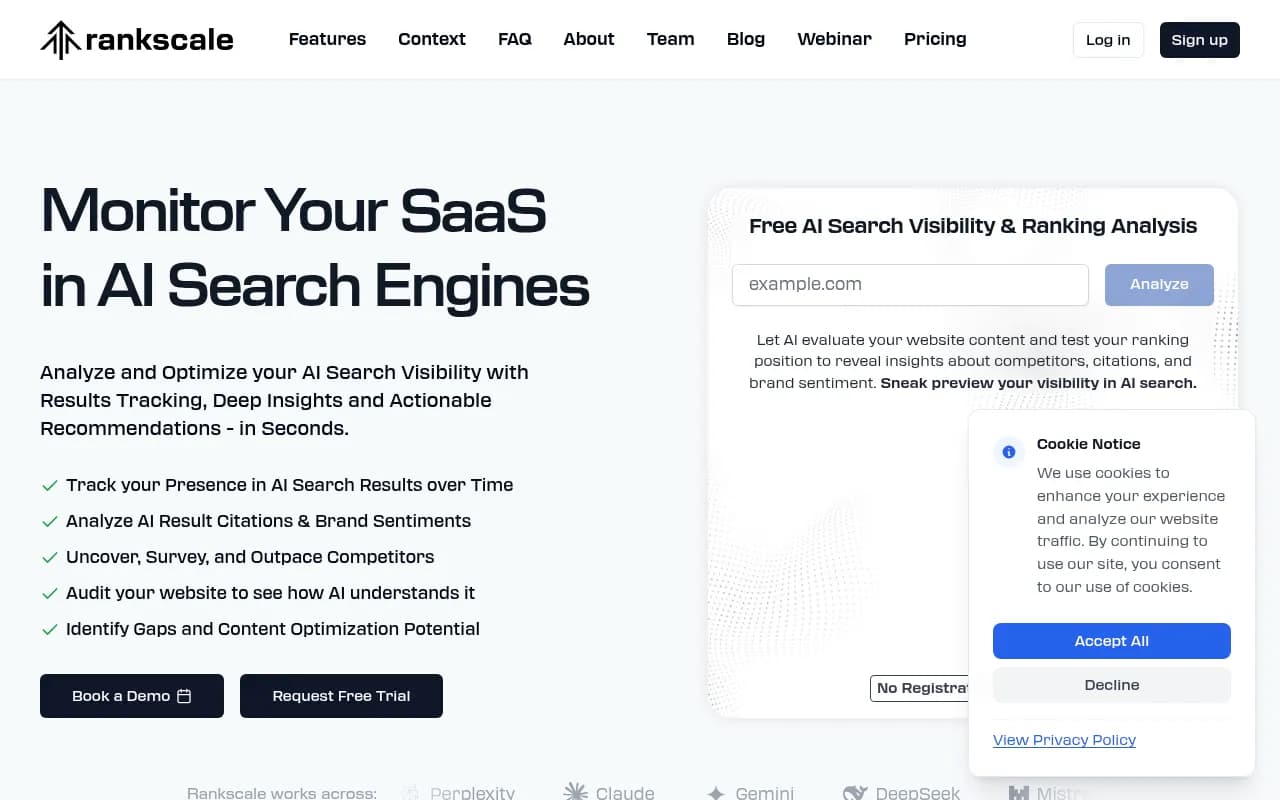
Rankscale positions itself as an agency-focused AI visibility tracking platform. It monitors how brands appear across 10 major AI search engines and provides what it calls "deep insights" through daily monitoring, citation analysis, and competitor benchmarking. The platform uses a credit-based pricing model that starts around $75-150/mo, with agency and enterprise tiers available on request. Rankscale emphasizes its ability to track presence over time, analyze sentiment in AI-generated answers, and audit websites to understand how AI engines interpret content.
Gauge
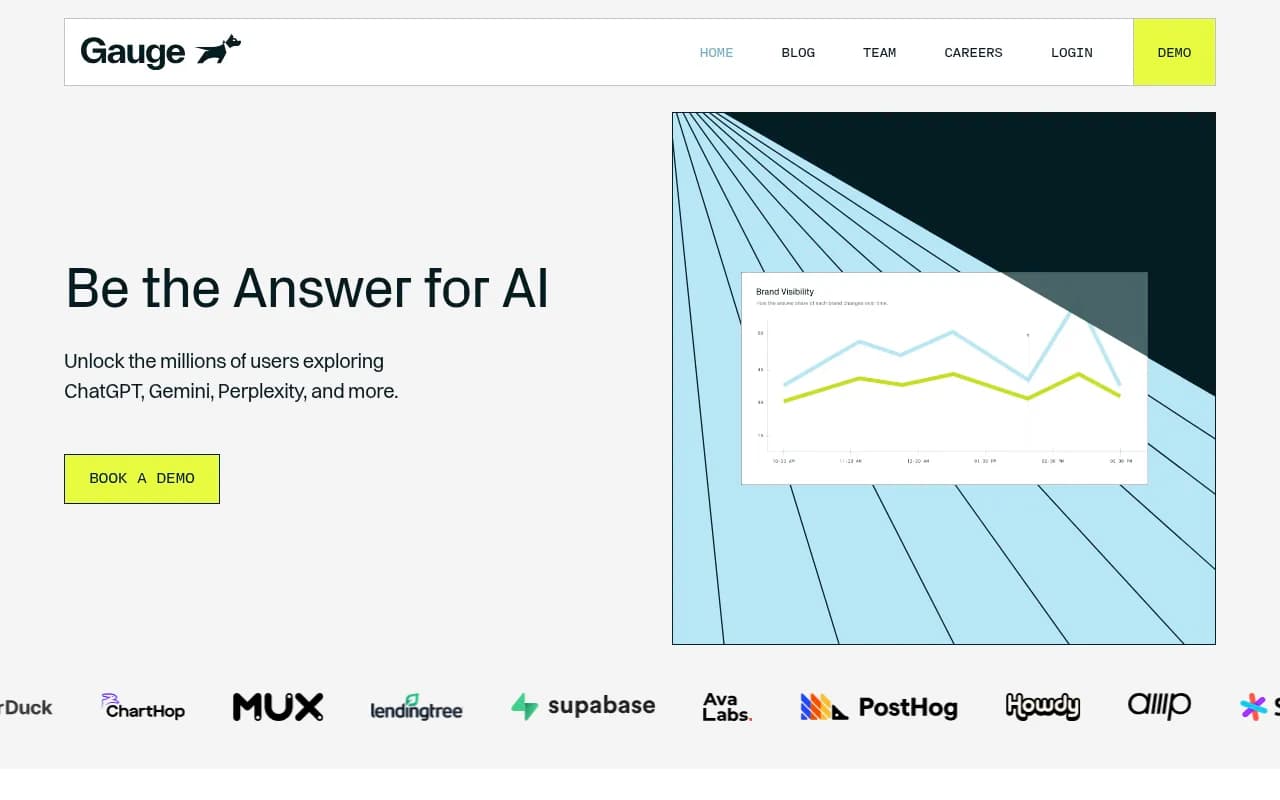
Gauge markets itself as a complete AI visibility platform with a three-step framework: Track, Understand, Act. It monitors the same 10 AI engines as Rankscale and adds what it describes as actionable recommendations for both onsite and offsite optimization. Gauge's pricing starts at $95/mo with annual billing, jumping to $399/mo for the Growth plan, with custom Enterprise pricing. The platform highlights its content gap analysis, competitor comparison tools, and what it calls a "complete toolkit" for AI search optimization. Gauge is used by brands like MotherDuck, Supabase, and several agencies.
Side-by-side comparison
| Feature | Rankscale | Gauge |
|---|---|---|
| Starting price | ~$75-150/mo (credits) | $95/mo (annual billing) |
| Pricing model | Credit-based | Fixed tiers |
| AI engines tracked | 10 (ChatGPT, Perplexity, Claude, Gemini, DeepSeek, Mistral, Grok, Copilot, AI Overviews, AI Mode) | 10 (same set) |
| Free trial | Yes | Yes (free tier available) |
| Agency focus | Explicit (multi-client management) | Supports agencies but not exclusively |
| Citation analysis | Deep citation tracking | Citation pattern analysis |
| Competitor tracking | Benchmarking and comparison | Competitor gap analysis |
| Content recommendations | Optimization potential identification | Onsite/offsite recommendations |
| Sentiment analysis | Yes (brand sentiment in AI answers) | Not explicitly mentioned |
| Website audit | Yes (how AI understands your site) | Not explicitly mentioned |
| Content generation | No | No |
| Detection accuracy | ~100% (Coalition Technologies testing) | Not publicly disclosed |
| Target audience | Agencies, multi-client management | Marketing teams, agencies |
Pricing breakdown
| Plan | Rankscale | Gauge |
|---|---|---|
| Entry tier | ~$75-150/mo (credit-based, varies by usage) | $95/mo (annual billing) |
| Mid tier | Custom agency pricing | $399/mo Growth plan |
| Enterprise | Custom pricing | Custom pricing |
| Free trial | Yes | Yes (plus free tier option) |
| Billing model | Credits consumed per query/check | Fixed monthly subscription |
The pricing structures are fundamentally different. Rankscale's credit system means you pay based on how many prompts you track and how often you check them. This can be cost-effective if you're monitoring a small set of high-value queries, but it gets expensive fast if you want comprehensive coverage. Gauge's fixed pricing is easier to budget for -- you know exactly what you're paying each month regardless of how much you use the platform.
For agencies managing 5-10 clients, Rankscale's credit model might actually cost more than Gauge's Growth plan once you factor in the volume of tracking needed across multiple brands. But for agencies with highly variable workloads (some months heavy, some light), credits offer flexibility.
Feature comparison
AI engine coverage
Both platforms track the exact same 10 AI engines: ChatGPT, Perplexity, Claude, Gemini, DeepSeek, Mistral, Grok, Copilot, Google AI Overviews, and Google AI Mode. This is table stakes in 2026 -- any serious AI visibility platform needs to cover at least these engines. Neither platform has an edge here.
Citation and mention tracking
Rankscale emphasizes "deep citation analysis" and has third-party validation from Coalition Technologies showing near 100% detection accuracy across 2,700 prompt pulls. That's a real data point, not marketing fluff. Gauge talks about "citation pattern analysis" but doesn't provide specific accuracy metrics publicly.
Both platforms show you which sources AI engines are citing when they mention (or don't mention) your brand. Rankscale's interface appears more focused on drilling into individual citations and understanding the context around each mention. Gauge frames this as part of its "Understand" phase, showing what content is being cited and what's being left out.
In practice, both tools do the same job here. Rankscale's documented accuracy gives it a slight credibility edge, but Gauge's framing around "gaps" makes the insights more immediately actionable.
Competitor analysis
Rankscale offers what it calls "competitor benchmarking" -- you can see how your brand stacks up against competitors in AI search results. Gauge has similar functionality, calling it "competitor gap analysis" and showing where competitors are visible but you're not.
The difference is mostly in presentation. Rankscale seems to focus on raw comparison metrics (who's mentioned more, who gets better sentiment). Gauge emphasizes finding the specific prompts and topics where competitors are winning and you're losing. Both approaches are useful; it depends whether you want high-level benchmarking or tactical gap identification.
Content optimization and recommendations
This is where the platforms diverge more clearly. Rankscale identifies "content optimization potential" and audits your website to show how AI engines understand it. But it doesn't explicitly spell out what to do about it.
Gauge's "Act" phase provides what it describes as "clear onsite and offsite recommendations." The platform tells you which pages to optimize, what content to create, and where to build external presence (like Reddit or affiliate sites). Gauge also mentions tools for writing new content and auditing existing pages, though it's not clear if these are built-in or just frameworks.
Neither platform generates content for you. If you're looking for an AI writing agent that creates articles based on citation data, you'd need to look at something like Promptwatch, which combines visibility tracking with an AI content generator trained on 880M+ citations.

Sentiment analysis
Rankscale explicitly tracks "brand sentiment" in AI-generated answers -- whether the AI is saying positive, negative, or neutral things about your brand. This is valuable for reputation management and understanding how AI engines frame your brand in different contexts.
Gauge doesn't mention sentiment analysis in its marketing materials. It's possible the feature exists but isn't highlighted, or it's genuinely missing. For brands worried about how they're being portrayed in AI answers (not just whether they're mentioned), Rankscale has the clear advantage here.
Agency-specific features
Rankscale is explicitly built for agencies managing multiple clients. The credit-based model, the emphasis on client reporting, and the overall positioning all point to multi-client workflows.
Gauge supports agencies (several agency clients are listed on the site) but isn't exclusively focused on them. The fixed pricing tiers and "team" framing suggest it's equally comfortable serving in-house marketing teams.
If you're an agency, Rankscale's structure will feel more natural. If you're an in-house team, Gauge's positioning will resonate more. Both can serve either audience, but the fit isn't equal.
Pros and cons
Rankscale pros
- Credit-based pricing offers flexibility for variable workloads
- Documented 100% detection accuracy from third-party testing
- Explicit sentiment analysis for brand reputation tracking
- Website audit shows how AI engines interpret your content
- Built specifically for agency workflows and multi-client management
Rankscale cons
- Credit model can get expensive with high-volume tracking
- Less explicit about actionable next steps (more analysis, less prescription)
- Pricing transparency is limited (need to request quotes for most tiers)
- No content generation capabilities
Gauge pros
- Fixed pricing is easier to budget and predict costs
- Strong emphasis on actionable recommendations (not just data)
- Content gap analysis explicitly identifies what you're missing
- Free tier available for testing before committing
- Clear three-phase framework (Track, Understand, Act) guides workflow
Gauge cons
- No sentiment analysis (or not prominently featured)
- Detection accuracy metrics not publicly disclosed
- Higher entry price than Rankscale's starting tier
- Less explicitly tailored to agency multi-client workflows
- No content generation capabilities
Who should pick which tool
Choose Rankscale if:
- You're an agency managing multiple clients with varying tracking needs
- You need detailed sentiment analysis to monitor brand reputation in AI answers
- You want documented detection accuracy (the Coalition Technologies validation matters to you)
- Your workload is variable and you'd benefit from paying only for what you use
- You prefer deep analytical tools over prescriptive recommendations
Choose Gauge if:
- You're an in-house marketing team managing your own brand
- You want clear, actionable recommendations instead of just raw data
- You need predictable monthly costs for budgeting purposes
- You value the explicit "gap analysis" framing for finding missed opportunities
- You want to start with a free tier before committing to paid plans
Consider alternatives if:
- You need AI content generation in addition to tracking -- neither Rankscale nor Gauge creates content for you. Promptwatch combines visibility tracking with an AI writing agent that generates articles based on real citation data.
- You're on a tight budget -- both platforms start around $75-150/mo, which may be steep for solopreneurs or very small businesses.
- You need features beyond AI search visibility -- these are specialized tools for one job.
Final verdict
Rankscale and Gauge are competing for the same market with very similar core capabilities. Both track the same AI engines, both analyze citations and competitor presence, both identify optimization opportunities. The real differences come down to pricing structure, target audience, and how prescriptive you want the platform to be.
Rankscale wins on flexibility (credit-based pricing), validation (documented accuracy), and sentiment tracking. It's the better fit for agencies juggling multiple clients with different needs.
Gauge wins on predictability (fixed pricing), actionability (explicit recommendations), and accessibility (free tier to start). It's the better fit for in-house teams that want to be told what to do, not just shown the data.
Neither platform is a clear winner across the board. Your choice depends on whether you value flexibility or predictability, analysis or prescription, agency workflows or in-house simplicity. Both will get the job done -- they just approach it from slightly different angles.