Gauge Review 2026
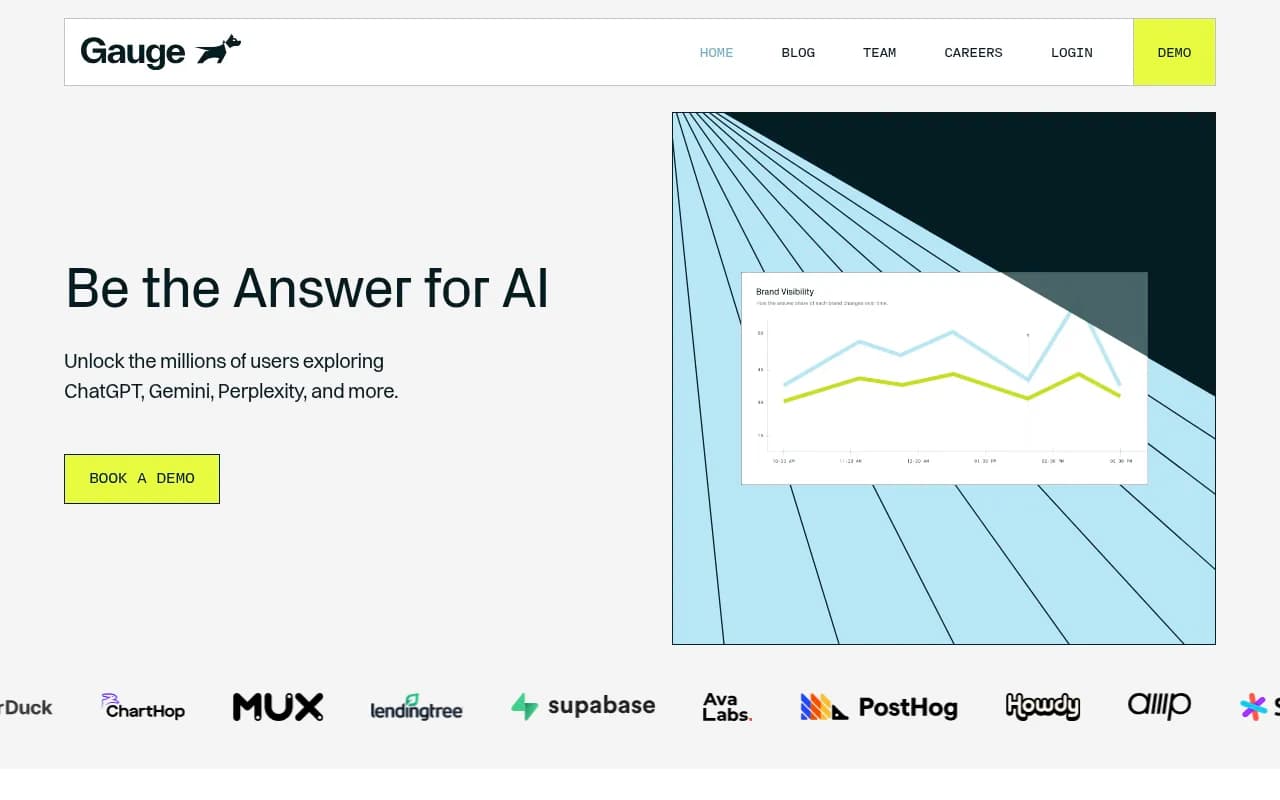
Gauge is an AI visibility platform that monitors how brands appear in ChatGPT, Claude, Gemini, Perplexity, and other LLMs. It tracks brand mentions, analyzes citation patterns, identifies content gaps, and provides actionable recommendations to improve AI search presence. Designed for marketing teams and agencies managing brand visibility in generative AI search results.
Key Takeaways:
• Gauge monitors brand mentions across 7+ AI platforms (ChatGPT, Claude, Gemini, Perplexity, Copilot, AI Mode, AI Overviews) with prompt tracking and citation analysis • Focuses on three core workflows: tracking mentions over time, analyzing gaps vs competitors, and providing content recommendations to improve visibility • Missing critical features like AI crawler logs and real-time indexing insights that more mature platforms offer • Pricing starts at $95/month with annual billing; enterprise plans available but no transparent tier breakdown • Best for: Marketing teams and agencies starting to explore AI visibility tracking who need basic monitoring and gap analysis
Gauge positions itself as a complete toolkit for tracking and improving brand visibility in AI-generated search results. Built by a technical team with data engineering backgrounds, the platform emerged in 2024 as generative AI search began reshaping how users discover brands and products. The core promise: stop manually prompting ChatGPT to see if your brand appears, and start systematically measuring and optimizing your AI presence.
The target audience is marketing teams, SEO professionals, and digital agencies managing brand visibility for B2B SaaS companies, e-commerce brands, and service businesses. Gauge is particularly aimed at teams that recognize AI search is growing but haven't yet invested in dedicated GEO (Generative Engine Optimization) tooling. The platform tries to bridge the gap between basic manual testing and enterprise-grade AI visibility platforms.
Prompt Tracking & Brand Monitoring Gauge's foundation is prompt tracking -- monitoring how AI models respond to specific queries over time. You configure a set of prompts relevant to your category (e.g. "best project management software", "top CRM for small business"), and Gauge tracks whether your brand appears in responses from ChatGPT, Claude, Gemini, Perplexity, Copilot, Google AI Mode, and Google AI Overviews. The platform measures two key metrics: mention rate (how often your brand is referenced) and citation rate (how often your website is cited as a source). This gives you a baseline understanding of your current AI visibility.
The tracking runs continuously, showing trends over days and weeks. You can see if your mention rate is improving, declining, or flat -- and compare your performance against competitors who are also being tracked. The interface presents this as time-series charts and percentage breakdowns by AI engine.
One limitation here: Gauge doesn't appear to offer the same depth of prompt intelligence that leading platforms provide. There's no mention of query volume estimates, difficulty scoring, or prompt fan-outs that show how one query branches into related sub-queries. You're essentially tracking the prompts you manually configure, without data-driven guidance on which prompts actually matter most to your business.
Gap Analysis & Competitor Benchmarking Gauge's "Understand" workflow focuses on identifying where your brand is invisible. The gap analysis feature shows prompts where competitors are mentioned but your brand is not. This is valuable for prioritizing optimization efforts -- you can see exactly which queries you're losing on and which competitors are winning.
The platform also provides coverage analysis -- the inverse view showing where your brand currently appears. Combined, these two views give you a competitive landscape map across AI engines. You can drill into specific prompts to see which brands are mentioned, how often, and which sources (URLs, Reddit threads, YouTube videos) are being cited.
Competitor analysis extends to tracking multiple brands simultaneously. You can monitor 3-5 key competitors and see how their mention rates trend over time. The platform highlights which competitors are gaining or losing visibility, though it doesn't always explain why. You're left to infer whether a competitor's rise is due to new content, better citations, or changes in how AI models weight sources.
What's missing: Gauge doesn't offer the granular citation and source analysis that more mature platforms provide. You won't see detailed breakdowns of which specific Reddit threads, YouTube videos, or third-party domains are driving competitor visibility. The analysis stays at a higher level -- mentions and citations by brand, not by individual content asset.
Content Recommendations & Actions Gauge's "Act" workflow provides recommendations to improve your AI visibility. This includes onsite actions (optimize existing pages, create new content targeting specific prompts) and offsite actions (engage with Reddit communities, target high-value affiliate sites, build citations on third-party domains).
The platform includes a content drafting tool that generates article outlines and drafts based on top-performing topics in your space. This is positioned as "data-driven content" -- articles engineered to rank in AI responses based on what's currently working for competitors. The content engine analyzes citation patterns and suggests topics, angles, and structures that align with how AI models prefer to cite sources.
In practice, this is a helpful starting point but not a complete solution. The content drafts are generic and require significant editing to match your brand voice and add unique insights. You're getting a template, not a publication-ready article. More advanced platforms offer AI writing agents that generate full articles grounded in real citation data, prompt volumes, and persona targeting -- Gauge's content tool is more basic.
The audit feature scans your owned properties (website pages, blog posts) and provides recommendations to improve AI visibility. This might include adding specific keywords, restructuring content to answer common queries more directly, or improving internal linking. The audit is useful for identifying low-hanging fruit but doesn't go as deep as a manual content review by an experienced GEO specialist.
Integrations & Data Access Gauge offers Google Analytics 4 integration to track real AI referral traffic to your website. This is critical for understanding the business impact of AI visibility -- you can see which URLs are receiving traffic from ChatGPT, Perplexity, and other engines, and connect that traffic to conversions in GA4. The platform also supports S3 integration to push data into your data lake and BI tools (Looker, Tableau, etc.).
There's an API for programmatic access to your data, which is useful for agencies managing multiple clients or teams building custom dashboards. You can also export data as CSV or JSON for offline analysis.
What's notably absent: AI crawler logs. Gauge doesn't provide real-time logs of AI crawlers (ChatGPT-User, Claude-Web, PerplexityBot, etc.) hitting your website. This is a significant gap. Crawler logs show you which pages AI models are reading, how often they return, and whether they're encountering errors (404s, slow load times, blocked resources). Without this data, you're flying blind on whether AI engines can even discover and index your content. Leading platforms like Promptwatch include crawler log analysis as a core feature -- Gauge's omission here is a major limitation for serious optimization work.
Gauge also lacks Reddit and YouTube insights as dedicated features. While the platform mentions targeting social sources like Reddit in its marketing copy, there's no evidence of a structured workflow for surfacing high-value Reddit threads or YouTube videos that influence AI recommendations. This is a missed opportunity, as Reddit discussions and YouTube content are increasingly cited by AI models.
Pricing & Value Gauge's pricing starts at $95/month with annual billing required. There's no transparent breakdown of what you get at this tier -- number of prompts tracked, number of brands monitored, number of AI engines included. The website pushes heavily toward booking a demo rather than self-service signup, which suggests the platform is targeting mid-market and enterprise customers rather than small teams or individual marketers.
Enterprise plans are available with custom pricing. Based on competitor research, Gauge likely offers tiered plans similar to other GEO platforms: a starter tier with limited prompts and engines, a professional tier with expanded tracking and integrations, and an enterprise tier with API access, white-label reporting, and dedicated support.
One data point from search results: a Growth plan at $399/month restricts monitoring to just ChatGPT, Perplexity, and AI Overviews -- only 3 of the 7+ engines Gauge claims to support. This is a significant limitation. If you're paying $400/month and can't monitor Claude, Gemini, or Copilot, you're missing a large portion of the AI search landscape. Full 10+ engine access appears to require a higher-tier plan.
Compared to competitors, Gauge's pricing is in the mid-range. Platforms like Promptwatch start at $99/month with transparent tier breakdowns and include more features (crawler logs, Reddit tracking, content generation with 880M+ citations analyzed). Monitoring-only tools like Otterly.AI and Peec.ai are cheaper but offer less functionality. Enterprise platforms like Profound and Scrunch are more expensive but provide deeper analytics and white-glove service.
Who Is It For Gauge is best suited for marketing teams at B2B SaaS companies, e-commerce brands, and digital agencies that are just starting to take AI visibility seriously. If you're currently doing manual spot-checks (typing prompts into ChatGPT to see if your brand appears) and want to systematize that process, Gauge provides a structured workflow for tracking, analyzing, and acting on AI visibility data.
The platform fits teams of 5-20 people at companies with $5M-$50M in revenue -- large enough to have a dedicated marketing function but not yet at enterprise scale. Agencies managing 5-15 clients in similar verticals (e.g. all SaaS, all e-commerce) can use Gauge to provide AI visibility reporting as a service.
Who should NOT use Gauge: Teams that need deep technical insights into how AI engines crawl and index their content. Without crawler logs, you can't diagnose indexing issues, optimize for AI bot behavior, or understand why certain pages are cited while others are ignored. If you're serious about GEO and want a platform that supports the full optimization loop (find gaps, create content, track indexing, measure results), you'll need a more complete solution like Promptwatch.
Gauge also isn't ideal for teams managing highly competitive categories where every percentage point of visibility matters. The lack of prompt intelligence (volume estimates, difficulty scores, query fan-outs) means you're guessing at which prompts to prioritize. More mature platforms provide data-driven prioritization so you focus on high-value, winnable queries.
Strengths
Multi-engine tracking: Monitoring 7+ AI platforms (ChatGPT, Claude, Gemini, Perplexity, Copilot, AI Mode, AI Overviews) in one dashboard is valuable. Most teams don't have time to manually check each engine.
Gap analysis: Seeing exactly which prompts competitors rank for but you don't is actionable. This is the most useful feature for prioritizing optimization work.
GA4 integration: Connecting AI visibility to real traffic and conversions closes the loop between monitoring and business impact. Many competitors don't offer this.
Data access: API and S3 integrations make it possible to build custom reporting or push data into your existing BI stack.
Limitations
No AI crawler logs: This is the biggest gap. Without real-time logs of AI bots crawling your site, you can't optimize for indexing, diagnose errors, or understand bot behavior. This is table stakes for serious GEO work.
Limited prompt intelligence: No volume estimates, difficulty scores, or query fan-outs. You're tracking prompts you manually configure without data-driven guidance on which prompts actually matter.
Basic content generation: The content drafting tool provides generic outlines, not publication-ready articles grounded in citation data and persona targeting. You'll need significant editing to make the content useful.
Opaque pricing: No transparent tier breakdown on the website. The push toward demos suggests the platform isn't optimized for self-service signup, which adds friction for small teams.
Restricted engine access on lower tiers: The Growth plan ($399/month) only monitors 3 engines (ChatGPT, Perplexity, AI Overviews), not the full 10+ engines advertised. This is a significant limitation for teams that need comprehensive coverage.
Bottom Line
Gauge is a solid entry-level AI visibility platform for marketing teams and agencies that want to move beyond manual spot-checks and start systematically tracking brand mentions across AI engines. The gap analysis and competitor benchmarking features are useful for identifying optimization opportunities, and the GA4 integration helps connect visibility to business outcomes.
However, the platform has significant limitations for teams serious about GEO. The lack of AI crawler logs means you can't optimize for indexing or diagnose technical issues. The limited prompt intelligence leaves you guessing at which queries to prioritize. And the basic content generation tool requires heavy editing to produce publication-quality articles.
Best use case: Marketing teams at mid-market B2B SaaS or e-commerce companies ($5M-$50M revenue) that are just starting to invest in AI visibility and need a structured workflow for tracking and reporting. If you're looking for a complete optimization platform with crawler logs, deep citation analysis, and AI-powered content generation, you'll need a more mature solution like Promptwatch.
Tags:
Similar and alternative tools to Gauge