Key Takeaways
- Promptwatch is the more mature platform with 7,000+ customers and 880M+ citations analyzed -- Gauge is newer but growing fast with clients like MotherDuck and Supabase
- Promptwatch costs less at entry level ($75-199/mo vs Gauge's $95-399/mo) and includes AI content generation in all plans -- Gauge charges extra for content features
- Gauge has a cleaner, more modern interface focused on simplicity -- Promptwatch packs more data and tools into the dashboard but has a steeper learning curve
- Promptwatch tracks 10 AI engines including DeepSeek, Grok, and Mistral -- Gauge covers 7 engines (no DeepSeek, Grok, or Mistral)
- Promptwatch's Answer Gap Analysis shows exactly which prompts competitors rank for but you don't -- Gauge focuses more on tracking existing mentions than finding gaps
- For agencies managing multiple clients, Promptwatch's multi-site plans and API make more sense -- Gauge is better for single brands wanting a streamlined experience
Overview
Both Gauge and Promptwatch solve the same core problem: helping brands understand and improve how they show up in AI search results. As ChatGPT, Perplexity, Claude, and Gemini become primary research tools, being invisible in AI responses means losing traffic and revenue.
Gauge overview
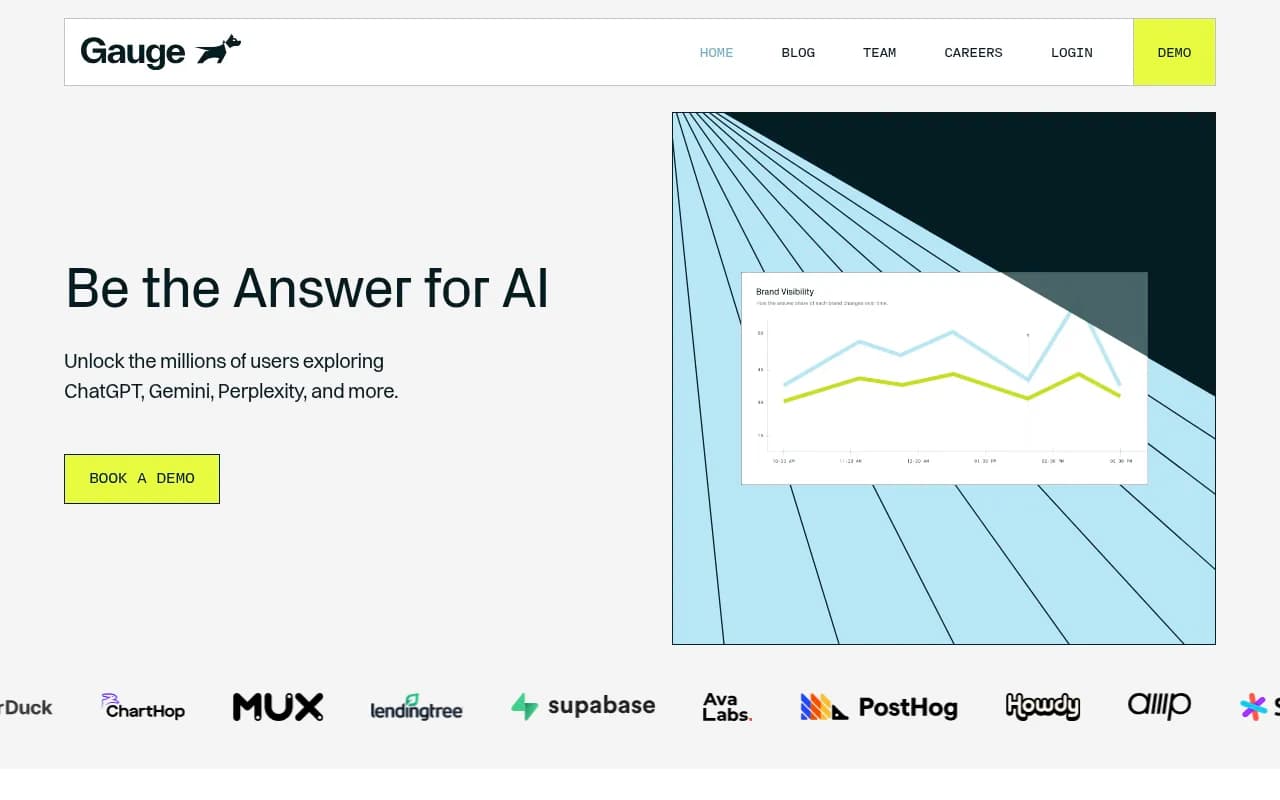
Gauge launched in 2024 as a focused AI visibility platform. It tracks brand mentions across ChatGPT, Claude, Gemini, Perplexity, Copilot, AI Mode, and AI Overviews. The pitch is simple: track what AI says about you, understand why, and get recommendations to improve. Gauge emphasizes a clean interface and actionable insights over data overload. Clients include MotherDuck, Supabase, and Howdy.
Promptwatch overview

Promptwatch is the market leader in AI search visibility, used by 7,000+ brands and agencies including Booking.com, Center Parcs, and Typeform. It monitors 10 AI engines, tracks real user prompts, logs AI crawler activity, and includes a built-in AI writing agent that generates content engineered to get cited by LLMs. The Wall Street Journal, Yahoo Finance, and Axios have featured its data (1.1 billion+ citations processed). Promptwatch positions itself as an optimization platform, not just a tracker -- it shows you what's missing, then helps you fix it.
Side-by-Side Comparison
| Feature | Gauge | Promptwatch |
|---|---|---|
| Starting price | $95/mo (annual) | $75/mo (Essential) |
| Free trial | Yes | Yes (7 days) |
| AI engines tracked | 7 (ChatGPT, Claude, Gemini, Perplexity, Copilot, AI Mode, AI Overviews) | 10 (adds DeepSeek, Grok, Mistral) |
| Prompt tracking | Yes | Yes (with volume estimates) |
| Competitor analysis | Yes | Yes (with heatmaps) |
| Citation analysis | Yes | Yes (880M+ citations) |
| AI crawler logs | No | Yes |
| Content gap analysis | Basic | Advanced (Answer Gap) |
| AI content generation | Add-on | Included in all plans |
| Reddit/YouTube tracking | No | Yes |
| ChatGPT Shopping | No | Yes |
| Multi-language support | Limited | Yes (any language) |
| API access | Enterprise only | Professional+ |
| Customer base | Growing (newer) | 7,000+ brands |
User interface and experience
Gauge wins on first impressions. The interface is clean, modern, and easy to navigate. You see your brand mentions, citation sources, and competitor comparisons without hunting through menus. The onboarding flow is smooth -- connect your brand, add prompts, and you're tracking within minutes. Everything feels designed for someone who wants insights fast without becoming a data analyst.
Promptwatch packs more functionality into the dashboard, which means more complexity. You get crawler logs, prompt intelligence, query fan-outs, Reddit discussions, YouTube mentions, and traffic attribution all in one platform. The learning curve is steeper, but once you know where everything is, you have more control. The interface feels built for power users who want every data point available.
Verdict: Gauge for simplicity and speed, Promptwatch for depth and control.
AI engine coverage
Gauge tracks 7 AI engines: ChatGPT, Claude, Gemini, Perplexity, Copilot, Google AI Mode, and Google AI Overviews. That covers the mainstream engines most users interact with daily.
Promptwatch tracks 10 engines, adding DeepSeek, Grok (X's AI), and Mistral to the list. DeepSeek is gaining traction in Asia and among developers. Grok matters if your audience uses X/Twitter. Mistral is popular in Europe. The extra coverage means you catch mentions Gauge would miss.
Both platforms let you filter results by engine, compare performance across models, and see which LLMs cite you most often.
Verdict: Promptwatch has broader coverage. If you only care about the big four (ChatGPT, Claude, Gemini, Perplexity), Gauge is fine. If you want complete visibility, Promptwatch wins.
Prompt tracking and intelligence
Both platforms let you add custom prompts to track -- questions your customers might ask where you want to be mentioned. You see when AI cites your brand, which competitors appear, and what sources the models pull from.
Promptwatch adds prompt volume estimates and difficulty scores. You can see which prompts get asked most often and which are easier to rank for. The query fan-out feature shows how one prompt branches into related sub-queries, helping you build a complete content strategy around a topic. This is missing in Gauge.
Gauge keeps it simpler: you track prompts, see results, and get recommendations. No volume data, no difficulty scoring. For some teams, that's actually a plus -- less noise, more focus on the prompts you care about.
Verdict: Promptwatch if you want to prioritize prompts by volume and difficulty. Gauge if you just want to track specific queries without extra metrics.
Citation and source analysis
Both platforms show which pages, articles, and domains AI models cite when they mention your brand. You can see if AI is pulling from your website, competitor sites, Reddit threads, news articles, or YouTube videos.
Promptwatch has analyzed 880M+ citations and surfaces patterns across all that data. You get Reddit and YouTube insights as dedicated features -- see which discussions influence AI recommendations, which subreddits matter for your category, which videos get cited. Gauge shows citations but doesn't break out Reddit and YouTube as separate intelligence layers.
Promptwatch also tracks ChatGPT Shopping -- when your brand appears in product recommendations and shopping carousels. Gauge doesn't monitor this.
Verdict: Promptwatch has deeper citation intelligence and covers more source types.
Content gap analysis and optimization
This is where the platforms diverge most.
Gauge identifies gaps in your content and gives recommendations for what to create or update. The insights are clear and actionable: "AI isn't citing you for X prompt because you don't have content about Y topic." You get onsite and offsite recommendations. But you're on your own to actually create the content.
Promptwatch includes Answer Gap Analysis that shows exactly which prompts competitors rank for but you don't. It then generates the missing content for you with a built-in AI writing agent. The agent uses real citation data, prompt volumes, persona targeting, and competitor analysis to create articles, listicles, and comparisons engineered to get cited by LLMs. This is included in all paid plans, not an add-on.
The difference: Gauge tells you what to fix. Promptwatch tells you what to fix and helps you fix it.
Verdict: Promptwatch if you want an end-to-end solution. Gauge if you have writers on your team and just need the insights.
AI crawler logs and indexing
Promptwatch logs every time an AI crawler (ChatGPT, Claude, Perplexity, etc.) hits your website. You see which pages they read, errors they encounter, how often they return, and whether they're successfully indexing your content. This is critical for diagnosing why AI models aren't citing you -- if the crawlers can't access your pages, you won't show up in responses.
Gauge doesn't offer crawler logs. You can infer some indexing issues from citation patterns, but you don't have direct visibility into crawler behavior.
Verdict: Promptwatch is the only option if you need crawler-level diagnostics.
Competitor analysis
Both platforms let you track competitors and see how your AI visibility compares.
Gauge shows competitor mentions side-by-side with yours for each prompt. You can see which brands AI recommends most often and what content it cites for them. The interface makes it easy to spot who's winning and why.
Promptwatch adds competitor heatmaps that visualize your performance vs competitors across all tracked prompts and LLMs. You see exactly where you're ahead, where you're behind, and which competitors dominate specific topics. The heatmaps make it easier to prioritize where to focus your efforts.
Verdict: Promptwatch has more sophisticated competitor visualization. Gauge is simpler but still effective.
Multi-language and multi-region support
Promptwatch supports monitoring in any language and from any country. You can set up personas that match how your actual customers prompt (e.g., a French-speaking user in Canada asking about accounting software). This matters for global brands or companies targeting non-English markets.
Gauge has limited multi-language support. It works best for English-language tracking.
Verdict: Promptwatch for international brands. Gauge for English-focused companies.
Pricing comparison
| Plan | Gauge | Promptwatch |
|---|---|---|
| Entry level | $95/mo (annual billing) | $75/mo (Essential) |
| Mid-tier | Growth: $399/mo | Professional: $249/mo |
| What you get (entry) | 1 brand, basic tracking | 1 site, 50 prompts, 5 AI articles, crawler logs |
| What you get (mid) | More prompts, advanced features | 2 sites, 150 prompts, 15 AI articles, state/city tracking |
| Enterprise | Custom pricing | Business: $579/mo (5 sites, 350 prompts, 30 articles) |
| Content generation | Add-on (extra cost) | Included in all plans |
| API access | Enterprise only | Professional+ |
| Free trial | Yes | Yes (7 days) |
Promptwatch is cheaper at every tier and includes content generation. Gauge charges more and makes content features an add-on. If you're managing multiple sites or clients, Promptwatch's multi-site plans are more cost-effective.
Pros and cons
Gauge pros
- Clean, intuitive interface that's easy to learn
- Fast setup and onboarding
- Clear, actionable recommendations
- Good for teams that want simplicity over data overload
- Growing customer base with recognizable brands
Gauge cons
- More expensive than Promptwatch at comparable tiers
- Content generation costs extra
- No crawler logs or indexing diagnostics
- Limited multi-language support
- Fewer AI engines tracked (no DeepSeek, Grok, Mistral)
- No Reddit/YouTube intelligence or ChatGPT Shopping tracking
Promptwatch pros
- Market leader with 7,000+ customers and 880M+ citations analyzed
- Lower pricing with content generation included
- Tracks 10 AI engines including DeepSeek, Grok, Mistral
- AI crawler logs show exactly how models index your site
- Answer Gap Analysis + built-in AI writing agent close the optimization loop
- Reddit, YouTube, and ChatGPT Shopping tracking
- Multi-language and multi-region support
- API access and Looker Studio integration for custom reporting
Promptwatch cons
- Steeper learning curve due to more features
- Interface can feel dense for users who just want the basics
- Might be overkill for small brands tracking a handful of prompts
Who should pick which tool
Choose Gauge if:
- You want a simple, clean interface without a learning curve
- You're a single brand (not an agency) tracking one website
- You have a content team and just need insights, not AI-generated articles
- You only care about mainstream AI engines (ChatGPT, Claude, Gemini, Perplexity)
- You prefer a newer, more modern UI over feature depth
Choose Promptwatch if:
- You want the most comprehensive AI visibility platform available
- You need content generation included, not as an add-on
- You're an agency managing multiple clients or a brand with multiple sites
- You want crawler logs to diagnose indexing issues
- You need Reddit, YouTube, and ChatGPT Shopping tracking
- You're targeting non-English markets or multiple regions
- You want API access for custom integrations
- You care about having the deepest citation data and prompt intelligence
Final verdict
Promptwatch is the better choice for most teams. It costs less, includes content generation, tracks more AI engines, and gives you tools to actually improve your visibility -- not just monitor it. The Answer Gap Analysis + AI writing agent combo is the killer feature: you see what's missing, then generate the content to fill the gap. Gauge doesn't offer anything close to this.
Gauge makes sense if you value simplicity and a modern interface over feature depth, and if you already have a content team that doesn't need AI assistance. But at $95/mo vs Promptwatch's $75/mo, you're paying more for less.
For agencies, Promptwatch is the obvious pick -- better multi-site pricing, API access, and more robust reporting. For single brands, Promptwatch still wins on value unless you specifically want the simplest possible tool and don't care about content generation, crawler logs, or advanced analytics.
Bottom line: Promptwatch is the market leader for a reason. Gauge is a solid alternative if you prioritize UX over functionality, but most teams will get more value from Promptwatch's comprehensive toolkit.