Key Takeaways
- Gauge costs $95/mo (annual billing) vs Peec AI's €89/mo (~$103), making Gauge slightly cheaper at entry level
- Both platforms track the same core AI models (ChatGPT, Perplexity, Claude, Gemini), but Gauge adds CoPilot and AI Mode coverage
- Peec AI emphasizes clean dashboards and competitive benchmarking -- it's built for teams who want quick visibility snapshots
- Gauge positions itself as a "complete toolkit" with content recommendations and gap analysis, not just monitoring
- Neither platform offers AI crawler logs or content generation features -- they're both monitoring-focused tools
- Peec AI has a free trial; Gauge offers both free trial and a free tier option
Overview
Gauge
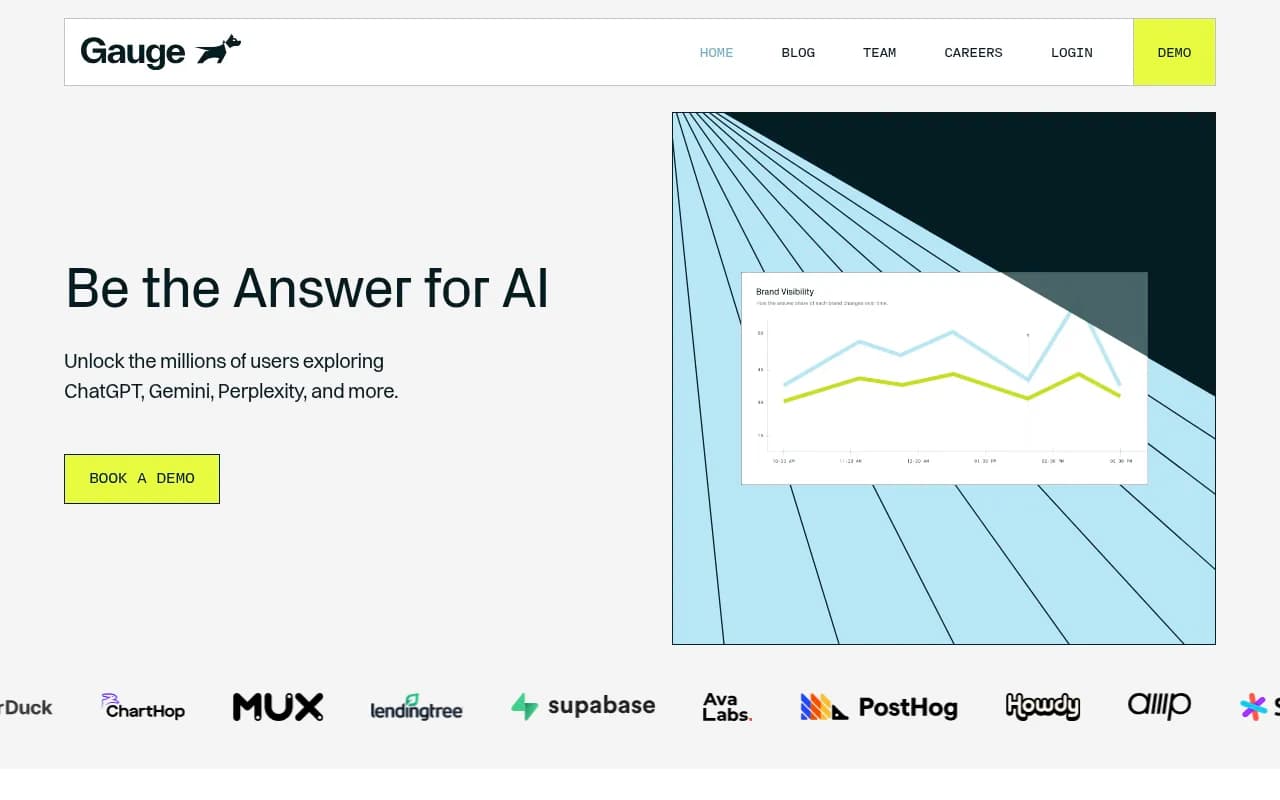
Gauge is an AI visibility platform that monitors brand mentions across ChatGPT, Claude, Gemini, Perplexity, CoPilot, AI Mode, and AI Overviews. The platform tracks three core metrics: where your brand appears, what content gets cited, and how you compare to competitors. Gauge markets itself as a "complete toolkit" that goes beyond tracking to provide actionable recommendations for improving AI search presence. Used by brands like MotherDuck, Supabase, and Howdy.
Peec AI

Peec AI is an AI search analytics platform built for marketing teams who need to track brand performance across major LLMs. The platform measures Visibility (share of chats mentioning your brand), Position (ranking within AI responses), and Sentiment (how AI perceives your brand). Peec AI emphasizes clean dashboards and competitive benchmarking, with 1,500+ marketing teams and agencies using the platform. European-based (pricing in euros) with a focus on agency-friendly reporting.
Side-by-side comparison
| Feature | Gauge | Peec AI |
|---|---|---|
| Starting price | $95/mo (annual) | €89/mo (~$103) |
| Free tier | Yes (limited) | Free trial only |
| AI models tracked | ChatGPT, Claude, Gemini, Perplexity, CoPilot, AI Mode, AI Overviews | ChatGPT, Perplexity, Claude, Gemini |
| Core metrics | Visibility, citations, competitor analysis | Visibility, Position, Sentiment |
| Custom prompts | ✓ | ✓ |
| Competitor tracking | ✓ | ✓ |
| Multi-country support | ✓ | ✓ |
| Content recommendations | ✓ (onsite/offsite) | ✗ |
| Citation source analysis | ✓ | ✓ |
| Agency features | Limited info | ✓ (workspace support) |
| API access | Not mentioned | Not mentioned |
| Reporting/export | ✓ | ✓ |
Platform coverage and tracking depth
Gauge tracks seven AI platforms: ChatGPT, Claude, Gemini, Perplexity, CoPilot, AI Mode, and AI Overviews. Peec AI covers four: ChatGPT, Perplexity, Claude, and Gemini. The difference matters if you care about Microsoft CoPilot or Google's AI Mode -- Gauge has you covered, Peec AI doesn't.
Both platforms let you add custom prompts and organize them with tags. Both support multi-country tracking, which is critical if you operate in multiple markets. Peec AI's interface shows a clean dashboard with trending visibility percentages and competitor comparisons. Gauge emphasizes its "Track, Understand, Act" workflow -- monitor mentions, analyze gaps, take action based on recommendations.
Neither platform appears to offer real-time AI crawler logs (the ability to see when ChatGPT or Claude actually crawls your website). That's a gap both tools share.
Verdict: Gauge wins on breadth of AI model coverage. Peec AI's four-model focus is sufficient for most teams, but if you need CoPilot or AI Mode tracking, Gauge is the only option here.
Core metrics and analytics
Peec AI measures three specific metrics:
- Visibility: Percentage of chats where your brand appears
- Position: Your ranking within AI responses (e.g., 2nd mention out of 5)
- Sentiment: How positively or negatively AI describes your brand (scored numerically)
Gauge tracks similar territory but frames it differently:
- Brand mention detection across AI engines
- Citation analysis (what content is being referenced)
- Competitor gap analysis (where competitors appear but you don't)
Peec AI's Position metric is interesting -- it quantifies where you rank in the response, not just whether you're mentioned. That's useful for understanding if you're a primary recommendation or an afterthought. Gauge doesn't explicitly call out position tracking in the same way, focusing more on presence/absence and citation patterns.
Both platforms show trending data over time. Peec AI's dashboard displays percentage changes ("Visibility trending up by 5.2% this month"). Gauge shows visual tracking across its monitored queries.
Verdict: Peec AI has a slight edge on metric specificity with its Position and Sentiment scoring. Gauge's citation analysis is valuable but less quantified.
Competitive analysis features
Both platforms emphasize competitor benchmarking, but they approach it differently.
Peec AI shows side-by-side competitor visibility percentages in a clean visual format. You can see at a glance that HubSpot has 65% visibility, Salesforce 62%, your brand 47%, etc. The interface is designed for quick competitive snapshots -- useful in client presentations or executive reports.
Gauge positions its competitor analysis as "gap analysis" -- identifying specific queries where competitors appear but you don't. The platform promises to show "what's being left out" and "how your brand stacks up." This is more diagnostic than Peec AI's approach. Instead of just showing you're behind, Gauge aims to show you why and where.
Neither platform appears to offer deep competitor content analysis (like seeing exactly what pages competitors have that you lack). The competitive features are focused on visibility metrics, not content audits.
Verdict: Peec AI for presentation-ready competitive dashboards. Gauge for identifying specific gaps to fix.
Content recommendations and action items
This is where the platforms diverge most clearly.
Gauge explicitly markets itself around taking action. The platform provides "clear onsite and offsite recommendations" to improve your AI presence. The website mentions helping teams "write new content, audit existing pages, target high value affiliates, and engage with social sources like Reddit." This suggests Gauge gives you specific tasks: create this content, fix this page, reach out to this affiliate.
Peec AI doesn't emphasize content recommendations. The platform is built around measurement and benchmarking, not prescriptive fixes. You get the data on where you're invisible, but figuring out what to do about it is on you.
Neither platform offers AI-powered content generation (tools that actually write the articles for you). If you want that capability, you'd need to look at platforms like Promptwatch, which combines tracking with an AI writing agent that generates content grounded in citation data.

Verdict: Gauge wins if you want actionable recommendations alongside your data. Peec AI is pure analytics.
User interface and reporting
Peec AI's screenshots show a polished, modern interface with clean data visualization. The dashboard uses cards, trend lines, and percentage metrics that feel designed for non-technical marketers. The competitor comparison view is particularly clean -- circular brand logos with visibility percentages underneath.
Gauge's website shows more conceptual diagrams than actual product screenshots, making it harder to judge the interface quality. The messaging emphasizes "complete control" and a "toolkit" approach, suggesting more complexity than Peec AI's streamlined dashboards.
Both platforms offer export functionality. Peec AI explicitly mentions "agency reporting friendly" features and workspace support (Growth plan includes 2 workspaces), which matters if you're managing multiple clients. Gauge's agency features are less clear from the available information.
Verdict: Peec AI appears more polished and agency-friendly based on visible interface design. Gauge's UI is harder to evaluate without product screenshots.
Pricing breakdown
| Plan | Gauge | Peec AI |
|---|---|---|
| Free tier | Available (limited) | Free trial only |
| Starter | $95/mo (annual billing) | €89/mo (~$103) - 50 prompts, 10 models |
| Growth/Mid-tier | $399/mo | €199/mo (~$230) - 150 prompts, 2 workspaces |
| Enterprise | Custom pricing | Custom pricing |
| Billing | Annual discount available | Monthly or annual |
Gauge is slightly cheaper at the entry level ($95 vs ~$103), but Peec AI's Growth plan at ~$230/mo is significantly cheaper than Gauge's $399/mo Growth plan. The value proposition shifts depending on your scale.
Peec AI's Starter plan explicitly includes 50 prompts and 10 models. Gauge doesn't publish prompt limits on its website, which makes it harder to compare apples-to-apples. If you need to track 100+ prompts, Peec AI's Growth plan might be the better deal.
Both platforms offer custom Enterprise pricing for larger teams.
Verdict: Gauge is cheaper for small teams ($95/mo entry). Peec AI is cheaper at mid-scale ($199 vs $399 for Growth tier).
Integration and workflow fit
Neither platform provides detailed integration information on their websites. No mention of API access, webhook support, or connections to tools like Slack, Looker Studio, or marketing automation platforms.
This is a notable gap for both tools. If you want to pipe AI visibility data into your existing reporting stack or trigger alerts when visibility drops, you'll need to ask during the sales process whether those capabilities exist.
Peec AI mentions integrations with "tools like Slack, Notion, and Segment" in one of the comparison contexts, but this isn't confirmed on their main website. Gauge doesn't mention integrations explicitly.
Verdict: Unclear -- both platforms need to be more transparent about integration capabilities.
Pros and cons
Gauge pros:
- Broader AI model coverage (7 platforms vs 4)
- Actionable content recommendations, not just data
- Slightly cheaper entry price ($95/mo)
- Free tier available
- Emphasis on gap analysis and specific fixes
Gauge cons:
- Less transparent about UI/interface quality
- Higher mid-tier pricing ($399/mo)
- Agency features unclear
- No visible sentiment scoring
Peec AI pros:
- Clean, modern dashboard design
- Position and Sentiment metrics quantified
- Agency-friendly with workspace support
- Cheaper Growth plan ($199 vs $399)
- Strong competitive benchmarking visuals
- 1,500+ teams using it (social proof)
Peec AI cons:
- Only tracks 4 AI models (missing CoPilot, AI Mode, AI Overviews)
- No content recommendations or action items
- No free tier (trial only)
- Slightly higher entry price (~$103 vs $95)
Who should pick which tool
Pick Gauge if:
- You need comprehensive AI model coverage including CoPilot and AI Mode
- You want specific recommendations on what content to create or fix
- You're a small team or solo marketer who needs a free tier to start
- You care more about actionable insights than polished dashboards
- You're tracking a brand in a competitive space and need gap analysis
Pick Peec AI if:
- You're an agency managing multiple client workspaces
- You want clean, presentation-ready dashboards for stakeholders
- You need quantified Position and Sentiment metrics, not just visibility
- You're tracking 150+ prompts and want better value at mid-scale ($199/mo)
- You prefer a focused tool that does monitoring really well over a "toolkit" approach
- You operate primarily in European markets (pricing in euros, European company)
Look elsewhere if:
- You need AI crawler logs to see when LLMs actually visit your site
- You want AI-powered content generation, not just recommendations
- You need deep integrations with your existing marketing stack
- You want to track Reddit discussions or YouTube mentions that influence AI responses
Final verdict
Gauge and Peec AI are both solid AI visibility monitoring platforms, but they serve slightly different needs.
Peec AI is the better choice for agencies and marketing teams who value clean dashboards, quantified metrics, and competitive benchmarking. The interface looks more polished, the pricing is better at mid-scale, and the workspace support makes multi-client management easier. If you want a monitoring tool that produces great-looking reports, Peec AI delivers.
Gauge is the better choice if you need broader AI model coverage and want actionable recommendations alongside your data. The platform tracks more AI engines, costs less at entry level, and emphasizes helping you fix gaps rather than just showing you they exist. If you're a hands-on marketer who wants to know what to do next, Gauge's "toolkit" approach fits better.
Neither platform is a complete AI optimization solution. Both are monitoring-focused tools that show you the problem but leave most of the solution work to you. They lack AI crawler logs, content generation capabilities, and deep integration options that more comprehensive platforms offer. For pure visibility tracking and competitive benchmarking, though, both Gauge and Peec AI do the job -- just pick the one that matches your workflow and budget.