Key Takeaways
- Multi-client management is non-negotiable: The best GEO platforms for agencies offer project separation, granular permissions, and centralized dashboards that let you manage dozens of clients without switching accounts
- White-label capabilities vary dramatically: Some platforms only add your logo to PDFs, while others provide fully branded portals on your own domain, custom subdomains, and complete brand removal
- Pricing models matter for profitability: Agency-specific pricing tiers, volume discounts, and reseller programs can make or break your margins when managing 10+ clients
- Promptwatch leads in action-oriented GEO: Unlike monitoring-only competitors, Promptwatch combines visibility tracking with Answer Gap Analysis and AI content generation to help agencies actually improve client results, not just report on them
- Integration depth determines workflow efficiency: API access, Looker Studio connectors, and white-label embedding capabilities let you build GEO data into existing client dashboards and reporting systems
Why Agencies Need Specialized GEO Platforms in 2026
AI search has fundamentally changed how brands get discovered. ChatGPT, Perplexity, Google AI Mode, Claude, and Gemini now influence purchase decisions across every industry. For agencies managing multiple clients, this creates both opportunity and complexity.
The challenge isn't just tracking visibility across AI engines—it's doing so at scale while maintaining professional, branded client experiences. Generic GEO tools built for individual brands fall apart when you're managing 15 clients across different industries, each needing separate dashboards, custom reports, and distinct branding.
Agencies need platforms that solve three core problems:
Scalable multi-client architecture. You can't log in and out of different accounts 20 times per day. The right platform lets you manage all clients from one master account with project-level separation, team permissions, and centralized billing.
Professional white-label presentation. Clients pay agencies for expertise and service, not to see another vendor's logo on every report. White-label capabilities—from branded portals to custom-domain dashboards—reinforce your agency's value and justify premium pricing.
Actionable optimization, not just monitoring. Showing clients a visibility score is table stakes. The platforms that win agency business help you actually improve those scores through content gap analysis, optimization recommendations, and AI-powered content generation.
What to Evaluate When Choosing a GEO Platform for Your Agency
Before comparing specific platforms, understand the criteria that separate agency-grade solutions from single-user tools:
Multi-Client Management Capabilities
Project separation and organization. Can you create distinct projects for each client with isolated data, custom settings, and separate user access? The best platforms treat each client as a self-contained workspace while giving you a master view across all accounts.
User permissions and access control. You need granular control over who sees what. Marketing managers shouldn't access technical crawler logs. Clients shouldn't see your internal notes or competitor analysis for other accounts. Look for role-based permissions that let you configure access at the project and feature level.
Team collaboration features. When multiple team members work on client accounts, you need commenting, task assignment, and activity logs. Platforms with built-in collaboration tools reduce the need for external project management software.
Centralized billing and reporting. Managing separate invoices for 20 clients is administrative overhead you don't need. Agency-tier platforms consolidate billing and let you allocate costs across clients however you structure your pricing.
White-Label and Branding Depth
Logo and color customization. This is the baseline—your logo, colors, and basic branding on reports and dashboards. Every platform claims to offer this, but implementation quality varies wildly.
Custom domain and subdomain support. The difference between client.yourplatform.com and analytics.youragency.com is credibility. Full custom domain support (not just subdomains) creates a seamless branded experience where clients never see the underlying platform.
Complete brand removal. Can you eliminate every trace of the original platform? Check footers, login screens, email notifications, and help documentation. Some platforms leave their branding in unexpected places that undermine the white-label experience.
Embeddable widgets and iframes. For agencies with existing client portals or custom dashboards, the ability to embed GEO data via iframe or JavaScript widget is critical. This lets you integrate AI visibility tracking into your existing infrastructure.
AI Search Coverage and Data Quality
Number of AI engines monitored. At minimum, track ChatGPT, Perplexity, Google AI Overviews, and Claude. Comprehensive platforms add Gemini, Grok, DeepSeek, Meta AI, Copilot, and Mistral. More coverage means better competitive intelligence and risk mitigation if one engine changes behavior.
Prompt volume and difficulty data. Knowing which prompts have high search volume and low competition helps prioritize optimization efforts. Platforms with prompt intelligence features (like Promptwatch's 1.1 billion citation database) give you data-driven targeting instead of guesswork.
Citation and source analysis. Understanding which pages, Reddit threads, YouTube videos, and domains AI models cite reveals optimization opportunities. This data tells you where to publish content and what formats AI engines prefer.
Multi-language and multi-region support. If you serve clients in multiple markets, you need tracking across languages and geographies. Some platforms limit you to English and US results, which doesn't work for international agencies.
Optimization and Content Creation Tools
Answer Gap Analysis. The most valuable feature for agencies: showing exactly which prompts competitors rank for but your client doesn't. This identifies content gaps and prioritizes optimization work based on actual visibility data, not assumptions.
AI content generation. Platforms that help you create optimized content—not just identify gaps—dramatically improve client results. Look for tools that generate articles, listicles, and comparisons grounded in citation data and competitor analysis.
Technical optimization features. AI crawler logs, indexing diagnostics, and structured data recommendations help you fix technical issues preventing AI engines from discovering client content.
Competitor tracking and benchmarking. Side-by-side visibility comparisons show clients where they stand versus competitors and quantify improvement over time. Heatmaps that visualize competitive positioning across prompts make reporting more compelling.
Pricing Structure and Agency Economics
Per-client vs. volume pricing. Some platforms charge per project/client, while others offer agency tiers with included client slots. Calculate total cost at your target client count—a $99/month per-client tool becomes $1,980/month for 20 clients.
Reseller and white-label pricing. Agency-specific plans often include volume discounts, reseller margins, or white-label add-ons. These can significantly impact profitability, especially if you're reselling GEO services as a standalone offering.
Feature limitations by tier. Understand what you lose at lower price points. Some platforms restrict AI crawler logs, Reddit tracking, or content generation to higher tiers, forcing you to upgrade sooner than expected.
Contract flexibility. Month-to-month billing gives you flexibility to scale up or down as client count changes. Annual contracts often provide 20-30% discounts but lock you in if you need to adjust.
Top GEO Platforms for Agencies: Detailed Comparison
Promptwatch: Action-Oriented GEO with Built-In Content Generation
Promptwatch stands out as the only GEO platform rated as a "Leader" across all categories in a 2026 comparison of 12 platforms. The core difference: most competitors are monitoring-only dashboards that show you data but leave you stuck. Promptwatch is built around taking action.

The Action Loop that agencies need: Find gaps with Answer Gap Analysis showing exactly which prompts competitors rank for but your clients don't. Create content using the built-in AI writing agent that generates articles grounded in 880M+ citations analyzed. Track results with page-level visibility scores and traffic attribution connecting AI visibility to actual revenue.
Multi-client management: Professional and Business tiers support 2-5 sites respectively, with agency and enterprise custom pricing for larger client portfolios. Each client gets isolated project dashboards with configurable user permissions.
White-label capabilities: Full branding customization with logo, colors, and custom reporting. API access and Looker Studio integration let you embed Promptwatch data into existing client dashboards.
AI coverage: Monitors 10 AI models including ChatGPT, Perplexity, Google AI Overviews, Google AI Mode, Claude, Gemini, Meta/Llama, DeepSeek, Grok, Mistral, and Copilot. Multi-language and multi-region tracking with customizable personas.
Unique features competitors lack: AI crawler logs showing real-time bot activity on client sites. Reddit and YouTube insights surfacing discussions that influence AI recommendations. ChatGPT Shopping tracking for e-commerce clients. Prompt volumes and difficulty scoring for prioritization. Query fan-outs showing how prompts branch into sub-queries.
Pricing: Essential $99/mo (1 site, 50 prompts, 5 articles), Professional $249/mo (2 sites, 150 prompts, 15 articles, crawler logs), Business $579/mo (5 sites, 350 prompts, 30 articles). Agency/Enterprise custom pricing available. Annual discounts offered.
Best for: Agencies that want to deliver results, not just reports. If you're tired of showing clients visibility scores without tools to improve them, Promptwatch's content generation and gap analysis features let you actually move the needle.
LLM Pulse: Embeddable White-Label Platform
LLM Pulse positions itself as a white-label solution specifically designed for agencies and SaaS platforms that want to embed AI search tracking into their own products.
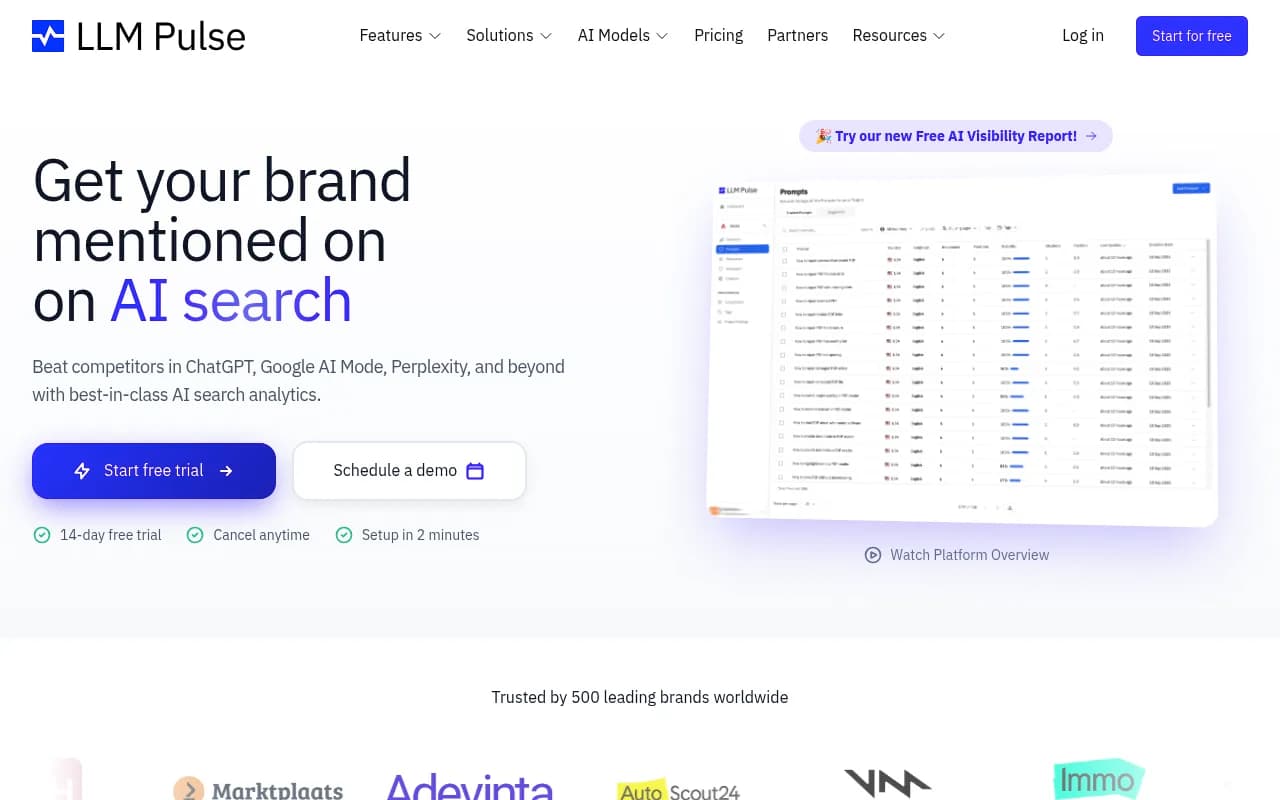
White-label depth: Full custom domain support, complete brand removal, and embeddable widgets that integrate into existing client portals. The platform can be entirely rebranded as your own product.
AI coverage: Tracks ChatGPT, Perplexity, Google AI Mode, Gemini, and AI Overviews. Coverage is solid but narrower than platforms monitoring 10+ engines.
Multi-client management: Built for agencies with project-level separation and team permissions. The embedding capabilities make it particularly valuable for SaaS companies adding GEO features to existing products.
Pricing: Starts at €49/mo plus a white-label add-on fee. Pricing structure favors agencies building GEO into their service stack rather than standalone monitoring.
Limitations: Monitoring-focused without built-in content generation or optimization tools. You'll need separate solutions for creating content that ranks in AI search.
Best for: Agencies and SaaS platforms that want to embed AI visibility tracking into existing dashboards and products under their own brand.
SE Ranking: All-in-One SEO Platform with AI Overviews Add-On
SE Ranking is a comprehensive SEO platform that added AI Overviews tracking as an optional module. It's not a pure GEO platform but offers agency-friendly features for teams managing traditional SEO alongside AI search.
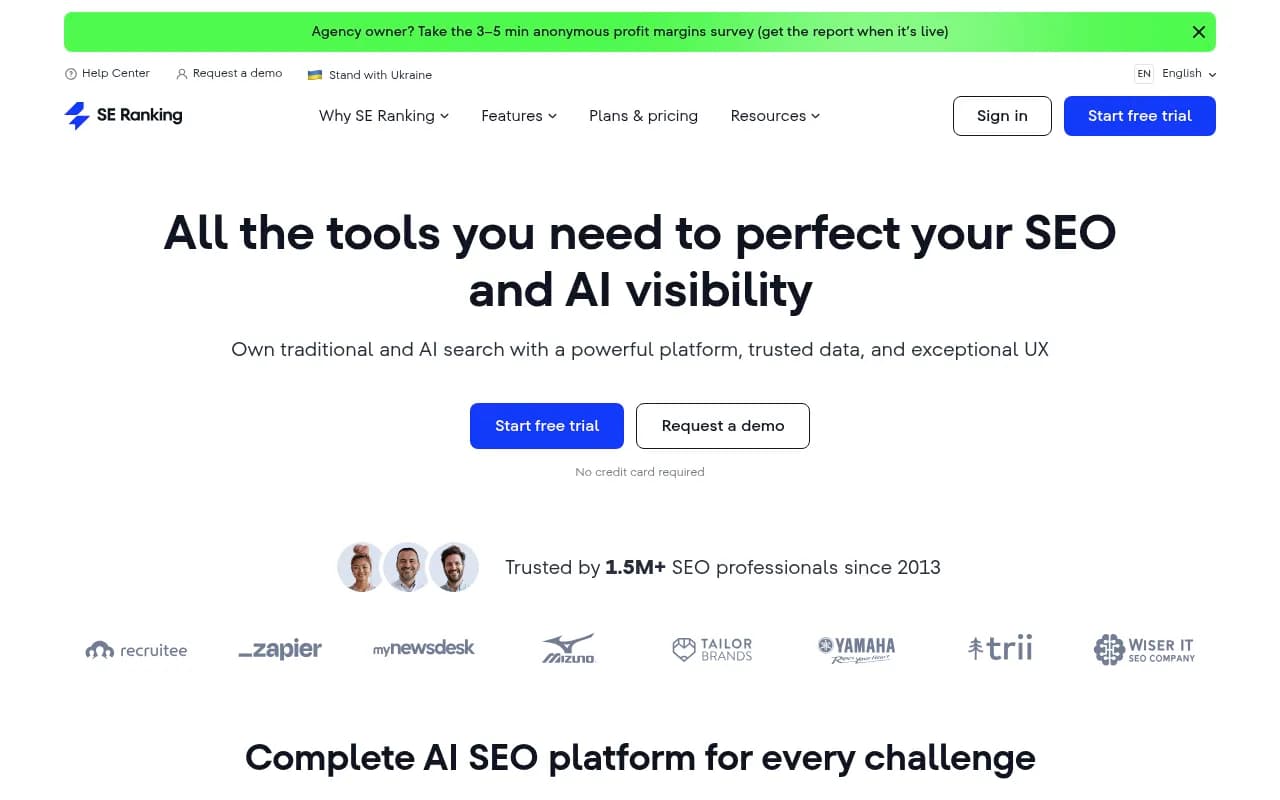
Multi-client management: Strong agency tools with unlimited projects, white-label reports, and team collaboration features. The Agency Pack adds custom domain support for fully branded client portals.
AI coverage: AI Overviews tracking is available as an add-on, but coverage is limited compared to dedicated GEO platforms. You won't get ChatGPT, Perplexity, or Claude tracking.
White-label capabilities: Full white-label reporting with custom domains via the Agency Pack. Reports, dashboards, and client portals can be completely branded.
Pricing: Starts at $55/mo for basic plans, with agency-specific pricing for larger client portfolios. AI Overviews tracking requires additional fees.
Best for: Agencies already using SE Ranking for traditional SEO who want to add basic AI search monitoring without switching platforms. Not ideal if GEO is your primary focus.
Semrush: Traditional SEO Giant with Limited AI Search Features
Semrush added AI search capabilities but remains primarily a traditional SEO platform. Its GEO features lag behind dedicated platforms.
AI coverage: Tracks AI Overviews but uses fixed prompts rather than custom tracking. You can't monitor specific prompts relevant to your clients' industries. No ChatGPT, Perplexity, or Claude monitoring.
Multi-client management: Strong agency features with project management, team permissions, and white-label reporting. The platform excels at traditional SEO but treats AI search as a secondary feature.
White-label capabilities: Full white-label reporting with custom branding. Reports can be exported and customized extensively.
Pricing: Starts at $139.95/mo, with agency and enterprise tiers for larger teams. Expensive compared to dedicated GEO platforms if AI search is your primary need.
Limitations: Fixed prompts, no AI traffic attribution, and limited optimization tools for AI search. The platform's strength is traditional SEO, not GEO.
Best for: Agencies with existing Semrush subscriptions who want basic AI Overviews data alongside comprehensive traditional SEO tools. Not recommended if GEO is a core service offering.
Ahrefs Brand Radar: Basic AI Monitoring Without Optimization
Ahrefs added Brand Radar to track brand mentions in AI search, but it's a monitoring-only feature without optimization capabilities.
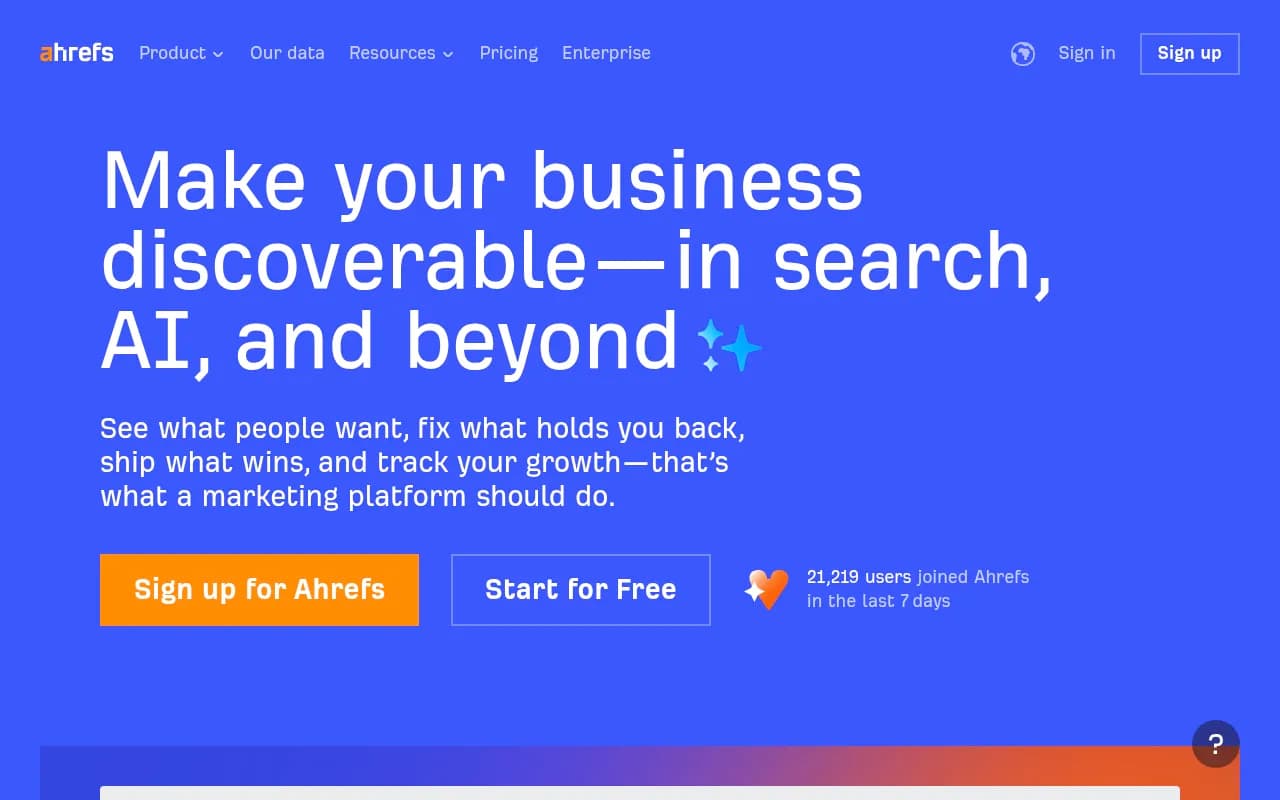
AI coverage: Tracks brand mentions across AI engines but uses fixed prompts. You can't customize tracking for specific industry queries or competitor comparisons.
Multi-client management: Ahrefs offers agency features for traditional SEO, but Brand Radar doesn't include project-level separation or client-specific dashboards.
White-label capabilities: Limited white-label options. Reports can be customized but lack the depth of dedicated agency platforms.
Pricing: Included with Ahrefs subscriptions starting at $129/mo. No separate GEO pricing, but you're paying for the full Ahrefs suite.
Limitations: No AI traffic attribution, no content generation, no optimization recommendations. It shows you visibility data but doesn't help you improve it.
Best for: Agencies already using Ahrefs who want basic brand mention tracking in AI search. Not suitable as a primary GEO platform.
Profound: Enterprise GEO with High Price Point
Profound offers comprehensive AI search tracking with strong features but at a significantly higher price point than most competitors.
Profound

AI coverage: Tracks 9+ AI engines including ChatGPT, Perplexity, and major LLMs. Comprehensive coverage comparable to top platforms.
Multi-client management: Enterprise-focused with robust project management and team collaboration features.
White-label capabilities: Full white-label reporting and branding options suitable for agency use.
Pricing: Premium pricing tier targeting enterprise clients. Significantly more expensive than platforms like Promptwatch or Otterly.AI.
Limitations: No Reddit tracking, no ChatGPT Shopping monitoring. Strong feature set but missing some capabilities available in lower-priced alternatives.
Best for: Enterprise agencies with large budgets serving Fortune 500 clients. Smaller agencies will find better value elsewhere.
Otterly.AI: Basic Monitoring Without Content Tools
Otterly.AI provides straightforward AI search monitoring but lacks optimization and content creation features.
Otterly.AI

AI coverage: Tracks ChatGPT, Perplexity, and Google AI Overviews. Solid coverage of major engines.
Multi-client management: Basic project separation available but less sophisticated than agency-focused platforms.
White-label capabilities: Limited white-label options. Primarily designed for individual brands rather than agency resale.
Pricing: Competitive pricing for monitoring-only features.
Limitations: No crawler logs, no visitor analytics, no content generation. Shows you visibility data but doesn't help you act on it.
Best for: Agencies that only need basic monitoring and have separate tools for content creation and optimization.
Search Party: Agency-Oriented with Limited Metrics
Search Party targets agencies but lacks the depth of prompt metrics and content analysis found in leading platforms.
Search Party
Multi-client management: Built for agencies with project management and collaboration features.
AI coverage: Monitors major AI engines but with less granular prompt-level data than competitors.
White-label capabilities: Agency-focused branding and reporting options.
Limitations: No content gap analysis, limited prompt metrics, and no AI traffic attribution. You can track visibility but lack tools to understand why you're visible or how to improve.
Best for: Agencies that need basic multi-client AI search monitoring without advanced optimization features.
How to Choose the Right GEO Platform for Your Agency
Selecting a GEO platform depends on your agency's specific needs, client base, and service model. Use this framework to evaluate options:
Define Your Service Model
Monitoring-only vs. full-service optimization. If you're only reporting on AI visibility without actively improving it, monitoring-only platforms like Otterly.AI or Peec.ai might suffice. But if you're selling GEO as a results-driven service, you need platforms like Promptwatch that include content generation and gap analysis.
White-label resale vs. internal use. Agencies reselling GEO as a standalone product need deep white-label capabilities with custom domains and complete brand removal. If you're using GEO internally to support broader marketing services, basic logo customization may be enough.
Client count and growth trajectory. Calculate total cost at your current client count and projected growth. A $99/client platform becomes expensive at scale, while agency tiers with volume pricing offer better economics as you grow.
Evaluate Integration Requirements
Existing tech stack. If you already use platforms like AgencyAnalytics, DashClicks, or custom client portals, prioritize GEO tools with API access and embeddable widgets. Platforms like LLM Pulse excel here.
Reporting workflow. Some agencies build custom reports in Looker Studio or Google Data Studio. Platforms with native connectors (like Promptwatch) integrate seamlessly. Others require manual data export and manipulation.
Client access preferences. Decide whether clients log into the GEO platform directly or receive scheduled reports. Direct access requires more robust white-label capabilities and user permission controls.
Assess Team Capabilities
Content creation capacity. If your team has bandwidth to create optimized content, platforms with Answer Gap Analysis (like Promptwatch) identify opportunities while you handle execution. If you need the platform to generate content, built-in AI writing tools become essential.
Technical expertise. Some platforms require technical setup for crawler log analysis, API integration, or traffic attribution. Ensure your team can implement and maintain the features you're paying for.
Client education and support. Consider how much time you'll spend educating clients on AI search concepts. Platforms with clear reporting and automated insights reduce the support burden.
Calculate True Total Cost
Per-client pricing multiplication. A $99/month per-client tool costs $1,188/year for one client but $23,760/year for 20 clients. Agency tiers with included client slots often provide better economics at scale.
Feature tier requirements. Identify must-have features (crawler logs, Reddit tracking, content generation) and determine which pricing tier includes them. Upgrading mid-contract can blow your budget.
White-label add-on fees. Some platforms charge separately for white-label capabilities. Factor these costs into your total pricing comparison.
Reseller margins. If you're reselling GEO services, calculate the markup you can charge clients versus platform costs. Healthy margins (40-60%) ensure profitability as you scale.
Test Before Committing
Most platforms offer free trials or demos. Use them to evaluate:
Setup complexity: How long does it take to add a new client and configure tracking?
Report quality: Do automated reports look professional enough to send directly to clients?
Data accuracy: Compare visibility scores across platforms for the same prompts to assess data quality.
Support responsiveness: Test customer support with technical questions to gauge response time and expertise.
Pricing Comparison: Agency Economics at Scale
Understanding pricing structures helps you project costs as your client base grows. Here's how leading platforms compare:
Promptwatch: Scales from $99/mo (1 site) to $579/mo (5 sites) with custom agency/enterprise pricing beyond that. The Professional tier at $249/mo (2 sites, 150 prompts, 15 AI-generated articles) offers strong value for agencies with 2-5 active clients. Content generation included at all tiers reduces the need for separate writing tools.
LLM Pulse: Starts at €49/mo plus white-label add-on fees. The base price is attractive but add-ons increase total cost. Best economics for agencies embedding the platform into existing products rather than standalone GEO services.
SE Ranking: Begins at $55/mo with agency-specific pricing for larger portfolios. AI Overviews tracking requires additional fees. Total cost depends on how many traditional SEO features you need alongside AI search monitoring.
Semrush: Starts at $139.95/mo with agency and enterprise tiers. Expensive if you only need GEO features, but competitive if you're using the full SEO suite. Fixed prompts limit customization for client-specific tracking.
Profound: Premium enterprise pricing significantly higher than competitors. Suitable for agencies serving Fortune 500 clients with large budgets, but cost-prohibitive for small to mid-size agencies.
Otterly.AI/Peec.ai: Competitive monitoring-only pricing but lack content generation and optimization tools. You'll need separate platforms for creating content that ranks in AI search, increasing total cost.
Agency tier sweet spot: For agencies managing 5-15 clients, platforms offering agency tiers with included client slots (rather than per-client pricing) provide the best economics. Promptwatch's custom agency pricing and LLM Pulse's embedding model both work well at this scale.
White-Label Reporting: What Agencies Actually Need
White-label capabilities vary dramatically across platforms. Here's what matters most:
Essential White-Label Features
Logo and color customization: Your logo, brand colors, and custom color schemes on all reports and dashboards. This is table stakes—every platform should offer it.
Custom domain or subdomain: The difference between client.platform.com and analytics.youragency.com is credibility. Full custom domain support (not just subdomains) creates a seamless branded experience.
Email notification branding: Automated emails sent to clients should come from your domain with your branding, not the underlying platform.
Report templates: Customizable report templates let you structure data presentation to match your agency's style and client preferences.
Footer and header customization: Remove platform branding from report footers and add your agency's contact information and disclaimers.
Advanced White-Label Capabilities
Complete brand removal: Eliminate every trace of the original platform from login screens, help documentation, and error messages. Some platforms leave their branding in unexpected places.
Custom help documentation: Replace default help content with your own documentation, FAQs, and support resources.
Embeddable widgets: JavaScript widgets or iframes that embed GEO data into your existing client portals or custom dashboards.
API access: Build custom integrations and pull GEO data into your own reporting systems or client dashboards.
White-label mobile apps: Some platforms offer branded mobile apps for client access, though this is rare in GEO tools.
Reporting Automation Features
Scheduled reports: Automated daily, weekly, or monthly reports sent to clients without manual intervention.
Custom report frequency: Different clients need different reporting cadences. Flexibility to set per-client schedules saves time.
AI-generated summaries: Platforms that automatically generate written summaries of visibility changes reduce the time you spend interpreting data for clients.
Threshold alerts: Automated alerts when visibility drops below defined thresholds or competitors gain ground.
Multi-format export: PDF, Excel, PowerPoint, and CSV export options let you integrate GEO data into broader client presentations.
Multi-Client Management: Workflow Efficiency at Scale
Managing 10+ clients requires platforms designed for agency workflows, not individual users. Key features that improve efficiency:
Project Organization
Master dashboard: A single view showing visibility scores, alerts, and key metrics across all clients. You shouldn't need to click into individual projects to spot issues.
Client grouping: Organize clients by industry, service tier, or team member for easier management.
Bulk actions: Apply settings, prompts, or competitors across multiple clients simultaneously rather than configuring each individually.
Project templates: Save time by creating templates for common client types (e-commerce, SaaS, local businesses) with pre-configured prompts and settings.
Team Collaboration
Role-based permissions: Configure access at the user and project level. Junior team members shouldn't see billing data. Clients shouldn't access internal notes.
Activity logs: Track who made changes, when, and what they modified. Essential for accountability and troubleshooting.
Internal comments and notes: Add context and action items without cluttering client-facing reports.
Task assignment: Assign optimization tasks to team members directly within the platform.
Client Access Controls
Granular feature access: Give clients access to dashboards and reports without exposing technical features like crawler logs or competitor analysis.
Read-only access: Prevent clients from modifying settings or prompts while allowing them to view data.
Custom user roles: Create roles specific to your agency's workflow (Account Manager, Content Writer, Technical SEO, Client View).
Time-limited access: Provide temporary access to clients or contractors without permanent account creation.
The Future of Agency GEO: What's Coming in 2026
AI search continues to evolve rapidly. Forward-thinking agencies should watch for these trends:
AI Shopping and Commerce Integration
ChatGPT Shopping, Google's AI-powered product recommendations, and e-commerce integrations in Perplexity are changing how consumers discover and purchase products. Agencies serving e-commerce clients need platforms tracking product visibility in AI shopping experiences. Promptwatch already monitors ChatGPT Shopping—expect this to become standard across GEO platforms.
Attribution and Revenue Tracking
Showing clients visibility scores isn't enough—they want to know if AI search drives revenue. Platforms adding traffic attribution (like Promptwatch's GSC integration and server log analysis) connect AI visibility to actual conversions. This data justifies GEO investments and helps agencies prove ROI.
Voice and Multimodal Search
As AI assistants become more conversational and incorporate image/video understanding, GEO tracking will expand beyond text prompts. Agencies should prepare for multimodal optimization where images, videos, and structured data influence AI recommendations.
Automated Optimization
Current platforms identify gaps and generate content, but future tools will automatically optimize existing pages, update structured data, and even publish content based on visibility changes. Agencies that adopt these automation features will serve more clients with smaller teams.
Industry-Specific Benchmarking
Generic visibility scores don't account for industry differences. Platforms are beginning to offer industry-specific benchmarks showing how clients compare to similar businesses rather than all brands. This context makes reporting more meaningful and helps agencies set realistic goals.
Conclusion: Choosing the Right GEO Platform for Your Agency
The best GEO platform for your agency depends on your service model, client count, and optimization capabilities. Here's the bottom line:
For agencies that want to deliver results, not just reports: Promptwatch's combination of Answer Gap Analysis, AI content generation, and comprehensive tracking across 10 AI engines makes it the clear choice. The platform doesn't just show you where clients are invisible—it helps you fix it with actionable data and built-in content tools. Custom agency pricing scales as you grow.
For agencies embedding GEO into existing products: LLM Pulse's white-label embedding capabilities and API access make it ideal for building AI visibility tracking into your own dashboards and client portals.
For agencies managing traditional SEO alongside AI search: SE Ranking or Semrush provide adequate AI Overviews tracking if you're already using them for traditional SEO. But their GEO features lag behind dedicated platforms.
For agencies on tight budgets: Otterly.AI and Peec.ai offer basic monitoring at competitive prices, but you'll need separate tools for content creation and optimization.
For enterprise agencies serving Fortune 500 clients: Profound's comprehensive feature set justifies the premium price point for large-budget clients.
The GEO landscape is still evolving, but one thing is clear: agencies that adopt AI search optimization early will set the standard for client service in 2026 and beyond. The platforms that win agency business won't just track visibility—they'll provide the tools, data, and automation needed to actually improve it at scale.
Start with free trials of your top 2-3 choices, test them with real client data, and evaluate setup complexity, report quality, and support responsiveness before committing. The right platform becomes a competitive advantage that helps you win clients, deliver better results, and scale your agency efficiently.