Key Takeaways
- Prompt volume data is the missing link in AI visibility: Most platforms track citations but don't show you which prompts actually have search demand—leaving you optimizing for queries nobody asks
- Only 3 platforms provide genuine demand estimates: Promptwatch, Profound, and seoClarity's ArcAI model offer real volume data; competitors rely on fixed prompt lists or guesswork
- The methodology matters more than the number: Scraped user data, query fan-outs, and difficulty scoring separate actionable intelligence from vanity metrics
- Volume data changes your entire strategy: Knowing which prompts have 10x more demand lets you prioritize content that actually drives traffic instead of chasing low-value citations
- Most "AI SEO tools" are just monitors: If a platform doesn't show you prompt volumes, difficulty scores, or query variations, it's telling you where you rank but not whether it matters
The AI visibility market has a dirty secret: most platforms show you data that looks impressive but tells you nothing about actual search demand.
You log into your dashboard. You see your brand mentioned in 47 AI responses this week. Your citation count is up 12%. Your "AI visibility score" improved from 6.2 to 6.8. Great, right?
Wrong. Because none of that tells you whether anyone is actually asking those prompts.
You could be ranking #1 for a prompt that gets asked twice a month. Meanwhile, a competitor dominates a similar query with 50,000 monthly searches—and you'd never know the difference. Both look identical in most AI visibility dashboards.
This is the fundamental problem with the current generation of GEO tools: they track visibility without measuring demand. It's like doing SEO in 2010 without access to keyword search volumes—you're flying blind.
In this guide, we'll break down which AI visibility platforms actually provide prompt volume data, how they calculate it, and why this metric is the difference between optimizing for vanity and optimizing for revenue.
Why Prompt Volume Data Matters (And Why Most Tools Hide It)
Traditional SEO has always had a north star metric: monthly search volume. You know exactly how many people search for "best project management software" (33,100/month) vs "top PM tools" (720/month). This lets you prioritize high-value keywords and ignore low-traffic variants.
AI search doesn't work that way—yet.
When someone asks ChatGPT "what's the best CRM for small businesses," there's no public API telling you how often that exact prompt gets asked. OpenAI doesn't publish query volumes. Neither does Perplexity, Claude, or Gemini. The data simply doesn't exist in the wild.
So most AI visibility platforms take the easy route: they track a fixed list of prompts and pretend volume doesn't matter.
They'll monitor 50-200 pre-written queries like "best email marketing tools" or "top SEO platforms" and show you where your brand ranks. But they won't tell you:
- How many users actually ask that specific prompt
- Whether a slight variation ("email marketing software" vs "email marketing tools") has 10x more demand
- Which prompts are worth optimizing for vs which are statistical noise
- How prompt difficulty compares across your target queries
This creates a massive blind spot. You end up optimizing for prompts that sound important but have zero real-world search demand—while competitors quietly dominate the high-volume queries you didn't know existed.
The uncomfortable truth: If your AI visibility tool doesn't show prompt volumes, it's not an optimization platform. It's a citation tracker. And citation tracking without demand data is like counting impressions without measuring clicks—interesting, but strategically useless.
The 3 Platforms That Actually Provide Prompt Volume Data
Out of 40+ AI visibility tools we analyzed, only three platforms provide genuine prompt volume estimates backed by real methodology:
1. Promptwatch: Scraped User Data + Query Fan-Outs
Promptwatch is the only platform that combines multiple data sources to estimate prompt volumes:

How they calculate volume:
- Scraped user data: Real queries from ChatGPT, Perplexity, and other AI platforms showing what actual users type
- Query fan-outs: Shows how one prompt branches into 15-20 related variations, each with estimated volume
- Difficulty scoring: Rates each prompt on a 0-100 scale based on competition and citation density
- Persona targeting: Volumes segmented by user intent (researcher, buyer, comparison-seeker)
This isn't a single number pulled from thin air—it's a multi-dimensional view of search demand across prompt variations. When you search for "email marketing software," Promptwatch shows you:
- Base prompt volume: 12,400 estimated monthly queries
- Related variations: "best email marketing tools" (8,900), "email automation software" (6,200), "mailchimp alternatives" (4,100)
- Difficulty score: 67/100 (high competition, established players dominate)
- Winning content types: Comparison articles, feature breakdowns, pricing guides
Why this matters: You're not guessing which prompts to target. You're seeing the entire demand landscape and can prioritize based on volume, difficulty, and strategic fit.
The catch: This level of data requires significant infrastructure. Promptwatch processes 1.1 billion+ citations and prompts to build these estimates—which is why they're one of the few platforms that can offer it. Pricing starts at $99/month (Essential) with volume data included in Professional ($249/month) and Business ($579/month) plans.
2. Profound: 400M+ Prompt Insights
Profound takes a different approach: massive prompt database with aggregated volume signals.
Profound

How they calculate volume:
- 400M+ prompt insights collected across 10+ AI engines
- Aggregated query patterns showing which prompts appear most frequently
- Competitive benchmarking: see which prompts your competitors rank for and estimated demand
- No difficulty scoring or query fan-outs (yet)
The strength: Profound's dataset is enormous. When they say a prompt has "high volume," it's based on seeing that query pattern appear thousands of times across their monitoring network.
The weakness: Volume data is less granular than Promptwatch. You'll see relative demand ("high" vs "medium" vs "low") but not specific monthly estimates or query variations. Still, this is far better than platforms that show zero demand data.
Pricing starts at $99/month with volume insights included in all plans.
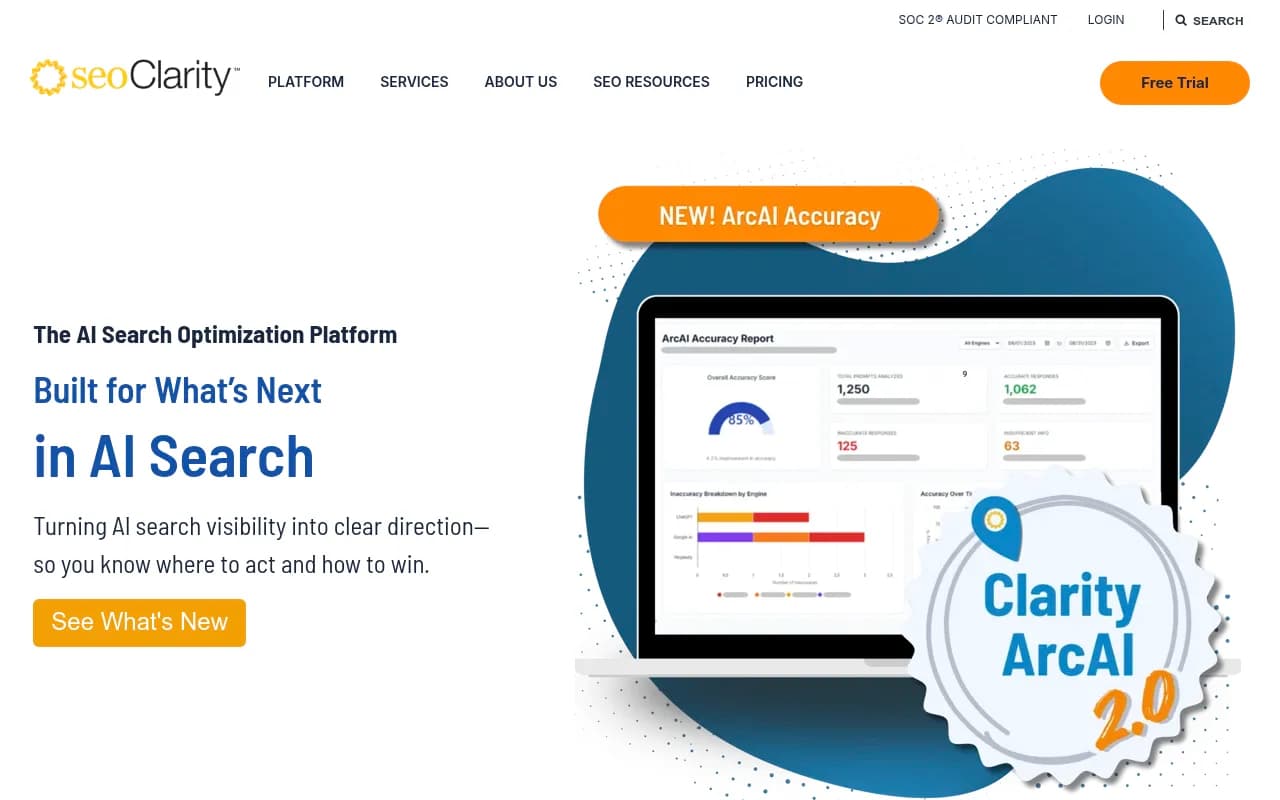
3. seoClarity ArcAI: Traditional Search Volume as Proxy
seoClarity takes a hybrid approach: use Google search volume as a baseline, then extrapolate to AI search.
How they calculate volume:
- Start with Google Keyword Planner data (mature demand baseline)
- Apply AI search multipliers based on query type and user behavior
- Estimate how traditional search volume translates to AI prompt demand
- Track correlation between Google searches and AI queries over time
The logic: Google still represents the majority of global search activity. If "best CRM software" gets 18,000 monthly Google searches, a significant portion of those users are also asking ChatGPT and Perplexity the same question. seoClarity's ArcAI model estimates that conversion rate.
The limitation: This is a proxy, not direct measurement. It works well for informational queries ("how to" guides, product comparisons) but breaks down for conversational AI-native prompts that don't have Google equivalents. Still, it's a data-driven approach that beats guessing.
seoClarity is enterprise-focused with custom pricing (typically $500+/month for mid-market teams).
What About Everyone Else?
The remaining 37+ AI visibility platforms fall into three categories:
Category 1: Fixed Prompt Lists (No Volume Data)
Tools like Otterly.AI, Peec.ai, AthenaHQ, and Search Party track a predefined list of 50-200 prompts. You can't add custom queries, and they provide zero volume estimates.
Otterly.AI

What you get: Citation tracking, share of voice, competitor mentions
What you don't get: Any indication of whether those prompts matter
Best for: Basic brand monitoring if you just want to know "are we mentioned at all?"
Category 2: Custom Prompts (Still No Volume Data)
Platforms like Profound (outside their 400M dataset), Scrunch, and Brandlight.ai let you add unlimited custom prompts—but still don't show volume estimates.
What you get: Flexible tracking, page-level citations, sentiment analysis
What you don't get: Prioritization data—you're still guessing which prompts to focus on
Best for: Teams that already know their high-value prompts from other research
Category 3: "AI Visibility Scores" (Vanity Metrics)
Some tools (SE Visible, Goodie AI, Gauge) provide an overall "AI visibility score" that aggregates citations across all tracked prompts. This sounds useful but is actually misleading—it treats all prompts as equally valuable.
The problem: A score of 7.2/10 tells you nothing. Are you winning high-volume prompts and losing low-volume ones? Or vice versa? You can't tell.
Best for: Executive dashboards where you need a single number to report, even if it's strategically useless
How to Evaluate Prompt Volume Data (The Right Questions to Ask)
If you're comparing AI visibility platforms, here's how to separate real demand data from marketing fluff:
Question 1: "Where does your volume data come from?"
Good answers:
- "We scrape real user queries from AI platforms"
- "We aggregate 400M+ prompt patterns from our monitoring network"
- "We use Google search volume as a baseline and apply AI-specific multipliers"
Bad answers:
- "Our AI estimates volume based on keyword difficulty" (that's not volume, that's competition)
- "We use proprietary algorithms" (translation: we made it up)
- "Volume data isn't available for AI search yet" (true for most platforms, but not all)
Question 2: "Can I see volume for custom prompts, or only your predefined list?"
Why this matters: If volume data only exists for the platform's fixed prompt list, you're locked into their assumptions about what matters. Custom prompt volume is the difference between a tool and a platform.
Best answer: "You can add any prompt and we'll estimate volume within 24-48 hours" (Promptwatch does this)
Question 3: "Do you show query variations and fan-outs?"
Why this matters: Real search demand is distributed across dozens of prompt variations. "Best email marketing software" and "top email marketing tools" and "email automation platforms" are all the same intent with different volumes.
If a platform only shows volume for the exact prompt you enter—without surfacing related queries—you're missing 80% of the demand landscape.
Best answer: "Yes, we show 15-20 related prompts with individual volume estimates for each"
Question 4: "How often do you update volume estimates?"
Why this matters: AI search is evolving rapidly. A prompt that had low volume in Q1 2026 might explode in Q2 as user behavior shifts. Static volume data becomes stale within weeks.
Good answers: Weekly or monthly updates based on fresh scraped data
Bad answers: "Our volume estimates are based on historical patterns" (i.e., they're not updating)
The Action Loop: What to Do With Prompt Volume Data
Having volume data is useless if you don't act on it. Here's the workflow that separates winners from losers:
Step 1: Find High-Volume, Low-Competition Prompts
Use your platform's volume + difficulty data to identify quick wins:
- High volume (5,000+ monthly queries)
- Medium-low difficulty (30-60/100)
- Currently zero or low citations for your brand
These are the prompts where you can realistically rank within 30-60 days with targeted content.
Example: A SaaS company discovers "project management tools for remote teams" has 8,200 monthly volume and 42/100 difficulty—but they're not cited at all. Competitor analysis shows most citations go to generic listicles. Opportunity: create a deep guide specifically for remote teams with async workflows, time zone management, and integration with Slack/Zoom.
Step 2: Create Content That Matches Prompt Intent
This is where most teams fail. They see a high-volume prompt and write a generic blog post. That doesn't work.
What AI models want:
- Comparison prompts ("X vs Y"): Side-by-side feature tables, pricing breakdowns, use case recommendations
- Best-of prompts ("best X for Y"): Ranked lists with specific criteria, not just "10 tools we like"
- How-to prompts ("how to do X"): Step-by-step guides with screenshots, not high-level overviews
- Alternative prompts ("alternatives to X"): Direct feature comparisons showing why your tool solves the same problem differently
Platforms like Promptwatch include an AI writing agent that generates content grounded in real citation data—it analyzes what currently ranks for that prompt and creates content engineered to compete.
Step 3: Track Results and Iterate
Publish your content, then monitor:
- Citation growth: Are AI models starting to cite your new page?
- Share of voice: Are you gaining ground vs competitors for that prompt?
- Traffic attribution: Are you seeing actual visitors from AI search? (Use Promptwatch's code snippet, GSC integration, or server log analysis to connect visibility to revenue)
If you're not seeing movement within 30 days, the content isn't resonating. Analyze winning competitors and iterate.
This is the cycle that separates optimization platforms from monitoring dashboards: Find gaps → Create content → Track results → Repeat.
Most AI visibility tools stop at step one. Promptwatch, Profound, and a handful of others support the full loop.
The Future of Prompt Volume Data (What's Coming in 2026-2027)
The AI visibility market is still immature. Here's what we expect over the next 12-18 months:
1. Real-Time Volume Tracking
Right now, even the best platforms update volume estimates weekly or monthly. As AI search grows, we'll see real-time demand spikes—a news event triggers a surge in related prompts, and brands that react within hours will dominate citations.
Expect platforms to add alerting: "Prompt volume for 'AI video tools' just increased 340% in the last 24 hours—create content now."
2. Intent Segmentation
Not all prompt volume is equal. 10,000 monthly queries from researchers ("what is X?") is less valuable than 1,000 queries from buyers ("best X for my use case").
Platforms will start segmenting volume by user intent:
- Informational: Learning, research, comparison
- Navigational: Looking for a specific brand or product
- Transactional: Ready to buy, need final validation
This lets you prioritize prompts based on conversion potential, not just raw volume.
3. Cross-Platform Volume Correlation
Google search volume, Reddit discussions, YouTube views, and AI prompts are all signals of demand. The next generation of tools will correlate volume across channels:
"This prompt has 6,200 monthly AI queries, 12,000 Google searches, and 340 Reddit threads—high confidence in demand."
Vs: "This prompt has 8,000 monthly AI queries but zero Google searches and no Reddit activity—likely low-quality or bot-generated traffic."
4. Predictive Volume Modeling
AI models will start predicting future demand based on early signals:
"This prompt currently has 400 monthly queries, but volume is growing 25% week-over-week and Reddit mentions are spiking—predicted to hit 3,000 queries within 60 days."
Early movers who create content before the spike will dominate citations as demand scales.
Platform Comparison: Prompt Volume Features
| Platform | Volume Data | Methodology | Custom Prompts | Query Fan-Outs | Difficulty Score | Update Frequency |
|---|---|---|---|---|---|---|
| Promptwatch | ✅ Yes | Scraped user data + aggregation | ✅ Unlimited | ✅ Yes (15-20 variations) | ✅ Yes (0-100) | Weekly |
| Profound | ✅ Yes | 400M+ prompt insights | ✅ Unlimited | ❌ No | ❌ No | Monthly |
| seoClarity ArcAI | ✅ Yes | Google volume proxy | ✅ Unlimited | ⚠️ Limited | ⚠️ Keyword difficulty (not prompt) | Monthly |
| Otterly.AI | ❌ No | N/A | ❌ Fixed list | ❌ No | ❌ No | N/A |
| Peec.ai | ❌ No | N/A | ✅ Unlimited | ❌ No | ❌ No | N/A |
| AthenaHQ | ❌ No | N/A | ✅ Unlimited | ❌ No | ❌ No | N/A |
| Search Party | ❌ No | N/A | ⚠️ Limited | ❌ No | ❌ No | N/A |
| Semrush | ⚠️ Indirect | Google volume only | ❌ Fixed list | ❌ No | ✅ Yes (traditional SEO) | Daily (for Google) |
| Ahrefs Brand Radar | ❌ No | N/A | ❌ Fixed list | ❌ No | ❌ No | N/A |
Who Needs Prompt Volume Data (And Who Doesn't)
You NEED volume data if:
- You're building a content strategy from scratch: Without volume, you're guessing which topics to prioritize
- You have limited resources: Can't create content for every prompt—need to focus on high-ROI queries
- You're in a competitive market: Need to find gaps where competitors aren't dominating yet
- You're measuring ROI: Need to connect AI visibility to actual traffic and revenue
You DON'T need volume data if:
- You're just monitoring brand mentions: If your goal is "are we mentioned at all," basic citation tracking is fine
- You already know your high-value prompts: If you've done the research elsewhere (customer interviews, sales calls), you just need tracking
- You're a household brand: If you're Nike or Salesforce, you'll rank for high-volume prompts by default—volume data is less critical
The Bottom Line: Volume Data Is the New Keyword Research
In 2010, doing SEO without keyword search volumes was malpractice. You'd never build a content strategy around keywords you thought were important without checking actual demand.
AI search is at that same inflection point right now.
The platforms that provide prompt volume data—Promptwatch, Profound, seoClarity—are building the foundation for the next decade of search optimization. The platforms that don't are building monitoring dashboards that will be obsolete within 18 months.
If you're serious about AI visibility, ask yourself: Am I optimizing for prompts people actually ask, or prompts I think sound important?
Because in 2026, the difference between those two strategies is the difference between traffic and vanity metrics.
Ready to see which prompts your competitors are winning (and how much demand they represent)? Promptwatch offers a free trial with full access to prompt volume data, query fan-outs, and difficulty scoring across 10 AI engines. Start tracking real demand →