Key Takeaways
- Gauge costs $95-399/mo and includes prompt tracking, citation analysis, content recommendations, and competitive benchmarking across 7 AI engines
- AI Peekaboo pricing isn't publicly listed (estimated $49-79/mo based on market positioning) but offers basic monitoring with multi-client management for agencies
- Gauge provides actionable recommendations and content gap analysis; Peekaboo stops at showing you the data without optimization guidance
- Neither platform offers AI crawler logs, prompt volume estimates, or built-in content generation -- features available in more comprehensive platforms like Promptwatch
- Gauge is better for brands that need strategic insights and want to improve their AI visibility; Peekaboo works for agencies doing simple client reporting
- If you're serious about AI search optimization, Gauge justifies the higher price with deeper analytics and actionable next steps
Overview
Gauge
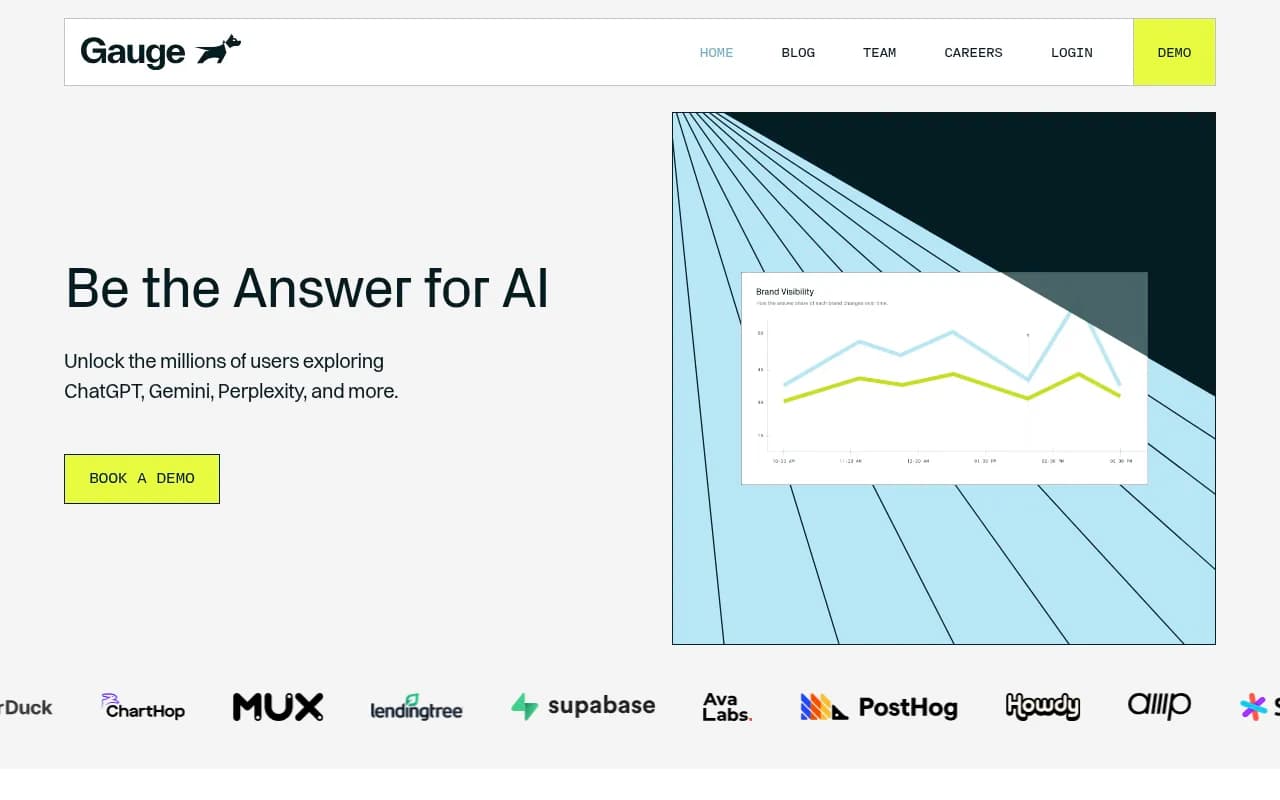
Gauge positions itself as a complete AI visibility platform that goes beyond monitoring. It tracks brand mentions across ChatGPT, Claude, Gemini, Perplexity, Copilot, Google AI Mode, and AI Overviews. The platform's core promise: track your mentions, understand what's working (and what's not), then take action to improve your presence.
The interface organizes around three stages -- Track, Understand, Act. You monitor AI-generated answers for your brand, analyze which content gets cited and which gets ignored, then receive recommendations for improving visibility. Gauge emphasizes competitive analysis and content gap identification.
Clients include MotherDuck, Supabase, and various B2B SaaS companies managing their AI search presence.
AI Peekaboo
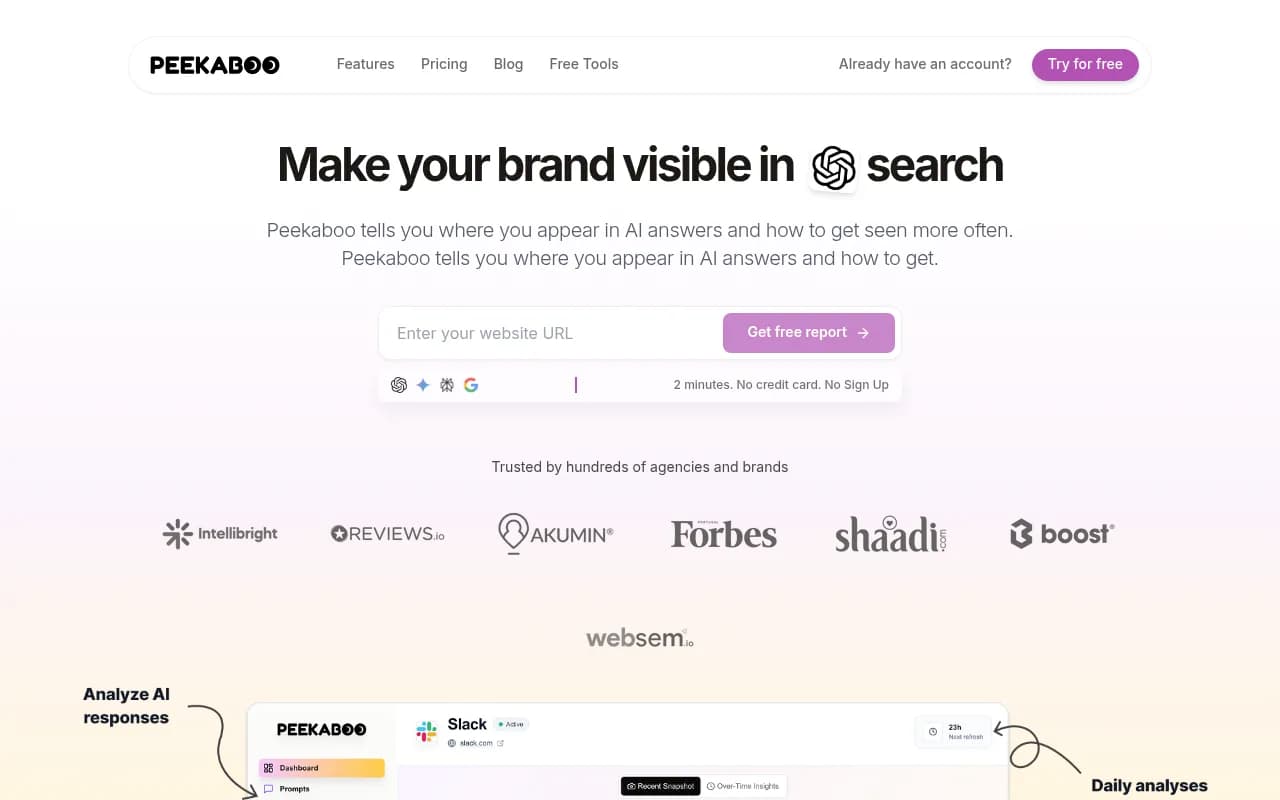
AI Peekaboo takes a simpler approach. It monitors brand mentions across ChatGPT, Perplexity, Gemini, and Google AI Overviews with a focus on basic visibility tracking. The platform shows you when AI models mention your brand and provides dashboards for tracking changes over time.
Peekaboo markets itself specifically to agencies managing multiple clients, with multi-client management built into the platform. The workflow: select prompts to track, analyze your visibility score, see how you stack up against competitors. It's monitoring-first, with less emphasis on optimization.
Pricing isn't publicly disclosed, which is a red flag for transparency. A 7-day free trial is available.
Side-by-side comparison
| Feature | Gauge | AI Peekaboo |
|---|---|---|
| Pricing | $95-399/mo (annual), Enterprise custom | Not disclosed (~$49-79/mo estimated) |
| Free trial | Yes | 7 days |
| AI engines tracked | 7 (ChatGPT, Claude, Gemini, Perplexity, Copilot, AI Mode, AI Overviews) | 4 (ChatGPT, Perplexity, Gemini, AI Overviews) |
| Citation analysis | Yes, detailed | Basic |
| Competitor tracking | Yes, with benchmarking | Yes, basic comparison |
| Content recommendations | Yes, actionable | No |
| Content gap analysis | Yes | No |
| Multi-client management | Not emphasized | Yes, agency-focused |
| AI crawler logs | No | No |
| Prompt intelligence | No | No |
| API access | Not mentioned | Not mentioned |
| Support | Email, demo calls | Not specified |
Coverage and monitoring capabilities
Gauge monitors seven AI engines: ChatGPT, Claude, Gemini, Perplexity, Copilot, Google AI Mode, and Google AI Overviews. That's broader coverage than Peekaboo's four engines (ChatGPT, Perplexity, Gemini, AI Overviews). The difference matters if you care about Claude or Copilot visibility -- two platforms with significant user bases.
Both tools let you define custom prompts to track. You're not stuck with a fixed prompt set, which is good. Gauge emphasizes tracking prompts across your entire category, not just branded searches. Peekaboo's interface shows a similar prompt selection workflow but doesn't detail how many prompts you can track per plan.
Neither platform offers real-time AI crawler logs -- the ability to see when ChatGPT or Claude's crawlers hit your website, which pages they read, or errors they encounter. That's a gap if you're trying to diagnose indexing issues. Tools like Promptwatch include crawler monitoring as a core feature, showing exactly how AI engines discover your content.

Verdict: Gauge wins on coverage breadth. Seven engines vs four is a meaningful difference, especially as Claude and Copilot usage grows.
Analytics and insights
Gauge's analytics focus on three layers: tracking mentions, understanding citation patterns, and identifying content gaps. The platform shows which of your pages get cited, which competitor pages beat you, and where your brand is completely invisible. The "Understand" stage analyzes what content is being left out and how you stack up in competitive benchmarks.
Peekaboo provides visibility scores and competitor comparisons but doesn't emphasize content gap analysis. The dashboards show when and how AI models mention your brand, with trend tracking over time. It's more about monitoring changes than diagnosing why those changes happen.
Neither platform offers prompt intelligence -- volume estimates, difficulty scores, or query fan-outs that show how one prompt branches into related searches. Without this, you're guessing which prompts are worth optimizing for. Comprehensive platforms provide this data to help you prioritize high-value, winnable prompts.
| Analytics feature | Gauge | AI Peekaboo |
|---|---|---|
| Mention tracking | Yes | Yes |
| Citation source analysis | Detailed | Basic |
| Competitor benchmarking | Yes, with category context | Yes, basic comparison |
| Content gap identification | Yes | No |
| Prompt volume data | No | No |
| Query fan-out analysis | No | No |
| Reddit/YouTube tracking | Not mentioned | Not mentioned |
Verdict: Gauge provides deeper insights. Peekaboo shows you the data; Gauge helps you understand what it means.
Actionable recommendations
This is where the platforms diverge sharply.
Gauge's "Act" stage delivers onsite and offsite recommendations for improving AI visibility. The platform identifies specific content gaps and suggests what to create or optimize. It's built around the idea that monitoring alone isn't enough -- you need guidance on what to fix.
Peekaboo doesn't emphasize recommendations. The workflow ends at analysis. You see your visibility score and competitor comparisons, but the platform doesn't tell you what to do about it. For agencies doing client reporting, that might be fine -- you're presenting the data and making recommendations yourself. For in-house teams, it's a gap.
Neither platform includes built-in content generation. You won't find an AI writing agent that creates articles optimized for AI search based on citation data and prompt analysis. That's a feature in platforms like Promptwatch, which combines gap analysis with content creation tools to close the loop from insight to action.
Verdict: Gauge wins decisively. Recommendations are the difference between a monitoring dashboard and an optimization platform.
Agency and multi-client features
Peekaboo explicitly targets agencies with multi-client management. You can track visibility for multiple brands from one account, which streamlines client reporting. The platform's marketing emphasizes this use case.
Gauge doesn't highlight agency features in its public materials. The focus is on individual brands managing their own AI presence. That doesn't mean it can't work for agencies, but it's not the primary positioning.
If you're an agency managing 5-10 clients and need simple dashboards to show AI visibility trends, Peekaboo's multi-client setup is an advantage. If you're managing one brand (or a few) and need strategic depth, Gauge's analytics matter more than account structure.
Verdict: Peekaboo for agencies doing basic reporting. Gauge for everyone else.
Pricing comparison
Gauge's pricing is transparent:
| Plan | Price | What you get |
|---|---|---|
| Starter | $95/mo (annual) | Core tracking and analytics |
| Growth | $399/mo | Advanced features, more prompts |
| Enterprise | Custom | Volume pricing, dedicated support |
Peekaboo doesn't list pricing publicly. Based on market positioning and feature set, it's likely in the $49-79/mo range for basic plans. The lack of transparency is frustrating -- you have to contact sales or sign up for the trial to find out what it costs.
Gauge's $95/mo entry point is reasonable for the feature set. You're paying for deeper analytics and actionable recommendations, not just monitoring. The $399/mo Growth plan likely includes more prompts, users, or advanced competitive analysis.
Peekaboo's estimated pricing is lower, but you're getting less. No content recommendations, fewer AI engines, and basic analytics. The value proposition is "cheap monitoring for agencies" rather than "strategic AI visibility platform."
Verdict: Gauge offers better value if you need optimization tools. Peekaboo might be cheaper but delivers less.
What's missing from both
Neither Gauge nor AI Peekaboo provides:
- AI crawler logs: Real-time monitoring of ChatGPT, Claude, and Perplexity crawlers hitting your site. You can't see which pages AI engines read, how often they return, or errors they encounter.
- Prompt intelligence: Volume estimates and difficulty scores for each prompt. Without this, you're optimizing blind.
- Content generation: Built-in AI writing tools that create articles optimized for AI search based on citation data.
- Reddit and YouTube tracking: Surface discussions that influence AI recommendations -- a channel most platforms ignore.
- Traffic attribution: Connect AI visibility to actual website traffic and revenue.
These gaps matter if you're serious about AI search optimization. Monitoring is step one. Understanding why you're invisible (crawler logs, prompt intelligence) and fixing it (content generation, gap analysis) are steps two and three. Gauge gets closer to step three than Peekaboo, but both stop short of a complete optimization loop.
Gauge pros and cons
Pros:
- Broader AI engine coverage (7 engines vs 4)
- Detailed citation analysis and content gap identification
- Actionable recommendations for improving visibility
- Competitive benchmarking with category context
- Transparent pricing
Cons:
- Higher price point ($95-399/mo)
- No AI crawler logs or prompt intelligence
- Not explicitly built for agency multi-client management
- No built-in content generation tools
AI Peekaboo pros and cons
Pros:
- Multi-client management for agencies
- Likely lower pricing (estimated $49-79/mo)
- Simple interface focused on core monitoring
- 7-day free trial
Cons:
- Pricing not publicly disclosed
- Fewer AI engines tracked (4 vs 7)
- No content recommendations or optimization guidance
- Basic analytics without strategic depth
- No crawler logs, prompt intelligence, or content tools
Who should pick Gauge
Choose Gauge if:
- You're an in-house marketing team managing AI visibility for one brand
- You need strategic insights, not just monitoring dashboards
- You want actionable recommendations for improving your AI presence
- You care about Claude and Copilot visibility in addition to ChatGPT and Perplexity
- You're willing to pay $95-399/mo for deeper analytics and optimization guidance
- You need competitive benchmarking to understand where you stand in your category
Gauge works for B2B SaaS companies, e-commerce brands, and any business that treats AI search as a strategic channel. The platform assumes you'll act on the insights, not just report them.
Who should pick AI Peekaboo
Choose AI Peekaboo if:
- You're an agency managing AI visibility for multiple clients
- You need simple dashboards for client reporting, not strategic optimization
- You're price-sensitive and want basic monitoring at the lowest cost
- You only care about ChatGPT, Perplexity, Gemini, and AI Overviews (not Claude or Copilot)
- You're comfortable making your own recommendations based on the data
- You don't need content gap analysis or optimization tools
Peekaboo is a reporting tool, not an optimization platform. It shows you the numbers. What you do with them is up to you.
Final verdict
Gauge is the better choice for most teams. It costs more ($95-399/mo vs an estimated $49-79/mo), but you're paying for strategic depth -- citation analysis, content gap identification, and actionable recommendations that help you improve AI visibility, not just monitor it.
AI Peekaboo works for agencies doing simple client reporting on a budget. The multi-client management is convenient, and the lower price point (assuming the estimate is accurate) makes sense if you're tracking visibility for 5-10 brands and don't need optimization guidance.
But here's the reality: both platforms are monitoring-first tools that stop short of a complete optimization loop. If you're serious about AI search, you need crawler logs to diagnose indexing issues, prompt intelligence to prioritize high-value queries, and content tools to fix the gaps you find. Gauge gets closer to this ideal than Peekaboo, but neither delivers the full package.
For teams that want to go beyond monitoring and actually improve their AI search presence, Gauge is the clear winner in this comparison. For agencies that just need dashboards, Peekaboo might be enough -- but ask yourself if "enough" is really what your clients are paying for.