Key Takeaways
- Pricing transparency: Gauge starts at $95/mo with public pricing tiers. Ansehn requires a demo call and doesn't disclose pricing upfront -- expect enterprise-level costs.
- Content generation: Gauge includes built-in content creation tools to close visibility gaps. Ansehn focuses on monitoring and recommendations but doesn't generate content for you.
- AI model coverage: Both track ChatGPT, Perplexity, Claude, and Google AI. Gauge adds Copilot and Gemini explicitly. Ansehn mentions Deepseek support.
- Target audience: Gauge is built for mid-market teams and agencies that want self-serve access. Ansehn positions itself for enterprise clients (Bosch, Aurubis) with custom implementations.
- Free trial: Gauge offers a free start option. Ansehn requires booking a 30-minute demo before you can see the platform.
- Action orientation: Gauge emphasizes a "track, understand, act" workflow with specific onsite and offsite recommendations. Ansehn focuses on measurement and benchmarking but leaves execution more open-ended.
Overview
Gauge
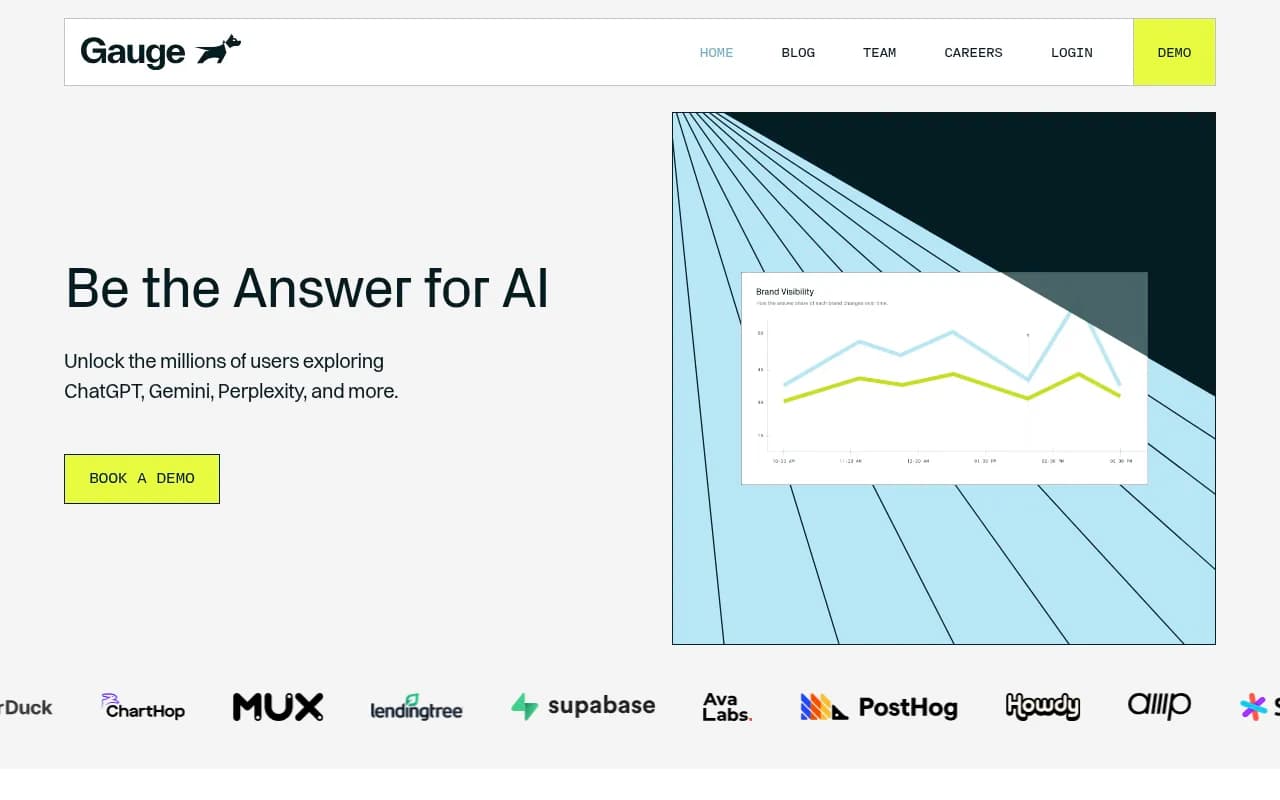
Gauge is an AI visibility platform that monitors brand mentions across ChatGPT, Claude, Gemini, Perplexity, Copilot, AI Mode, and AI Overviews. It's designed for marketing teams and agencies that want to track how their brand shows up in AI-generated search results, identify content gaps, and get actionable recommendations to improve visibility. The platform emphasizes a three-step workflow: track mentions, understand citation patterns and competitor positioning, then act on specific recommendations to close gaps. Gauge includes content creation tools to help teams generate AI-optimized content based on the gaps it identifies. Pricing starts at $95/mo with annual billing, scaling to $399/mo for the Growth plan and custom pricing for Enterprise.
Ansehn
Ansehn
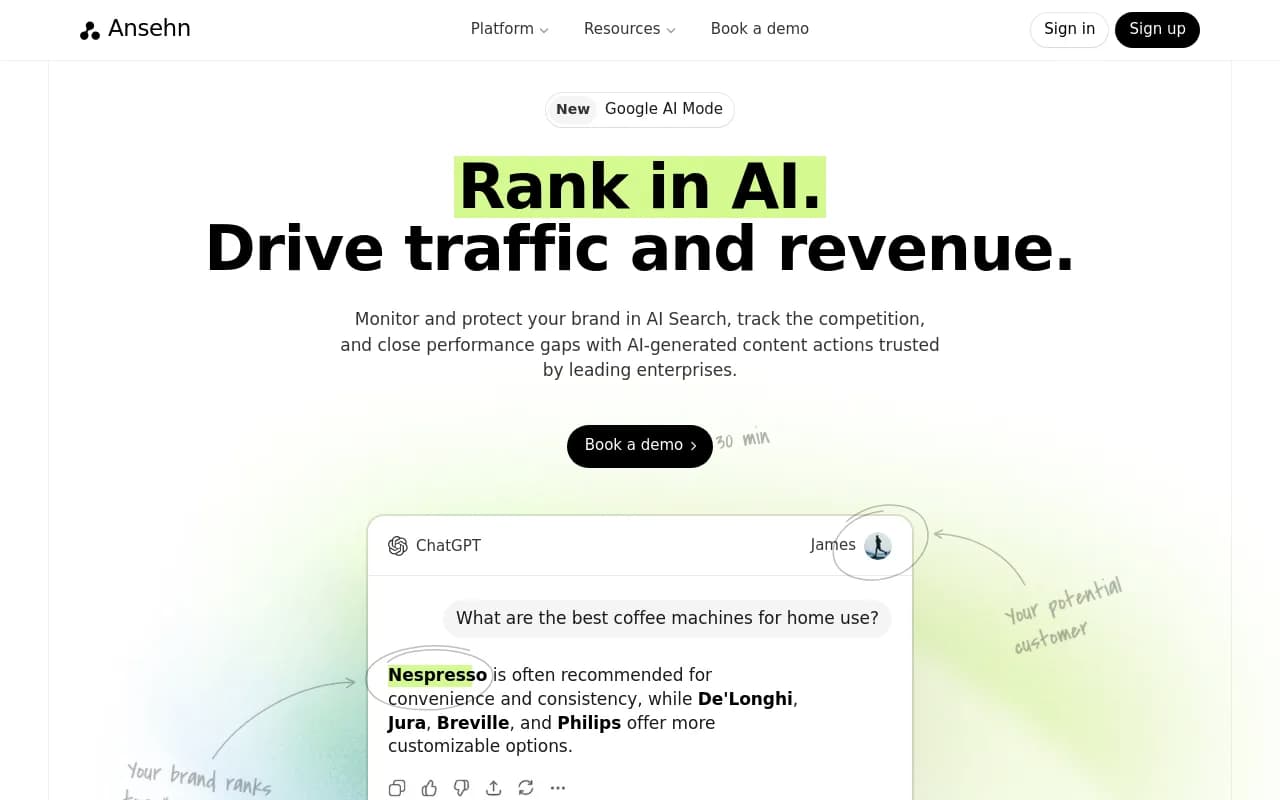
Ansehn is an AI search visibility platform that tracks brand rankings across ChatGPT, Perplexity, Google AI Mode, Claude, and Deepseek. It's built for marketing teams and agencies managing AI search optimization (GEO/AEO) for B2B and B2C brands. The platform focuses on three pillars: measure your rankings in AI search, understand what drives those rankings, and improve your position with content recommendations. Ansehn positions itself as an enterprise solution -- its customer logos include Bosch, Aurubis, and Pixum. Pricing is custom and requires a demo call. There's no free trial or public pricing tiers disclosed on the website.
Side-by-side comparison
| Feature | Gauge | Ansehn |
|---|---|---|
| Starting price | $95/mo (annual billing) | Custom (demo required) |
| Free trial | Yes (free start option) | No (demo required) |
| AI models tracked | ChatGPT, Claude, Gemini, Perplexity, Copilot, AI Mode, AI Overviews | ChatGPT, Perplexity, Claude, Google AI Mode, Deepseek, Gemini |
| Content generation | Built-in content creation tools | Recommendations only |
| Competitor benchmarking | Yes | Yes |
| Citation analysis | Yes (tracks what content is cited) | Yes |
| Gap identification | Yes (finds where brand is invisible) | Yes |
| Target audience | Mid-market teams, agencies | Enterprise clients |
| Pricing transparency | Public pricing tiers | Custom pricing only |
| Self-serve access | Yes | No (requires demo) |
| API access | Not mentioned | Yes (documentation available) |
| Social source tracking | Reddit mentioned | Not mentioned |
Feature deep-dive
AI model coverage
Gauge explicitly lists ChatGPT, Claude, Gemini, Perplexity, Copilot, AI Mode, and AI Overviews. The platform emphasizes broad coverage across the major LLMs that consumers and B2B buyers actually use.
Ansehn tracks ChatGPT, Perplexity, Claude, Google AI Mode, Deepseek, and Gemini. The inclusion of Deepseek is notable -- it's a newer model that most competitors haven't added yet. Ansehn also highlights Google AI Overview support prominently.
Verdict: Roughly equivalent coverage with minor differences. Gauge adds Copilot, Ansehn adds Deepseek. Both cover the core models that matter for most brands.
Tracking and measurement
Both platforms monitor brand mentions and rankings in AI-generated answers. Gauge's "Track" pillar focuses on detecting mentions across all monitored models. The platform shows you when your brand appears, how often, and in what context.
Ansehn's "Measure" pillar does the same -- it tracks rankings and benchmarks your position against competitors. The platform emphasizes ranking position ("Rank #1") as a core metric, similar to traditional SEO.
Verdict: Functionally similar. Both give you visibility into where and how often your brand is mentioned. The presentation differs slightly -- Gauge focuses on mention detection, Ansehn emphasizes ranking position.
Gap analysis and insights
Gauge's "Understand" step analyzes what content is being cited, what's missing, and how your brand compares to competitors. The platform identifies specific gaps where your brand is invisible and should be present.
Ansehn's "Understand" pillar focuses on what drives AI search rankings. The platform provides insights into why certain brands rank higher and what factors influence visibility.
Verdict: Gauge is more explicit about identifying content gaps. Ansehn focuses on understanding ranking drivers but is less specific about actionable gaps in the marketing materials.
Content creation and optimization
| Capability | Gauge | Ansehn |
|---|---|---|
| Content recommendations | Yes | Yes |
| Built-in content generation | Yes (mentioned in toolkit) | No |
| Onsite optimization guidance | Yes | Yes |
| Offsite recommendations | Yes (affiliates, Reddit) | Not mentioned |
Gauge includes content creation tools as part of its "Act" step. The platform helps teams write new content, audit existing pages, and engage with social sources like Reddit. It's positioned as a complete toolkit that takes you from insight to execution.
Ansehn provides content recommendations to improve visibility but doesn't appear to include built-in content generation. The "Improve" pillar focuses on AI-generated content actions, but the specifics suggest recommendations rather than actual content creation within the platform.
Verdict: Gauge wins on content creation. If you want a platform that helps you generate content to close gaps, Gauge is the better choice. Ansehn gives you the insights but leaves execution to your team.
Competitor analysis
Both platforms offer competitor benchmarking. Gauge shows how your brand stacks up against competitors in AI search results. Ansehn emphasizes tracking the competition and comparing performance.
Neither platform provides detailed specifics on competitor analysis features in their marketing materials, so it's hard to differentiate here without hands-on testing.
Verdict: Tie. Both offer competitor benchmarking as a core feature.
User interface and workflow
Gauge emphasizes a three-step workflow: Track, Understand, Act. The interface is designed around this linear progression from monitoring to action. The platform targets mid-market teams that want self-serve access without heavy onboarding.
Ansehn uses a similar three-pillar structure: Measure, Understand, Improve. The platform positions itself as an enterprise solution with custom implementations, suggesting a more consultative onboarding process.
Verdict: Gauge is likely easier to get started with for smaller teams. Ansehn's enterprise positioning suggests more complexity and customization.
Integrations and API
Gauge doesn't mention API access or integrations in the provided materials. The platform appears to be a standalone tool.
Ansehn explicitly mentions comprehensive guides and API reference in its documentation. This suggests programmatic access for teams that want to build custom workflows or integrate AI visibility data into other systems.
Verdict: Ansehn wins on extensibility if you need API access. Gauge is more of a closed platform.
Pricing comparison
| Plan | Gauge | Ansehn |
|---|---|---|
| Entry-level | $95/mo (annual billing) | Custom (demo required) |
| Mid-tier | Growth: $399/mo | Custom (demo required) |
| Enterprise | Custom pricing | Custom (demo required) |
| Free trial | Yes (free start) | No |
Gauge's pricing is transparent and accessible. You can start for free, then upgrade to $95/mo or $399/mo depending on your needs. Enterprise pricing is custom but you have clear self-serve options below that.
Ansehn doesn't disclose any pricing publicly. You have to book a 30-minute demo to learn what it costs. This is a classic enterprise sales motion -- expect pricing in the thousands per month based on the customer logos (Bosch, Aurubis) and the demo-required approach.
Verdict: Gauge is dramatically more accessible for small to mid-sized teams. Ansehn's pricing opacity suggests it's targeting larger budgets.
Pros and cons
Gauge pros
- Public pricing starting at $95/mo makes it accessible for smaller teams
- Free start option lets you test before committing
- Built-in content creation tools help you act on insights
- Explicit focus on Reddit and affiliate targeting
- Self-serve platform -- no mandatory demo calls
Gauge cons
- No API access mentioned for custom integrations
- Less emphasis on enterprise features and customization
- Newer brand with fewer recognizable enterprise customers
Ansehn pros
- API access for custom workflows and integrations
- Enterprise positioning with recognizable customer logos (Bosch, Aurubis)
- Deepseek support for teams tracking newer AI models
- Comprehensive documentation for technical teams
Ansehn cons
- No public pricing -- requires demo call to learn costs
- No free trial or self-serve option
- Content recommendations but no built-in content generation
- Higher barrier to entry for smaller teams
Who should pick which tool
Pick Gauge if:
- You're a mid-market brand or agency with a budget under $500/mo
- You want to start tracking AI visibility quickly without a sales call
- You need help creating content to close visibility gaps, not just identifying them
- You're targeting Reddit and affiliate channels as part of your AI visibility strategy
- You prefer self-serve tools over enterprise sales processes
Pick Ansehn if:
- You're an enterprise brand with a larger budget and custom requirements
- You need API access to integrate AI visibility data into existing systems
- You have a technical team that can build on top of the platform
- You're tracking Deepseek specifically (though this is a niche use case)
- You're comfortable with a consultative sales process and custom pricing
Consider Promptwatch if:
- You want the action loop that both Gauge and Ansehn are missing: not just tracking and recommendations, but actual content generation grounded in 880M+ citations, prompt volumes, and competitor analysis. Promptwatch shows you the gaps (Answer Gap Analysis), generates the content (AI writing agent), and tracks the results (page-level citation tracking + traffic attribution). It's the only platform that closes the loop from insight to content to revenue.

Final verdict
Gauge is the better choice for most teams. It's more accessible (public pricing, free start), more action-oriented (built-in content creation), and easier to get started with (no mandatory demo). The $95/mo entry point makes it realistic for mid-market brands and agencies that want to start tracking AI visibility without a massive commitment.
Ansehn is built for enterprise clients with larger budgets and custom requirements. If you need API access, have a technical team, and are comfortable with a consultative sales process, it's worth a demo call. But for most teams reading this comparison, Gauge's transparency and self-serve approach will be more appealing.
The real differentiator is content creation. Gauge helps you generate content to close gaps. Ansehn gives you recommendations but leaves execution to your team. If you want a platform that takes you from insight to action, Gauge is the clear winner.