Key Takeaways
- Gauge offers broader AI engine coverage (7 platforms) vs Briljant's 3, making it better for global brands tracking multiple LLMs
- Briljant is significantly cheaper at €49/month vs Gauge's $95/month starting price, with strong appeal for Dutch/European businesses needing GDPR compliance
- Gauge provides 3x more prompt testing capacity in comparable tiers and includes content creation tools that Briljant lacks entirely
- Briljant's localized Dutch support and European market focus make it the practical choice for Netherlands-based SMBs, while Gauge targets international agencies and enterprise teams
- Neither platform offers the full action loop of content gap analysis + AI content generation + crawler logs that platforms like Promptwatch provide, but both handle basic monitoring well
- Gauge has stronger competitor analysis features and affiliate targeting capabilities; Briljant keeps things simpler with straightforward visibility tracking
Overview: Two approaches to AI visibility
Gauge and Briljant both tackle the same core problem -- helping brands understand and improve how they show up in AI search results. But they take different paths to get there.
Gauge
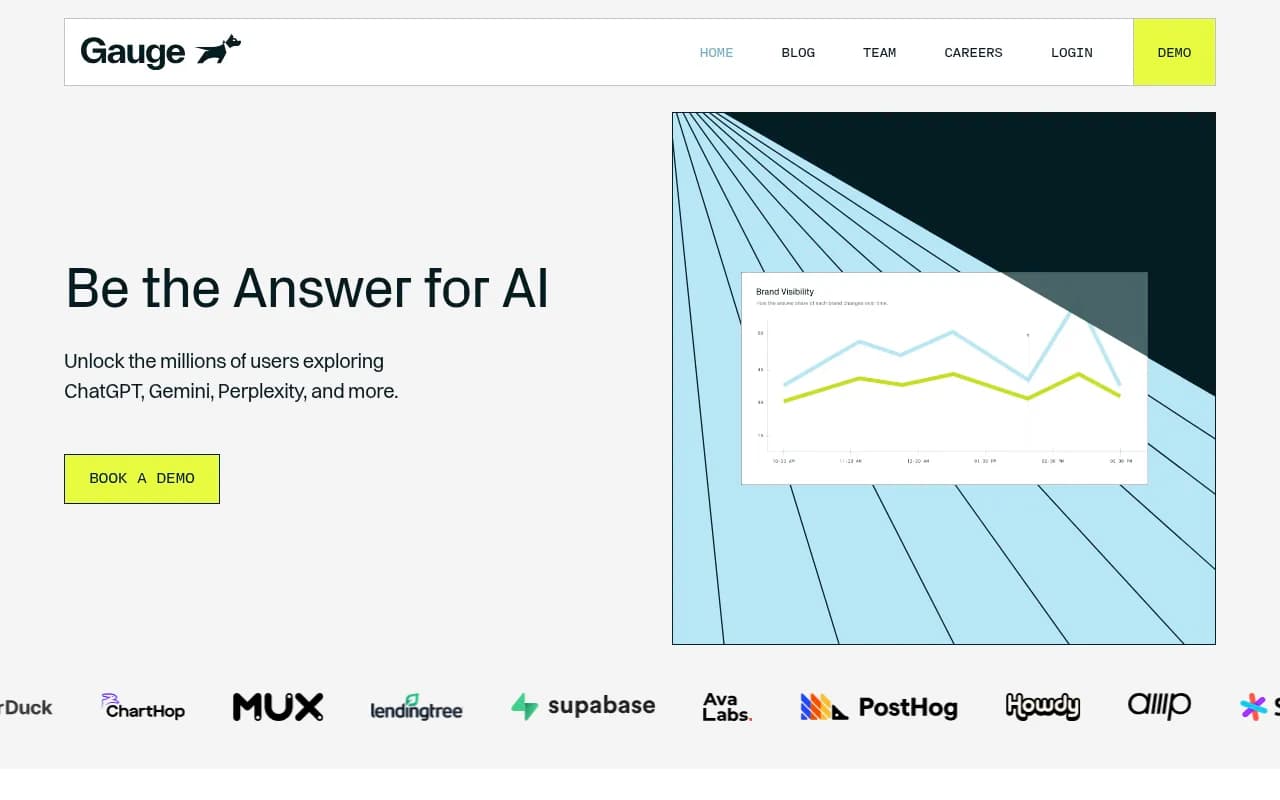
Gauge positions itself as a complete AI visibility platform covering ChatGPT, Claude, Gemini, Perplexity, Copilot, AI Mode, and AI Overviews. It monitors brand mentions across these engines, analyzes citation patterns, and provides recommendations for improving presence. The platform targets marketing teams and agencies managing AI visibility for multiple clients or brands. Pricing starts at $95/month with annual billing, jumping to $399/month for the Growth plan.
The platform emphasizes three pillars: Track (monitor AI-generated answers), Understand (analyze what's cited and find gaps), and Act (get onsite and offsite recommendations). Gauge includes tools for content audits, affiliate targeting, and social source engagement like Reddit.
Briljant
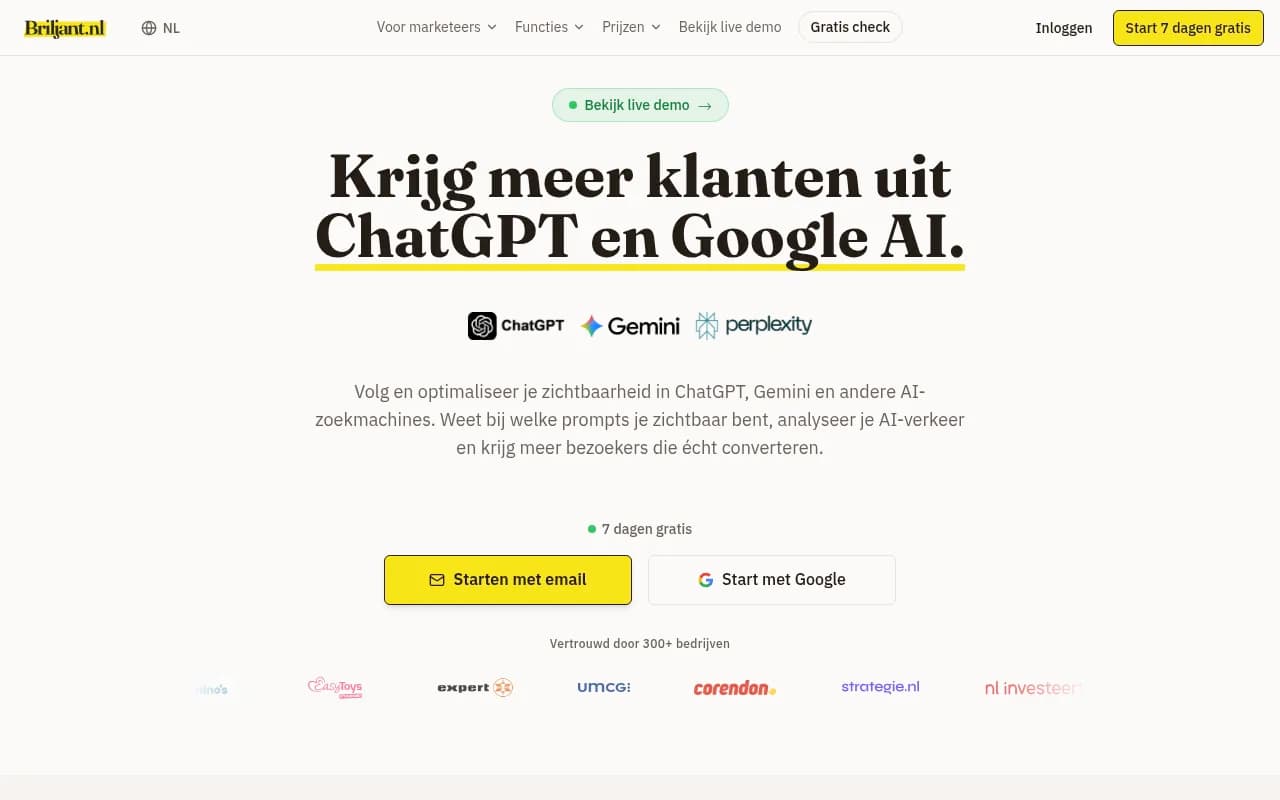
Briljant takes a more focused approach as a Netherlands-based GEO platform. It monitors ChatGPT, Google AI, and Perplexity with 3,000 prompts tested monthly. The platform is explicitly designed for Dutch businesses and agencies, offering localized support and GDPR compliance for European markets. Pricing is simpler: €49/month or €399/year after a 7-day free trial.
Briljant's pitch is straightforward -- track your AI visibility, compare against competitors, and optimize your content for AI discoverability. The platform includes AI analytics, prompt tracking, technical audits, and competitor comparison. It's used by 300+ Dutch companies including recognizable brands like Domino's, Easytoys, and Expert.
Side-by-side comparison
| Feature | Gauge | Briljant |
|---|---|---|
| AI engines covered | 7 (ChatGPT, Claude, Gemini, Perplexity, Copilot, AI Mode, AI Overviews) | 3 (ChatGPT, Google AI, Perplexity) |
| Prompts tested | Not disclosed (likely higher in Growth tier) | 3,000/month |
| Starting price | $95/mo (annual billing) | €49/mo (€399/year) |
| Free trial | Not mentioned | 7 days |
| Target market | Global, agencies, enterprise | Netherlands/Europe, SMBs |
| Content creation tools | Yes (content audits, recommendations) | No |
| Competitor analysis | Yes (detailed) | Yes (basic comparison) |
| Affiliate targeting | Yes | No |
| Reddit/social tracking | Yes | No |
| GDPR compliance | Not emphasized | Explicitly mentioned |
| Localized support | English | Dutch |
| Technical audits | Yes | Yes |
AI engine coverage
Gauge monitors seven AI platforms: ChatGPT, Claude, Gemini, Perplexity, Copilot, AI Mode, and AI Overviews. This broad coverage matters if you're tracking how different LLMs respond to the same prompts -- Claude might cite you while ChatGPT doesn't, or Perplexity might favor different sources than Gemini.
Briljant covers three: ChatGPT, Google AI (presumably AI Overviews), and Perplexity. For most businesses, these three represent the bulk of consumer AI search activity. ChatGPT dominates consumer LLM usage, Google AI Overviews appear in traditional search results, and Perplexity is the rising star for research queries.
The gap matters more for agencies managing multiple clients across different industries. A B2B software company might care deeply about Claude (popular with developers), while a consumer brand might only care about ChatGPT and Google. Briljant's three-engine approach covers the essentials; Gauge's seven-engine coverage is overkill for some, essential for others.
Verdict: Gauge wins for comprehensive coverage, but Briljant's focused approach is sufficient for most European SMBs.
Prompt testing volume
Briljant explicitly states 3,000 prompts tested per month. Gauge doesn't disclose prompt volumes on their website, which is frustrating -- this metric directly impacts how thoroughly the platform can assess your visibility.
3,000 prompts/month is respectable for a single brand or website. That's roughly 100 prompts per day, enough to cover your core product categories, competitor comparisons, and informational queries in your niche. For an agency managing 5-10 clients, you'd need to split that budget carefully.
Gauge's lack of transparency here is a red flag. The $95/month tier likely includes fewer prompts than the $399/month Growth plan, but without numbers, you're buying blind. If you're comparing these two, ask Gauge directly about prompt volumes before committing.
Verdict: Briljant wins on transparency. 3,000 prompts/month is a concrete number you can evaluate.
Pricing comparison
| Plan | Gauge | Briljant |
|---|---|---|
| Free trial | Not mentioned | 7 days |
| Entry tier | $95/mo (annual billing) | €49/mo |
| Mid tier | $399/mo (Growth) | N/A |
| Enterprise | Custom pricing | N/A |
| Annual discount | Required for $95 rate | €399/year (€33/mo effective) |
Briljant is cheaper, full stop. €49/month ($53 USD at current rates) vs $95/month is nearly half the cost. If you pay annually, Briljant drops to €33/month effective rate.
Gauge's $95/month requires annual billing -- the monthly rate is likely higher. The jump to $399/month for Growth is steep, and we don't know what you get for that 4x price increase without seeing their full pricing page.
Briljant's single-tier pricing is refreshing. You know exactly what you're getting: 3,000 prompts, three AI engines, competitor comparison, technical audits. No hidden tiers or surprise limitations.
Verdict: Briljant wins on price and transparency. Gauge's pricing structure feels opaque.
Content optimization and recommendations
Gauge emphasizes its "Act" pillar -- taking action based on visibility data. The platform provides onsite and offsite recommendations, content audits, and tools for targeting high-value affiliates. The website mentions helping teams "write new content" and "audit existing pages," though it's unclear if this includes AI-assisted content generation or just recommendations.
Briljant offers a "GEO Optimizer" for technical and content optimization, but the website doesn't detail what this includes. It's likely more basic -- identifying pages that aren't being cited and suggesting technical fixes.
Neither platform appears to offer the full content generation capabilities that platforms like Promptwatch provide, where you can generate articles grounded in citation data and prompt volumes. Gauge gets closer with content audits and recommendations, but you're still writing the content yourself.

Verdict: Gauge has more robust optimization features, but both platforms leave content creation largely manual.
Competitor analysis
Gauge includes detailed competitor analysis -- you can see how your brand stacks up against competitors across different AI engines and prompts. The platform lets you identify where competitors are winning and where you have opportunities.
Briljant offers competitor comparison as a core feature, letting you benchmark your AI visibility against rivals. The website doesn't detail how deep this goes, but for a €49/month tool, expect basic comparison metrics rather than granular prompt-by-prompt breakdowns.
For agencies pitching GEO services, robust competitor analysis is table stakes. You need to show clients exactly where they're losing to competitors and why. Gauge's emphasis on this feature suggests more depth.
Verdict: Gauge likely offers more detailed competitor analysis, though both platforms cover the basics.
Technical audits and optimization
Both platforms include technical audits to improve AI discoverability. This typically means:
- Identifying crawlability issues that prevent AI engines from reading your content
- Checking structured data and metadata that AI models use for context
- Analyzing page speed and mobile optimization (factors that indirectly affect AI citations)
- Reviewing content structure and semantic markup
Briljant explicitly mentions "technische optimalisatie" (technical optimization) as part of its GEO Optimizer. Gauge's "Act" pillar includes technical recommendations alongside content suggestions.
Neither platform appears to offer real-time AI crawler logs -- the ability to see when ChatGPT, Claude, or Perplexity actually crawl your site, which pages they read, and what errors they encounter. That's a more advanced feature found in platforms like Promptwatch.
Verdict: Tie. Both offer technical audits; neither provides real-time crawler monitoring.
Market positioning and target audience
Gauge targets international agencies and enterprise marketing teams. The website showcases clients like MotherDuck, Supabase, and other tech companies. The messaging emphasizes "complete control" and "the complete toolkit" -- positioning for sophisticated users managing complex AI visibility strategies.
Briljant explicitly targets Dutch businesses and agencies. The website is in Dutch, pricing is in euros, and the client list includes recognizable Dutch brands (Domino's Netherlands, Easytoys, Expert, UMCG, Corendon). The platform emphasizes GDPR compliance and local support -- critical for European businesses navigating data privacy regulations.
This positioning difference matters. If you're a Dutch marketing agency serving local clients, Briljant's localized approach and lower price point make it the obvious choice. If you're a global agency managing AI visibility for international clients across multiple markets, Gauge's broader engine coverage and English-language platform fit better.
Verdict: Depends entirely on your market. Briljant for Netherlands/Europe, Gauge for global/English-speaking markets.
Affiliate and social source tracking
Gauge includes tools for targeting high-value affiliates and engaging with social sources like Reddit. This matters because AI models increasingly cite Reddit discussions, YouTube videos, and affiliate review sites when answering product-related queries.
If you're in e-commerce or SaaS, understanding which Reddit threads and affiliate sites influence AI recommendations is valuable. You can then engage with those communities or build relationships with those affiliates.
Briljant doesn't mention affiliate targeting or social source tracking. The platform focuses on core visibility metrics -- which prompts mention your brand, how often, and how you compare to competitors.
Verdict: Gauge wins for advanced use cases involving affiliate marketing and social listening.
Ease of use and learning curve
Briljant's single-tier pricing and focused feature set suggest a simpler, more accessible platform. The website emphasizes getting started quickly with a 7-day free trial. For a Dutch SMB owner or solo marketer, this simplicity is a feature, not a bug.
Gauge's multi-tier pricing and broader feature set imply more complexity. The platform likely requires more onboarding and training to use effectively. For an agency team, that's fine -- you have the resources to learn the tool. For a small business owner juggling multiple responsibilities, it's friction.
Neither platform has public demo videos or detailed walkthroughs on their websites, which is frustrating. You're buying somewhat blind until you book a demo or start a trial.
Verdict: Briljant likely has a gentler learning curve; Gauge offers more power at the cost of complexity.
Reporting and analytics
Both platforms include AI analytics and reporting, but details are sparse on both websites.
Gauge emphasizes "track and analyze" with dashboards showing brand mentions, citation patterns, and competitor comparisons. The platform likely includes exportable reports for client presentations.
Briljant includes "AI analytics & rapportage" (reporting) as a core feature. For a €49/month tool, expect standard dashboards and CSV exports rather than custom reporting or API access.
Neither platform mentions API access or integrations with other marketing tools (Google Analytics, Looker Studio, etc.). If you need to pipe AI visibility data into your existing reporting stack, you'll likely need to export and import manually.
Verdict: Tie. Both offer basic reporting; neither appears to offer advanced integrations.
Pros and cons
Gauge pros
- Broader AI engine coverage (7 platforms vs 3)
- More robust content optimization and recommendation features
- Affiliate targeting and social source tracking
- Better suited for agencies managing multiple clients
- Detailed competitor analysis
Gauge cons
- Higher starting price ($95/mo vs €49/mo)
- Opaque pricing structure -- unclear what you get at each tier
- No disclosed prompt volumes
- Likely steeper learning curve
- No free trial mentioned
Briljant pros
- Significantly cheaper (€49/mo or €33/mo annual)
- Transparent pricing and features (3,000 prompts/month)
- 7-day free trial
- Localized for Dutch/European market with GDPR compliance
- Simpler, more accessible for SMBs
- Covers the three most important AI engines
Briljant cons
- Limited to three AI engines (no Claude, Copilot, etc.)
- No affiliate targeting or social source tracking
- Less detailed competitor analysis
- Dutch-language interface may not suit international teams
- Fewer advanced optimization features
Who should pick which tool
Choose Briljant if you:
- Are based in the Netherlands or Europe and need GDPR compliance
- Serve primarily Dutch-speaking clients or markets
- Want a straightforward, affordable tool for basic AI visibility tracking
- Don't need coverage beyond ChatGPT, Google AI, and Perplexity
- Prefer transparent pricing and a simple feature set
- Are a small business or solo marketer without a dedicated team
Choose Gauge if you:
- Manage AI visibility for international clients across multiple markets
- Need comprehensive coverage of 7+ AI engines including Claude and Copilot
- Want advanced features like affiliate targeting and Reddit tracking
- Are an agency with the budget and team to leverage complex tools
- Need detailed competitor analysis and content optimization recommendations
- Serve tech/SaaS clients who care about developer-focused LLMs like Claude
Consider Promptwatch if you:
- Want the full action loop: find content gaps, generate optimized content, track results
- Need real-time AI crawler logs to see exactly when and how AI engines read your site
- Want prompt volume estimates and difficulty scores to prioritize high-value opportunities
- Need Reddit and YouTube insights that directly influence AI recommendations
- Want to track ChatGPT Shopping and product recommendation visibility
- Are serious about treating AI visibility as a core marketing channel, not just a monitoring exercise
Final verdict
Briljant is the smarter choice for Dutch and European businesses that want affordable, straightforward AI visibility tracking. At €49/month with 3,000 prompts and coverage of the three most important AI engines, it delivers solid value without complexity. The localized support and GDPR compliance are real advantages for European markets.
Gauge makes sense for international agencies and enterprise teams that need comprehensive coverage across seven AI engines and advanced features like affiliate targeting. But the opaque pricing and lack of disclosed prompt volumes are frustrating -- you're paying a premium without clear visibility into what you're getting.
Neither platform offers the full optimization loop that makes AI visibility actionable at scale. If you're serious about not just tracking but actually improving your AI search presence, look at platforms that combine monitoring with content gap analysis, AI-assisted content generation, and real-time crawler insights. Tracking is step one; optimization is where the real value lives.