JetOctopus Review 2026
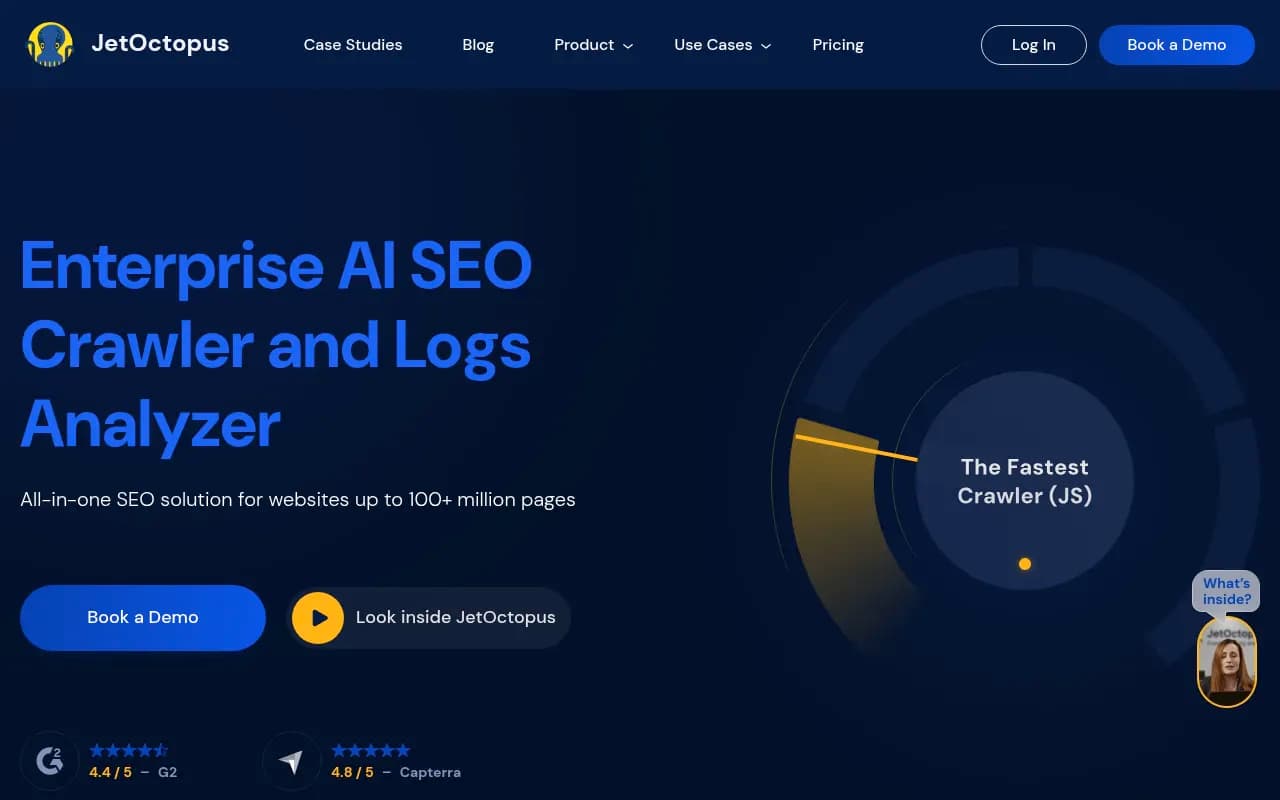
JetOctopus is a cloud-based technical SEO platform combining JavaScript crawling, log file analysis, and Google Search Console integration for large websites (10K to 100M+ pages). Used by Fiverr, IHG, and 35,000+ sites, it helps enterprise SEO teams optimize crawl budget, fix indexation issues, and
Key Takeaways:
- Built for scale: Cloud-based crawler handles 10K to 100M+ pages with no crawl limits, no project caps, and unlimited historical data retention
- Three tools in one: Combines JavaScript rendering crawler, real-time log file analyzer, and extended GSC integration in a single platform
- Action-oriented insights: Pre-configured charts, AI-powered internal linking suggestions, and custom alerts help teams fix issues fast instead of drowning in data exports
- Best for: Enterprise SEO teams, large e-commerce sites, and agencies managing 10K+ page websites that need crawl budget optimization and indexation control
- Pricing: Starts around $99/mo for smaller sites; custom enterprise pricing for high-volume crawls and log analysis
JetOctopus is a cloud-based technical SEO platform built specifically for large websites -- think 10,000 pages and up, scaling to 100 million or more. Founded by a team of Ukrainian SEO engineers, the tool has crawled over 10 billion pages and processed 380 billion log lines for 35,000+ websites including Fiverr, IHG Hotels, Kiwi.com, CVS, Whirlpool, and Seeking Alpha. It's rated 4.4/5 on G2 and 4.8/5 on Capterra, with endorsements from SEO experts like Kevin Indig (growth advisor at Hims, Softr, Riverside), Aleyda Solís, and Fili Wiese (ex-Google engineer).
What sets JetOctopus apart from desktop crawlers like Screaming Frog or enterprise platforms like Botify and Lumar (formerly DeepCrawl) is its combination of three core capabilities in one interface: a next-generation JavaScript crawler, a real-time log file analyzer, and deep Google Search Console integration. Most competitors force you to use separate tools or export CSV files to connect these datasets. JetOctopus merges them automatically, letting you see how Googlebot crawls your site, what it renders, and which pages actually get impressions and clicks -- all in one dashboard.
The core problem JetOctopus solves: On large websites, Google doesn't crawl every page equally. You have a crawl budget -- a finite number of pages Googlebot will visit per day. If Google wastes time on low-value pages (faceted navigation, duplicate content, broken URLs), your important pages don't get indexed or updated. JetOctopus shows you exactly where crawl budget is being wasted and helps you redirect it to pages that drive revenue.
Visualized Log File Analyzer
This is JetOctopus's standout feature. Most log analyzers (Screaming Frog Log File Analyzer, Botify Analytics, OnCrawl) show you raw tables of bot activity. JetOctopus visualizes it with charts, heatmaps, and pre-configured reports that answer specific questions: Which pages is Googlebot crawling most? Which pages get zero bot visits despite being important? How long does it take for new content to get crawled? What's your crawl budget waste percentage?
You upload server logs (Apache, Nginx, IIS, Cloudflare, AWS CloudFront) or integrate live via a two-line code snippet. The platform processes logs in real-time and shows you:
- Crawl budget distribution: See which sections of your site consume the most bot visits (e.g. 40% of crawls hitting pagination URLs that shouldn't be indexed)
- Crawl delay tracking: Measure the time gap between when you publish a page and when Googlebot first visits it -- critical for news sites and time-sensitive content
- Bot behavior by status code: Identify if Googlebot is wasting crawls on 404s, 301 chains, or soft 404s
- Crawl frequency heatmaps: Visual calendar showing which days/hours bots are most active, helping you time site updates and deployments
- User-agent breakdowns: Separate data for Googlebot Desktop, Googlebot Mobile, Googlebot Image, Bingbot, and other crawlers
Unlike competitors that charge per log line or cap historical data at 90 days, JetOctopus has no log line limits and retains all historical data as long as you're a customer. This is huge for enterprise sites that generate millions of log entries per day.
Next-Generation JavaScript Crawler
Many large sites (especially e-commerce, SaaS, and React/Vue/Angular apps) rely on JavaScript to render content. Google can render JS, but it's a two-stage process: first it crawls the raw HTML, then it queues the page for rendering (which can take days or weeks). If your critical content only appears after JS execution, you have an indexation problem.
JetOctopus crawls your site twice: once with JS disabled (showing what Google sees in the initial HTML) and once with full Chrome rendering (showing what appears after JS executes). Side-by-side comparison reports highlight:
- Content that only appears in JS: Headings, product descriptions, prices, reviews that Google might miss
- Links that only exist after JS: Internal links that don't pass PageRank because they're not in the raw HTML
- Lazy-loaded images: Images that load on scroll but might not be indexed
- Render-blocking resources: Scripts and stylesheets that delay page rendering
The crawler is cloud-based, so it doesn't paralyze your local machine like Screaming Frog does on 100K+ page crawls. Speed is a major selling point -- JetOctopus claims to be one of the fastest crawlers on the market, with users reporting multi-million page crawls completing in hours instead of days.
Crawl settings include:
- Custom user-agents (desktop, mobile, Googlebot)
- Crawl speed throttling to avoid overloading your server
- Custom extraction rules (pull specific data from pages using CSS selectors or regex)
- Sitemap and robots.txt validation
- Pagination and faceted navigation handling
- Hreflang and canonical tag analysis
Google Search Console Integration (GSC on Steroids)
Google Search Console limits you to 1,000 rows per export and 16 months of data. JetOctopus pulls your full GSC dataset (no row limits) and stores it indefinitely. More importantly, it merges GSC data with crawl data and log data, so you can answer questions like:
- Which pages get Googlebot crawls but zero impressions? (Indexation problem)
- Which pages get impressions but zero clicks? (Title/meta description problem)
- Which pages get clicks but have technical SEO issues? (Prioritize fixes by traffic impact)
- Which keywords drive impressions to pages with slow load times? (Speed optimization targets)
Pre-configured reports include:
- SEO Efficiency Dashboard: Combines crawl health, bot activity, and SERP performance in one view
- Keyword Cannibalization Detector: Finds multiple pages ranking for the same query
- Low-Hanging Fruit Report: Pages ranking 11-30 that could jump to page one with optimization
- Declining Pages Alert: Pages that lost impressions or clicks week-over-week
You can also create custom segments (e.g. "product pages with 500+ impressions but <2% CTR") and export them to Google Sheets with one click -- a workflow improvement over manual CSV wrangling.
AI-Powered Internal Linking Tool
Internal linking at scale is a nightmare. On a 50,000-page e-commerce site, manually adding contextual links is impossible. JetOctopus's AI Internal Linker analyzes your content and suggests relevant internal links based on:
- Semantic similarity between pages
- Anchor text relevance
- PageRank flow (prioritize linking to high-value pages)
- Crawl depth (surface deep pages that are hard to reach)
You review the suggestions, approve them, and export a list for your dev team to implement. This is similar to LinkWhisper or Link Whisper for WordPress, but built for enterprise sites on any CMS.
Custom Alerts
Set up automated alerts for:
- Crawl issues: Sudden spike in 404s, 500 errors, or redirect chains
- Googlebot activity: Drop in crawl rate or increase in crawl errors
- SERP performance: Pages losing impressions or clicks
- Page speed: Core Web Vitals degradation
Alerts go to Slack, email, or webhook. This is critical for large teams where one person can't manually check dashboards every day.
Preset Charts and Unlimited Dataset Joins
JetOctopus comes with 50+ pre-configured charts (e.g. "Pages with Thin Content", "Orphan Pages", "Redirect Chains", "Slow Pages by Traffic"). You don't have to build these from scratch like you do in Screaming Frog or Sitebulb.
The "Join Datasets" feature lets you merge any two data sources on the fly -- crawl data + GSC data, log data + GA4 data, etc. -- without writing SQL or exporting to Excel. This is a massive time-saver for technical SEOs who spend hours in spreadsheets.
Who Is JetOctopus For?
JetOctopus is built for enterprise SEO teams and agencies managing large websites (10,000+ pages). Specific personas:
- E-commerce SEO managers at sites with 50K-10M product pages (Fiverr, Trendyol, Kiwi.com) who need to optimize crawl budget and fix indexation issues across category pages, filters, and facets
- In-house SEO teams at SaaS companies with large documentation sites, blog archives, or JavaScript-heavy apps (DataRobot, HealthTap) who need to ensure Google renders their content correctly
- SEO agencies managing 10-50 client sites who need unlimited projects, unlimited users, and white-label reporting
- News and media sites (Distractify, Seeking Alpha) that publish hundreds of articles per day and need real-time crawl delay tracking to ensure new content gets indexed fast
- Enterprise brands (IHG Hotels, CVS, Whirlpool) with multi-regional, multi-language sites that need hreflang validation and international SEO tracking
Who should NOT use JetOctopus: Small businesses with <10K pages, solo bloggers, or anyone who just needs a one-time site audit. Screaming Frog Desktop (free up to 500 URLs, $259/year for unlimited) or Sitebulb ($35-$99/mo) are better fits. JetOctopus is overkill unless you're dealing with scale, crawl budget issues, or need log file analysis.
Integrations & Ecosystem
JetOctopus integrates with:
- Google Search Console: Full data sync, no API limits
- Google Analytics 4: Pull organic traffic data and merge with crawl/log data
- PageSpeed Insights: Automated Core Web Vitals scoring for every crawled URL
- Google Sheets: One-click export of any report
- Slack: Alert notifications
- Looker Studio (formerly Data Studio): Pre-built dashboards for client reporting
- API access: Build custom workflows or pull data into your own BI tools
No Zapier integration, but the API is well-documented. No browser extension or mobile app -- this is a desktop web app.
Pricing & Value
JetOctopus doesn't publish exact pricing on the website (you have to book a demo), but based on user reviews and competitor comparisons:
- Starter/Small Site Plan: Around $99-$149/mo for sites up to 50K-100K pages
- Professional Plan: Around $249-$399/mo for sites up to 500K-1M pages, includes log analysis and GSC integration
- Enterprise Plan: Custom pricing for 1M-100M+ pages, includes dedicated support, Slack access, and SEO audits from the JetOctopus team
All plans include:
- Unlimited projects (no extra charge per domain)
- Unlimited users (no seat-based pricing)
- Unlimited crawl pages (no caps on how many pages you crawl per month)
- Unlimited log lines (no caps on log file volume)
- Unlimited historical data retention (as long as you're a customer)
Annual billing gets you 25% off. Free trial available (typically 14 days).
How does this compare to competitors?
- vs Screaming Frog: SF is $259/year but desktop-only, slow on large crawls, no log analysis, no GSC integration. JetOctopus is cloud-based, faster, and merges all data sources.
- vs Botify: Botify is enterprise-only, starts around $500-$1,000/mo, similar feature set but more expensive and less user-friendly according to reviews.
- vs Lumar (DeepCrawl): Lumar is $300-$600/mo, strong log analysis but clunky UI and slower crawls. JetOctopus is faster and cheaper.
- vs Sitebulb: Sitebulb is $35-$99/mo, great for audits but no log analysis, no GSC integration, desktop-only. Not built for enterprise scale.
- vs OnCrawl: OnCrawl is $50-$500/mo, strong log analysis but weaker crawler and limited GSC features. JetOctopus is more complete.
JetOctopus's "no limits" pricing model is a major differentiator. Most competitors charge per page crawled, per log line, or per user. JetOctopus charges a flat monthly fee based on site size, then lets you crawl and analyze as much as you want. For agencies managing 20+ client sites, this is a huge cost saver.
Strengths
- Speed: Consistently praised as one of the fastest crawlers, especially for multi-million page sites
- Data visualization: Pre-configured charts and dashboards save hours of manual report building
- Log file analysis: Best-in-class log analyzer with real-time processing and unlimited retention
- No artificial limits: Unlimited projects, users, crawls, logs, and historical data
- Customer support: Human support via Slack, email, and scheduled calls -- not just a ticketing system. Enterprise customers get dedicated SEO audits and strategy sessions.
- GSC integration: Full data pull with no row limits, merged with crawl and log data
Limitations
- Pricing transparency: No public pricing page -- you have to book a demo to get a quote. This is common for enterprise tools but frustrating for smaller teams.
- Learning curve: The platform is powerful but dense. New users report needing a few weeks to fully understand all the features and reports.
- No rank tracking: JetOctopus doesn't track keyword rankings like Ahrefs or Semrush. You get GSC impressions/clicks data, but not daily rank positions.
- Limited backlink analysis: No backlink checker or link building tools. You'll still need Ahrefs, Majestic, or Moz for off-page SEO.
- Overkill for small sites: If you have <10K pages, you don't need this level of tooling. Screaming Frog or Sitebulb are better fits.
Bottom Line
JetOctopus is the best choice for enterprise SEO teams and agencies managing large, complex websites (10K to 100M+ pages) who need to optimize crawl budget, fix indexation issues, and scale internal linking. The combination of JavaScript rendering, real-time log analysis, and unlimited GSC data in one platform saves hours of manual work and gives you insights that competitors miss. The "no limits" pricing model makes it especially attractive for agencies managing multiple client sites.
Best use case in one sentence: E-commerce sites with 50K+ product pages that need to stop wasting crawl budget on faceted navigation and get their new products indexed faster.
Frequently asked questions
What is JetOctopus and what does it do?
Who is JetOctopus best for?
How much does JetOctopus cost?
Is JetOctopus free to use?
How is JetOctopus different from Screaming Frog?
What makes JetOctopus different from Botify or Lumar?
Can JetOctopus crawl JavaScript websites?
How many pages can JetOctopus crawl?
Does JetOctopus integrate with Google Search Console?
What is log file analysis in JetOctopus?
Similar and alternative tools to JetOctopus