Answer Socrates Review 2026
Specializes in discovering keywords and prompts that drive visibility in generative AI search engines for content optimization strategies.
Summary: Key Takeaways
• Best for: Content marketers, bloggers, and SEO professionals who need to generate hundreds of keyword ideas and questions quickly from a single seed topic -- especially useful for building comprehensive content strategies and topic clusters • Standout strength: Combines traditional keyword research with AI visibility tracking (LLM Brand Tracker) and trending topics discovery in one platform -- most competitors focus on only one of these areas • Pricing advantage: Generous free tier with unlimited searches (limited features), paid plans start at $15/mo -- significantly cheaper than enterprise tools like Ahrefs or Semrush • Main limitation: Search volume and competition data quality may not match enterprise-grade tools; clustering algorithm works best with larger keyword sets • Bottom line: If you need to rapidly generate content ideas, find what people are actually asking, and track your AI search visibility without spending $100+/month, Answer Socrates delivers exceptional value
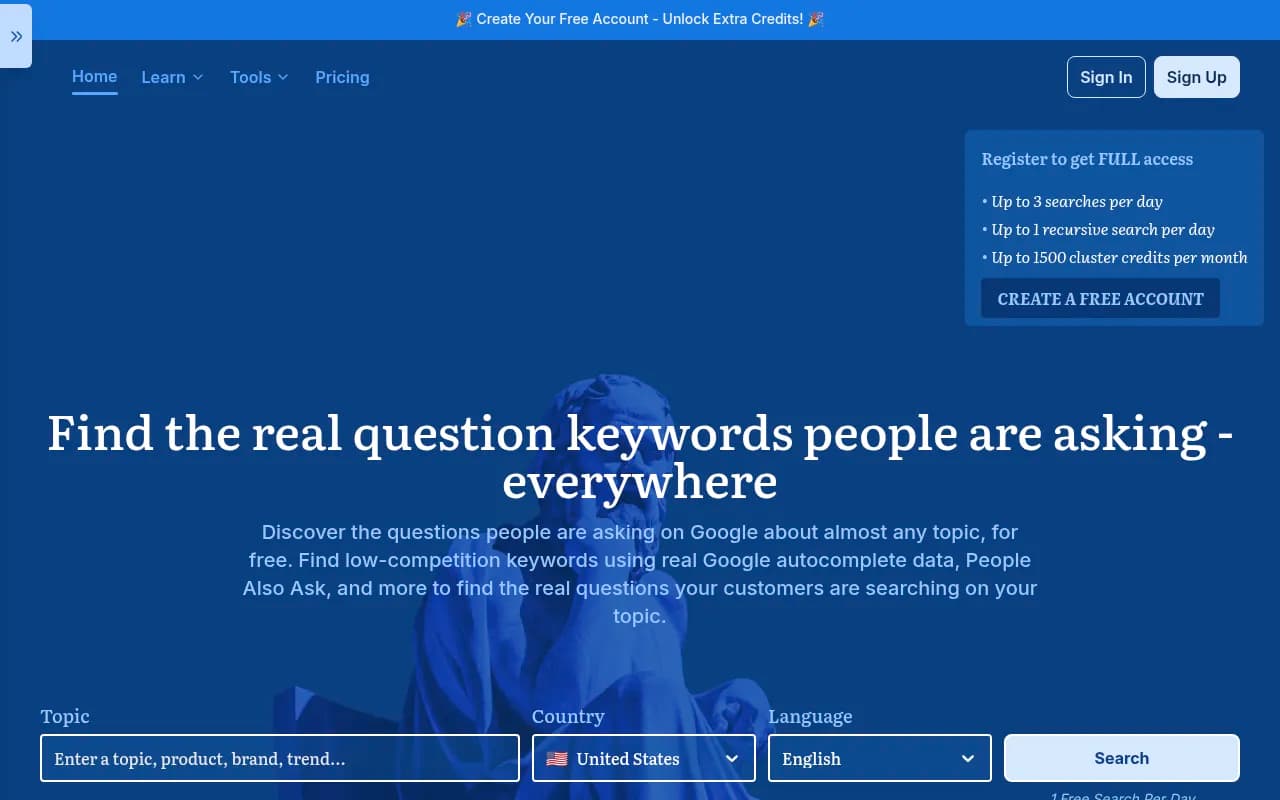
Answer Socrates has quietly become one of the most widely-used keyword research tools on the market, trusted by over 1 million marketers across 150+ countries. Built by a team focused on making SEO research accessible and fast, the platform takes a fundamentally different approach than traditional keyword tools: instead of starting with keyword difficulty scores and backlink analysis, it starts with the actual questions people are typing into search engines right now. The result is a tool that feels less like an SEO analytics dashboard and more like a content idea generator that happens to include all the metrics you need.
What makes Answer Socrates particularly relevant in 2026 is its dual focus on both traditional search (Google) and AI search engines (ChatGPT, Perplexity, Gemini, Grok, Claude). While most keyword tools are still optimizing for blue links, Answer Socrates added an LLM Brand Tracker that shows whether AI models are actually citing or recommending your brand -- a critical blind spot for most content teams who are investing heavily in SEO without realizing they're invisible in AI search results.
Keyword Research + Question Generation The core feature is deceptively simple: enter a seed keyword, and Answer Socrates returns hundreds (sometimes thousands) of related search queries, organized by question type. You get "how to" questions, "what is" definitions, "best" comparisons, "vs" alternatives, location-based queries, and more. These aren't AI-generated suggestions -- they're pulled from real Google search data, autocomplete suggestions, and People Also Ask boxes.
What sets this apart from tools like AnswerThePublic (which visualizes questions but lacks metrics) or Ubersuggest (which focuses on broad match keywords) is the depth and organization. Each question comes with search volume, CPC (cost-per-click for Google Ads), and competition level. You can sort by volume to prioritize high-traffic opportunities or filter by question type to build FAQ sections. The interface is fast -- results load in seconds, not minutes like some enterprise tools.
The "recursive search" feature is particularly powerful: click any generated keyword and Answer Socrates will run a new search on that term, letting you drill down into sub-topics. For example, searching "content marketing" might surface "content marketing strategy," which you can then expand to find "content marketing strategy for B2B SaaS" and keep going. This makes it easy to map out an entire content silo in one session.
Keyword Clustering & Grouping This is where Answer Socrates moves beyond basic keyword generation into strategic content planning. The clustering algorithm groups related keywords together automatically, showing you which terms can be targeted in a single piece of content versus which deserve their own dedicated pages. You can cluster thousands of keywords with one click.
The clustering logic considers semantic similarity, search intent, and overlapping terms. When you cluster keywords, Answer Socrates calculates the total search volume for the entire group, plus average CPC and competition -- making it easy to prioritize which clusters to tackle first. You can export these clusters to CSV with all metrics included, giving you a ready-made content brief for writers.
Compared to dedicated clustering tools like Keyword Insights ($58/mo) or Keyword Cupid ($8 per 1,000 keywords), Answer Socrates' clustering is more basic -- it doesn't analyze SERP overlap or use advanced NLP models -- but it's fast, included in the base price, and good enough for most content teams who just need to organize large keyword lists into logical groups.
LLM Brand Tracking - AI Visibility Monitoring This is Answer Socrates' newest feature and arguably its most forward-thinking. The LLM Brand Tracker lets you check whether your brand is being mentioned or recommended by ChatGPT, Perplexity, Gemini, Grok, and Claude when users ask relevant questions. You enter your brand name and related prompts, and Answer Socrates queries each AI model to see if you appear in the response.
You can track visibility over time with historical data and trend graphs, showing whether your AI presence is growing or shrinking. This is critical because AI search is fundamentally different from Google -- there are no blue links, just a single synthesized answer. If you're not in that answer, you don't exist.
The limitation here is that Answer Socrates is a monitoring tool, not an optimization platform. It shows you whether you're visible, but doesn't tell you why you're missing or how to fix it. For deeper analysis -- like citation tracking, content gap analysis, or AI crawler logs -- you'd need a dedicated GEO platform like Promptwatch, which specializes in helping brands improve their AI search rankings through content optimization and prompt intelligence. But for basic visibility tracking and trend monitoring, Answer Socrates gives you the essential data at a fraction of the cost.
Search Volume, CPC, and Competition Metrics Every keyword comes with three core metrics: monthly search volume (estimated), CPC (what advertisers are bidding for that keyword in Google Ads), and competition level (low/medium/high). These metrics are pulled from Google's Keyword Planner API and third-party data sources.
The accuracy is solid for high-volume terms but can be less reliable for very niche or long-tail keywords (a common issue across all keyword tools that aren't Google itself). The CPC data is particularly useful for affiliate marketers and agencies who want to prioritize commercial-intent keywords. High CPC usually signals strong buyer intent -- if advertisers are paying $15+ per click, it's a valuable keyword.
Answer Socrates automatically sorts questions by search volume, so the highest-traffic opportunities appear first. When you cluster keywords, it sums the total volume across the cluster, giving you a realistic picture of how much traffic a pillar page could capture if it ranks for all related terms.
CSV Downloads One-click CSV export for everything: individual keyword searches, clustered groups, trending topics, and LLM tracking results. The CSV includes all metrics (volume, CPC, competition) plus the keyword text and question type. This is a huge time-saver for agencies managing multiple clients or content teams who need to share keyword lists with writers and editors.
The free plan limits CSV downloads, but paid plans ($15/mo and up) include unlimited exports. This alone makes the paid tier worth it if you're doing any serious content planning -- manually copying keywords from a web interface is painful.
Trending Topics The Trending Topics feature surfaces search queries that are spiking in real-time, organized by country and language. You can see what's about to break out before it hits mainstream news, making it valuable for digital PR campaigns, newsjacking, and viral content creation.
For each trending topic, you can click "More questions" to generate hundreds of related keyword ideas, just like the main search tool. This bridges the gap between trend discovery (what's hot right now) and content execution (what should I write about it). Tools like Google Trends show you what's trending but don't give you the keyword ideas to act on it -- Answer Socrates does both.
The trending data updates frequently (hourly or daily depending on the topic), so you can catch trends early. This works across any country and language, making it useful for international campaigns.
People Also Ask Questions Answer Socrates extracts the exact People Also Ask (PAA) questions that Google displays for your seed keyword. These are the expandable question boxes that appear in search results, and they're a goldmine for content ideas because they represent real user intent.
You can add PAA questions directly into your content as FAQ sections, H2 headers, or separate blog posts. If you can get your page featured in a PAA box, it's a visibility boost and traffic driver. Answer Socrates makes it easy to find these questions in bulk rather than manually clicking through Google results.
Social Media Content Ideas Beyond SEO, Answer Socrates generates content ideas for YouTube, TikTok, Instagram, and other social platforms. The tool identifies question-based topics that perform well on social media -- the kind of content that gets shares, comments, and engagement.
For example, searching "keto diet" might surface questions like "Can you eat fruit on keto?" or "Keto vs paleo: which is better?" -- both of which work as YouTube video titles, TikTok hooks, or Instagram carousel posts. This multi-channel approach is rare in keyword tools, which typically focus only on Google SEO.
International Keyword Research Answer Socrates works in any language and any country. You can switch the target location and language in the settings, and the tool will pull search data specific to that market. This is essential for international SEO campaigns or brands operating in multiple regions.
The interface supports dozens of languages, and the keyword generation quality is consistent across markets (unlike some tools that work well in English but struggle with other languages).
Who Is Answer Socrates For?
Answer Socrates is built for content-first marketers who need to generate ideas quickly and at scale. The primary users are:
Bloggers and niche site owners building topical authority in specific verticals (health, finance, travel, SaaS, etc.). If you're publishing 10-50 articles per month and need a constant stream of keyword ideas, Answer Socrates gives you a year's worth of content topics in one afternoon. The free plan is generous enough for solo creators, and the $15/mo paid plan is affordable even for side projects.
Content marketing teams at startups and SMBs who don't have the budget for enterprise tools like Ahrefs ($129/mo) or Semrush ($139/mo) but still need solid keyword data and content planning capabilities. Answer Socrates covers 80% of what most teams need -- keyword discovery, clustering, metrics, and exports -- at a fraction of the cost.
SEO agencies managing multiple clients who need to quickly generate keyword reports and content strategies. The CSV export and clustering features make it easy to deliver professional keyword research deliverables. The LLM Brand Tracker is a nice value-add for clients who are starting to think about AI search visibility.
Digital PR teams and social media managers who use the Trending Topics feature to find newsjacking opportunities and viral content ideas. The ability to pivot from trending topics to hundreds of related questions makes it easy to create timely, relevant content that rides the wave of current interest.
Who should NOT use Answer Socrates: Enterprise SEO teams who need advanced features like SERP analysis, backlink tracking, rank tracking, or site audits. Answer Socrates is a keyword research and ideation tool, not a full SEO suite. If you need to analyze competitor backlinks, track daily rankings, or audit technical SEO issues, you'll need Ahrefs, Semrush, or Moz.
Similarly, brands serious about AI search optimization should consider a dedicated GEO platform like Promptwatch, which goes beyond visibility monitoring to provide content gap analysis, AI crawler logs, and optimization recommendations. Answer Socrates tells you if you're visible in AI search; Promptwatch tells you how to fix it if you're not.
Integrations & Ecosystem
Answer Socrates is a standalone web app with no native integrations. You can export data to CSV and import it into Google Sheets, Excel, Airtable, or your content management system manually. There's no API, no Zapier integration, and no browser extension.
This simplicity is both a strength and a limitation. It keeps the tool fast and focused, but it means you can't automate workflows or connect Answer Socrates directly to other tools in your stack. For most users, CSV export is sufficient, but agencies with complex workflows might miss the automation.
Pricing & Value
Answer Socrates offers a generous free tier and two paid plans:
Free Plan: Unlimited keyword searches (with limited features), basic question generation, no CSV downloads, no search volume/CPC/competition data, no clustering, no LLM tracking. Good for casual users or testing the tool.
Pro Plan ($15/mo): 100 keyword searches per month, 30 recursive searches, unlimited CSV downloads, full SEO metrics (volume, CPC, competition), keyword clustering, LLM Brand Tracker, trending topics. This is the sweet spot for most users -- affordable and feature-complete.
Agency Plan ($99/mo): 1,000 keyword searches per month, 300 recursive searches, priority support, white-label reports (coming soon). Designed for agencies managing multiple clients.
Compared to competitors:
- AnswerThePublic: $9/mo for basic, $99/mo for pro. Similar question generation but no clustering, no LLM tracking, and less robust metrics.
- Ubersuggest: $29/mo. Broader feature set (rank tracking, site audit) but weaker question generation and no AI visibility tracking.
- Ahrefs/Semrush: $129-$139/mo. Enterprise-grade tools with backlink analysis, rank tracking, and site audits, but overkill if you only need keyword research.
- Keyword Insights: $58/mo. Stronger clustering algorithm but no trending topics or LLM tracking.
Answer Socrates is the best value in the $15-$30/mo range for teams who prioritize keyword discovery and content ideation over technical SEO analysis.
Strengths
Speed and simplicity: Results load in seconds, the interface is intuitive, and you can go from seed keyword to exported CSV in under 5 minutes. No learning curve.
Question-first approach: Unlike tools that dump thousands of broad match keywords, Answer Socrates organizes results by question type, making it easy to find content angles that match user intent.
LLM Brand Tracker: One of the few keyword tools that includes AI search visibility monitoring. This is a forward-thinking feature that will become more valuable as AI search grows.
Affordable pricing: $15/mo for full features is a steal compared to enterprise tools. The free plan is usable, not just a trial.
International support: Works well in any language and country, with consistent data quality across markets.
Limitations
No rank tracking or SERP analysis: Answer Socrates tells you what to write about, but not where you currently rank or how hard it will be to rank. You'll need a separate tool for competitive analysis.
Basic clustering algorithm: The clustering works, but it's not as sophisticated as tools like Keyword Insights or Keyword Cupid that analyze SERP overlap and semantic relationships in depth.
Limited LLM tracking depth: The LLM Brand Tracker shows visibility but doesn't explain why you're missing or how to improve. For optimization, you'd need a dedicated GEO platform.
Bottom Line
Answer Socrates is the best keyword research tool for content marketers who need to generate hundreds of ideas quickly, organize them into clusters, and track their AI search visibility -- all without spending $100+/month. It's not a replacement for enterprise SEO suites like Ahrefs or Semrush, but for keyword discovery and content planning, it's faster, simpler, and more affordable.
Best use case in one sentence: If you're a blogger, content marketer, or agency who needs to turn one seed keyword into a year's worth of content ideas in under an hour, Answer Socrates is the tool to use.
Tags:
Similar and alternative tools to Answer Socrates