Moz Review 2026
SEO toolset providing keyword research, link building insights, site audits, and rank tracking with proprietary domain authority metrics.
Summary: Key Takeaways
• Best for: Mid-market to enterprise SEO teams, agencies managing multiple clients, and brands serious about data-driven search optimization • Standout strengths: Industry-standard Domain Authority metric, massive link index (44.8T links), enterprise-grade STAT platform for large-scale tracking, and unmatched educational resources • Limitations: Higher price point than newer competitors, some features feel dated compared to modern alternatives, STAT requires separate enterprise pricing • Pricing: Starts at $49/month (currently $39/mo with promotion), with plans up to $299/month for Moz Pro; STAT and Moz Local priced separately • Bottom line: The established choice for SEO professionals who value data quality, proprietary metrics, and proven reliability over flashy new features
Moz has been shaping the SEO industry since 2004, and it shows -- both in the depth of its data and the maturity of its platform. Founded by Rand Fishkin and Gillian Muessig in Seattle, Moz pioneered many of the metrics and methodologies that SEO professionals now take for granted. The company's Domain Authority score has become the de facto standard for evaluating link quality across the industry, cited in countless agency reports and marketing dashboards. Today, Moz serves over 500,000 brands and agencies, from small businesses to enterprise clients like Zillow, Trivago, and Alaska Airlines. The platform has evolved from a simple toolbar into a comprehensive SEO ecosystem spanning keyword research, technical audits, rank tracking, local SEO, and now AI-powered content planning.
Moz targets SEO professionals who need reliable, defensible data to justify their strategies and prove ROI. This isn't a tool for casual bloggers or side-project founders -- it's built for marketing teams at growing companies, agencies managing client portfolios, and enterprise SEO departments tracking thousands of keywords across multiple properties. The platform assumes you understand SEO fundamentals and need powerful tools to execute at scale, not hand-holding tutorials for beginners (though Moz provides those separately through their extensive educational content).
Moz Pro: The Core SEO Toolkit
Moz Pro is the flagship all-in-one SEO platform, redesigned in recent years with AI-powered features while maintaining the data quality Moz is known for. Here's what you actually get:
Keyword Explorer provides access to 1.25 billion keyword suggestions with accurate search volume data, Keyword Difficulty scores, organic CTR estimates, and priority scores that combine all metrics into a single actionable number. The tool shows you actual SERP features appearing for each keyword, question variations, and related topics. Unlike competitors that pull API data, Moz's keyword volumes come from clickstream data partnerships, making them more reliable than Google Keyword Planner estimates. You can save keywords into lists, track them over time, and export data for client reports. The interface shows you exactly which SERP features (featured snippets, local packs, knowledge panels) appear for each term, helping you understand what type of content to create.
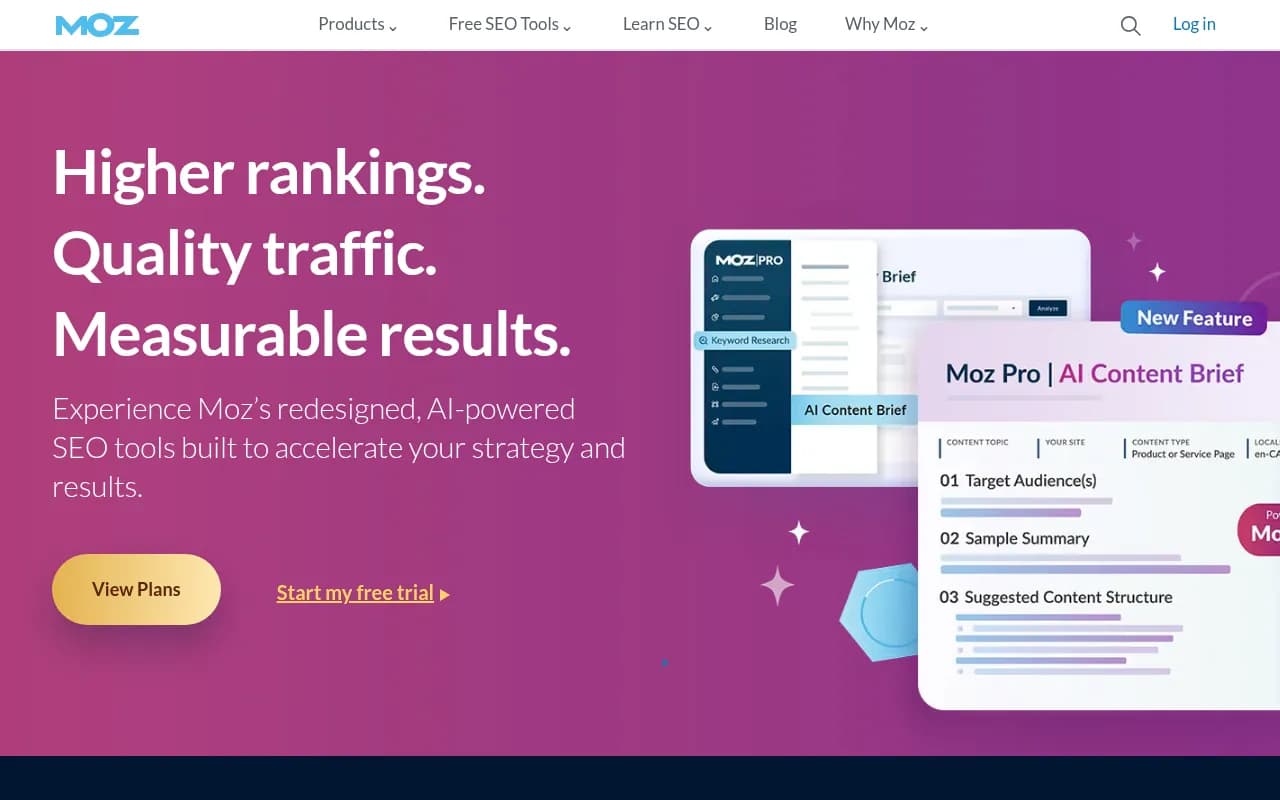
AI Content Brief is Moz's newest feature, launched in 2024 to help content teams create search-optimized briefs at scale. Enter a target keyword and the tool analyzes top-ranking pages to identify primary search intent, key questions users are asking, interesting facts to include, and recommended content structure. It's not generating full articles -- it's creating the strategic blueprint your writers need to produce content that ranks. This bridges the gap between keyword research and content creation, giving you actionable direction instead of just a list of keywords. The briefs include specific headings, topics to cover, and competitive insights drawn from SERP analysis.
Competitive Research Suite helps you identify who you're actually competing against in search (not just who you think your competitors are), discover keyword gaps where competitors rank but you don't, and find link opportunities by analyzing competitor backlink profiles. The tool shows you organic share of voice metrics, letting you track how much SERP real estate you own versus competitors for your target keyword set. You can see which competitors are winning for specific topics, then drill into their strategies to understand why.
Link Explorer gives you access to Moz's index of 44.8 trillion links -- one of the largest link databases in the industry. Enter any domain or URL to see its Domain Authority (DA), Page Authority (PA), linking domains, top pages by authority, anchor text distribution, and spam score. The tool identifies your most valuable backlinks, shows you link velocity over time, and helps you find link building opportunities by analyzing competitor link profiles. Link Explorer also includes the proprietary Spam Score metric, which flags potentially risky links that could harm your rankings. This is particularly valuable for link audits and disavow file creation.
Domain Authority and Brand Authority are Moz's proprietary metrics that have become industry standards. Domain Authority (DA) predicts how well a site will rank based on its link profile, scored 1-100. It's calculated using machine learning against Google's actual rankings, making it a reliable proxy for ranking potential. Brand Authority is a newer metric measuring brand strength at scale, useful for tracking brand-building efforts and comparing brand presence across thousands of sites. These metrics appear throughout Moz's tools and are widely used by agencies in client reporting, even by teams that don't use Moz for other features.
Rank Tracking monitors your keyword positions across 170+ search engines with daily updates. You can track desktop and mobile rankings separately, monitor local rankings by city or zip code, and segment keywords into custom groups for more granular reporting. The tool shows you SERP feature appearances, visibility scores, and share of voice metrics. Rank tracking integrates with Google Search Console and Google Analytics for a complete picture of search performance. You can set up automated reports to send ranking updates to clients or stakeholders on a schedule.
Site Crawl audits your website for technical SEO issues, crawling up to 3 million pages depending on your plan. It identifies broken links, duplicate content, missing meta tags, slow-loading pages, redirect chains, and other issues that hurt rankings. The tool prioritizes issues by severity and provides specific recommendations for fixing each problem. Site Crawl runs on a schedule you set (weekly, monthly, etc.) and alerts you to new critical issues. It integrates with Google Search Console to surface indexing errors and manual actions. The crawl data helps you track technical SEO health over time and prove the impact of fixes.
Domain Overview provides a quick SEO snapshot for any domain, showing key metrics like Domain Authority, Brand Authority, ranking keywords, top pages, and backlink summary in a single dashboard. This is useful for quick competitive analysis or vetting potential link partners. You can compare multiple domains side-by-side to see how you stack up.
STAT: Enterprise Rank Tracking at Scale
STAT is Moz's enterprise-grade rank tracking platform, sold separately from Moz Pro and aimed at agencies, enterprises, and anyone tracking thousands to millions of keywords. STAT provides daily rank tracking with full SERP HTML capture, meaning you get not just positions but the complete search result page for analysis. You can track rankings in any location, on any device, across all major search engines. STAT excels at SERP feature tracking, showing you exactly which features (featured snippets, local packs, image carousels, etc.) appear for your keywords and how much visibility they drive. The platform offers unlimited custom segments, letting you slice data by product line, geography, device, or any other dimension. STAT includes flexible APIs and pre-built Looker Studio connectors for custom reporting and analysis. It's designed for teams managing multiple sites or clients who need industrial-strength rank tracking with complete data ownership. Pricing is custom based on keyword volume and requirements.
Moz Local: Local SEO and Reputation Management
Moz Local helps multi-location businesses manage their local search presence at scale. The platform distributes your business information (NAP data, hours, photos, etc.) to Google Business Profile, Facebook, and dozens of other directories from a single dashboard. It monitors for inconsistent listings across the web and helps you fix them. Moz Local includes review management, letting you monitor and respond to customer reviews across multiple platforms from one interface. You can post updates and offers to your Google Business Profile and social media simultaneously. The platform provides local visibility scoring, showing you how well you're ranking in local search and where you have gaps. Moz Local is particularly valuable for franchises, retail chains, healthcare systems, and other businesses with 10+ locations. Pricing starts around $129/year per location with volume discounts.
Moz API: Data for Custom Solutions
Moz offers API access to its proprietary metrics and link data, letting developers build custom tools and dashboards. The API provides Domain Authority, Page Authority, Brand Authority, Spam Score, and detailed link data including anchor text and link counts. This is popular with agencies building white-label reporting tools, SaaS companies adding SEO features to their products, and enterprises integrating Moz data into internal dashboards. API pricing ranges from $20-$500/month depending on call volume, with custom enterprise pricing available.
Who Should Use Moz
Moz Pro is ideal for mid-market companies with dedicated SEO teams (1-5 people), digital marketing agencies managing 5-50 client sites, and in-house marketers at B2B SaaS companies, e-commerce brands, or media publishers. It's particularly strong for teams that need to justify their SEO investments with reliable data and clear reporting. If you're presenting to executives or clients who want to see Domain Authority scores and defensible metrics, Moz delivers. The platform works well for teams managing 50-5,000 keywords across a handful of sites.
STAT is built for enterprise SEO teams at major brands tracking 10,000+ keywords, large agencies managing dozens of client accounts, and anyone who needs industrial-strength rank tracking with complete SERP data. If you're tracking rankings for multiple countries, devices, and search engines at scale, STAT is one of the few platforms that can handle it.
Moz Local is perfect for multi-location businesses (restaurants, retail, healthcare, automotive, real estate) that need to manage local listings and reviews at scale. If you have 10+ locations and struggle to keep your business information consistent across directories, Moz Local solves that problem.
Who should NOT use Moz: Solo bloggers and small site owners on a tight budget will find better value in cheaper alternatives like Ahrefs' Webmaster Tools (free) or Mangools ($29/mo). Moz's pricing assumes you're making money from SEO and need professional-grade tools. If you're just starting out or running a hobby site, the investment won't pay off. Additionally, if you need the absolute freshest backlink data or the largest keyword database, Ahrefs and Semrush have larger indexes and faster update cycles.
Integrations and Ecosystem
Moz Pro integrates with Google Search Console, Google Analytics, and Google Business Profile to pull in additional data. It offers Looker Studio connectors for custom reporting. The platform has a Chrome extension for checking Domain Authority and other metrics while browsing. Moz Local connects to major directories including Google, Facebook, Yelp, Apple Maps, and dozens of others. STAT offers robust APIs and pre-built connectors for data warehouses and BI tools. Moz's API is widely integrated into third-party SEO tools, CMS plugins, and marketing dashboards. The company maintains an active developer community and provides extensive API documentation.
Pricing and Value
Moz Pro pricing (as of February 2026): Standard plan at $49/month (currently $39/mo with promotion) includes 150 keyword queries, 5 campaigns, 1,200 tracked keywords, and 60,000 pages crawled. Medium plan at $99/month ($79/mo with promo) increases limits to 5,000 tracked keywords and 180,000 pages crawled. Large plan at $179/month ($143/mo) and Premium at $299/month ($239/mo) add more capacity. All plans include a 30-day free trial. Annual billing saves 20%.
Moz Local pricing starts around $129/year per location with discounts for multiple locations. STAT pricing is custom based on keyword volume and requirements -- expect to pay several thousand dollars monthly for enterprise-scale tracking. Moz API pricing ranges from $20-$500/month for standard plans, with custom enterprise pricing available.
Compared to competitors, Moz Pro sits in the middle of the market. It's more expensive than budget tools like Mangools ($29/mo) or Ubersuggest ($29/mo), but cheaper than Ahrefs ($129/mo) and Semrush ($139/mo) at the entry level. However, Moz's data quality and proprietary metrics justify the premium for teams that rely on Domain Authority and need defensible data for client reporting.
Strengths
Industry-standard metrics: Domain Authority is the most widely recognized third-party ranking metric in SEO. Having DA scores in your reports adds credibility and provides a common language for discussing link quality with clients and stakeholders.
Data quality and reliability: Moz's data comes from real clickstream partnerships and extensive crawling, not just API estimates. The company has been refining its data collection for 20+ years, resulting in more accurate keyword volumes and link data than many newer competitors.
Educational resources: Moz's Beginner's Guide to SEO has been read over 10 million times. The company offers Moz Academy certifications, hosts the annual MozCon conference, and publishes the industry-leading Moz Blog. If you're learning SEO or training a team, Moz's educational content is unmatched.
Enterprise-grade rank tracking: STAT is one of the most powerful rank tracking platforms available, with daily updates, full SERP HTML capture, and unlimited segmentation. For large-scale tracking needs, few competitors match its capabilities.
Proven reliability: Moz has been around since 2004 and isn't going anywhere. The platform is stable, well-maintained, and backed by a company with a strong reputation. For risk-averse enterprises, this matters.
Limitations
Smaller link index than Ahrefs: While Moz's 44.8 trillion links is impressive, Ahrefs claims over 40 trillion and updates faster. For competitive link analysis and finding the newest backlinks, Ahrefs has an edge.
Interface feels dated: Compared to newer tools like Ahrefs or Semrush, Moz Pro's interface can feel clunky and less intuitive. The recent redesign improved things, but it still lags behind competitors in user experience.
Separate pricing for STAT and Local: If you need enterprise rank tracking or local SEO management, you're paying for multiple Moz products. Competitors like Semrush bundle more features into a single subscription.
Bottom Line
Moz remains a solid choice for SEO professionals who value data quality, proprietary metrics, and proven reliability over cutting-edge features. If you're an agency that needs Domain Authority scores in every client report, a mid-market company building an SEO program on defensible data, or an enterprise team that needs industrial-strength rank tracking with STAT, Moz delivers. The platform's educational resources and community support add significant value beyond the tools themselves. However, if you're on a tight budget, need the absolute largest link database, or want the most modern interface, competitors like Ahrefs and Semrush may be better fits. Moz is the established, reliable choice -- not the flashiest, but consistently dependable for teams serious about SEO.
Similar and alternative tools to Moz