Contentful Review 2026
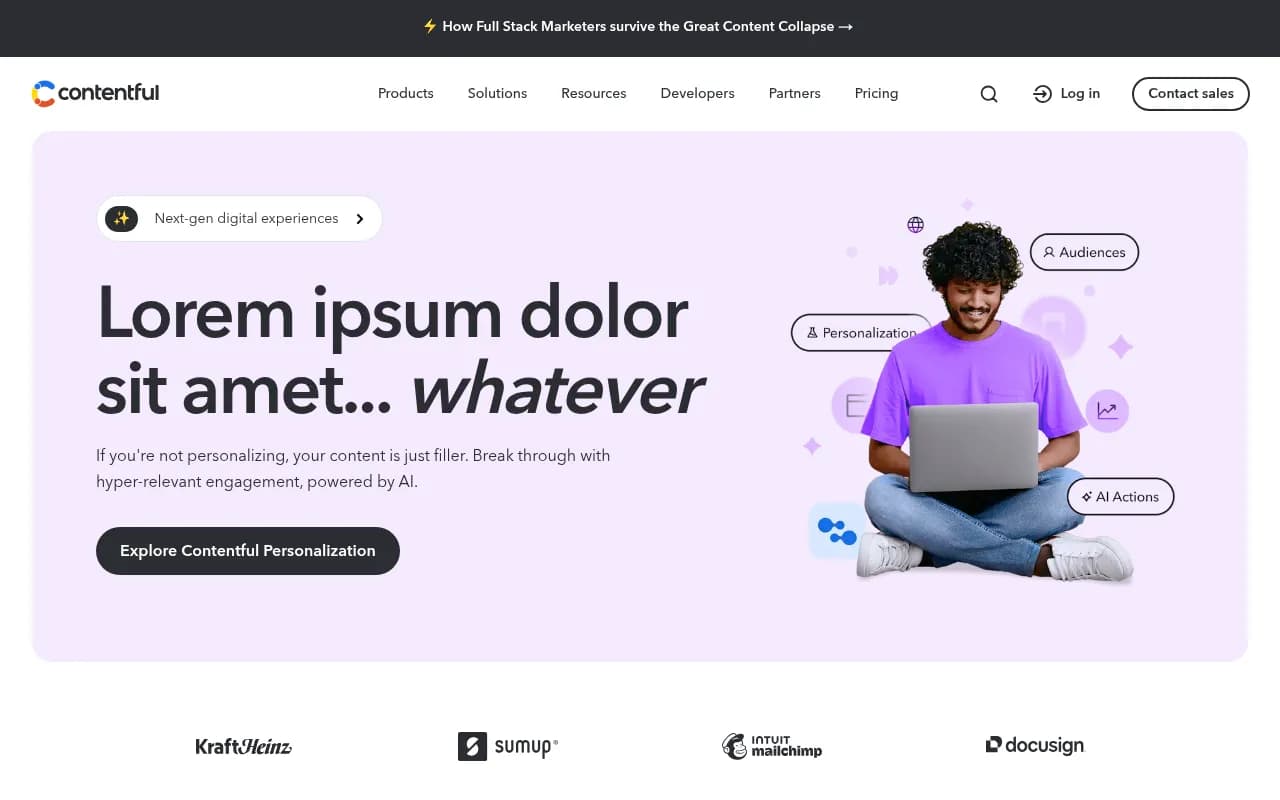
Contentful is an enterprise-grade Digital Experience Platform (DXP) that helps marketing and product teams create, manage, and deliver personalized content across all digital channels. With AI-powered content generation, modular architecture, and no-code personalization tools, it enables brands like
Key Takeaways:
• Best for: Enterprise marketing teams, product managers, and developers at mid-to-large companies managing multi-channel digital experiences across brands, regions, or product lines • Standout strengths: Modular content architecture that updates everywhere instantly, native AI for content generation and translation, component-level analytics, and true headless flexibility with 99.99% uptime • Limitations: Premium pricing targets enterprise budgets, steeper learning curve for non-technical marketers compared to traditional CMSs, free tier is limited to basic use cases • Pricing: Free tier available; paid plans start around $300/month for teams (Basic), with Premium and Enterprise tiers requiring custom quotes • Bottom line: If you're managing content for multiple brands, regions, or channels and need to personalize at scale without developer bottlenecks, Contentful delivers. Smaller teams with simpler needs may find it overkill.
Contentful is a composable Digital Experience Platform (DXP) built for brands that need to deliver personalized, on-brand content across websites, mobile apps, kiosks, email, and any other digital touchpoint—without the chaos of scattered tools or constant developer dependency. Founded in 2013 and now trusted by over 30% of the Fortune 500 (including Kraft Heinz, Docusign, Notion, Atlassian, and Danone), Contentful has evolved from a headless CMS into a full-stack content platform with AI-powered creation, no-code personalization, and component-level optimization.
The platform's core value proposition is simple: create content once, reuse it everywhere, and personalize it for every audience—all while giving marketers the autonomy to move fast without waiting on engineering. During Black Friday 2024, Contentful powered 4.6 billion API requests across retail brands, maintaining 99.99% uptime even during peak traffic. That reliability, combined with modular content architecture and AI-driven workflows, is why companies managing complex, multi-brand, or multi-region digital ecosystems choose Contentful over traditional CMSs or monolithic DXPs.
Modular Content Architecture (Content as Components) Contentful's defining feature is its composable, component-based approach to content. Instead of building pages as monolithic blocks, you create reusable content modules—hero sections, product cards, testimonials, CTAs—that can be mixed, matched, and deployed across any channel. Update a product description or pricing detail once, and it instantly updates everywhere that component appears: website, mobile app, email campaign, in-store kiosk. This eliminates the copy-paste chaos that plagues traditional CMSs and dramatically accelerates campaign launches. Kraft Heinz reported a 78% increase in conversion rates by using Contentful's modular system to personalize product pages across regions and audience segments.
AI-Powered Content Generation & Translation Contentful's native AI tools (Contentful AI) help teams create, localize, and optimize content without leaving the platform. The AI content generator produces on-brand copy based on your existing content library and brand guidelines—so it sounds like you, not a generic chatbot. The translation engine supports 20+ languages and can localize entire content libraries in seconds, a capability SumUp leveraged to scale across multiple European markets. The AI also surfaces audience insights and suggests A/B test variations, helping marketers experiment faster. Unlike bolt-on AI tools, Contentful's AI is contextual—it understands your content model, brand voice, and audience segments, so suggestions are actually useful.
No-Code Personalization & Experimentation Contentful Personalization lets marketers create audience segments (based on behavior, location, device, referral source, or custom attributes) and serve tailored content to each segment—no developer required. Set up rules like "show this hero image to mobile users in Germany" or "display this CTA to returning customers," and Contentful handles the rest. The built-in experimentation tools let you A/B test headlines, images, CTAs, or entire page layouts, then automatically optimize based on performance. Ruggable used Contentful's personalization to increase conversions by 25% and click-through rates by 7x during their Black Friday campaign. This is a major differentiator vs traditional CMSs (WordPress, Drupal) that require plugins or custom code for personalization.
Component-Level Analytics & Optimization Most analytics tools show page-level metrics. Contentful goes deeper: you can track performance at the component level—which hero image drives more clicks, which product card converts better, which CTA gets ignored. This granular visibility lets you optimize specific elements without rebuilding entire pages. The analytics dashboard integrates with Google Analytics, Adobe Analytics, and other tools, but also provides native insights tied directly to your content model. You see what works, tweak it in real time, and measure the impact—all within the same interface.
Omnichannel Content Delivery (Headless CMS) Contentful is API-first and fully headless, meaning content lives in a central hub and can be delivered to any frontend: web, mobile apps (iOS/Android), smartwatches, IoT devices, voice assistants, digital signage, or even AR/VR experiences. Developers use Contentful's RESTful or GraphQL APIs to fetch content and render it however they want—React, Next.js, Vue, Flutter, Swift, whatever. This flexibility is why product teams at Notion, Atlassian, and Docusign use Contentful to power complex, multi-platform experiences. The Content Delivery Network (CDN) ensures sub-50ms response times globally, and the 99.99% uptime SLA means your content is always available, even during traffic spikes.
Multi-Brand & Multi-Region Management For companies managing multiple brands, product lines, or regional sites, Contentful's Spaces and Environments architecture is a game-changer. You can create separate content repositories (Spaces) for each brand or region, or use a single Space with localized content variants. Environments let you stage changes, run QA, and preview updates before pushing them live. Kraft Heinz uses Contentful to manage content for dozens of brands across 40+ countries, ensuring consistency while allowing regional teams to customize messaging. The workflow tools (roles, permissions, approval chains) keep governance tight without slowing teams down.
Integrations & Ecosystem (Contentful Ecosystem) Contentful integrates with 100+ tools across ecommerce (Shopify, BigCommerce, Commercetools), marketing automation (HubSpot, Marketo, Salesforce), analytics (Google Analytics, Segment, Mixpanel), DAMs (Bynder, Cloudinary), and AI platforms (OpenAI, Anthropic). The Contentful App Framework lets developers build custom integrations or extend the UI with plugins. There's also a marketplace of pre-built apps for SEO, translation, workflow automation, and more. The platform plays well with modern dev stacks—Next.js, Gatsby, Nuxt, Astro—and has official SDKs for JavaScript, Python, Ruby, PHP, Java, and .NET.
Developer Experience & Flexibility Developers love Contentful because it doesn't force them into a specific frontend framework or tech stack. The APIs are well-documented, the SDKs are actively maintained, and the GraphQL support is robust. The Content Management API lets you programmatically create, update, and delete content, which is useful for bulk imports, migrations, or automated workflows. The CLI and migration tools make it easy to version-control your content model and deploy changes across environments. Contentful also supports webhooks, so you can trigger builds, send notifications, or sync data to other systems whenever content changes.
AI Crawler Logs & Content Indexing Contentful provides visibility into how AI crawlers (ChatGPT, Claude, Perplexity, etc.) interact with your content. You can see which pages AI models are reading, how often they return, and whether they're encountering errors. This is increasingly important as AI search engines become a primary discovery channel. While Contentful doesn't offer full AI visibility tracking (that's where platforms like Promptwatch come in), it does ensure your content is structured and delivered in a way that AI models can easily parse and cite.
Professional Services & Support Contentful offers 24/7 support, a 99.99% uptime SLA, and dedicated Customer Success teams for Premium and Enterprise customers. Professional Services help with onboarding, content model design, migration from legacy CMSs, and custom integrations. There's also a large partner ecosystem (agencies, system integrators, consultants) that specialize in Contentful implementations. The community is active—Discord, forums, GitHub—and the documentation is thorough, though the learning curve can be steep for non-technical users.
Who Is It For
Contentful is built for mid-to-large enterprises and fast-growing startups that need to manage content across multiple channels, brands, or regions. Primary users include:
Marketing teams at multi-brand companies (e.g. CPG, retail, hospitality) that need to personalize content for different audiences, regions, or product lines without rebuilding pages from scratch. If you're managing 5+ websites or apps, Contentful's modular architecture and multi-brand tools save massive time.
Product managers and growth teams at SaaS companies, ecommerce brands, or media companies that need to iterate fast—launch landing pages, run A/B tests, and optimize conversion funnels without waiting on developers. Contentful's no-code personalization and experimentation tools give marketers autonomy.
Developers and engineering teams that want a flexible, API-first CMS that doesn't lock them into a specific frontend framework. If you're building with React, Next.js, Vue, or mobile apps (iOS/Android), Contentful's headless architecture and robust APIs make it easy to deliver content wherever you need it.
Agencies and consultancies managing content for multiple clients. Contentful's Spaces and Environments architecture, combined with role-based permissions and approval workflows, make it easy to manage dozens of client projects from a single platform.
Who should NOT use Contentful: Small businesses or solo creators with simple content needs (a blog, a basic marketing site) will find Contentful overkill. The pricing, complexity, and learning curve are designed for teams managing complex, multi-channel experiences. If you just need a blog or a simple website, WordPress, Webflow, or Ghost are better fits. Similarly, if you don't have developer resources or technical expertise, the headless architecture may feel like a barrier—traditional CMSs with built-in templates (Squarespace, Wix) are easier to get started with.
Integrations & Ecosystem
Contentful integrates with major ecommerce platforms (Shopify, BigCommerce, Commercetools, Salesforce Commerce Cloud), marketing automation tools (HubSpot, Marketo, Salesforce Marketing Cloud), analytics platforms (Google Analytics, Adobe Analytics, Segment, Mixpanel), DAMs (Bynder, Cloudinary, Aprimo), and AI platforms (OpenAI, Anthropic). The Contentful App Framework and marketplace offer pre-built integrations for SEO (Yoast, SEMrush), translation (Smartling, Transifex), workflow automation (Zapier, Make), and more. The platform also supports webhooks, so you can trigger custom workflows or sync data to external systems. Browser extensions and mobile SDKs (iOS, Android) are available for content editing on the go.
Pricing & Value
Contentful offers four pricing tiers:
Free: For individuals or small projects. Includes 2 users, 25,000 records, 1 million API calls/month, and basic features. Good for testing or small side projects, but limited for production use.
Basic: Starts around $300/month (billed annually). Includes 5 users, 100,000 records, 5 million API calls/month, and access to Contentful AI, personalization, and analytics. Best for small-to-mid-sized teams managing a single brand or product.
Premium: Custom pricing (typically $1,000-$5,000+/month depending on usage). Includes unlimited users, higher API limits, advanced personalization, multi-brand management, and dedicated support. Best for enterprises managing multiple brands, regions, or high-traffic sites.
Enterprise: Custom pricing. Includes everything in Premium plus SLA guarantees, professional services, custom integrations, and white-glove support. Best for Fortune 500 companies or brands with complex, mission-critical content operations.
Contentful's pricing is usage-based (API calls, records, users), so costs scale with your needs. Compared to competitors like Sanity (similar pricing, more developer-focused), Strapi (open-source, cheaper but requires self-hosting), or Sitecore (enterprise DXP, significantly more expensive), Contentful sits in the mid-to-high range. The value is clear if you're managing complex, multi-channel content at scale—the time saved on content reuse, personalization, and optimization justifies the cost. For smaller teams or simpler use cases, the pricing may feel steep.
Strengths & Limitations
Strengths: • Modular content architecture that eliminates copy-paste chaos and accelerates campaign launches • Native AI for content generation, translation, and optimization—contextual and on-brand • No-code personalization and experimentation tools that give marketers autonomy • Component-level analytics for granular optimization • 99.99% uptime SLA and sub-50ms global CDN performance • Robust API-first architecture with excellent developer experience • Strong multi-brand and multi-region management capabilities
Limitations: • Premium pricing targets enterprise budgets—not ideal for small businesses or solo creators • Steeper learning curve for non-technical marketers compared to traditional CMSs (WordPress, Webflow) • Headless architecture requires developer resources to build and maintain frontends • Free tier is limited—production use requires paid plans • Some advanced features (multi-brand management, advanced personalization) are locked behind Premium/Enterprise tiers
Bottom Line
Contentful is the go-to platform for enterprises and fast-growing companies that need to manage content across multiple channels, brands, or regions—and personalize it at scale without developer bottlenecks. If you're a marketing team at a multi-brand company, a product team at a SaaS startup, or a developer building complex digital experiences, Contentful's modular architecture, AI-powered workflows, and no-code personalization tools will save you time and accelerate results. The pricing reflects its enterprise focus, so smaller teams with simpler needs should look elsewhere. But if you're managing complex content operations and need a platform that scales with you, Contentful delivers.
Similar and alternative tools to Contentful