Key Takeaways
- Peec AI focuses on monitoring with basic content suggestions—tracks 6 AI engines (ChatGPT, Perplexity, Claude, Gemini, Grok, DeepSeek) but requires manual execution of recommendations outside the platform
- Searchable bridges tracking and content creation with built-in AI writing tools—generates SEO-optimized articles directly from visibility gaps but lacks advanced workflow automation
- AirOps is an end-to-end content engineering platform—combines AI visibility tracking with bulk content operations, CMS publishing, and workflow automation for teams managing large content estates
- Promptwatch offers a fourth option: the only platform rated as a "Leader" across all categories in 2026 comparisons, combining Answer Gap Analysis, AI content generation grounded in 880M+ citations, and page-level tracking with traffic attribution

The AI Visibility Landscape in 2026
The AI visibility market has matured rapidly. What started as simple monitoring dashboards in 2024 has evolved into platforms that not only track where your brand appears in ChatGPT, Perplexity, and Claude—but also help you fix visibility gaps with content generation capabilities.
Three platforms stand out for combining visibility tracking with content creation: Peec AI, Searchable, and AirOps. Each takes a different approach to solving the same problem: turning AI search insights into published content that actually ranks.
But here's the reality: most platforms still stop at monitoring. They show you the data, then leave you to figure out what to do next. The platforms we're comparing today go further—though how much further varies dramatically.
Peec AI: Monitoring-First with Basic Content Suggestions

Peec AI positions itself as a clean, intuitive AI visibility monitoring platform for mid-market brands. It tracks six AI engines: ChatGPT, Perplexity, Claude, Gemini, Grok, and DeepSeek. The interface is straightforward, the data is reliable, and the pricing ($89-499/month with a 14-day trial) makes it accessible to teams without enterprise budgets.
What Peec AI Does Well
The platform excels at visibility monitoring. You can track how often your brand appears in AI responses, monitor competitor mentions, and see which queries trigger citations. The dashboard is genuinely easy to navigate—no steep learning curve, no overwhelming feature bloat.
Peec AI's "Actions Module" surfaces recommendations based on visibility gaps. If competitors are appearing for prompts where you're invisible, the platform flags it. If certain content types consistently outperform others, you'll see that pattern.
A case study on Peec AI's blog reports that Momentum achieved roughly a 10× improvement in AI search visibility using the platform by July 2025. That's a real result, and it demonstrates that monitoring alone can drive action—if your team has the resources to execute on the insights.
Where Peec AI Falls Short
The content generation capabilities are minimal. Peec AI will suggest topics and angles based on visibility gaps, but it doesn't write the content for you. You're still opening Google Docs (or your CMS) and creating articles manually.
For small teams or solo marketers, this creates a bottleneck. You see the opportunity, you understand what needs to be written, but you're stuck doing the actual writing yourself. There's no bulk content generation, no workflow automation, no direct CMS publishing.
Peec AI is a monitoring tool with basic recommendations—not a content operations platform.
Best For
- Mid-market brands with dedicated content teams who can execute on recommendations manually
- Companies that need clean visibility dashboards for stakeholder reporting
- Teams already using external content tools (like Jasper or Surfer SEO) who just need visibility data
Not Ideal For
- Small teams that need end-to-end content creation, not just monitoring
- Agencies managing multiple clients who need bulk content operations
- Brands with large content estates requiring ongoing refresh and optimization
Searchable: Built-In Content Generation Meets Visibility Tracking
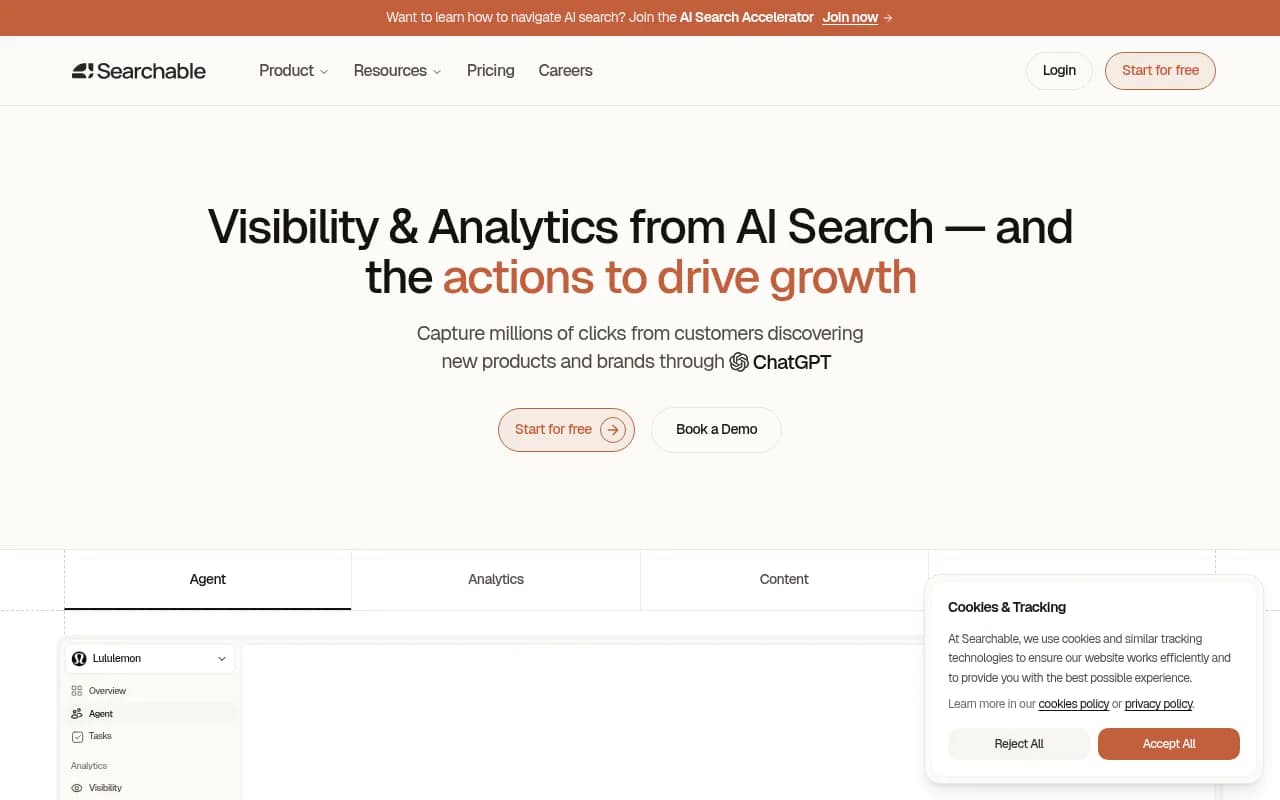
Searchable takes a different approach. Instead of stopping at recommendations, the platform includes built-in AI writing tools that generate SEO-optimized articles directly from visibility gaps. It's a true hybrid: visibility tracking plus content creation in one system.
What Searchable Does Well
The content generation is genuinely useful. Searchable analyzes your visibility gaps (where competitors appear but you don't), then generates articles targeting those prompts. The AI writer produces publish-ready drafts optimized for both traditional SEO and AI search engines.
You're not just seeing a list of topics you should write about—you're getting the actual articles. For teams without dedicated writers, this is transformative. The platform handles research, structure, optimization, and drafting in one workflow.
Searchable also includes basic workflow features: content calendars, approval processes, and publishing integrations. It's not as advanced as AirOps' automation, but it's more than Peec AI offers.
Where Searchable Falls Short
The platform lacks the depth of advanced workflow automation. You can generate content and publish it, but you can't build complex, multi-step operations. There's no bulk refresh capability for updating hundreds of existing pages. There's no advanced CMS integration beyond basic publishing.
Searchable is strong for creating new content from scratch, but weaker for managing and optimizing large content estates over time. If you're a SaaS company with 500+ blog posts that need ongoing refresh, Searchable won't scale to that use case.
The visibility tracking is also less comprehensive than enterprise platforms. You get the core AI engines (ChatGPT, Perplexity, Google AI Overviews), but you're missing some of the advanced features like crawler log analysis or page-level citation tracking.
Best For
- Small to mid-sized content teams that need both visibility tracking and content creation
- Brands launching new content strategies from scratch
- Teams that want a single platform for monitoring and writing without managing multiple tools
Not Ideal For
- Enterprise teams managing thousands of pages that require bulk optimization
- Agencies needing advanced workflow automation across multiple clients
- Brands that already have strong content creation processes and just need visibility data
AirOps: Content Engineering Platform with AI Visibility
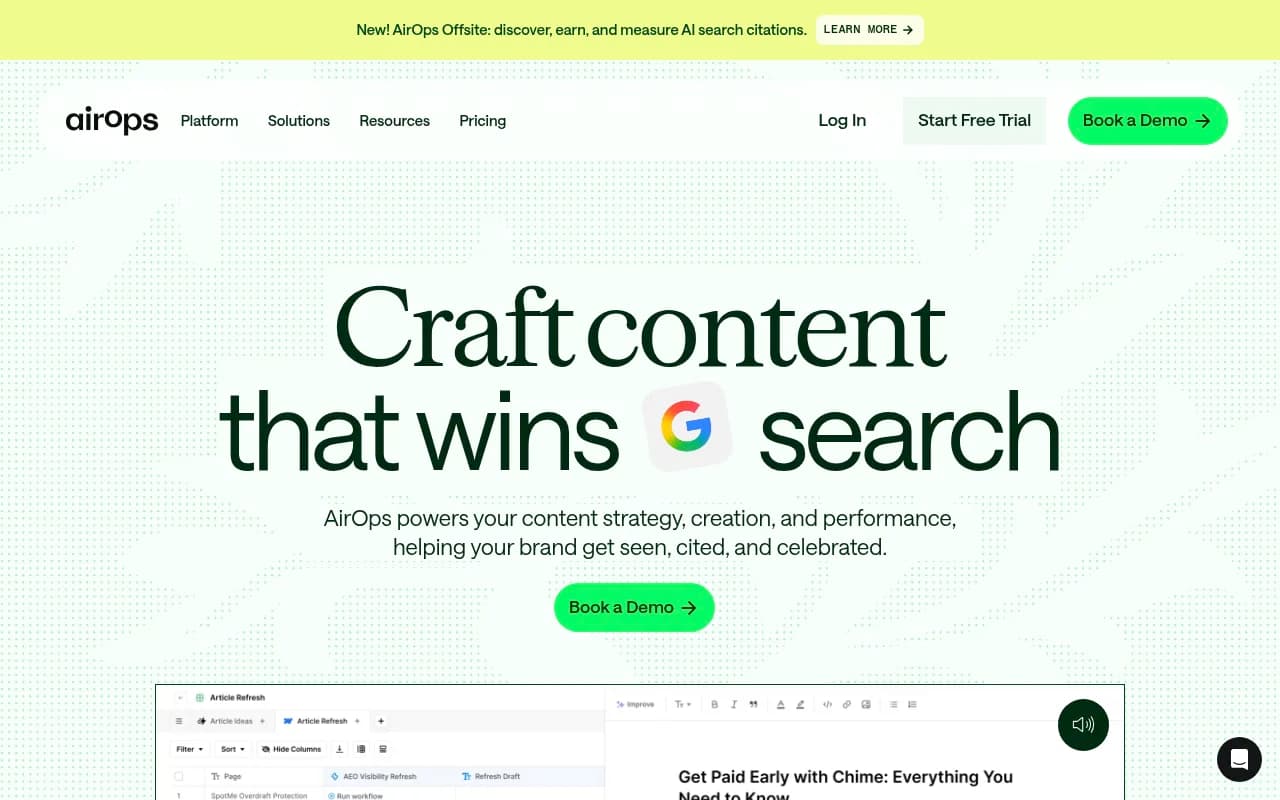
AirOps is the most execution-heavy platform in this comparison. It's not a monitoring tool with content features—it's a content engineering platform that includes AI visibility tracking as one component of a larger workflow automation system.
AirOps serves brands like Webflow, Ramp, Carta, and Chime. These are companies producing 100+ content pieces monthly, managing large content estates, and requiring end-to-end automation from insight to publication.
What AirOps Does Well
The workflow automation is unmatched. AirOps' "Grids" feature allows you to prioritize pages, run bulk content refreshes, and publish directly to your CMS—all in one system. You're not just generating individual articles; you're orchestrating large-scale content operations.
The platform combines AI visibility signals from ChatGPT, Gemini, Perplexity, Google AI Mode, and Google AI Overviews with execution workflows. When visibility gaps are identified, AirOps doesn't just suggest topics—it generates content, optimizes existing pages, and publishes updates automatically.
For teams managing 500+ pages, this is the difference between spending weeks on manual updates and executing the same work in days. The platform is built for scale.
AirOps also includes advanced features like CMS integrations (Webflow, WordPress, Contentful), brand voice customization, and multi-step workflow builders. You can create complex operations that would require multiple tools to replicate elsewhere.
Where AirOps Falls Short
The platform is overkill for small teams. If you're publishing 10 articles per month, you don't need enterprise-grade workflow automation. The learning curve is steeper than Peec AI or Searchable because the feature set is broader.
Pricing reflects the enterprise focus: AirOps offers a free tier, but paid plans start at $99/month and scale up quickly for teams with serious content operations. This isn't a budget option.
The AI visibility tracking, while solid, isn't as comprehensive as dedicated monitoring platforms like Promptwatch. AirOps focuses on execution—visibility tracking is a means to an end, not the core product.
Best For
- Content teams at scale producing 100+ pieces monthly
- Brands managing large content estates (500+ pages) requiring ongoing optimization
- Agencies running content operations for multiple clients
- Companies that need end-to-end automation from insight to publication
Not Ideal For
- Small teams or solo marketers who just need basic visibility tracking
- Brands that prefer manual content creation and don't want workflow automation
- Companies on tight budgets looking for the most affordable option
The Fourth Option: Promptwatch's Action Loop
While Peec AI, Searchable, and AirOps each offer content generation capabilities, Promptwatch takes a different approach entirely—one that positions it as the only platform rated as a "Leader" across all categories in 2026 comparisons of 12 GEO platforms.
The core difference: Promptwatch is built around an action loop that most competitors don't close.
1. Find the Gaps
Answer Gap Analysis shows exactly which prompts competitors are visible for but you're not. You see the specific content your website is missing—the topics, angles, and questions AI models want answers to but can't find on your site.
This isn't just "here are some topics to write about." It's "here are the 50 prompts driving 10,000 monthly searches where your competitors appear and you're invisible—ranked by difficulty and volume."
2. Create Content That Ranks in AI
The built-in AI writing agent generates articles, listicles, and comparisons grounded in real citation data (880M+ citations analyzed), prompt volumes, persona targeting, and competitor analysis. This isn't generic SEO filler—it's content engineered to get cited by ChatGPT, Claude, Perplexity, and other AI models.
Unlike Peec AI's basic suggestions or Searchable's standard AI writer, Promptwatch's content generation is trained on actual citation patterns from 1.1 billion data points. The platform knows what AI models cite because it's analyzed what they've already cited.
3. Track the Results
Page-level tracking shows exactly which pages are being cited, how often, and by which models. You can close the loop with traffic attribution (code snippet, GSC integration, or server log analysis) to connect visibility to actual revenue.
Most competitors (Otterly.AI, Peec AI, AthenaHQ, Search Party) stop at step one. Searchable gets to step two. AirOps focuses on workflow automation but lacks the citation intelligence. Promptwatch is the only platform that closes the full loop from gap identification to content generation to results tracking.
Additional Capabilities That Support the Action Loop
- AI Crawler Logs: Real-time logs of AI crawlers (ChatGPT, Claude, Perplexity) hitting your website—which pages they read, errors they encounter, how often they return. Understand how AI engines discover your content and fix indexing issues. Most competitors lack this entirely.
- Prompt Intelligence: Volume estimates and difficulty scores for each prompt, plus query fan-outs that show how one prompt branches into sub-queries. Prioritize high-value, winnable prompts instead of guessing.
- Citation & Source Analysis: See exactly which pages, Reddit threads, YouTube videos, and domains AI models cite in their responses. Know where to publish and what to optimize.
- Reddit & YouTube Insights: Surface discussions that directly influence AI recommendations—a channel most competitors ignore entirely.
- ChatGPT Shopping Tracking: Monitor when your brand appears in ChatGPT's product recommendations and shopping carousels.
Promptwatch monitors 10 AI models (OpenAI/ChatGPT, Perplexity, Google AI Overviews, Google AI Mode, Claude, Gemini, Meta/Llama, DeepSeek, Grok, Mistral, Copilot) with pricing starting at $99/month (Essential plan: 1 site, 50 prompts, 5 articles). Professional ($249/mo) and Business ($579/mo) plans add crawler logs, state/city tracking, and higher limits.
Feature Comparison: What Each Platform Actually Delivers
Visibility Tracking
Peec AI: Tracks 6 AI engines (ChatGPT, Perplexity, Claude, Gemini, Grok, DeepSeek). Clean dashboards, competitor analysis, basic reporting. Requires manual query input.
Searchable: Tracks core AI engines (ChatGPT, Perplexity, Google AI Overviews). Visibility gaps identified automatically. Less comprehensive than enterprise platforms but covers the essentials.
AirOps: Tracks ChatGPT, Gemini, Perplexity, Google AI Mode, Google AI Overviews. Visibility signals integrated directly into workflow automation. Not as deep as dedicated monitoring tools but sufficient for execution-focused teams.
Promptwatch: Tracks 10 AI models with page-level citation tracking, crawler logs, prompt volumes, difficulty scoring, and query fan-outs. The most comprehensive monitoring in this comparison.
Content Generation
Peec AI: Basic recommendations only. No built-in content writer. You execute manually in external tools.
Searchable: Built-in AI writer generates SEO-optimized articles from visibility gaps. Publish-ready drafts with research, structure, and optimization included. Best for creating new content from scratch.
AirOps: Advanced content generation with bulk operations, brand voice customization, and CMS publishing. Built for scale—can refresh hundreds of pages in one workflow. Best for managing large content estates.
Promptwatch: AI writing agent generates content grounded in 880M+ citations, prompt volumes, and competitor analysis. Content engineered specifically to get cited by AI models, not just rank in Google. Essential plan includes 5 articles/month; Professional includes 15; Business includes 30.
Workflow Automation
Peec AI: None. Monitoring and recommendations only.
Searchable: Basic workflow features (content calendars, approval processes, publishing integrations). Sufficient for small teams but not enterprise-grade.
AirOps: Enterprise workflow automation with Grids, bulk operations, CMS integrations, and multi-step workflow builders. The strongest automation in this comparison.
Promptwatch: Focused on the action loop (gap identification → content generation → tracking) rather than complex workflow automation. Sufficient for most teams but not as advanced as AirOps for large-scale operations.
Pricing
Peec AI: $89-499/month with 14-day trial. Mid-market pricing.
Searchable: Pricing not publicly listed; contact for quote. Likely mid-market to enterprise.
AirOps: Free tier available; paid plans start at $99/month and scale up for enterprise needs.
Promptwatch: Essential $99/mo (1 site, 50 prompts, 5 articles), Professional $249/mo (2 sites, 150 prompts, 15 articles, crawler logs), Business $579/mo (5 sites, 350 prompts, 30 articles). Agency/Enterprise custom pricing. Free trial available.
Which Platform Should You Choose?
Choose Peec AI If:
- You have a dedicated content team that can execute on recommendations manually
- You need clean visibility dashboards for stakeholder reporting
- You're already using external content tools and just need monitoring data
- Budget is a primary concern and you want affordable monitoring
Choose Searchable If:
- You need both visibility tracking and content creation in one platform
- You're launching a new content strategy from scratch
- You want publish-ready articles generated from visibility gaps
- You don't need enterprise-grade workflow automation
Choose AirOps If:
- You're producing 100+ content pieces monthly
- You manage a large content estate (500+ pages) requiring ongoing optimization
- You need end-to-end workflow automation from insight to publication
- You have the budget and team size to justify enterprise-grade tooling
Choose Promptwatch If:
- You want the only platform that closes the full action loop (gaps → content → tracking)
- You need content engineered specifically to get cited by AI models (not just rank in Google)
- You want comprehensive monitoring (10 AI models, crawler logs, citation analysis, Reddit/YouTube insights)
- You need page-level tracking with traffic attribution to connect visibility to revenue
- You want a platform rated as a "Leader" across all categories in 2026 comparisons
The Real Question: Monitoring or Optimization?
The fundamental difference between these platforms isn't features—it's philosophy.
Peec AI is a monitoring tool. It shows you where you're invisible, then expects you to fix it yourself. For teams with strong content operations already in place, this is sufficient.
Searchable bridges monitoring and content creation. It generates articles from visibility gaps, but it doesn't optimize large content estates or automate complex workflows. For small teams launching new strategies, this is ideal.
AirOps is an execution platform. It automates content operations at scale, with visibility tracking as one input into larger workflows. For enterprise content teams, this is transformative.
Promptwatch is an optimization platform. It doesn't just show you where you're invisible—it tells you exactly what's missing, generates content engineered to get cited by AI models, and tracks the results with page-level attribution. For teams that want to close the full loop from insight to action to revenue, this is the only platform that delivers.
Most competitors in 2026 are still building monitoring dashboards. The platforms that win will be the ones that help you take action—not just see the data.
Final Thoughts
AI visibility tracking is no longer optional. With ChatGPT usage soaring and Google AI Overviews appearing in nearly half of all searches, your brand's reputation lives inside algorithms you don't control.
Peec AI, Searchable, and AirOps each offer content generation capabilities that go beyond basic monitoring. But their approaches differ dramatically:
- Peec AI monitors and recommends, but you execute manually
- Searchable generates content from visibility gaps, but lacks enterprise automation
- AirOps automates content operations at scale, but focuses on workflow over citation intelligence
- Promptwatch closes the action loop with gap analysis, AI content generation grounded in 880M+ citations, and page-level tracking with traffic attribution
The right choice depends on your team size, content volume, and whether you need monitoring, content creation, workflow automation, or all three.
But here's the reality: in 2026, the platforms that win won't be the ones with the prettiest dashboards. They'll be the ones that help you take action—and prove the results.