AirOps Review 2026
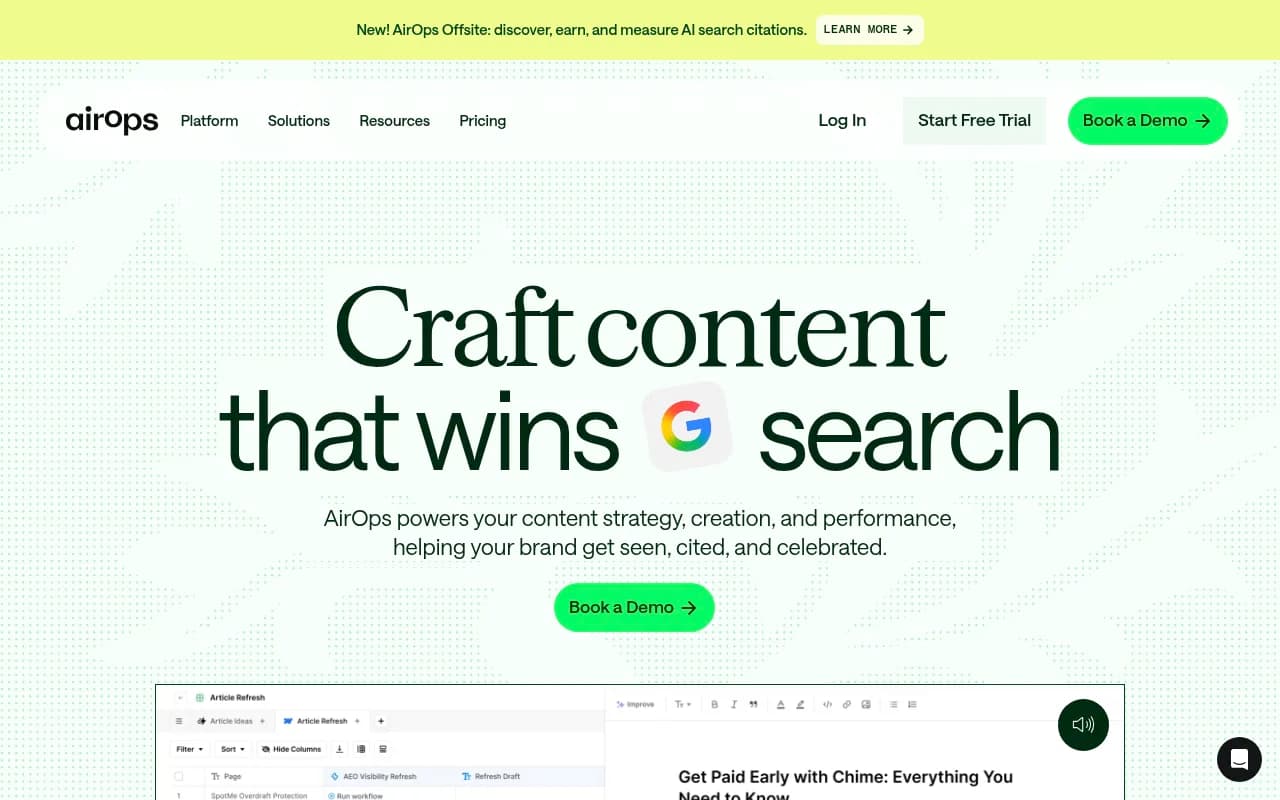
AirOps is a content engineering platform that helps brands create, optimize, and scale content for AI search engines like ChatGPT, Perplexity, and Google AI Overviews. Used by Webflow, Chime, Ramp, and Carta, it combines AI search insights, content gap analysis, and AI-powered writing workflows to help marketing teams increase citations, visibility, and traffic from AI-driven search.
Summary
• Best for: Mid-market to enterprise marketing teams, SEO teams, and agencies focused on AI search visibility and content velocity • Standout strength: End-to-end platform that goes beyond monitoring to actually help you create and optimize content for AI search engines • Key limitation: Higher price point than basic AI writing tools; requires commitment to content engineering workflows • Pricing: Starts at $199/month (Starter plan with 10,000 tasks/month); custom pricing for Scale and Enterprise • Bottom line: If you're serious about winning in AI search and need a platform that combines insights, content creation, and team collaboration, AirOps delivers. If you just need basic AI writing or simple monitoring, look elsewhere.
AirOps started as an AI content writing tool but has evolved into something far more strategic: a full content engineering platform built for the AI search era. While competitors like Jasper and Copy.ai focus on generating blog posts, AirOps has pivoted hard into helping brands understand and win visibility in AI search engines like ChatGPT, Claude, Perplexity, Gemini, and Google AI Overviews. The company serves over 6,700+ brands and agencies, including notable names like Webflow, Chime, Ramp, Carta, Apollo, Docebo, and LegalZoom.
What makes AirOps different is its focus on the full content lifecycle for AI search: discover what's missing (content gap analysis), create content engineered to get cited by AI models, and track performance across AI search engines. Most AI writing tools stop at generation. Most AI search monitoring tools (like Otterly.AI or Peec.ai) stop at showing you data. AirOps connects the dots between insight and action.
The platform is built around two core layers: Insights (understanding where you're invisible in AI search) and Action (creating content that fixes those gaps). This isn't a tool for cranking out generic blog posts at scale—it's a system for engineering content that AI models actually want to cite.
Insights Layer: Finding the Gaps
The Insights layer is where AirOps shows you exactly where to invest next. It pulls together data from SEO tools, AI search engines, and your own analytics to surface opportunities. The standout feature here is Answer Gap Analysis, which shows you the specific prompts and topics where competitors are getting cited but you're not. You see the exact content your website is missing—the questions, angles, and topics AI models are looking for but can't find on your site.
Page360 is another key feature that unifies SEO, AI search, and Google Analytics 4 data into a single view of content health. Instead of jumping between tools to understand how a page is performing, you see everything in one place: keyword rankings, AI citations, traffic, and conversion data. This makes it easy to prioritize which pages to refresh or optimize.
The platform also tracks AI search visibility across 10 AI models: ChatGPT, Perplexity, Google AI Overviews, Google AI Mode, Claude, Gemini, Meta/Llama, DeepSeek, Grok, Mistral, and Copilot. You can see which prompts your brand appears in, how often you're cited, and how you compare to competitors. Prompt Intelligence adds volume estimates and difficulty scores for each prompt, plus query fan-outs that show how one prompt branches into related sub-queries. This helps you prioritize high-value, winnable prompts instead of guessing.
Citation & Source Analysis shows exactly which pages, Reddit threads, YouTube videos, and domains AI models are citing in their responses. This is critical for understanding where to publish and what to optimize. AirOps also surfaces Reddit & YouTube insights—discussions and videos that directly influence AI recommendations. Most competitors ignore these channels entirely, but they're increasingly important for AI search visibility.
For brands selling products, ChatGPT Shopping Tracking monitors when your brand appears in ChatGPT's product recommendations and shopping carousels. Competitor Heatmaps let you compare your AI visibility vs competitors across LLMs, showing who's winning for each prompt and why.
The platform supports multi-language and multi-region tracking, so you can monitor AI responses in any language, from any country, with customizable personas that match how your actual customers prompt. There's also a Looker Studio integration and API for custom reporting and workflows.
One feature that sets AirOps apart from pure monitoring tools: AI Crawler Logs. These are real-time logs of AI crawlers (ChatGPT, Claude, Perplexity, etc.) hitting your website—which pages they read, errors they encounter, how often they return. This helps you understand how AI engines discover your content and fix indexing issues. Most competitors (Otterly.AI, Peec.ai, AthenaHQ, Search Party) lack this entirely.
Action Layer: Creating Content That Ranks in AI
The Action layer is where AirOps moves from insights to execution. The platform includes a built-in AI writing agent that generates articles, listicles, comparisons, and other content formats grounded in real citation data (880M+ citations analyzed), prompt volumes, persona targeting, and competitor analysis. This isn't generic SEO filler—it's content engineered to get cited by AI models.
The writing agent draws from your Brand Kits & Knowledge Bases, which store your tone, rules, references, and context in one place. This ensures every piece of content feels true to your brand, even when AI is doing the heavy lifting. You can upload internal documents, product specs, customer research, and other proprietary knowledge that only your brand has. This is what separates AirOps content from generic AI slop—it's grounded in your unique expertise.
Workflows are the core of the Action layer. These are customizable, multi-step content creation processes that combine live data sources, brand knowledge, AI generation, and human review steps. You can build workflows for specific use cases (e.g. "refresh existing blog posts with AI search optimization" or "create comparison pages based on competitor gap analysis") and run them at scale. The platform includes a library of Power Agents—pre-built, agentic workflows for common tasks like keyword research, content audits, and SERP analysis. You can fork and customize these to fit your needs.
Grids is the project management layer that ties everything together. It's a collaborative interface where you manage every article, workflow, and update from one place. Think of it as a content operations hub designed for teams working at velocity. You can assign tasks, track progress, review drafts, and push finished content directly to your CMS.
Speaking of integrations, AirOps connects to your existing stack: Google Search Console, Google Analytics 4, Ahrefs, Semrush, WordPress, Webflow, HubSpot, and custom APIs. You can also bring your own LLMs (OpenAI, Anthropic, etc.) for more control over content generation. Finished content can be pushed directly to your CMS with no manual handoffs.
Who Is AirOps For?
AirOps is built for mid-market to enterprise marketing teams, SEO teams, and digital agencies that are serious about AI search visibility and content velocity. The ideal customer is a brand with an established content operation (10+ articles/month) that wants to scale without sacrificing quality or losing visibility in AI search.
Specific personas that fit well: • SEO teams at SaaS companies managing 50-500 pages and trying to stay visible as Google shifts to AI Overviews • Content marketing teams at B2B brands (fintech, HR tech, martech) that need to refresh stale content and create new content faster • Digital agencies managing content for 5-20 clients and looking for a platform that handles strategy, creation, and performance tracking in one place • Growth marketers at Series B+ startups who need to prove content ROI and connect visibility to revenue
The platform is particularly strong for brands in competitive, high-intent verticals where AI search is already influencing buying decisions: financial services (Chime, Ramp, Brex), HR/payroll (Carta, Gusto), project management (Monday.com, Notion), and travel/hospitality (Kayak, Hard Rock Digital).
Who should NOT use AirOps: Solo bloggers, early-stage startups with no content operation, or teams that just need a basic AI writing assistant. If you're publishing fewer than 10 articles per month or don't care about AI search visibility, AirOps is overkill. Tools like Jasper, Copy.ai, or even ChatGPT directly will be cheaper and simpler. If you only need AI search monitoring without content creation, platforms like Promptwatch (which focuses exclusively on AI search visibility and optimization) or basic tools like Otterly.AI will be more cost-effective.
Integrations & Ecosystem
AirOps integrates with the tools marketing teams already use: Google Search Console, Google Analytics 4, Ahrefs, Semrush (for SEO data), WordPress, Webflow, HubSpot (for content publishing), and Slack (for notifications). The platform also supports custom API integrations and lets you bring your own LLMs (OpenAI, Anthropic, etc.) for content generation.
There's a Looker Studio connector for custom reporting and dashboards. The API is available for enterprise customers who want to build custom workflows or integrate AirOps data into their own systems.
AirOps also offers a Content Engineering Certification program—a hands-on training cohort where marketers learn to build advanced workflows and optimize content for AI search. Graduates have reported promotions, increased content velocity (2-5x), and measurable improvements in AI search visibility. The program includes access to the AirOps Slack community, where 1,000+ marketers share playbooks and strategies.
Pricing & Value
AirOps pricing is structured around "tasks" (AI operations like generating content, analyzing pages, or running workflows):
• Solo Plan: Free tier with 1,000 tasks/month. Good for testing the platform but not enough for serious content operations. • Starter Plan: $199/month for 10,000 tasks/month. Suitable for small teams publishing 5-10 articles/month. • Scale Plan: Custom pricing for teams publishing 20+ articles/month or managing multiple sites. Includes advanced features like AI crawler logs, multi-region tracking, and priority support. • Enterprise: Custom pricing for agencies and large brands. Includes dedicated account management, custom integrations, and white-label options.
Additional tasks beyond your plan cost $0.025 per task. Annual billing offers discounts.
How does this compare to competitors? AirOps is more expensive than basic AI writing tools (Jasper starts at $49/month, Copy.ai at $49/month) but cheaper than enterprise content platforms (Contently, Skyword) that require six-figure contracts. Compared to AI search monitoring tools, AirOps is mid-range: Promptwatch starts at $99/month (monitoring + optimization), Otterly.AI at $99/month (monitoring only), and Profound at $299/month (monitoring + basic insights).
The value proposition is clear if you're a team that needs both insights and execution. If you're paying an agency $5,000-$10,000/month for content creation, AirOps can replace or significantly reduce that cost while giving you more control and faster turnaround. Chime reported dropping their agency and 10xing content output after adopting AirOps. Docebo cut production costs by 50% by eliminating external agencies.
Strengths
• End-to-end platform: Unlike competitors that only monitor or only generate content, AirOps connects insights to action. You see what's missing, create content to fill the gaps, and track results—all in one platform. • AI search focus: The platform is purpose-built for the AI search era. Features like Answer Gap Analysis, AI crawler logs, and citation tracking are designed specifically to help you win visibility in ChatGPT, Perplexity, and other AI engines. • Brand knowledge integration: The ability to upload proprietary knowledge and enforce brand guidelines means content feels authentic, not generic. This is critical for maintaining quality at scale. • Proven results: Case studies from Webflow (6% increase in AI-attributed signups), Chime (3x increase in AI citations), and Ramp (10x ROI on Reddit strategy) show the platform delivers measurable outcomes. • Strong community and education: The Content Engineering Certification program and Slack community provide real value beyond the software. You're not just buying a tool—you're joining a network of marketers solving the same problems.
Limitations
• Higher price point: At $199/month minimum for serious use, AirOps is more expensive than basic AI writing tools. Teams on tight budgets or just starting with AI content may find it hard to justify. • Learning curve: The platform is powerful but complex. Workflows, Power Agents, and Brand Kits require time to set up properly. Expect a 2-4 week onboarding period before you're running at full speed. • Task-based pricing can be confusing: Understanding how many tasks you'll need per month requires some trial and error. Teams that underestimate usage may face surprise overage charges. • Not ideal for solo creators: If you're a freelance writer or solo blogger, AirOps is overkill. The platform is designed for teams and agencies managing multiple projects.
Bottom Line
AirOps is the right choice for marketing teams, SEO teams, and agencies that are serious about winning in AI search and need a platform that goes beyond monitoring to actually help you create and optimize content. The combination of AI search insights, content gap analysis, brand-aware content generation, and team collaboration tools makes it a true end-to-end solution.
If you're a mid-market or enterprise brand publishing 10+ articles per month, managing multiple content initiatives, and trying to stay visible as search shifts to AI, AirOps will pay for itself quickly. The case studies speak for themselves: Webflow 5xed content velocity, Chime tripled AI citations, Docebo cut costs by 50%.
If you're a solo creator, early-stage startup, or just need basic AI writing assistance, look elsewhere. Tools like Jasper, Copy.ai, or ChatGPT directly will be simpler and cheaper. If you only need AI search monitoring without content creation, platforms like Promptwatch (which focuses exclusively on AI visibility and optimization) will be more cost-effective and feature-complete for that specific use case.
Best use case in one sentence: Marketing teams at B2B SaaS companies or agencies that need to scale content velocity, improve AI search visibility, and prove content ROI—all without sacrificing brand quality.
Tags:
Similar and alternative tools to AirOps