Alli AI Review 2026
AI-powered SEO automation platform that makes bulk optimizations across entire websites to improve rankings without manual page-by-page editing.
Key Takeaways:
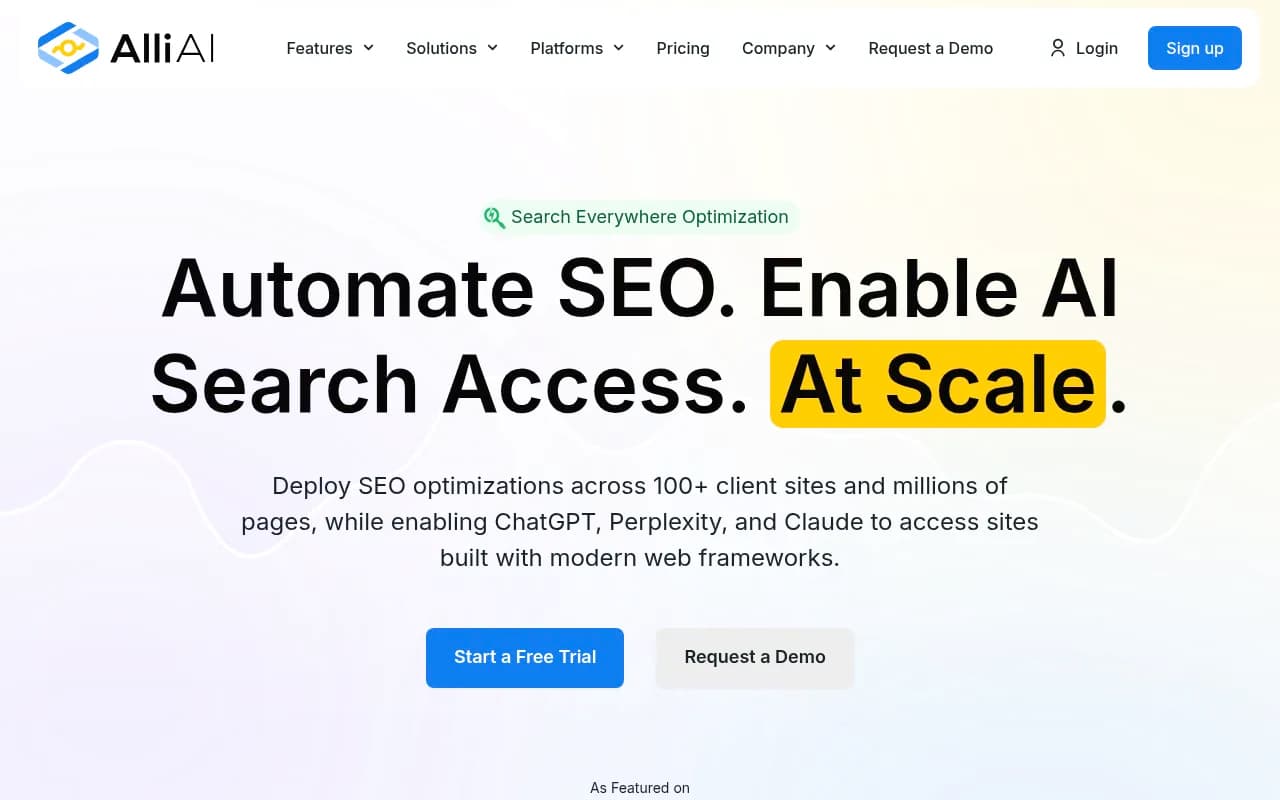
- Portfolio-scale automation: Deploy title tags, schema markup, and meta descriptions across thousands of pages on 100+ sites in under 60 seconds using rule-based automation
- AI crawler enablement: Server-side rendering makes React, Vue, Next.js, and other JavaScript frameworks instantly readable to ChatGPT, Perplexity, Claude, and 50+ AI platforms (63% of modern websites are currently invisible to AI search)
- Unified search optimization: Single deployment optimizes for both traditional search engines (Google, Bing) and AI platforms simultaneously, with cross-platform analytics
- Best for: SEO agencies managing 10-50+ client sites, enterprise teams with large portfolios, and companies running modern JavaScript frameworks who need AI search visibility
- Honest limitation: Pricing is higher than single-site tools, and the platform is overkill if you're only managing 1-2 websites
Alli AI is an enterprise-grade SEO automation platform built to solve two critical problems that hit agencies and multi-site operators hardest: the manual implementation bottleneck that makes traditional SEO tools unusable at scale, and the infrastructure gap that renders 63% of modern websites completely invisible to AI search platforms like ChatGPT, Perplexity, and Claude. Founded by Kyle Duck, the platform has been featured in Forbes, Yahoo Finance, Search Engine Land, and is used by agencies managing portfolios of 50-100+ client sites.
The core value proposition is speed and scale. Where traditional SEO tools identify issues but leave you to implement fixes manually across every property in your portfolio, Alli AI deploys optimizations in bulk across thousands of pages on dozens of sites in under 60 seconds. This isn't incremental improvement -- it's a fundamental shift from weeks of manual work to instant deployment.
Bulk Deployment Automation (The Core Engine)
Alli AI's rule-based automation system is the foundation of everything else. You create one optimization rule -- say, updating title tags to include target keywords -- and the platform automatically applies it to all matching pages across every site in your portfolio. This works through JavaScript injection, which means you don't need FTP access, SSH credentials, or backend permissions for any CMS. The platform injects code that modifies page elements in real-time as they load.
The Visual Browser Editor lets you edit any element directly in your browser, see changes live, and deploy instantly. Click on a title tag, edit it, and the change goes live across all matching pages. No developer dependency, no CMS training for different platforms. The same workflow works identically on WordPress, Shopify, Wix, custom builds, or any other platform.
AI-Powered Content Generation analyzes page content and automatically generates optimized meta descriptions, title tags, and schema markup based on semantic analysis. This isn't template-based -- the AI reads the actual page content and creates unique, contextually relevant metadata for each page. For portfolios with thousands of pages, this eliminates weeks of manual copywriting.
Complete Rollback Capability maintains full deployment history with one-click rollback for any change across any property. If an optimization doesn't perform as expected, you can revert thousands of pages instantly. This safety net makes aggressive testing viable at scale.
Real-world example from their case studies: A restaurant SEO agency deployed title tag updates across 17 million code changes (yes, million) for a client portfolio in minutes. Manual implementation would have taken months.
AI Crawler Enablement (The Infrastructure Fix)
This is where Alli AI diverges from every other SEO tool on the market. Modern websites built with React, Vue, Next.js, Angular, and other JavaScript frameworks render blank pages to AI crawlers. ChatGPT's GPTBot, Perplexity's PerplexityBot, and Claude's ClaudeBot can't execute JavaScript -- they see empty HTML shells. According to Alli AI's data, 63% of websites are completely inaccessible to AI search platforms because of this.
Alli AI's Server-Side Rendering for AI solves this by detecting AI crawlers automatically and serving pre-rendered HTML specifically to those bots. The platform maintains a whitelist of 50+ AI crawlers (GPTBot, ClaudeBot, PerplexityBot, Google's AI crawlers, Bing's AI crawlers, and emerging platforms) and serves them fully rendered HTML while maintaining normal performance for human visitors.
Security Tool Configuration is critical here. Cloudflare, firewalls, and security plugins often block AI crawlers by default because they look like scraper bots. Alli AI automatically manages crawler whitelist configuration to prevent these tools from blocking legitimate AI search platforms. This is infrastructure work that most SEO teams don't even know they need to do.
Real-Time Analytics show which AI platforms are accessing your sites, crawl frequency by platform, and which pages are being indexed. Citation Tracking measures where and how often your content appears in ChatGPT, Perplexity, and Claude responses. This visibility is essential for understanding AI search performance -- you can't optimize what you can't measure.
This capability is unique in the SEO tool market. Traditional tools like Semrush, Ahrefs, and Moz don't address this infrastructure problem at all. AI-specific platforms like Promptwatch focus on monitoring and content optimization but don't solve the crawler access issue. Alli AI is the only platform that makes modern JavaScript frameworks readable to AI search at scale.
Unified Search Optimization (One Deployment, All Channels)
Search has fragmented beyond Google. Users search across Google, ChatGPT, Perplexity, Claude, Bing, and emerging AI assistants. Optimizing only for traditional search engines leaves massive visibility gaps. Alli AI's unified approach deploys structured data, meta tags, and content updates that work across all channels simultaneously.
Search Engine Optimized Schema formats structured data for both Google's search index and AI platform training data. The same schema markup that helps Google understand your content also helps ChatGPT and Claude cite you accurately. Single deployment, dual benefit.
Traditional SEO Automation covers all the standard on-page elements: title tags, meta descriptions, H1s, canonical URLs, alt text, and content optimizations. These deploy at scale using the same rule-based system. Update 10,000 title tags across 50 sites in under a minute.
AI Optimized Content Structure formats meta tags and content specifically to improve AI citation likelihood and semantic retrieval. This includes structured data that AI models prefer, content formatting that improves extraction accuracy, and metadata that helps AI platforms understand context.
Unified Analytics Dashboard tracks traditional search rankings, AI platform citations, and traffic attribution by source from one view. See Google rankings, ChatGPT citation frequency, Perplexity visibility, and Claude mentions side by side. This cross-platform visibility is essential for understanding total search performance in 2026.
Cross Platform Performance Monitoring shows visibility across Google, ChatGPT, Perplexity, and Claude from one unified view. Most teams use separate tools for traditional SEO (Semrush, Ahrefs) and AI search monitoring (Promptwatch, Otterly.AI), creating fragmented workflows and blind spots. Alli AI consolidates both into one platform.
Who Is Alli AI For
Alli AI is built for three specific user personas:
SEO Agencies Managing 10-50+ Client Sites: This is the core audience. Agencies that manage portfolios of client websites face the exact problems Alli AI solves -- manual implementation doesn't scale, clients use different CMS platforms, and modern frameworks create AI search blind spots. The platform's rule-based deployment means one optimization applies across all clients instantly. The visual editor means no CMS training for different platforms. The AI crawler enablement means React and Vue sites become visible to AI search without rebuilding. Agencies report cutting implementation time from weeks to minutes, which directly impacts profitability.
Enterprise Teams with Large Portfolios: Companies managing 20-100+ properties (multi-brand portfolios, international sites, product-specific microsites) face similar scale challenges. Alli AI's bulk deployment and unified analytics make portfolio-wide optimization viable. The platform works particularly well for enterprises running modern JavaScript frameworks (React, Vue, Next.js) who need AI search visibility without migrating to traditional CMS platforms.
E-commerce Operations with Thousands of Product Pages: Online retailers with large catalogs (5,000-50,000+ products) need to optimize at scale. Alli AI's AI-powered content generation creates unique meta descriptions and title tags for every product page automatically. Schema markup deployment for products, reviews, and pricing happens in bulk. The platform's case studies include specialty e-commerce retailers who transformed visibility across thousands of SKUs.
Who Should NOT Use Alli AI: If you're managing 1-2 websites, Alli AI is overkill and overpriced. Single-site operators are better served by traditional SEO tools like Surfer SEO, Clearscope, or even Yoast. If you don't have modern JavaScript frameworks and don't care about AI search visibility, you're paying for capabilities you don't need. If you're a solo blogger or small business owner, the learning curve and cost don't justify the benefits.
Integrations & Ecosystem
Alli AI works with any CMS or framework: WordPress, Shopify, Wix, Squarespace, custom builds, React, Vue, Next.js, Angular -- the JavaScript injection approach means platform compatibility is universal. No plugins to install, no theme modifications required.
Google Search Console integration pulls ranking data and traffic attribution directly into the dashboard. This connects traditional SEO performance to AI search visibility in one view.
API availability is mentioned but not extensively documented on the public site. Enterprise customers likely have API access for custom integrations and reporting.
Browser extensions and mobile apps are not mentioned -- the platform is web-based and accessed through the dashboard.
Pricing & Value
Alli AI uses tiered pricing based on the number of sites and pages you're managing. Exact pricing is not published on the website -- you need to request a demo or contact sales. Based on third-party sources and competitor comparisons, pricing appears to range from approximately $249-579/month for small agency plans to custom enterprise pricing for large portfolios.
The platform offers Flex Pricing with 20+ plans so you can scale up or down based on current needs. This is important for agencies with fluctuating client counts.
Free trial available -- you can test the platform before committing.
Value assessment: For agencies managing 10+ client sites, the time savings alone justify the cost. Deploying optimizations that would take weeks manually in under 60 seconds means you can handle more clients with the same team. The AI crawler enablement capability is unique in the market -- if you have modern JavaScript sites that need AI search visibility, there's no comparable alternative. For single-site operators, the pricing is prohibitive and the capabilities are excessive.
Compared to traditional SEO tools (Semrush at $139-499/month, Ahrefs at $129-999/month), Alli AI is more expensive but solves a fundamentally different problem. Semrush and Ahrefs identify issues; Alli AI deploys fixes at scale. Compared to AI search monitoring tools (Promptwatch at $99-579/month), Alli AI is competitively priced and includes both monitoring and infrastructure enablement.
Strengths & Limitations
Strengths:
- Deployment speed is unmatched: 60 seconds to update thousands of pages across dozens of sites is genuinely transformative for agencies
- AI crawler enablement is unique: No other platform solves the JavaScript framework visibility problem at scale
- Platform agnostic: Works identically on WordPress, Shopify, React, Vue, custom builds -- no CMS lock-in
- Visual editor eliminates developer dependency: Non-technical team members can deploy optimizations without backend access
- Unified analytics: Traditional SEO and AI search performance in one dashboard eliminates tool fragmentation
Limitations:
- Pricing is higher than single-site tools: Not cost-effective for solo operators or small businesses managing 1-2 sites
- Learning curve for advanced features: The platform is powerful but requires onboarding to use effectively
- Limited public documentation: Feature details and best practices are not extensively published -- you need to request demos and talk to sales
- AI content generation quality varies: Automated meta descriptions are good but not always perfect -- human review recommended for high-stakes pages
Bottom Line
Alli AI is the definitive solution for SEO agencies and enterprise teams managing 10+ websites who need to deploy optimizations at portfolio scale and make modern JavaScript frameworks visible to AI search platforms. The combination of bulk deployment automation (60-second updates across thousands of pages), AI crawler enablement (server-side rendering for React/Vue/Next.js), and unified search optimization (Google + ChatGPT + Perplexity in one platform) solves problems that no other tool addresses.
Best use case in one sentence: SEO agencies managing 20-50 client sites built on mixed platforms (WordPress, Shopify, React) who need to deploy optimizations in minutes instead of weeks while ensuring AI search platforms can actually read their clients' content.
Tags:
Similar and alternative tools to Alli AI