TL;DR: AirOps wins if you're serious about AI search visibility (ChatGPT, Perplexity, Google AI Overviews) and need content that actually gets cited by AI engines. Copy.ai is now a GTM platform focused on sales workflows and go-to-market automation -- it's no longer primarily a content tool. If you just need fast marketing copy generators, Copy.ai's free tools work. If you need content that ranks in AI search and drives measurable traffic, AirOps is the clear choice.
What AirOps and Copy.ai actually do
AirOps: Content engineering for AI search
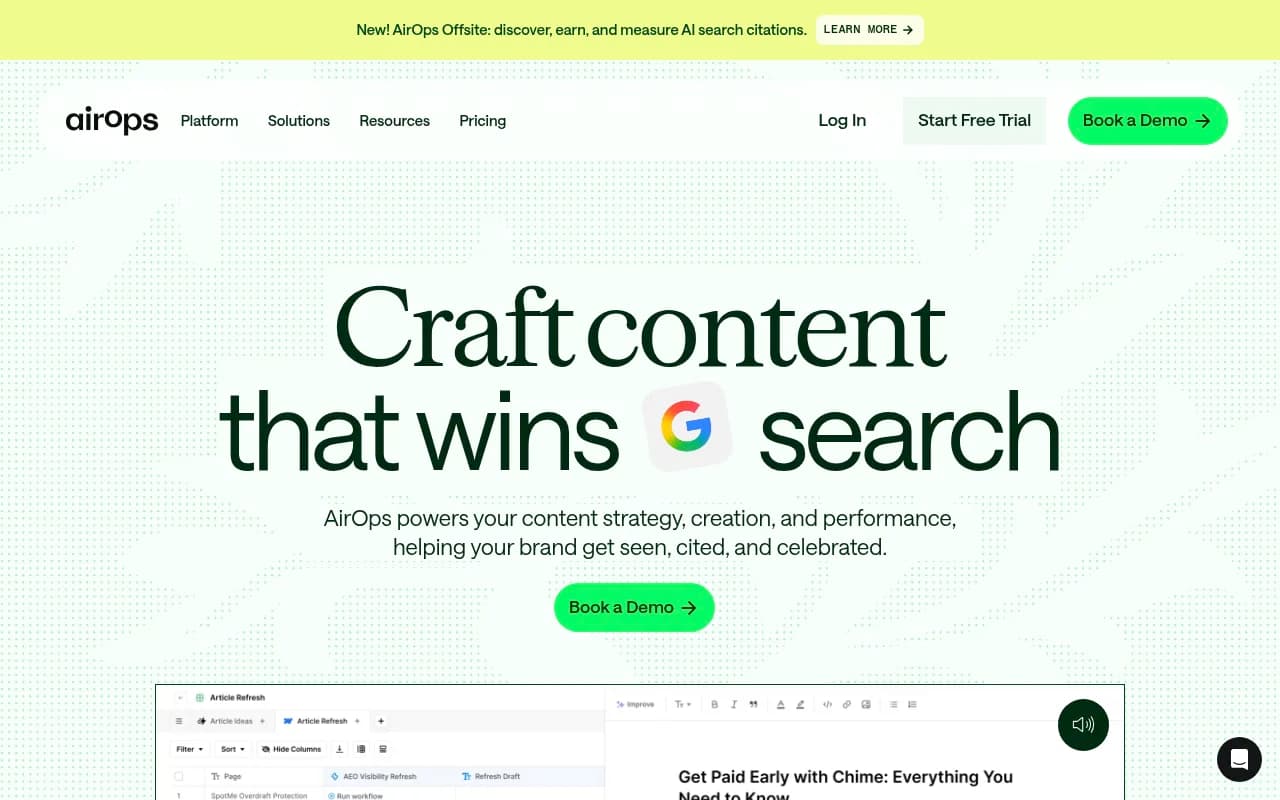
AirOps is an end-to-end content engineering platform built specifically for AI search visibility. Brands like Webflow, Chime, Ramp, and Carta use it to create content that gets cited by ChatGPT, Perplexity, and Google AI Overviews. The platform combines AI search insights (which prompts are driving visibility, where competitors are winning), content gap analysis (what's missing from your site that AI engines want), and AI-powered writing workflows that generate articles grounded in real citation data.
Webflow increased AI-attributed signups by 6% within days of using AirOps. Chime tripled their AI search citations from 24 to 68 priority questions. These aren't vanity metrics -- they're tracking actual visibility in AI-driven search results and the traffic that follows.
AirOps starts at $199/mo (Starter plan with 10,000 tasks/month). There's a free tier capped at 1,000 tasks/month. Scale and Enterprise plans are custom-priced.
Copy.ai: GTM platform (formerly AI copywriting)

Copy.ai started as an AI copywriting tool for marketers who needed to overcome writer's block -- email subject lines, social posts, ad copy. In 2026, it's pivoted hard into a "GTM AI Platform" after being acquired by Fullcast. The focus is now on go-to-market automation: connecting content creation with sales workflows, CRM integrations, and broader GTM operations.
The homepage pitches "the first AI-native GTM platform" and talks about eliminating "GTM bloat" by replacing "dozens of copilots and point solutions." Copy.ai still offers free writing generators (emails, social media), but the core product is now aimed at sales and revenue teams, not content marketers optimizing for search.
Pricing details aren't publicly listed on the site anymore. The free tier still exists for basic generators.
Head-to-head: Where each tool wins
Use case fit
AirOps is purpose-built for content teams that need to rank in AI search. If your goal is to show up when someone asks ChatGPT "best project management tools" or Perplexity "how to improve customer retention," AirOps gives you the insights and workflows to make that happen. It tracks which prompts competitors are visible for, identifies content gaps on your site, and generates articles designed to get cited.
Copy.ai is now a GTM platform. If you're a sales leader trying to automate outreach sequences or connect content to pipeline, Copy.ai's new direction might fit. If you're a content marketer who just needs a fast way to write email subject lines or social posts, the free generators still work. But if you're trying to optimize content for AI search visibility, Copy.ai doesn't have the tools.
Verdict: AirOps for AI search and content engineering. Copy.ai for GTM automation or quick copywriting tasks.
AI search visibility and tracking
AirOps tracks your brand's visibility across ChatGPT, Perplexity, Google AI Overviews, and other AI engines. You see which prompts you're being cited in, which competitors are winning, and where you're invisible. The platform shows citation counts, share of voice, and page-level performance. Chime used this data to go from 24 to 68 citations in priority questions.
Copy.ai doesn't track AI search visibility at all. It's not part of the product.
Verdict: AirOps is the only option here. Copy.ai doesn't compete in this category.
Content gap analysis
AirOps identifies exactly which prompts competitors are visible for but you're not. It shows you the specific topics, angles, and questions AI models want answers to but can't find on your site. This is the "find the gaps" step that tells you what content to create next.
Copy.ai doesn't have content gap analysis. It generates copy based on prompts you give it, but it won't tell you what's missing from your content strategy.
Verdict: AirOps. Copy.ai doesn't offer this capability.
AI-powered content generation
AirOps has a built-in AI writing agent that generates articles, listicles, and comparisons grounded in real citation data (880M+ citations analyzed), prompt volumes, persona targeting, and competitor analysis. The content is engineered to get cited by AI models, not just rank in traditional SEO. Webflow 5xed their content refresh velocity using AirOps workflows.
Copy.ai generates marketing copy -- emails, social posts, ad copy, product descriptions. The free generators are fast and versatile. But the output is generic marketing copy, not content optimized for AI search. Copy.ai doesn't analyze citation data or competitor visibility when generating content.
Verdict: AirOps for content that ranks in AI search. Copy.ai for quick marketing copy.
Workflow automation and integrations
AirOps offers content workflows that connect research, writing, editing, and publishing. You can build custom workflows for different content types (blog posts, landing pages, comparison pages). Integrations aren't the main focus -- the platform is self-contained.
Copy.ai (post-acquisition) is all about GTM workflow automation. It connects content creation with sales workflows, CRM integrations, and go-to-market operations. The pitch is "infuse AI across your go-to-market engine" and eliminate point solutions. If you need content tied to sales sequences or pipeline stages, Copy.ai's new direction supports that.
Verdict: Copy.ai for GTM automation. AirOps for content-specific workflows.
Ease of use
User reviews (SourceForge, Capterra) consistently rate Copy.ai higher for ease of use. The interface is simple -- you pick a generator, fill in a prompt, and get output. No learning curve.
AirOps has more complexity because it does more. You're working with AI search insights, content gap analysis, and multi-step workflows. The learning curve is steeper, but the payoff is content that actually performs in AI search.
Verdict: Copy.ai is easier to pick up. AirOps requires more setup but delivers more value.
Pricing
AirOps:
- Free tier: 1,000 tasks/month
- Starter: $199/mo (10,000 tasks/month)
- Scale and Enterprise: Custom pricing
Copy.ai:
- Free tier: Basic generators
- Paid plans: Not publicly listed (likely custom pricing for GTM platform)
Verdict: AirOps has transparent pricing. Copy.ai's pricing is unclear post-pivot.
Pros and cons
AirOps pros:
- Tracks AI search visibility across ChatGPT, Perplexity, Google AI Overviews
- Content gap analysis shows exactly what to create next
- AI writing agent generates content grounded in citation data
- Proven results: Webflow, Chime, Ramp case studies with measurable outcomes
- Built specifically for content teams optimizing for AI search
AirOps cons:
- Steeper learning curve than simple copywriting tools
- Higher starting price ($199/mo vs free)
- Focused on AI search -- if that's not your goal, it's overkill
Copy.ai pros:
- Free tier for basic marketing copy generators
- Very easy to use -- no learning curve
- Fast output for emails, social posts, ad copy
- GTM platform features for sales and revenue teams (post-acquisition)
Copy.ai cons:
- No AI search visibility tracking
- No content gap analysis or competitive insights
- Generic marketing copy, not optimized for AI search
- Pivoted away from content marketing -- unclear product direction
- Pricing not transparent
Who should pick which tool
Pick AirOps if:
- You're a content team at a B2B SaaS, e-commerce, or media company
- You need to rank in AI search (ChatGPT, Perplexity, Google AI Overviews)
- You want data-driven insights on what content to create next
- You need content that gets cited by AI engines and drives measurable traffic
- You're willing to invest in a platform that does more than just generate copy
Pick Copy.ai if:
- You're a sales or GTM leader looking for workflow automation
- You need fast marketing copy for emails, social posts, or ads
- You want a free tool for overcoming writer's block
- You don't care about AI search visibility or citation tracking
- You're exploring the new GTM platform features (post-acquisition)
Final verdict
AirOps and Copy.ai aren't really competitors anymore. AirOps is a content engineering platform for AI search visibility. Copy.ai is a GTM platform for sales and revenue teams. If you're a content marketer trying to rank in AI search, AirOps is the obvious choice -- it's the only tool that tracks visibility, identifies gaps, and generates content designed to get cited. If you just need a fast way to write email subject lines or you're exploring GTM automation, Copy.ai's free tier or new platform features might fit. But for serious content work in 2026, AirOps is built for the job Copy.ai used to do.