Summary
- AI content tools like AirOps and Byword enabled mass content production in 2025, allowing marketers to generate thousands of articles cheaply—but the flood of thin, repetitive content triggered widespread Google penalties and a crisis of trust in traditional SEO
- Google's algorithms evolved to punish low-quality AI spam, focusing on E-E-A-T signals and topical authority rather than keyword stuffing—sites that relied solely on automated content without human refinement saw traffic collapse
- The real shift wasn't just about penalties—it was about user behavior: consumers abandoned Google's cluttered SERPs for AI search engines like ChatGPT, Perplexity, and Claude, where answers felt personalized and trustworthy
- The future belongs to Generative Engine Optimization (GEO), not traditional SEO—brands must now optimize for AI citations, build topical authority, and create content that AI models actually want to reference
- Tools like Promptwatch are leading the next wave by helping brands track AI visibility, identify content gaps, and generate articles engineered to get cited by ChatGPT, Perplexity, and other AI models
The Perfect Storm: How AI Content Tools Broke SEO in 2025
In early 2025, the SEO world looked unstoppable. Content marketing budgets were at an all-time high. Agencies were scaling faster than ever. And then the bottom fell out.
The culprit? AI content tools like AirOps, Byword, and dozens of others that promised to "automate SEO at scale." These platforms made it trivially easy to generate hundreds—sometimes thousands—of articles per month. Feed them a keyword list, and they'd spit out blog posts, product descriptions, and listicles faster than any human writer could dream of.
On paper, it was a marketer's dream. In practice, it became a nightmare.
The Flood Begins
By mid-2025, the web was drowning in AI-generated content. Sites that once published 10 articles a month were now pushing out 500. Affiliate blogs exploded with thin product reviews. SaaS companies churned out "ultimate guides" that said nothing new. Every SERP became a sea of sameness—articles that looked different but read like they were written by the same robot.
Because they were.
Google's index ballooned. Users started complaining that search results felt "spammy" and "useless." The content was technically correct, grammatically sound, and keyword-optimized. But it lacked depth. It lacked experience. It lacked the human insight that made content worth reading.
Google Fights Back
Google's response was swift and brutal. Throughout 2025, the search giant rolled out a series of algorithm updates specifically targeting low-quality AI content. The focus shifted dramatically toward E-E-A-T signals—Experience, Expertise, Authoritativeness, and Trustworthiness.
Sites that relied purely on AI-generated content without human oversight saw their traffic collapse overnight. Rankings that took years to build vanished in weeks. The penalties weren't just about detecting AI—Google didn't care who wrote the content. The issue was quality.
Thin, repetitive, keyword-stuffed articles got hammered regardless of whether they came from a human or a machine. But because AI tools made it so easy to mass-produce garbage, they became the primary vector for spam.
The Real Problem: Topical Authority
The winners in 2025 weren't the sites that published the most content. They were the sites that demonstrated topical authority—deep, comprehensive coverage of a subject that proved genuine expertise.
Google's algorithms got smarter at recognizing content clusters, internal linking structures, and whether a site actually owned its niche. A single well-researched, experience-driven article from an authoritative source started outranking dozens of AI-generated listicles.
This was the death knell for the "spray and pray" approach that tools like AirOps had enabled. Volume stopped mattering. Quality and authority became everything.
The User Exodus: Why People Stopped Trusting Google
But the real crisis wasn't just about Google's algorithm updates. It was about user behavior.
By late 2025, consumers were fed up. They were tired of clicking through 10 generic articles to find a real answer. They were exhausted by affiliate spam, thin product reviews, and content that clearly existed only to rank for keywords.
So they left.
The Rise of AI Search Engines
Users didn't stop searching—they just traded search bars for chat boxes. Platforms like ChatGPT, Perplexity, Claude, and Gemini exploded in popularity because they offered something Google couldn't: concise, personalized answers that felt like they came from a trusted expert.
No more scrolling through SERPs. No more dodging ads and affiliate links. Just a direct answer to the question.
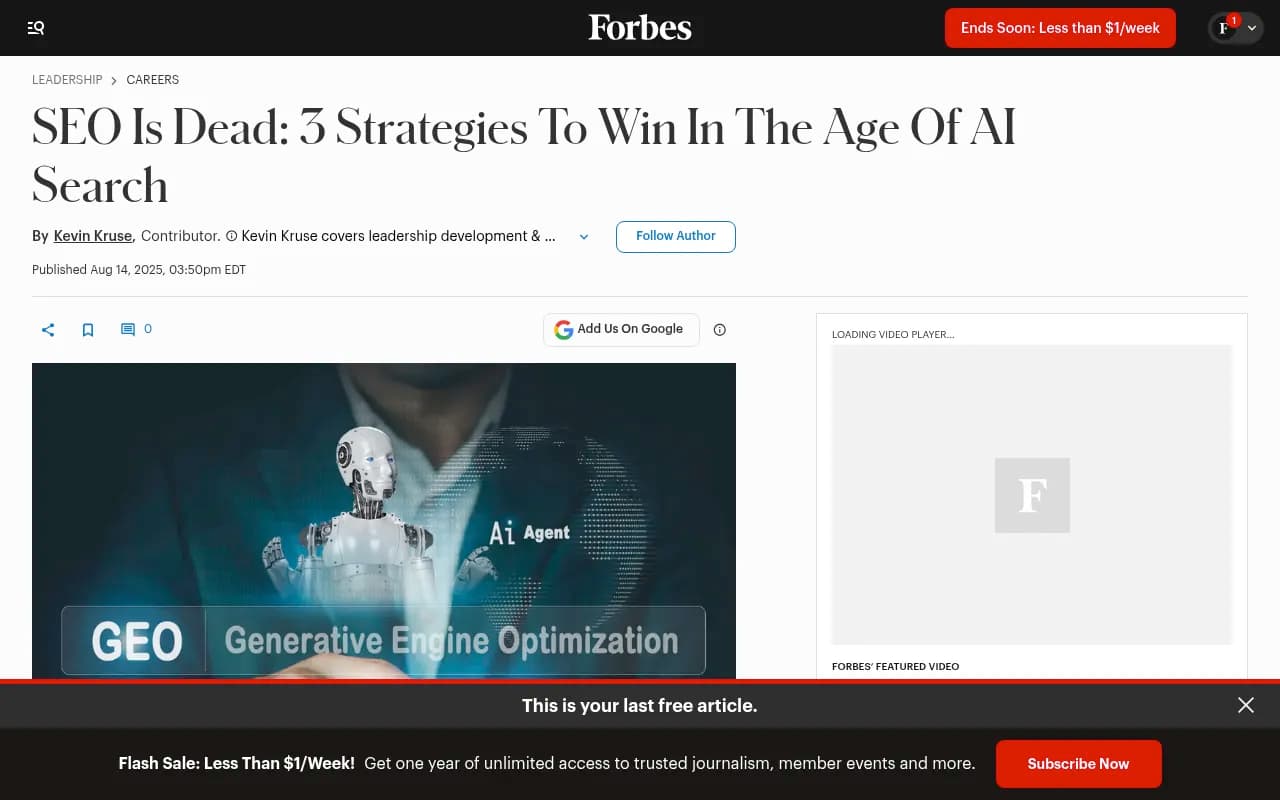
Traditional SEO traffic collapsed. According to research cited by Forbes, $74 billion in marketing budgets tied to SEO evaporated as AI search engines captured more and more query volume. Google's dominance started to crack.
The Conversion Advantage
Here's the kicker: the traffic from AI search engines was better. Rob Hoffman, CEO of Mentions, reported that clients were seeing traffic from LLMs convert 7x higher than traditional Google traffic.
Why? Because AI search engines pre-qualify users. By the time someone clicks through from a ChatGPT citation, they've already had a conversation with the AI. They've asked follow-up questions. They've narrowed down their options. They're further along in the decision-making process.
This wasn't just a traffic shift—it was a fundamental change in how people discover and evaluate brands.
What Actually Worked in 2025 (And What Flopped)
What Worked
1. Strong E-E-A-T Signals
Content that demonstrated real experience, expertise, and trustworthiness survived—and thrived. This meant:
- First-hand case studies and data
- Author bios with verifiable credentials
- Citations to authoritative sources
- Content that solved real problems, not just chased keywords
2. Topical Authority
Sites that built comprehensive content clusters around a core topic dominated. Instead of chasing random long-tail keywords, winners focused on owning their niche. This meant:
- Deep, interconnected content hubs
- Internal linking that demonstrated expertise
- Consistent publishing on related subtopics
3. Structured Data and Schema Markup
Structured data became critical for AI search engines. LLMs rely on structured information to understand and cite content. Sites that implemented proper schema markup saw better visibility in AI-generated answers.
4. Digital PR and Brand Mentions
Getting cited by authoritative sources—news sites, industry publications, research papers—became more valuable than backlinks. AI models prioritize content that's already been validated by trusted sources.
What Flopped
1. Mass AI Content Without Human Oversight
The "publish 500 articles a month" strategy died hard. Sites that relied purely on AI tools like AirOps without human editing, fact-checking, or expertise got crushed.
2. Keyword Stuffing and Thin Content
The old SEO playbook—targeting exact-match keywords, writing 500-word fluff pieces, optimizing for search volume—stopped working. Google and AI engines both learned to ignore it.
3. Ignoring AI Search Engines
Brands that focused exclusively on Google SEO while ignoring ChatGPT, Perplexity, and other AI platforms missed the boat entirely. By the time they realized users had moved on, their competitors had already captured the AI search market.
The Shift to Generative Engine Optimization (GEO)
Traditional SEO isn't dead—but it's no longer enough. The future belongs to Generative Engine Optimization (GEO): optimizing content to be discovered, cited, and recommended by AI search engines.
GEO is fundamentally different from SEO:
SEO vs GEO: Key Differences
SEO (Traditional Search Engine Optimization)
- Goal: Rank #1 on Google SERPs
- Metric: Click-through rate from search results
- Strategy: Keywords, backlinks, on-page optimization
- Content: Optimized for human readers scanning search results
GEO (Generative Engine Optimization)
- Goal: Get cited by AI models in their responses
- Metric: Citation frequency across ChatGPT, Perplexity, Claude, etc.
- Strategy: Topical authority, structured data, AI-friendly formatting
- Content: Optimized for AI models to understand, extract, and reference
The Three Pillars of GEO Strategy
1. AI Visibility Tracking
You can't optimize what you don't measure. Brands need to track:
- How often they're cited by AI models
- Which prompts trigger citations
- Which competitors are winning AI visibility
- Which content gaps exist in AI responses
This is where platforms like Promptwatch become essential. Unlike traditional SEO tools, Promptwatch tracks your brand's visibility across ChatGPT, Perplexity, Claude, Gemini, and 10+ other AI models. It shows you exactly which prompts you're visible for, which ones you're missing, and what content you need to create to close the gap.

2. Content Gap Analysis and Creation
AI models cite content that directly answers user questions with authority and depth. The key is identifying what's missing:
- Which topics do competitors cover that you don't?
- Which questions are users asking that your content doesn't answer?
- Which formats (listicles, comparisons, tutorials) perform best in AI citations?
Promptwatch's Answer Gap Analysis reveals exactly which prompts competitors rank for but you don't—then helps you generate content specifically engineered to get cited. The built-in AI writing agent creates articles grounded in real citation data from 880M+ analyzed citations, not generic SEO filler.
3. Digital PR and Authority Building
AI models prioritize content from authoritative sources. This means:
- Getting featured in industry publications
- Building relationships with journalists and researchers
- Creating original research and data that others cite
- Earning mentions on Reddit, YouTube, and forums where AI models scrape
Promptwatch tracks Reddit discussions and YouTube videos that influence AI recommendations—channels most competitors ignore entirely.
The Role of AI Content Tools in 2026
So are AI content tools like AirOps inherently bad? No—but they're dangerous when used wrong.
The problem in 2025 wasn't AI itself. It was the misuse of AI: treating it as a replacement for human expertise rather than a tool to augment it.
How to Use AI Content Tools Responsibly
1. Start with Strategy, Not Volume
Don't ask "How many articles can we publish?" Ask "What content will actually help our audience and get cited by AI models?"
2. Human Oversight is Non-Negotiable
Every AI-generated article needs:
- Fact-checking by a subject matter expert
- Original insights and examples
- Proper citations and sources
- A human editor who understands the topic
3. Focus on Depth, Not Breadth
One comprehensive, authoritative article beats 10 thin AI-generated posts. Build topical authority by going deep on subjects you actually understand.
4. Optimize for AI Citations, Not Just Rankings
Structure content so AI models can easily extract and reference it:
- Use clear headings and subheadings
- Include structured data and schema markup
- Answer questions directly and concisely
- Provide data, examples, and evidence
What Comes Next: The Post-SEO World
We're entering a new era where traditional search rankings matter less than AI citations. The brands that win in 2026 and beyond will be those that:
1. Embrace GEO as a Core Strategy
GEO isn't a side project—it's the future of digital visibility. Brands need dedicated resources, tools, and expertise to optimize for AI search engines.
2. Build Real Expertise and Authority
There's no shortcut. AI models favor content from genuine experts. Invest in subject matter experts, original research, and first-hand experience.
3. Track and Optimize AI Visibility
Use platforms like Promptwatch to monitor your brand's presence across AI models, identify gaps, and create content that gets cited. The action loop—find gaps, generate optimized content, track results—is what separates winners from losers.
4. Diversify Beyond Google
Google is no longer the only game in town. ChatGPT, Perplexity, Claude, and other AI search engines are capturing significant query volume. Brands that optimize for multiple platforms will capture more traffic and higher-quality leads.
5. Focus on Conversion, Not Just Traffic
AI search traffic converts better because users are more qualified. Optimize your content and landing pages for visitors who've already had a conversation with an AI model and are ready to make a decision.
The Bottom Line
The AI content spam crisis of 2025 wasn't caused by AI itself—it was caused by marketers who prioritized volume over value. Tools like AirOps and Byword made it easy to flood the web with thin content, and Google responded by punishing low-quality spam.
But the real shift wasn't about penalties. It was about users abandoning traditional search for AI-powered alternatives that deliver better, faster answers.
The future belongs to brands that understand this shift and adapt. Traditional SEO isn't dead, but it's no longer enough. The winners in 2026 will be those who master Generative Engine Optimization—tracking AI visibility, building topical authority, and creating content that AI models actually want to cite.
The tools exist. The data is available. The question is: will you adapt, or will you keep chasing yesterday's playbook?
If you're serious about AI visibility, start by understanding where you stand. Track your brand across ChatGPT, Perplexity, Claude, and other AI models. Identify the content gaps. Create articles engineered to get cited. Close the loop by measuring results.
That's the action loop that separates optimization platforms from monitoring dashboards. And it's the only way to win in the age of AI search.