Key Takeaways
- AirOps is a content-first platform built for high-volume content creation with AI search insights baked in -- if you need to produce 50+ articles per month, it's the stronger choice
- Promptwatch is a tracking-first platform that shows you exactly where you're invisible in AI search, then helps you fix it with targeted content generation -- better for brands focused on monitoring and optimization
- AirOps charges by "tasks" (credits consumed per action), while Promptwatch charges by sites and prompts tracked -- pricing models are completely different
- Promptwatch tracks 10 AI models including ChatGPT Shopping and has crawler logs; AirOps focuses on ChatGPT, Perplexity, and Google AI Overviews
- Both platforms offer content generation, but AirOps emphasizes workflow automation and scale, while Promptwatch ties generation directly to citation data and content gaps
- For agencies managing multiple clients, Promptwatch's per-site pricing is more predictable; AirOps' task-based model can get expensive fast at scale
Overview
AirOps
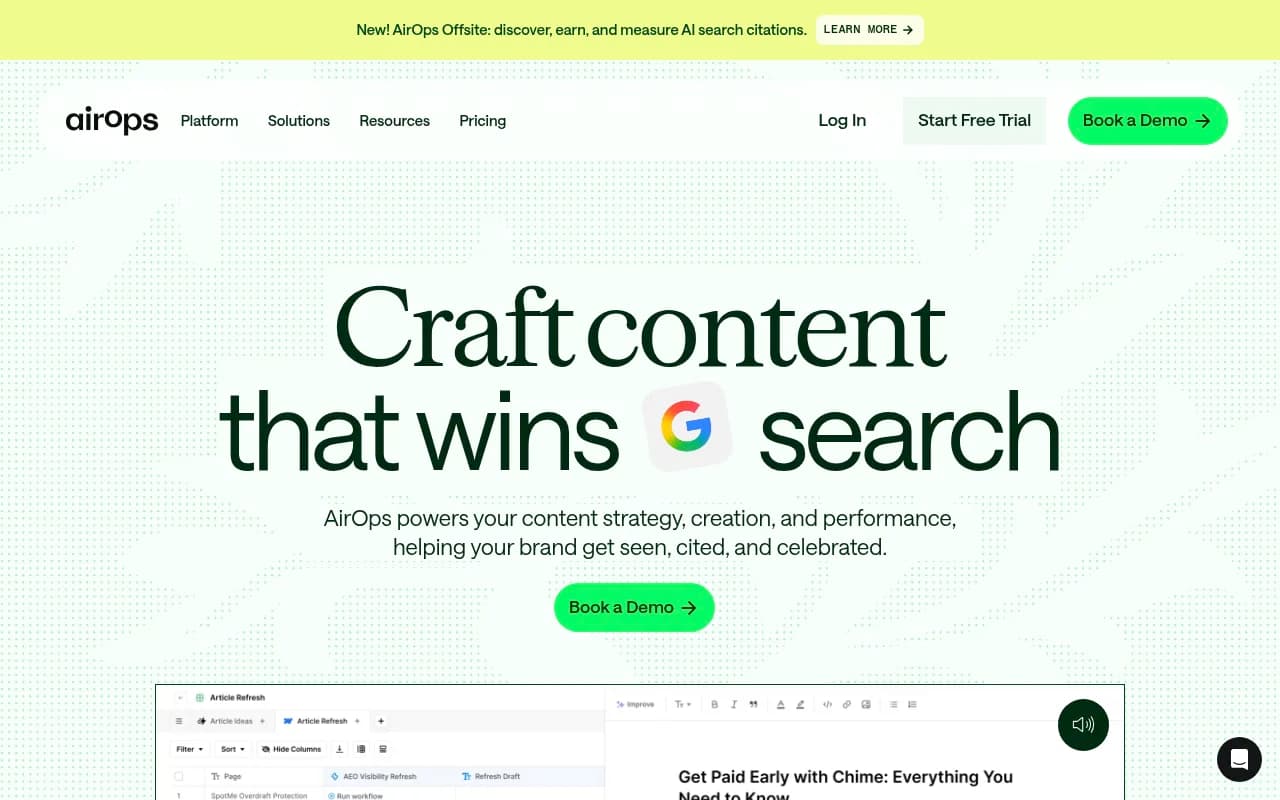
AirOps positions itself as an "end-to-end content engineering platform" for AI search visibility. Used by Webflow, Chime, Ramp, and Carta, it combines AI search insights with content creation workflows. The platform helps marketing teams create and scale content that gets cited by ChatGPT, Perplexity, and Google AI Overviews. AirOps has a freemium model with a free tier (1,000 tasks/month) and paid plans starting at $199/month for 10,000 tasks.
The core pitch: produce content at volume with AI search optimization built into the workflow. Webflow reportedly 5xed their content refresh velocity using AirOps, and Chime went from 24 to 68 priority question citations.
Promptwatch

Promptwatch is an AI Search Visibility platform used by 7,000+ brands and agencies including Booking.com, Center Parcs, and Google. It tracks how ChatGPT, Claude, Perplexity, Gemini, and 6 other AI models mention your brand, then shows you exactly what content you're missing. The platform monitors real user prompts, logs AI crawler activity, analyzes citations, and generates content grounded in 880M+ citations analyzed.
The core difference: Promptwatch doesn't just show you data -- it closes the loop. Answer Gap Analysis tells you which prompts competitors rank for but you don't, the AI writing agent creates content to fill those gaps, and page-level tracking shows results. Plans start at $99/month (Essential) with a free trial available.
Side-by-Side Comparison
| Feature | AirOps | Promptwatch |
|---|---|---|
| Pricing model | Task-based credits | Per-site + prompts tracked |
| Starting price | Free (1,000 tasks), $199/mo paid | $99/mo (Essential) |
| Free tier | Yes (1,000 tasks/mo) | 7-day free trial |
| AI models tracked | ChatGPT, Perplexity, Google AI Overviews | 10 models: ChatGPT, Claude, Perplexity, Gemini, Grok, DeepSeek, Meta AI, Mistral, Copilot, Google AI |
| Content generation | High-volume workflows, brand voice training | Gap-driven generation tied to citation data |
| Crawler logs | Not mentioned | Real-time AI crawler tracking |
| Citation analysis | Yes, with source tracking | Yes, 880M+ citations analyzed |
| Reddit/YouTube tracking | Not mentioned | Yes, surfaces discussions influencing AI |
| ChatGPT Shopping | Not mentioned | Yes, tracks product recommendations |
| Prompt intelligence | Yes, tracks priority questions | Yes, volume estimates + difficulty scores |
| Multi-language support | Not specified | Yes, any language/region |
| API access | Not specified | Yes, plus Looker Studio integration |
| Traffic attribution | Not specified | Code snippet, GSC integration, server logs |
| Target audience | Content teams scaling production | Marketing/SEO teams, agencies, brand monitoring |
Content creation and workflows
AirOps: Built for volume
AirOps is designed around high-throughput content production. The platform offers workflow automation, brand voice training, and templates that let you spin up articles, listicles, and comparisons quickly. Webflow's case study mentions they "5xed content refresh velocity" -- that's the AirOps value prop in a nutshell.
The content engine uses AI search insights to guide what you write, but the emphasis is on speed and scale. If your strategy is "publish 100 articles this quarter and optimize for AI citations," AirOps gives you the infrastructure to do that. The task-based pricing means you pay per action (generation, optimization, etc.), which works well if you have predictable volume.
One limitation: the platform doesn't surface Reddit or YouTube discussions that influence AI recommendations, so you're missing a channel that often drives citations.
Promptwatch: Gap-driven generation
Promptwatch takes a different approach. The AI writing agent doesn't just generate content -- it generates content based on what's missing. Answer Gap Analysis shows you exactly which prompts competitors are visible for but you're not, then the agent creates articles targeting those gaps.
The content is grounded in citation data (880M+ citations analyzed), prompt volumes, and persona targeting. This isn't generic SEO filler -- it's content engineered to get cited by specific AI models. The generation is tied to the tracking loop: find gaps, create content, track results.
Promptwatch also surfaces Reddit threads and YouTube videos that AI models cite, giving you insight into what discussions are shaping recommendations. That's a channel AirOps doesn't cover.
The trade-off: Promptwatch isn't built for churning out 50 articles per week. It's built for creating the right articles that close specific visibility gaps.
Verdict: If you need to produce content at scale with AI optimization baked in, AirOps wins. If you want to know exactly what content you're missing and generate targeted pieces to fill those gaps, Promptwatch is the better fit.
Tracking and monitoring
AirOps: Priority question tracking
AirOps tracks "priority questions" -- prompts that matter for your business. The platform monitors ChatGPT, Perplexity, and Google AI Overviews. Chime's case study mentions going from 24 to 68 priority question citations, which suggests the tracking is focused on a curated set of high-value prompts.
The platform shows you when AI mentions your brand and tracks citation sources. It's monitoring-plus-action: you see the data, then use AirOps' content workflows to respond.
What's missing: no mention of crawler logs (understanding how AI bots read your site), no Reddit/YouTube tracking, no ChatGPT Shopping monitoring, and coverage is limited to 3 AI models.
Promptwatch: Multi-platform tracking with crawler logs
Promptwatch monitors 10 AI models: ChatGPT, Claude, Perplexity, Gemini, Grok, DeepSeek, Meta AI, Mistral, Copilot, and Google AI Overviews. You can track custom prompts, see real user query volumes, and get difficulty scores for each prompt.
The platform includes AI Crawler Logs -- real-time tracking of when ChatGPT, Claude, Perplexity, and other bots hit your website, which pages they read, errors they encounter, and how often they return. This is critical for understanding indexing issues. Most competitors (including AirOps) don't offer this.
Promptwatch also tracks ChatGPT Shopping (when your brand appears in product recommendations), Reddit discussions, and YouTube videos that influence AI responses. Citation analysis shows exactly which pages, threads, and domains AI models cite.
The tracking is more comprehensive, but the content generation is less workflow-oriented than AirOps.
Verdict: Promptwatch has deeper tracking capabilities across more platforms, plus crawler logs and Reddit/YouTube insights. AirOps covers the big three (ChatGPT, Perplexity, Google AI) but lacks the breadth and crawler-level visibility.
Pricing comparison
| Plan | AirOps | Promptwatch |
|---|---|---|
| Free tier | 1,000 tasks/mo | 7-day free trial |
| Starter | $199/mo (10,000 tasks) | $99/mo Essential (1 site, 50 prompts, 5 articles) |
| Mid-tier | Scale plan (custom pricing) | $249/mo Professional (2 sites, 150 prompts, 15 articles, crawler logs) |
| High-tier | Enterprise (custom pricing) | $579/mo Business (5 sites, 350 prompts, 30 articles) |
| Agency/Enterprise | Custom | Custom |
The pricing models are fundamentally different. AirOps charges by tasks consumed -- every content generation, optimization, or workflow action burns credits. This works well if you have predictable usage, but it can get expensive fast if you're scaling content production.
Promptwatch charges by sites tracked and prompts monitored. You know exactly what you're paying each month. For agencies managing multiple clients, this is more predictable.
One thing to note: AirOps' free tier (1,000 tasks) is generous for testing, but once you're in production, you'll likely need the $199/mo plan or higher. Promptwatch's $99/mo Essential plan is cheaper but more limited (1 site, 50 prompts).
Verdict: AirOps' task-based model can get expensive at scale. Promptwatch's per-site pricing is more predictable, especially for agencies.
Citation and source analysis
AirOps
AirOps tracks citation sources and shows you which URLs AI models are pulling from. The platform categorizes sources (corporate, organic, news) and tracks position changes over time. This is useful for understanding what content is driving citations.
The limitation: no Reddit or YouTube tracking, which are increasingly important citation sources for AI models.
Promptwatch
Promptwatch's citation analysis covers pages, Reddit threads, YouTube videos, and domains. You see exactly what AI models cite in their responses, broken down by source type and traffic potential. The platform has analyzed 880M+ citations, so the recommendations are grounded in real data.
The Reddit and YouTube insights are a differentiator -- you can see which discussions are influencing AI recommendations and either participate in those threads or create content that addresses the same questions.
Verdict: Promptwatch has more comprehensive citation analysis, especially for Reddit and YouTube.
Competitor analysis
AirOps
AirOps doesn't emphasize competitor tracking in its public materials. The focus is on your own content performance and AI search visibility.
Promptwatch
Promptwatch includes competitor heatmaps that show your AI visibility vs competitors across LLMs. You see who's winning for each prompt and why. This is useful for benchmarking and identifying gaps.
Verdict: Promptwatch has built-in competitor analysis; AirOps doesn't highlight this feature.
Pros and cons
AirOps pros
- High-volume content workflows with brand voice training
- Freemium model with generous free tier for testing
- Strong case studies from Webflow, Chime, Ramp, Carta
- Focus on content velocity and scale
- Priority question tracking for high-value prompts
AirOps cons
- Task-based pricing can get expensive at scale
- Limited to 3 AI models (ChatGPT, Perplexity, Google AI)
- No crawler logs or Reddit/YouTube tracking
- No ChatGPT Shopping monitoring
- Less emphasis on gap analysis and targeted optimization
Promptwatch pros
- Tracks 10 AI models including ChatGPT Shopping
- AI Crawler Logs show exactly how bots read your site
- Reddit and YouTube tracking for citation sources
- Answer Gap Analysis shows exactly what content you're missing
- Predictable per-site pricing
- 880M+ citations analyzed for grounded recommendations
- Competitor heatmaps and benchmarking
Promptwatch cons
- Not built for high-volume content production (30 articles/mo max on Business plan)
- No free tier (7-day trial only)
- Content generation is gap-driven, not workflow-driven
- Steeper learning curve for teams used to traditional SEO tools
Who should pick which tool
Pick AirOps if:
- You need to produce 50+ articles per month with AI search optimization
- Your strategy is content velocity and scale
- You want workflow automation and brand voice training
- You're primarily focused on ChatGPT, Perplexity, and Google AI Overviews
- You have a content team that needs infrastructure for high-throughput production
- You want a free tier to test before committing
Pick Promptwatch if:
- You want to know exactly where you're invisible in AI search and why
- You need to track 10 AI models including ChatGPT Shopping
- Crawler logs and indexing visibility matter to you
- You want Reddit and YouTube insights that influence AI recommendations
- You're an agency managing multiple clients and need predictable per-site pricing
- You want content generation tied directly to citation data and content gaps
- You need competitor benchmarking and heatmaps
Final verdict
AirOps and Promptwatch solve different problems. AirOps is a content production engine with AI search insights -- if you need to scale content creation and optimize for AI citations, it's the right tool. Promptwatch is a tracking and optimization platform that shows you exactly what's missing, then helps you fix it -- if you want to understand your AI search visibility and close specific gaps, it's the better choice.
The pricing models reflect this difference. AirOps charges by tasks consumed (content actions), while Promptwatch charges by sites and prompts tracked (monitoring scope). For high-volume content teams, AirOps makes sense. For agencies and brands focused on visibility optimization, Promptwatch's predictable pricing and deeper tracking win.
One thing worth noting: if you're looking to track AI search visibility across multiple platforms and get actionable insights on what content to create, Promptwatch's Answer Gap Analysis and crawler logs give you visibility that AirOps doesn't offer. The Reddit and YouTube tracking is also a differentiator -- those channels increasingly drive AI citations.
Bottom line: AirOps for content velocity, Promptwatch for visibility optimization. If you need both, you might end up using them together -- AirOps for production workflows, Promptwatch for tracking and gap analysis.