Key takeaways
- All three platforms (SE Ranking, Semrush, Ahrefs) have added AI visibility features, but they're add-ons to traditional SEO tools, not purpose-built GEO platforms
- Semrush's AI Toolkit tracks 5 AI models with fixed prompts; Ahrefs Brand Radar covers 4 models with no AI traffic attribution; SE Ranking's Brand Radar covers selected AI channels with competitive monitoring
- None of the three offer content gap analysis, AI content generation, or crawler log monitoring for AI bots -- the features that actually help you fix visibility problems
- If you need serious GEO capabilities (prompt-level tracking, content optimization, AI crawler logs), purpose-built platforms outperform SEO suite add-ons significantly
- For teams already paying for Semrush or Ahrefs, the AI features are a decent starting point -- but don't expect them to replace a dedicated AI visibility tool
The pitch from all three platforms sounds similar: "We do SEO, and now we do AI visibility too." And technically, that's true. Semrush has an AI Toolkit. Ahrefs has Brand Radar. SE Ranking has its own Brand Radar and a separate product called SE Visible. They all let you see whether your brand shows up when someone asks ChatGPT or Perplexity a question.
The real question is whether any of them go beyond showing you the problem.
This guide breaks down what each platform actually does, where each one falls short, and whether the convenience of having AI visibility inside your existing SEO tool is worth the trade-offs.
What "AI visibility" means in an SEO platform context
Before comparing features, it's worth being clear about what we're actually measuring here.
AI visibility tracking means querying AI search engines (ChatGPT, Perplexity, Claude, Gemini, Google AI Overviews, etc.) with prompts relevant to your industry, then recording whether your brand appears in the response, how prominently, and what's said about you. The more sophisticated platforms also track which sources the AI cites, how your visibility compares to competitors, and -- critically -- what you can do to improve it.
Traditional SEO tools were built for a different job: tracking keyword rankings in Google's blue-link results, auditing technical site health, analyzing backlinks. Adding AI visibility on top of that architecture is possible, but it creates some inherent limitations. The underlying data models, crawling infrastructure, and workflow assumptions were all designed for a world where "ranking" means a position number, not a mention inside a synthesized paragraph.
That context matters when evaluating how well SE Ranking, Semrush, and Ahrefs have actually pulled this off.
SE Ranking: Brand Radar and SE Visible
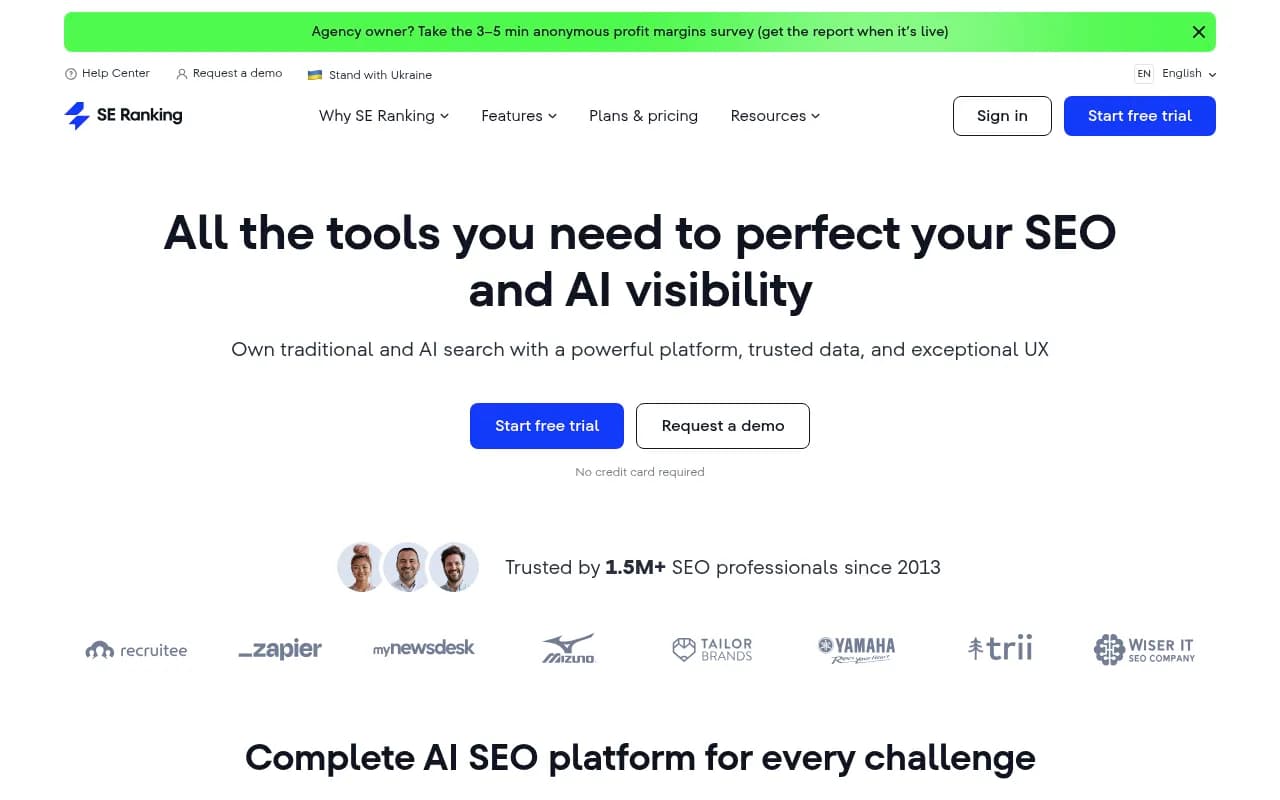
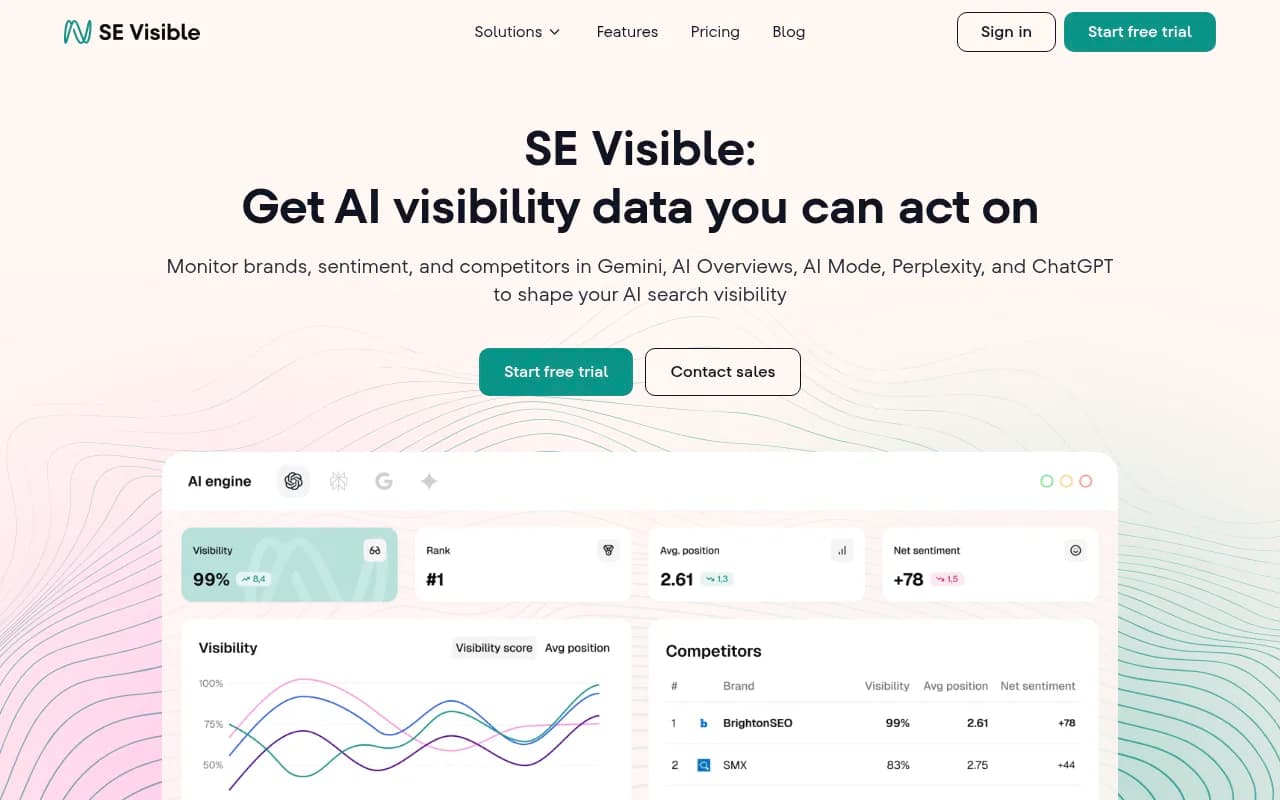
SE Ranking has taken a two-pronged approach. The main platform includes a Brand Radar feature for tracking brand mentions across AI channels, and there's a separate product called SE Visible focused specifically on AI Mode tracking and multi-brand coverage.
What it does well
SE Ranking's value proposition is price. Multiple independent reviews in 2026 put its cost at 35-50% less than buying separate SEO and AI visibility tools. If you're a small team that needs basic rank tracking, site audits, content tools, and some AI mention monitoring under one subscription, SE Ranking makes that math work.
SE Visible specifically tracks 5 AI models and includes multi-brand coverage, which is useful for agencies managing several clients. The interface is clean, and the Brand Radar gives you a reasonable overview of where your brand appears in AI-generated answers.
Where it falls short
The AI visibility features are monitoring-only. You can see that your brand isn't appearing for certain prompts, but SE Ranking doesn't tell you why or what to do about it. There's no answer gap analysis, no AI content generation tied to citation data, and no crawler log monitoring to understand how AI bots are actually reading your site.
The prompt coverage is also limited. SE Ranking tracks "selected AI channels" rather than the full range of models your audience might actually use. For teams that care about visibility in Claude, Grok, DeepSeek, or Meta AI, that's a meaningful gap.
Semrush AI Toolkit
Semrush is the most feature-rich of the three traditional SEO platforms, and its AI Toolkit reflects that. It's been one of the more talked-about additions to the platform in 2026, with a dedicated toolkit that sits inside the broader Semrush suite.
What it does well
Semrush tracks 5 AI models and surfaces brand mention data alongside its existing competitive intelligence. If you're already a Semrush user, the AI Toolkit is bundled in, so there's no additional cost to start experimenting with it. The integration with Semrush's keyword data is genuinely useful -- you can cross-reference which keywords you rank for traditionally with how you appear in AI responses for related prompts.
The platform also has ContentShake AI for writing assistance, which at least gestures toward the content optimization side of GEO.
Where it falls short
The prompts are fixed. Semrush uses a predefined set of prompts rather than letting you define the specific questions your target customers are actually asking. That's a significant limitation for GEO work, where the whole point is understanding your visibility for the exact queries that matter to your business.
There's also no AI traffic attribution. Semrush can tell you that your brand appeared in a ChatGPT response, but it can't connect that appearance to actual website visits or revenue. For marketing teams trying to justify GEO investment, that missing link is a real problem.
No crawler log monitoring either. Understanding how GPTBot, ClaudeBot, and PerplexityBot are crawling your site -- which pages they read, which they skip, what errors they encounter -- is increasingly important for AI SEO. Semrush doesn't surface this.
Ahrefs Brand Radar
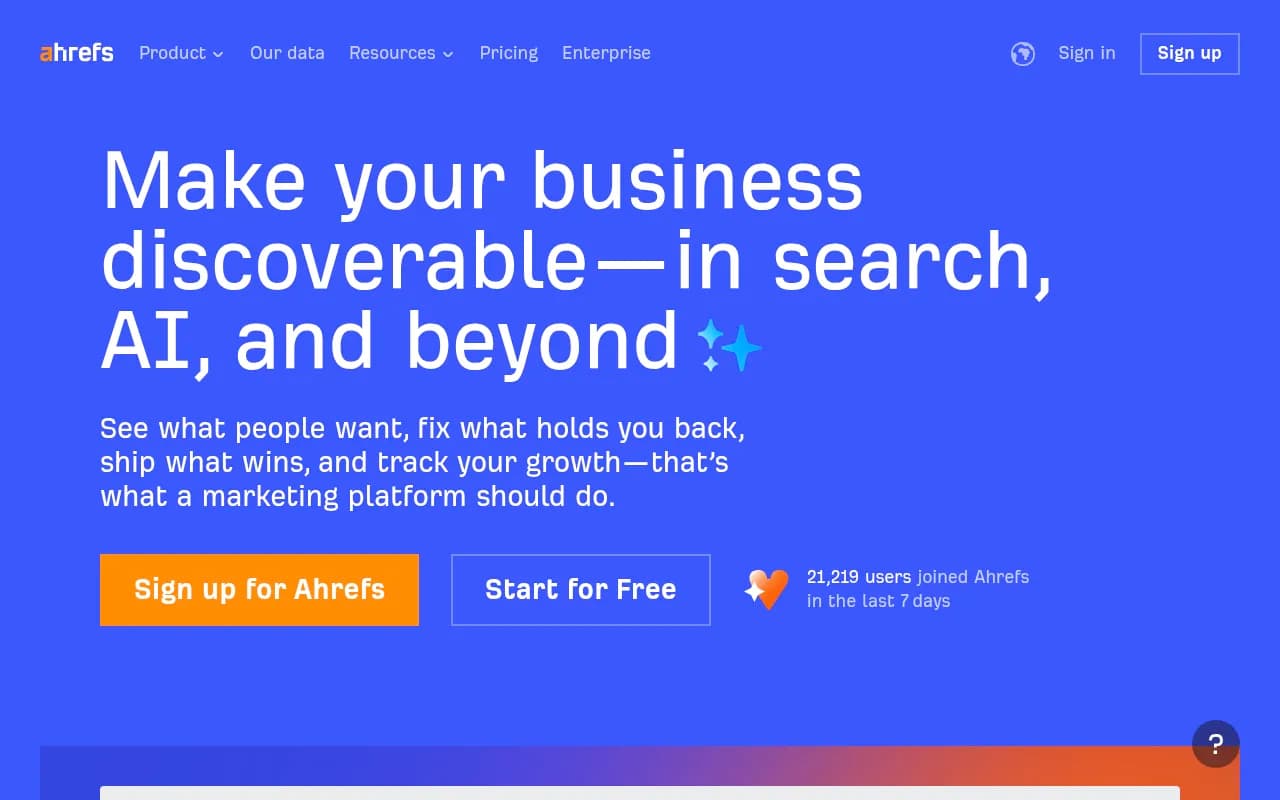
Ahrefs Brand Radar is the newest of the three, and it's the most limited in scope. It tracks 4 AI models and is included with existing Ahrefs subscriptions, which makes it easy to try.
What it does well
Ahrefs' core strength has always been its backlink data and content gap analysis for traditional SEO. Brand Radar sits on top of that foundation, and for teams that already live in Ahrefs, it's a low-friction way to get a first look at AI visibility.
The interface follows Ahrefs' usual design philosophy: clean, data-forward, relatively easy to interpret. If you want a quick snapshot of whether your brand is appearing in AI responses without learning a new tool, Brand Radar delivers that.
Where it falls short
Four models is thin coverage. Ahrefs Brand Radar tracks ChatGPT, Perplexity, Google AI Overviews, and Gemini -- which covers the most popular AI search surfaces, but misses Claude, Grok, DeepSeek, Copilot, and others that are increasingly part of how people search.
Like Semrush, Ahrefs uses fixed prompts. You can't customize the queries to match your specific market or customer personas. And there's no AI traffic attribution -- no way to connect Brand Radar data to actual traffic or conversions.
Tim Soulo, Ahrefs' CMO, acknowledged in a February 2026 Medium post that AI visibility is a distinct discipline from traditional SEO, and that the tools to handle it properly are still evolving. That's an honest framing, but it also signals that Brand Radar is more of a first step than a complete solution.
Head-to-head comparison
| Feature | SE Ranking | Semrush AI Toolkit | Ahrefs Brand Radar |
|---|---|---|---|
| AI models tracked | 5 (SE Visible) | 5 | 4 |
| Custom prompts | Limited | No (fixed) | No (fixed) |
| Competitor comparison | Yes | Yes | Yes |
| AI traffic attribution | No | No | No |
| Crawler log monitoring | No | No | No |
| Content gap analysis (GEO) | No | No | No |
| AI content generation | No | Basic (ContentShake) | No |
| Reddit/YouTube insights | No | No | No |
| Pricing model | Bundled / SE Visible from $99/mo | Bundled with Semrush | Included with Ahrefs |
| Best for | Budget-conscious teams wanting one tool | Existing Semrush users wanting a quick look | Existing Ahrefs users wanting a quick look |
The pattern is consistent across all three: solid monitoring, limited action. You can see where you're invisible. You can't easily fix it from within the same platform.
The fundamental problem with SEO-suite AI add-ons
Here's the honest assessment: SE Ranking, Semrush, and Ahrefs built their businesses on a specific model of search. You find keywords, you create content, you track rankings, you build links. That model works well for traditional Google search, and all three platforms are genuinely good at it.
AI search works differently. The "ranking" isn't a position -- it's whether an AI model has enough trust in your content to cite it when synthesizing an answer. The "keywords" aren't just search terms -- they're full prompts with intent, context, and persona embedded in them. The "content strategy" isn't just about topical coverage -- it's about creating content that answers the specific questions AI models are being asked, in formats they can easily parse and cite.
Bolting AI visibility monitoring onto a traditional SEO platform is relatively straightforward. Building the infrastructure to actually help you improve AI visibility -- prompt-level tracking, citation analysis, content gap identification, AI-optimized content generation, crawler log monitoring -- requires a fundamentally different architecture.
That's why purpose-built GEO platforms tend to outperform SEO suite add-ons for teams that take AI visibility seriously.
What purpose-built platforms do differently
For context, here's what the leading dedicated AI visibility platforms offer that SE Ranking, Semrush, and Ahrefs don't:
Prompt customization: You define the exact questions your customers ask, not a fixed list chosen by the platform.
Content gap analysis: You see which prompts your competitors appear for but you don't -- and specifically what content is missing from your site.
AI content generation tied to citation data: Content created specifically to get cited by AI models, based on analysis of what those models actually cite.
Crawler log monitoring: Real-time data on how AI bots (GPTBot, ClaudeBot, PerplexityBot) are crawling your site.
Traffic attribution: Connecting AI visibility to actual website visits and revenue.
Broader model coverage: Tracking 8-10+ AI models rather than 4-5.
Promptwatch is one example of a platform built around this full loop -- find gaps, create content, track results. It's used by 6,700+ brands and agencies, and the distinction it draws is between monitoring (showing you data) and optimization (helping you act on it).

Other dedicated platforms worth considering depending on your use case:
Profound

Otterly.AI


So which SEO platform's GEO add-on is actually usable?
All three are usable in the sense that they work and provide real data. The question is whether "usable" is the right bar.
If you're already paying for Semrush or Ahrefs and want a quick sense of your AI visibility without adding another tool, the built-in features are a reasonable starting point. You'll get a directional view of whether your brand appears in AI responses, and you can cross-reference that with your existing SEO data.
SE Ranking makes the most sense if you're budget-constrained and want to consolidate. The price point is genuinely competitive, and SE Visible gives you more dedicated AI tracking than what Semrush or Ahrefs bundle in by default.
But if you're trying to actually improve your AI visibility -- not just measure it -- all three platforms leave you with the same problem: you know you have a gap, and you're on your own to figure out how to close it.
For teams where AI search is a serious channel (and in 2026, that's most B2B and consumer brands), the better move is to use your existing SEO platform for what it's good at, and add a dedicated GEO tool for the optimization work. The two categories are complementary, not redundant.
The SEO platforms are getting better at this. But right now, the gap between "we track AI visibility" and "we help you improve AI visibility" is still wide enough to matter.