Key takeaways
- Ranksmith is an AI search visibility tool that tracks brand mentions across ChatGPT, Perplexity, and other LLMs, with a stated focus on actionable recommendations rather than raw data dumps.
- The platform covers the basics well: prompt tracking, mention monitoring, and some competitor comparison. But it falls short on content generation, crawler log analysis, and traffic attribution.
- For teams that just want to know "where do I show up?" Ranksmith is a reasonable starting point. For teams that also want to know "what do I do about it?" you'll likely need to supplement it or switch to a more complete platform.
- The AI visibility tool market in 2026 is crowded. The real differentiator isn't what data a tool shows you -- it's whether it helps you act on that data.
The AI search visibility space has exploded. Eighteen months ago, tracking whether ChatGPT mentioned your brand felt like a novelty. Now it's a line item in marketing budgets, a KPI in quarterly reviews, and the subject of a genuinely overwhelming number of tools.
Ranksmith is one of them. It positions itself around "actionable insights" -- a phrase that every tool in this category uses, and that most of them fail to deliver on. So I wanted to test whether Ranksmith actually earns that label, or whether it's another monitoring dashboard dressed up in action-oriented language.
Here's what I found.
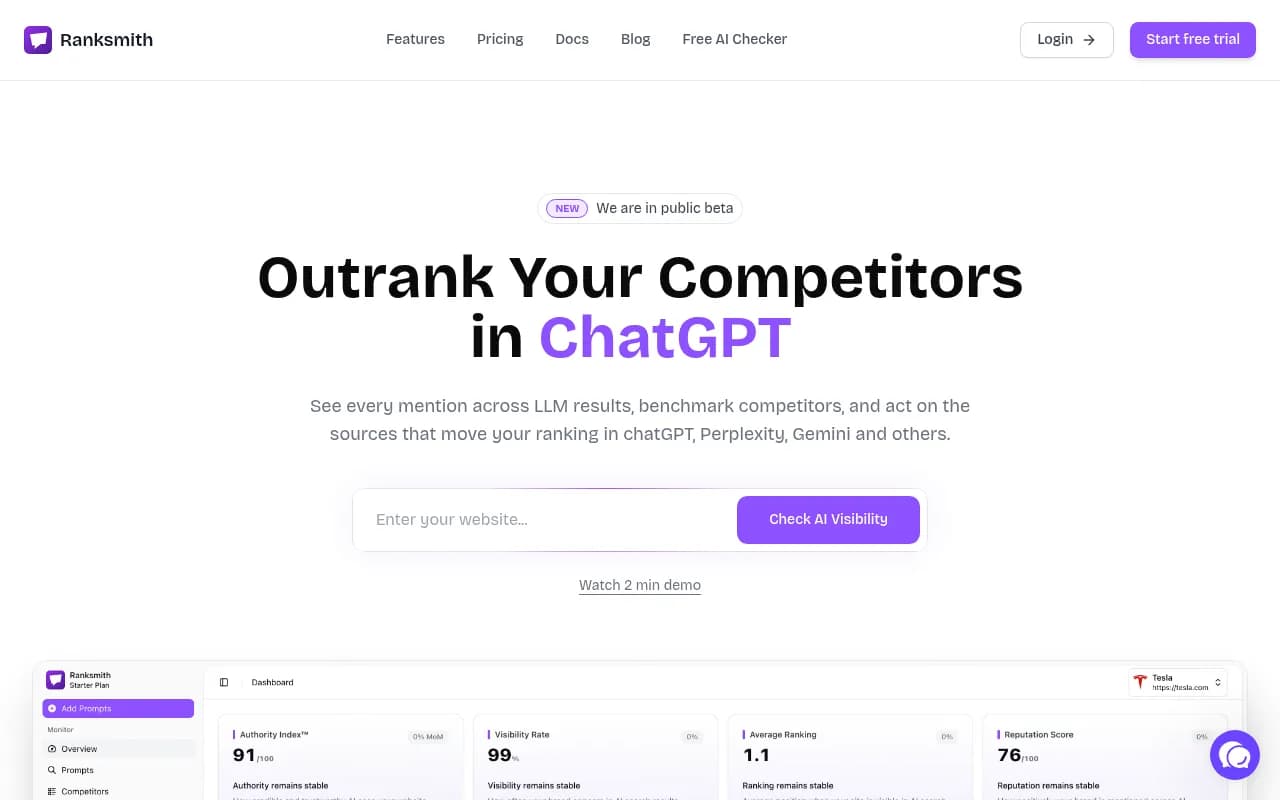
What Ranksmith actually does
At its core, Ranksmith tracks your brand's visibility across AI search engines. You set up a brand profile, define a set of prompts (the questions your customers might ask ChatGPT or Perplexity), and the tool runs those prompts periodically to check whether your brand appears in the responses.
That's the foundation. On top of that, Ranksmith adds:
- A visibility score that aggregates how often your brand appears across monitored prompts and models
- Competitor comparison, so you can see how your visibility stacks up against named rivals
- Mention context, showing the actual AI-generated responses where your brand was (or wasn't) cited
- Some form of recommendation layer that flags where gaps exist
The "actionable insights" claim comes from that last part. The idea is that instead of just showing you a visibility score, Ranksmith tells you which prompts you're losing and suggests what to do about it.
Whether that recommendation layer is genuinely useful is the real question.
The monitoring side: solid but not exceptional
The tracking functionality works. Ranksmith runs your prompts across the major AI models, logs the responses, and surfaces where your brand appears. The interface is clean enough that you can get oriented quickly.
Competitor tracking is a useful addition. Seeing that a rival appears in 68% of prompts where you appear in 22% is the kind of concrete gap that motivates action. Most teams respond better to "your competitor is winning this specific prompt" than to an abstract visibility score.
The mention context -- seeing the actual AI response -- is also genuinely helpful. It lets you understand how your brand is being referenced, not just whether it is. That matters because AI models sometimes mention brands in neutral or negative contexts, and raw mention counts don't capture that nuance.
Where the monitoring side starts to feel limited:
- No AI crawler logs. You can see that you're not being cited, but you can't see whether AI crawlers are even visiting your site, which pages they're reading, or whether they're hitting errors. That's a meaningful blind spot for diagnosing why your visibility is low.
- Prompt coverage depends heavily on what you set up manually. There's no automated discovery of prompts you should be tracking but haven't thought of yet.
- No Reddit or YouTube tracking. A significant portion of AI citations come from forum discussions and video content. If Ranksmith isn't surfacing those, you're missing part of the picture.
For context: a 2026 Yext analysis of 6.8 million AI citations found that 47% came from first-party websites, 44% from business listings, and the remainder from reviews, social, news, and forums. Tools that only track your direct brand mentions miss the upstream signals that actually influence AI recommendations.
The "actionable" part: does it hold up?
This is where I spent the most time, because it's the core claim.
Ranksmith does surface gap information -- prompts where competitors appear but you don't, topics where your visibility is weak. That's more than a pure monitoring tool gives you. Seeing "you're invisible for 'best [category] tools for [use case]' prompts" is useful.
But the recommendations stop short of telling you what to create. There's a difference between "you have a gap here" and "here's the specific content you need to write to close that gap." Most teams, especially smaller ones, need the latter. Knowing you're invisible for a category of prompts doesn't automatically tell you whether the fix is a new blog post, a FAQ page, a product comparison, or a PR push.
The tools that genuinely earn the "actionable" label go further. They analyze what content AI models are actually citing for those prompts, identify the specific topics and angles missing from your site, and in some cases generate the content directly. Ranksmith's recommendation layer is more like a gap report than a fix-it guide.
That's not a fatal flaw -- gap reports are valuable. But it's worth being clear-eyed about what you're getting.
How Ranksmith compares to the broader market
The AI visibility tool market in 2026 breaks down roughly into three tiers:
Tier 1: Pure monitoring. Tools that track mentions and show you dashboards. Most of the market lives here. You get data, you don't get direction.
Tier 2: Monitoring plus gap analysis. Tools that show you where you're invisible relative to competitors and which prompts you're losing. Ranksmith sits here, along with several others.
Tier 3: Full optimization loop. Tools that find gaps, help you create content to close them, track whether that content improves your visibility, and connect visibility to actual traffic and revenue. Very few tools operate at this level.
Here's a quick comparison of how Ranksmith stacks up against some alternatives:
| Tool | Prompt tracking | Competitor gaps | Content generation | Crawler logs | Traffic attribution |
|---|---|---|---|---|---|
| Ranksmith | Yes | Yes | No | No | No |
| Otterly.AI | Yes | Limited | No | No | No |
| Peec AI | Yes | Yes | No | No | No |
| AthenaHQ | Yes | Yes | No | No | No |
| Profound | Yes | Yes | No | Yes (Agent Analytics) | Limited |
| Promptwatch | Yes | Yes | Yes (built-in AI writer) | Yes | Yes |
Otterly.AI


Profound


The pattern is consistent: most tools in this space are good at showing you the problem. Fewer help you solve it.
Promptwatch is the clearest example of a tool that tries to close the full loop -- gap analysis feeds into content generation, which feeds into tracking, which feeds into traffic attribution. Whether that full stack is worth the higher price point depends on your team's needs and capacity.
Who Ranksmith is actually for
Ranksmith makes the most sense for:
- Teams that are new to AI visibility and want a relatively simple way to start tracking brand mentions across LLMs
- Marketers who need to report on AI visibility to stakeholders and want a clean dashboard to pull numbers from
- Brands doing competitive benchmarking who want to see how they compare to specific rivals in AI search responses
It's less suited for:
- Teams that want to act on visibility data, not just observe it
- SEOs who need to understand the technical side of AI crawling and indexing
- Brands that want to connect AI visibility to actual traffic and revenue metrics
- Agencies managing multiple clients who need workflow tools, not just data exports
The broader context: why "actionable" matters so much right now
The reason the actionable vs. monitoring distinction matters is that AI search visibility is still early enough that the teams who move fastest will capture disproportionate share. Knowing you're invisible is only useful if you do something about it.
Mike Sadowski of Brand24 made this point in a January 2026 webinar: the teams winning in AI search aren't the ones with the best dashboards, they're the ones who've figured out what content AI models want to cite and have actually published it.
That requires more than a monitoring tool. It requires understanding which prompts matter, what content currently gets cited for those prompts, what's missing from your site, and how to create content that AI models will actually reference. Most tools in this space -- Ranksmith included -- don't take you all the way there.
A few alternatives worth considering
If Ranksmith's gap analysis approach appeals to you but you want more firepower, here are a few tools worth evaluating:
For more comprehensive monitoring with some additional depth:
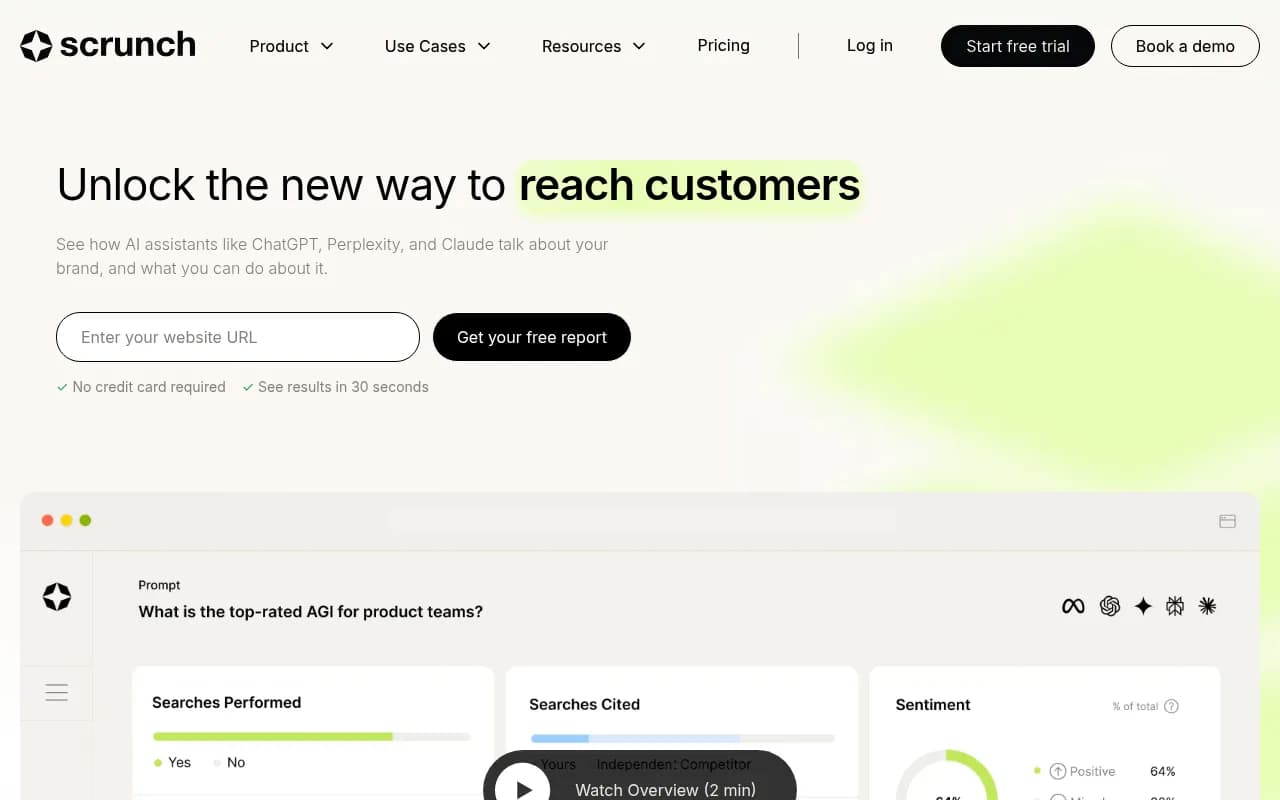

For teams that want to go beyond monitoring into content optimization:
For the full optimization loop (find gaps, generate content, track results, attribute traffic):
Promptwatch is the most complete option in this category -- it covers crawler logs, prompt volume and difficulty scoring, AI-powered content generation grounded in citation data, and traffic attribution through GSC integration or server log analysis. It's priced accordingly, starting at $99/month for the Essential tier.
Verdict
Ranksmith does what it says. It tracks your AI visibility, surfaces competitor gaps, and gives you a cleaner picture of where you stand in AI search results than you'd get from manual checking. The interface is approachable, and the gap reporting is genuinely useful as a starting point.
The honest limitation is that "actionable insights" in Ranksmith's case means "here's where you're losing" rather than "here's what to do about it." For teams that have the content strategy expertise to take gap data and turn it into a publishing plan, that's fine. For teams that need more hand-holding through the optimization process, it will feel incomplete.
In a market where the tools that actually move the needle are the ones that help you create and optimize -- not just observe -- Ranksmith sits in the middle tier. Useful, but not transformative on its own.
If you're just starting to track AI visibility, it's a reasonable place to begin. If you're past the "what's my visibility score?" question and into "how do I improve it?", you'll want to look at what else is available.