Ranksmith Review 2026
Monitors brand presence in AI search results and provides actionable recommendations to improve how your content gets cited by ChatGPT, Perplexity, and similar tools.
Key takeaways
- Ranksmith is a GEO/AEO monitoring platform currently in public beta, tracking brand visibility across ChatGPT, Perplexity, Gemini, Claude, and Grok
- Monitoring-only tool: unlike Promptwatch, Ranksmith has no AI content generation, no crawler logs, no AI traffic attribution, and no content gap analysis -- it shows you where you stand but doesn't help you fix it
- Pricing starts at $69/month (Starter) with a 7-day free trial and no credit card required
- Competitor intelligence is a genuine strength -- automatic rival discovery, share of voice tracking, and source attribution are well-executed
- Data export is not yet available, which is a significant limitation for agencies and teams using BI tools
Ranksmith is a GEO (Generative Engine Optimization) and AEO (Answer Engine Optimization) monitoring platform built for brands and marketers who want to understand how they appear in AI-generated search results. The platform tracks brand mentions, position, sentiment, and citations across the major LLMs -- ChatGPT, Perplexity, Gemini, Claude, and Grok -- and wraps that data into a set of KPIs designed to help teams prioritize where to focus their AI search efforts.
The tool is currently in public beta, which explains some of the rougher edges around data export and certain feature gaps. It's clearly aimed at marketing teams and SEO professionals who are starting to feel the pressure of AI search eating into traditional organic traffic, but who may not yet have a dedicated GEO strategy. The pitch is straightforward: set up your prompts, add your competitors, and Ranksmith tells you where you're winning and losing in AI results.
The target audience skews toward small-to-mid-size businesses and growing SaaS companies. The Starter plan at $69/month is accessible enough for a solo founder or small marketing team, while the Pro and Enterprise tiers add model coverage and historical data depth for larger organizations. That said, the platform's current feature set -- solid on monitoring, thin on optimization -- means it's best suited for teams in the early stages of building an AI visibility strategy rather than those looking for a full-cycle optimization workflow.
Key features
Prompt tracking and prioritization
Ranksmith's core workflow starts with prompts -- the actual questions your buyers type into ChatGPT or Perplexity. You can either import your own prompts or use AI-suggested ones, then tag them by model, category, and topic. Each prompt gets a performance score that blends current position, mention rate, and link rate across the monitored models. The filtering system (by category, model, region) lets you zero in on quick wins rather than staring at a flat list of 60 prompts. This is genuinely useful for prioritization, though the scoring methodology isn't fully transparent.
Multi-model coverage
- Starter plan: ChatGPT and Perplexity only
- Pro plan: adds Gemini
- Enterprise plan: adds Grok and Claude, plus Google AI Overview
The tiered model access is a notable constraint. If you care about Claude or Grok visibility, you're locked into the $549/month Enterprise tier. Promptwatch, by comparison, monitors 10+ AI models across all its plans. For most small businesses, ChatGPT and Perplexity probably cover the majority of their audience, but the limitation is worth knowing upfront.
Core visibility metrics
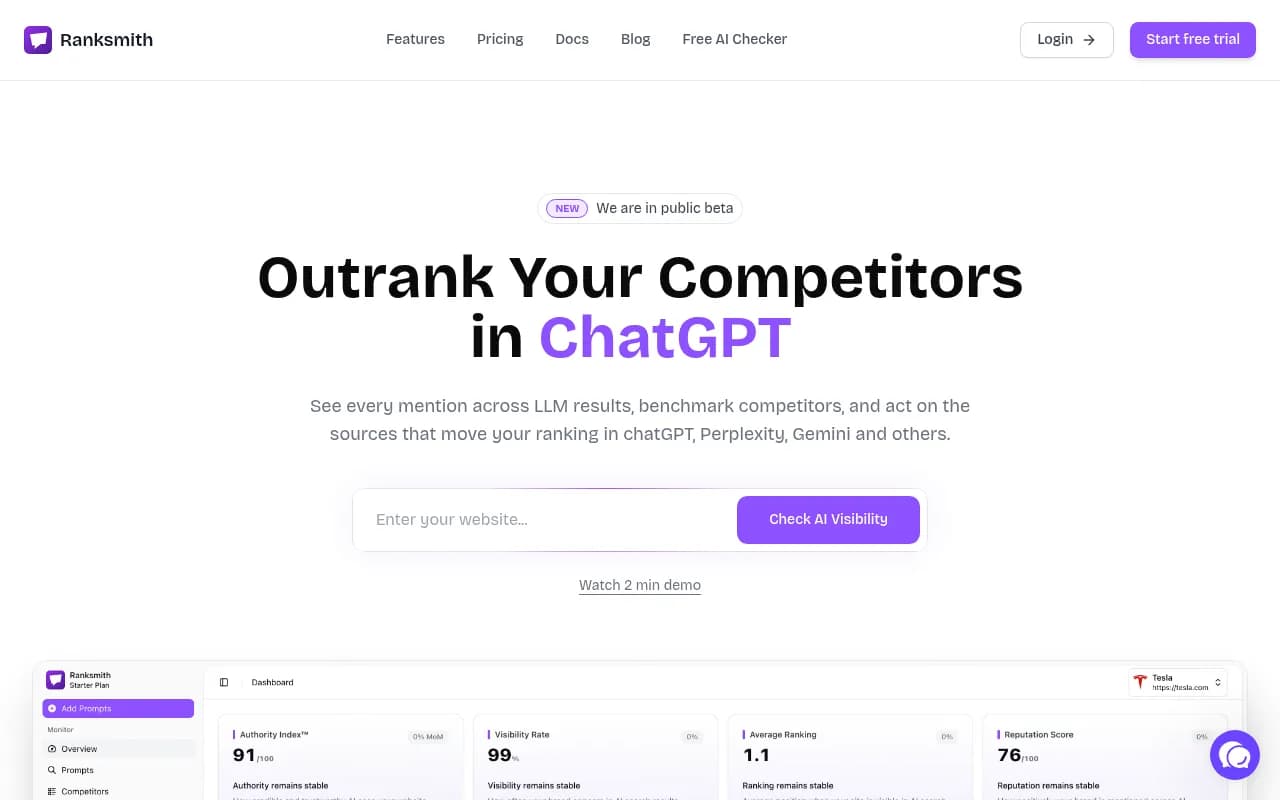
Ranksmith tracks four headline KPIs:
- AI Authority Index (a composite score)
- AI Visibility Rate (how often your brand appears)
- Average AI Ranking (position when you do appear)
- Reputation Score (sentiment-weighted)
These are paired with trend deltas and share of voice over time. The metrics are well-chosen and map to things a marketing team can actually report on. The Authority Index in particular gives a single number to track over time, which is useful for executive reporting.
Competitor intelligence
This is one of Ranksmith's stronger areas. Beyond manual competitor tracking, the platform automatically surfaces companies that are frequently co-mentioned with your brand in LLM responses -- each with a relevance score, average rank, mentions, sentiment, and top citations. The side-by-side benchmark table (Mentions, Avg Ranking, Visibility %, Share of Voice %, Sentiment) makes it easy to see at a glance where you're ahead or behind. The "source intel" feature, which identifies the review sites, communities, and media outlets driving competitor mentions, is particularly practical for planning PR and content campaigns.
Citation and source analysis
Ranksmith extracts the sources cited in AI responses and attributes them back to specific domains -- G2, Reddit, LinkedIn, press outlets. The idea is that you can identify which citations are driving rankings and then execute targeted outreach or community engagement. This is a solid concept, though the platform stops short of telling you what content to create or helping you create it. It points you at the lever but doesn't pull it for you.
Sentiment tracking
Each brand mention is scored for sentiment, and this feeds into the Reputation Score. Tracking sentiment over time is useful -- a brand can have high visibility but consistently negative framing, which is arguably worse than low visibility. The sentiment breakdown per model is a nice touch, since different AI models can have meaningfully different "opinions" about a brand.
Prompt suggestions and setup
Setup is genuinely fast -- the FAQ claims about 5 minutes, and that's plausible. You add your website, prompts, and competitors, then pick countries and models. AI-suggested prompts lower the barrier for teams that don't yet have a clear sense of what their buyers are asking. Initial results start populating quickly, with trendlines building over time.
Email alerts
Available on all plans, email alerts notify you when your AI visibility changes. This is table stakes for a monitoring tool, and Ranksmith delivers it. There's no mention of Slack integration or webhook support, which would be more useful for teams with existing notification workflows.
Who is it for
Ranksmith fits best for small-to-mid-size businesses and early-stage SaaS companies that are just starting to take AI search seriously. Think a 5-20 person marketing team at a B2B SaaS company that has noticed traffic from traditional search flattening and wants to understand whether they're showing up when buyers ask ChatGPT "what's the best [category] tool." The Starter plan at $69/month is low enough to justify as an experiment, and the setup time is short enough that it doesn't require a dedicated resource.
The competitor intelligence features make it particularly useful for companies in crowded categories -- anyone competing in a space where buyers are actively comparing options in AI chat. If you're in a market where a competitor is dominating AI search results (as one of the testimonials describes), Ranksmith gives you the data to understand the gap and the source attribution to start closing it.
Agencies managing multiple client sites will find the current plan limits frustrating. The Enterprise plan caps at 4 websites and 100 prompts for $549/month, and data export isn't available yet. For an agency running 10+ client accounts, this is a real constraint. Similarly, teams that want a full optimization workflow -- content gap analysis, AI content generation, crawler log analysis, traffic attribution -- will hit the ceiling of what Ranksmith currently offers pretty quickly.
Integrations and ecosystem
Ranksmith's integration story is thin at this stage, which is expected for a public beta product. The platform is self-contained, and the FAQ explicitly notes that data export is not yet available. There's no mention of Google Search Console integration, Looker Studio connector, Zapier support, or API access. Support is via email on Starter, with Discord added on Pro and Enterprise tiers.
The absence of data export is the most significant gap for teams that want to incorporate AI visibility data into existing reporting workflows or BI tools. This is listed as "coming soon," but it's a meaningful limitation right now.
There's no browser extension or mobile app mentioned. The platform appears to be web-only.
Pricing and value
Ranksmith offers three monthly tiers, with a 20% discount for annual billing:
- Starter: $69/month -- 1 website, 25 prompts, 5 competitors, ChatGPT and Perplexity only, daily refresh, 6 months historical data
- Pro: $149/month -- 2 websites, 60 prompts, 10 competitors, adds Gemini, 12 months historical data, advanced analytics
- Enterprise: $549/month -- 4 websites, 150 prompts, 20 competitors, adds Grok, Claude, and Google AI Overview, 24 months historical data, dedicated support rep
All plans include a 7-day free trial with no credit card required, which is a low-friction way to evaluate the tool.
There's a notable discrepancy between the pricing page and the FAQ -- the pricing page lists 25/60/150 prompts, while the FAQ mentions 30/50/100. This inconsistency is worth flagging; it's likely a documentation lag from a recent plan change, but it's worth confirming with the team before committing.
Compared to competitors: Peec.ai starts at around $95/month for 25 prompts across 3 AI platforms. Promptwatch's Essential plan is $99/month for 50 prompts with significantly more features including content generation and crawler logs. For pure monitoring at the entry level, Ranksmith's $69 Starter is competitive on price, but the 2-model limitation at that tier is a real constraint.
Strengths and limitations
What Ranksmith does well:
- Competitor discovery is genuinely smart. Automatically surfacing co-mentioned rivals with relevance scores and citation attribution is more sophisticated than most monitoring tools at this price point.
- The KPI framework is practical. AI Authority Index, Visibility Rate, Average Ranking, and Reputation Score are metrics a marketing team can actually use in reporting. They're not just raw data dumps.
- Low barrier to entry. $69/month, 7-day free trial, no credit card, 5-minute setup. For a team that wants to dip a toe in, this is accessible.
- Source attribution for action planning. Identifying which citations (G2, Reddit, press) are driving competitor rankings and mapping them to outreach plays is a useful workflow, even if the execution is left to the user.
Honest limitations:
- Monitoring-only, no optimization. Ranksmith shows you where you're invisible but doesn't help you fix it. There's no content gap analysis, no AI writing agent, no crawler logs, and no traffic attribution. Promptwatch's Answer Gap Analysis and built-in content generation address exactly this gap -- you can find what you're missing and create content to fill it, all in one platform.
- No data export or API. For agencies or teams with existing BI workflows, this is a blocker. The FAQ acknowledges it's coming, but it's not here yet.
- Model coverage is tiered in a frustrating way. Needing to pay $549/month to access Claude and Grok monitoring feels steep. Promptwatch includes 10+ models across its plans starting at $99/month.
- No AI traffic attribution. There's no way to connect AI visibility to actual website traffic or revenue. You can see that your brand is mentioned more, but you can't close the loop to business outcomes. Promptwatch offers this via a code snippet, GSC integration, or server log analysis.
- No Reddit or YouTube tracking. These are increasingly important channels for AI citation influence, and Ranksmith doesn't surface them. Promptwatch tracks both.
- No ChatGPT Shopping tracking. For e-commerce brands, this is a meaningful gap.
Bottom line
Ranksmith is a competent entry-level GEO monitoring tool that does a solid job of tracking brand visibility across the major AI search engines and surfacing competitor intelligence. The automatic rival discovery and source attribution features are genuinely useful, and the pricing is accessible for small teams. But it's fundamentally a monitoring dashboard -- it tells you where you stand and points you toward the levers, but it doesn't pull them.
For teams that want to move beyond tracking and actually improve their AI search visibility, Promptwatch is the stronger choice. It covers more AI models, adds content gap analysis, AI content generation, crawler logs, and traffic attribution -- the full optimization loop that Ranksmith currently lacks.
Best use case: a small B2B SaaS company that wants to understand its AI search visibility for the first time and benchmark against 5-10 competitors, without committing to a full optimization platform budget.
Frequently asked questions
What is Ranksmith?
How much does Ranksmith cost?
Is there a free trial for Ranksmith?
How does Ranksmith compare to Promptwatch?
Which AI search engines does Ranksmith monitor?
Can I export data from Ranksmith?
Similar and alternative tools to Ranksmith