Key takeaways
- Peec.ai is built for research-heavy teams that want deep AI search analysis, but it lacks a built-in content action layer
- Ranksmith focuses on actionable insights from AI search visibility data, making it a solid middle-ground option
- Rankshift covers multi-engine brand tracking across ChatGPT, Perplexity, and others with a clean interface
- AccuRanker is primarily a traditional rank tracker with on-demand updates -- strong for Google/Bing, limited for AI search
- If you need to both track and fix AI visibility gaps, platforms like Promptwatch close the loop with content generation and citation analysis
The phrase "AI rank tracking" is doing a lot of heavy lifting right now. Some tools use it to mean traditional SERP tracking with an AI Overviews layer bolted on. Others mean monitoring how often your brand appears in ChatGPT or Perplexity responses. A few mean something closer to what SEOs actually need: not just where you rank, but why, and what to do about it.
This guide compares four tools that show up frequently in 2026 discussions: Peec.ai, Ranksmith, Rankshift, and AccuRanker. They come from different angles, serve different audiences, and have meaningfully different ideas about what "actionable" means.
Let's get into it.
What we're actually comparing
Before the breakdown, it's worth being clear about what matters when evaluating these tools:
- Do they track AI search engines (ChatGPT, Perplexity, Gemini, etc.) or just Google AI Overviews?
- How deep is the data -- citation-level, page-level, prompt-level?
- Is there anything beyond monitoring? Content recommendations, gap analysis, publishing?
- How does pricing scale with usage?
- Who is the tool actually built for?
These questions separate the monitoring dashboards from the optimization platforms. That distinction matters more than it did 12 months ago.
Peec.ai
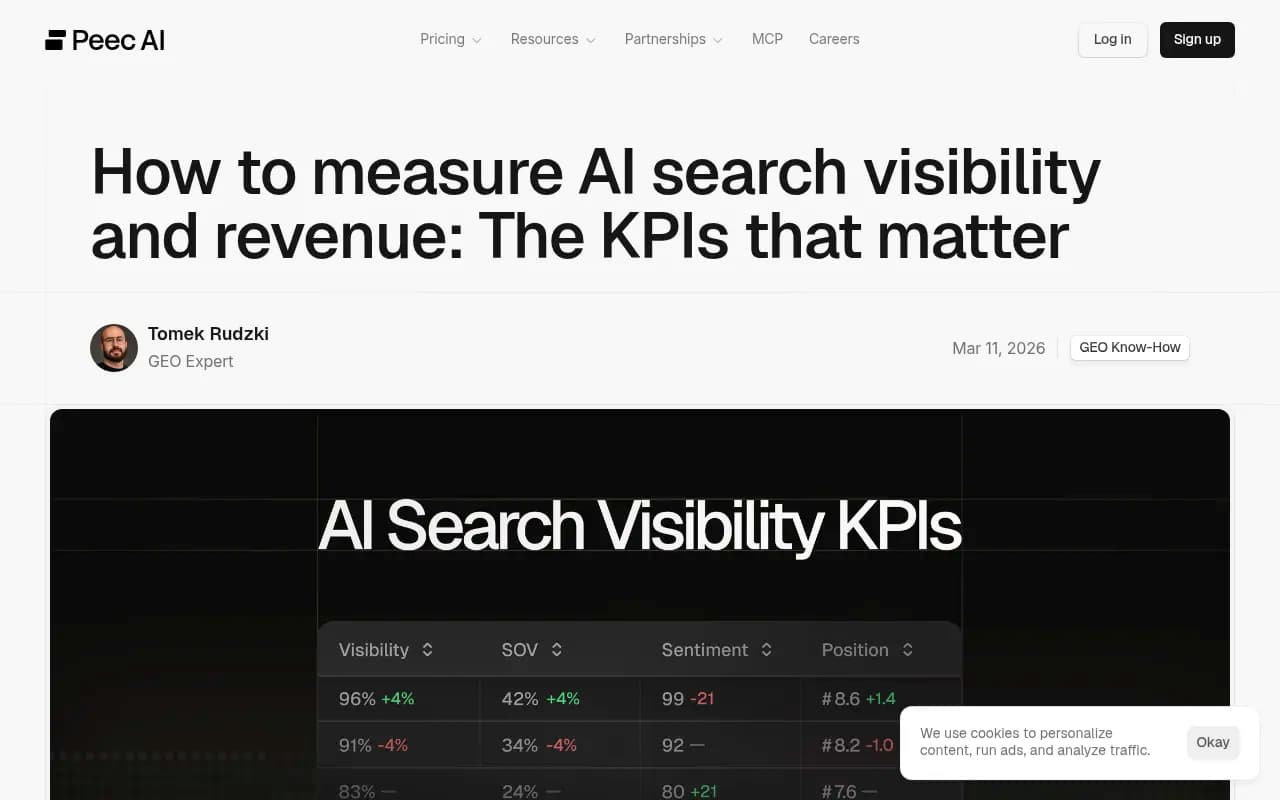
Peec AI positions itself as a research-first platform for AI search visibility. The focus is on understanding how AI models respond to queries in your category -- which brands get mentioned, with what sentiment, and how consistently.

The platform covers multiple AI engines and gives you visibility percentage (does your brand appear at all?), position within responses, and brand sentiment analysis. Their own published guidance on AI search KPIs is worth reading -- they break down visibility percentage, position prominence, and sentiment as the three metrics that actually matter, and they're right that traffic attribution from LLMs is still a mess because most AI-driven discovery doesn't produce a direct click.
Where Peec.ai gets strong marks: the depth of its research features, the quality of its agency-style reporting, and the fact that it treats AI search as its own discipline rather than a Google Overviews add-on.
Where it falls short: third-party reviewers have noted that Peec.ai "emphasizes research and exploration over real-time monitoring" and lacks "an action layer for content recommendations or publishing." You get excellent diagnosis but the treatment plan is up to you.
Good fit for: agencies that need to brief clients on AI search performance, research-heavy SEO teams, and anyone who wants to understand the competitive landscape in AI responses before deciding what to build.
Ranksmith
Ranksmith takes a different angle -- the name signals intent. It's built around the idea that visibility data should lead somewhere, not just sit in a dashboard.
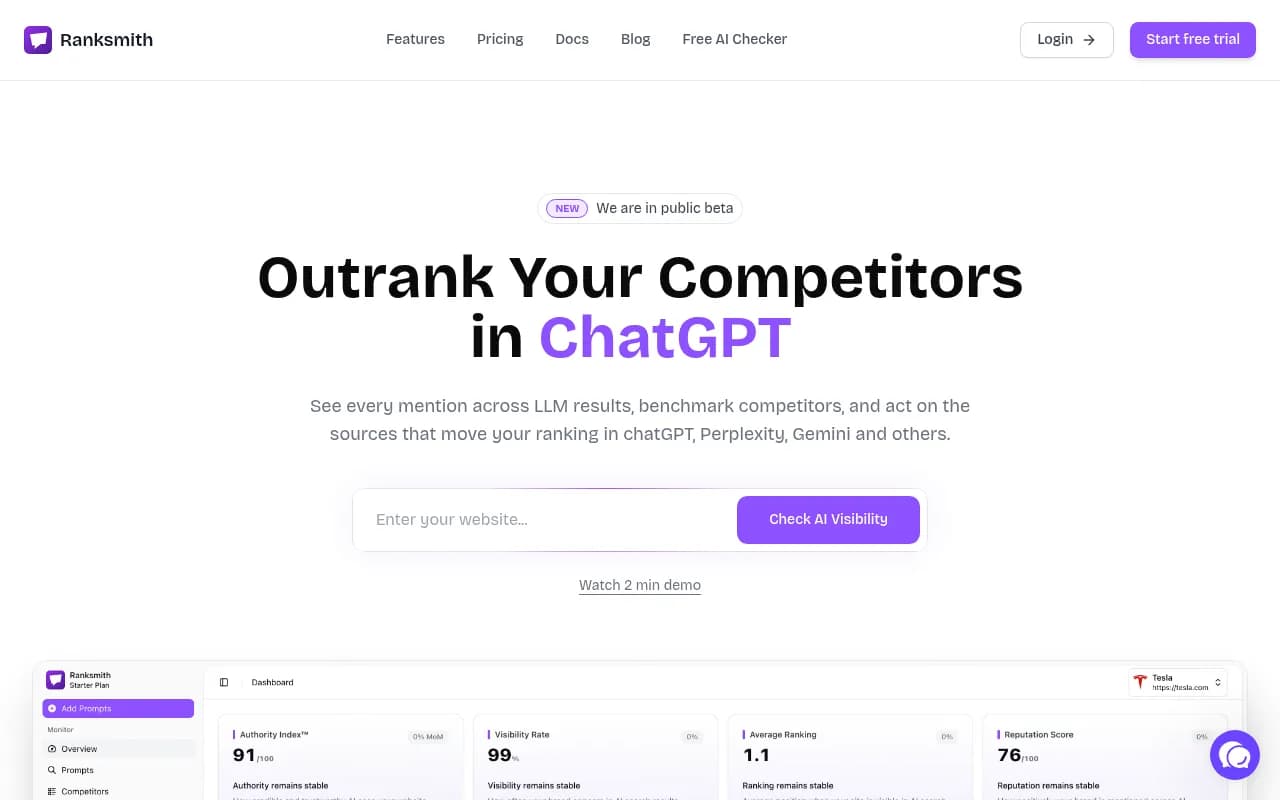
The platform tracks brand mentions and citations across AI search engines and pairs that with what it calls "actionable insights" -- recommendations tied to specific gaps in your content or citation profile. Where Peec.ai gives you the research, Ranksmith tries to give you the next step.
For teams that don't have a dedicated GEO strategist to interpret raw visibility data, this matters. Knowing your brand appears in 34% of relevant ChatGPT responses is useful. Knowing which specific topics are driving that 34% -- and which topics your competitors own that you don't -- is more useful.
Ranksmith is a newer entrant compared to Peec.ai and AccuRanker, so its dataset and prompt coverage are still maturing. But the product direction is clear, and for teams that want monitoring plus direction without paying enterprise prices, it's worth evaluating.
Good fit for: in-house marketing teams that want AI visibility data with clear next steps, and smaller agencies that don't have the bandwidth to interpret raw research output.
Rankshift
Rankshift focuses on multi-engine brand tracking -- specifically how your brand appears across ChatGPT, Perplexity, and other AI search platforms. The interface is clean, the setup is fast, and the core use case is clear: you want to know if AI models are recommending you, and how that changes over time.

The platform covers the basics well: brand mention tracking, competitor comparisons, and trend monitoring across AI engines. It's a solid choice for teams that are just getting started with AI visibility and need a clear, low-friction way to see where they stand.
Where Rankshift is more limited: it sits closer to the monitoring-only end of the spectrum. You get the data, but the platform doesn't generate content recommendations or help you close the gaps it surfaces. It's a visibility window, not a full optimization workflow.
That said, for teams that already have a content strategy and just need reliable signal on AI search performance, Rankshift does the job without unnecessary complexity.
Good fit for: brands and marketing teams that want a clean AI visibility dashboard without a steep learning curve, and teams that handle content strategy separately.
AccuRanker
AccuRanker is a different beast. It's been around since 2013 and built its reputation on fast, accurate traditional rank tracking -- on-demand SERP updates, high-frequency monitoring, and solid agency reporting features.
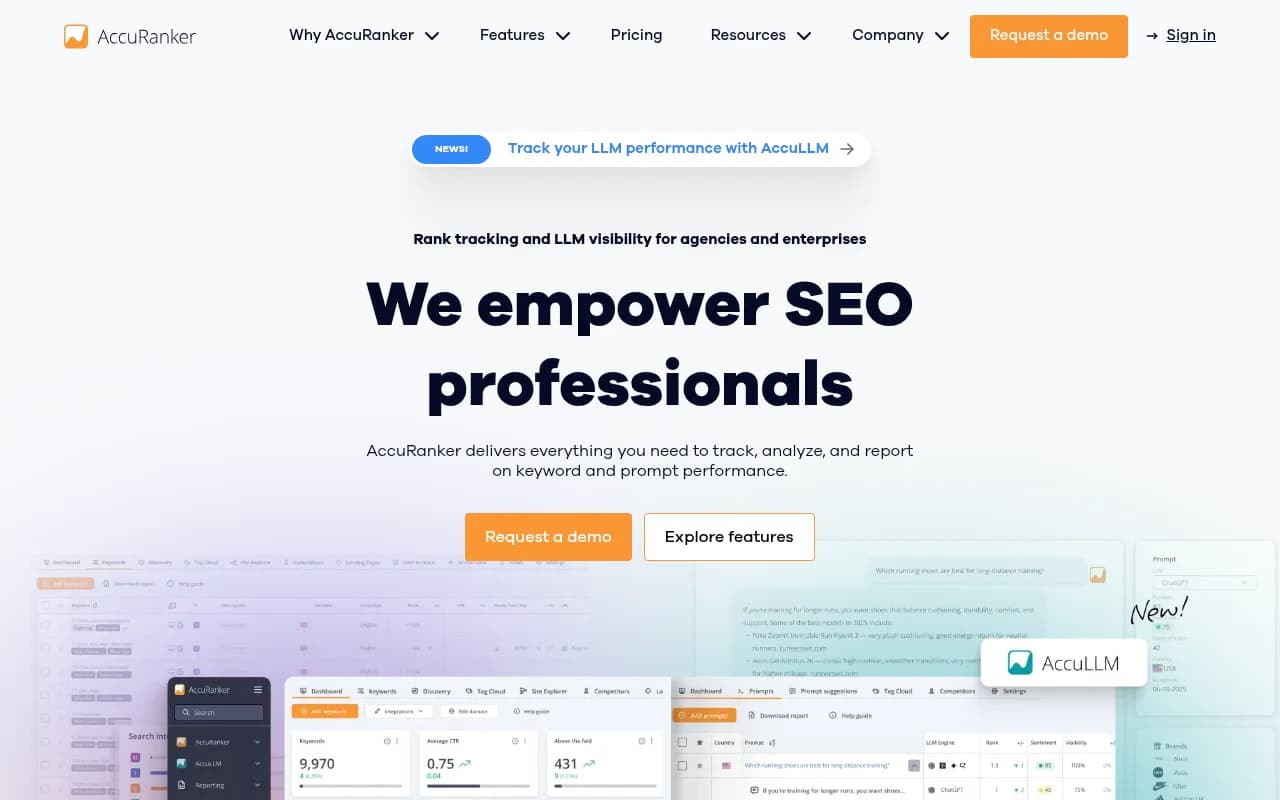
In 2026, AccuRanker has added AI Overviews tracking to its feature set, which means you can see when your pages appear in Google's AI-generated summaries alongside your standard position data. For teams that are primarily Google-focused and want one tool to cover both traditional rankings and Google AI Overviews, this is genuinely useful.
What AccuRanker doesn't do is track ChatGPT, Perplexity, Claude, Gemini (outside of Google Search), or other LLM-based search engines. If your concern is "does my brand appear when someone asks ChatGPT for a recommendation in my category," AccuRanker isn't the right tool. It's built for search engine rank tracking, and AI Overviews is an extension of that -- not a pivot to LLM monitoring.
The on-demand update feature is legitimately good. Most rank trackers update daily or weekly; AccuRanker lets you pull fresh data whenever you need it, which matters when you're testing changes or responding to a competitor move.
Good fit for: agencies and SEO teams that live in Google data and want AI Overviews coverage alongside traditional rank tracking. Not the right choice if your primary concern is LLM-based AI search visibility.
Side-by-side comparison
| Feature | Peec.ai | Ranksmith | Rankshift | AccuRanker |
|---|---|---|---|---|
| LLM tracking (ChatGPT, Perplexity, etc.) | Yes | Yes | Yes | No |
| Google AI Overviews tracking | Yes | Partial | Partial | Yes |
| Traditional rank tracking | No | No | No | Yes (core feature) |
| Brand sentiment analysis | Yes | Limited | Limited | No |
| Content gap / action layer | No | Yes (basic) | No | No |
| Content generation | No | No | No | No |
| Citation-level analysis | Yes | Partial | Limited | No |
| Competitor comparison | Yes | Yes | Yes | Yes |
| On-demand rank updates | No | No | No | Yes |
| Agency reporting | Yes | Yes | Limited | Yes |
| Best for | Research-heavy teams, agencies | In-house teams wanting direction | Monitoring-focused teams | Google-first SEO agencies |
The gap none of them fully close
Here's the honest problem with all four tools: they're primarily built around monitoring. Even Ranksmith, which leans toward actionability, stops short of actually generating the content you'd need to close the gaps it identifies.
This matters because AI search visibility is a content problem at its core. ChatGPT and Perplexity cite your brand because your content answers the questions their users are asking. If your content doesn't cover a topic, no amount of monitoring will fix that -- you need to create something.
The platforms that are starting to close this loop are the ones worth watching. Promptwatch is one of them -- it combines gap analysis (which prompts are competitors winning that you're not?) with a built-in AI writing agent that generates content grounded in real citation data, then tracks whether that content starts getting cited. It's a different model from what any of the four tools above offer.

That's not a knock on Peec.ai or Ranksmith -- they're doing real work in a space that's still figuring itself out. But if you're evaluating tools in 2026, the question to ask is: after I see the data, what does this tool help me do next?
How to choose
The right tool depends on what you actually need right now.
If you're an agency that needs to show clients a comprehensive picture of their AI search performance, Peec.ai's research depth and reporting quality make it a strong choice. The lack of a content action layer is a real gap, but agencies often have their own content workflows anyway.
If you're an in-house team that wants to understand AI visibility and get pointed toward what to fix, Ranksmith's direction toward actionable insights is the right instinct. Watch how the product develops -- the data coverage will matter more as the platform matures.
If you just need a clean, fast way to monitor brand mentions across AI engines without a lot of complexity, Rankshift is a reasonable starting point. It won't overwhelm you, and it gives you the core signal you need.
If your world is Google and you want AI Overviews coverage alongside traditional rank tracking in one place, AccuRanker is the obvious choice. It's reliable, fast, and built for agencies that run on SERP data.
And if you want to close the full loop -- find the gaps, create content that fills them, and track whether it works -- you'll need something that goes beyond monitoring. That's where platforms like Promptwatch, which has processed over 1.1 billion citations and prompts, start to look different from the rest of the field.
A note on what "actionable" actually means
The word gets used loosely. Every tool in this comparison will tell you it provides "actionable insights." What that usually means is: here's a chart showing your visibility is lower than a competitor's.
Real actionability in AI search looks like this: here are the specific prompts where you're invisible, here's the content your competitors have that you don't, here's a draft article grounded in what AI models actually cite, and here's your visibility score three weeks after you published it.
That's a higher bar. Most tools in 2026 are still working toward it. Knowing where each tool sits on that spectrum -- monitoring, insights, or optimization -- is the most useful frame for making a decision.
The market is moving fast. A tool that was monitoring-only six months ago may have shipped content features by the time you read this. But the underlying question -- does this tool help me fix my AI visibility, or just measure it -- is the right one to keep asking.