Key takeaways
- Similarweb is a traffic intelligence platform built for competitive research and audience analysis — it wasn't designed for AI search visibility or GEO.
- Promptwatch is purpose-built for Generative Engine Optimization: it tracks how your brand appears in ChatGPT, Perplexity, Gemini, and 7 other AI models, then helps you improve that visibility.
- The two tools answer fundamentally different questions. Similarweb asks "where does traffic come from?" Promptwatch asks "is AI recommending you, and why not?"
- If your goal is to understand and grow your presence in AI search, Similarweb's GEO-adjacent features are too shallow to act on. You need a dedicated platform.
- For teams that need both competitive traffic data and AI visibility optimization, the answer is usually to run both tools — not to pick one.
Comparing Promptwatch and Similarweb feels a bit like comparing a GPS to a weather app. Both involve navigation in some sense. But they're solving different problems, and using the wrong one for the wrong job will leave you frustrated.
Similarweb has been a staple of competitive intelligence for years. It's genuinely useful for understanding traffic sources, audience demographics, and how competitors are growing. But as AI search has become a real distribution channel in 2026, marketers are asking whether Similarweb can pull double duty as a GEO tool. The short answer: not really.
Let's break down exactly what each platform does, where the overlap is (and isn't), and which one you actually need.
What Similarweb does
Similarweb is a digital intelligence platform. Its core job is to estimate website traffic and help you understand the competitive landscape around it.
The things Similarweb does well:
- Traffic volume estimates for any domain
- Traffic source breakdown (organic, paid, referral, social, direct)
- Audience demographics and interests
- Competitor benchmarking across industries
- Keyword gap analysis for traditional search
- Market share tracking across categories
In 2025-2026, Similarweb added some AI-adjacent features. You can see estimated traffic from AI-referral sources (like ChatGPT.com or Perplexity.ai) in their referral data. That's genuinely useful context.
But there's a meaningful difference between seeing that you got 1,200 visits from perplexity.ai last month and understanding why Perplexity is or isn't citing your brand in its responses. Similarweb shows you the downstream traffic signal. It doesn't show you the upstream visibility problem.
What Promptwatch does
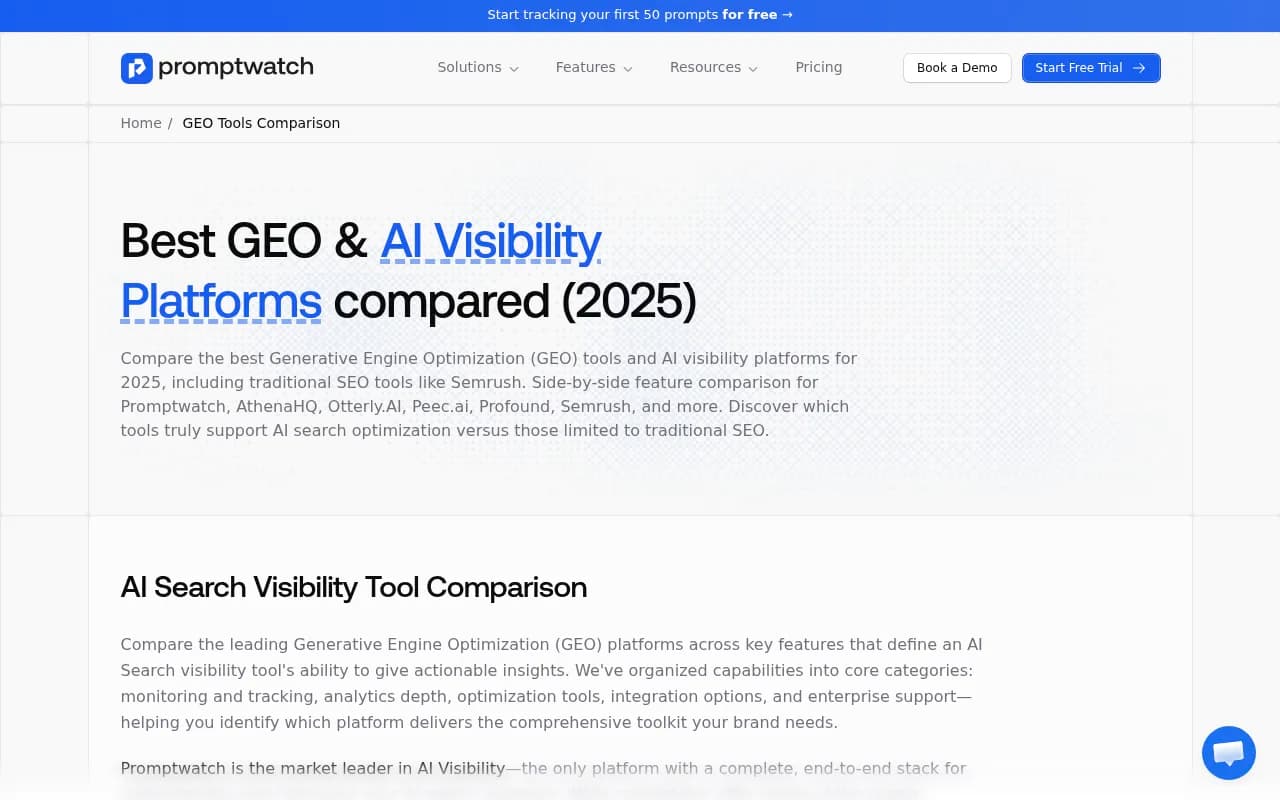
Promptwatch is built specifically for AI search visibility. It tracks how your brand appears when real users ask AI engines questions, then gives you the tools to improve that visibility.

The core workflow looks like this:
- You define the prompts your customers are actually asking ("best CRM for startups," "what's the top project management tool for remote teams," etc.)
- Promptwatch queries 10+ AI models with those prompts and records what they say, who they cite, and whether your brand appears
- Answer Gap Analysis shows you which prompts competitors are visible for but you're not
- Content Agents generate articles, comparisons, and briefs designed to fill those gaps
- Page-level tracking shows when new content gets crawled and starts generating citations
The platform covers ChatGPT, Perplexity, Google AI Overviews, Google AI Mode, Claude, Gemini, Meta/Llama, DeepSeek, Grok, Mistral, and Copilot. That's the full picture of where AI-driven discovery is actually happening.
What makes it different from just "monitoring" is the action loop. Most tools in this space show you a dashboard of where you're invisible. Promptwatch shows you that and helps you fix it.
Where the comparison gets interesting
The honest version of this comparison isn't "which is better." It's "what are you actually trying to do?"
Traffic intelligence vs. visibility optimization
Similarweb answers: "How much traffic is my competitor getting from AI referrals?"
Promptwatch answers: "When someone asks ChatGPT to recommend a tool like mine, does my brand show up? And if not, what content do I need to create to change that?"
These are related but distinct questions. One is retrospective (what happened to traffic). The other is diagnostic and forward-looking (what's happening inside AI responses, and what can I do about it).
Keyword research vs. prompt intelligence
Similarweb's keyword data is built for traditional Google search. You can find keyword gaps, see what competitors rank for, and estimate search volumes. That's still useful.
Promptwatch's Prompt Intelligence feature is built for AI search. It gives you volume estimates and difficulty scores for specific prompts, plus query fan-outs that show how one question branches into sub-queries. These aren't the same as search keywords. AI models respond to conversational prompts, not just keyword strings, and the optimization logic is different.
Competitive benchmarking
Both tools let you track competitors. But they're measuring different things.
Similarweb measures traffic share. Promptwatch measures AI visibility share — which brands appear in AI responses for a given set of prompts, how often, and with what sentiment. Promptwatch's Competitor Heatmaps show you exactly who's winning for each prompt and why.
Feature comparison
| Feature | Similarweb | Promptwatch |
|---|---|---|
| Website traffic estimates | Yes | No |
| AI referral traffic (e.g. from perplexity.ai) | Yes (referral data) | Yes (attribution) |
| AI model coverage | Limited | 10+ models |
| Prompt/query tracking | No | Yes |
| Brand mention tracking in AI responses | No | Yes |
| Citation analysis (which pages AI cites) | No | Yes |
| Answer Gap Analysis | No | Yes |
| AI content generation | No | Yes (Content Agents) |
| AI crawler logs | No | Yes |
| Reddit & YouTube AI influence tracking | No | Yes |
| ChatGPT Shopping tracking | No | Yes |
| Competitor AI visibility heatmaps | No | Yes |
| Keyword research (traditional) | Yes | No |
| Audience demographics | Yes | No |
| Traffic source breakdown | Yes | No |
| Market share by industry | Yes | No |
| Pricing (entry) | ~$125/mo | $99/mo |
The table tells the story pretty clearly. These tools have almost no feature overlap in the areas that matter for GEO. Similarweb is strong where Promptwatch doesn't play, and vice versa.
When Similarweb is the right choice
Similarweb makes sense when your primary questions are about traffic, not AI visibility. Specifically:
- You're doing competitive research and want to understand how a competitor's overall traffic is growing
- You want to see which channels (paid, organic, social, referral) are driving growth for a category leader
- You're evaluating a market opportunity and need rough traffic estimates for multiple domains
- You want to track AI referral traffic as one signal among many in a broader analytics setup
If you're a strategist, an investor doing due diligence, or a growth marketer building a channel mix, Similarweb is a solid tool for that job.
When Promptwatch is the right choice
Promptwatch is the right choice when AI search visibility is a priority. That means:
- You want to know if ChatGPT, Perplexity, or Gemini is recommending your brand when users ask relevant questions
- You're losing traffic to AI-generated answers and want to understand why
- You want to create content that gets cited by AI models, not just ranked by Google
- You need to track which pages on your site are being crawled and cited by AI engines
- You're managing multiple brands or clients and need to report on AI visibility alongside traditional SEO metrics
The platform is used by 1,480+ brands and agencies including Booking.com and Center Parcs, which gives you a sense of the scale it operates at.
The case for running both
For most marketing teams in 2026, the honest recommendation is: use both, for different jobs.
Similarweb tells you what's happening at the traffic level. Promptwatch tells you what's happening inside AI responses. Together, you get a more complete picture.
A practical workflow might look like this:
- Use Similarweb to identify competitors gaining AI referral traffic
- Use Promptwatch to find which specific prompts those competitors are winning
- Use Promptwatch's Answer Gap Analysis to identify where your brand is missing
- Use Promptwatch's Content Agents to create content that fills those gaps
- Track the results in Promptwatch as new content gets crawled and cited
Similarweb surfaces the "something is happening" signal. Promptwatch tells you what to do about it.
What other tools are in this space?
If you're evaluating options beyond these two, a few other platforms are worth knowing about.
For AI visibility monitoring specifically, tools like Otterly.AI and Peec AI offer simpler, cheaper monitoring dashboards. They're fine for basic tracking but don't have content generation or crawler log features.
Otterly.AI


Profound and AthenaHQ are more enterprise-oriented monitoring platforms with strong prompt tracking but limited optimization capabilities.
Profound


For traditional SEO competitive intelligence alongside some AI features, Semrush and Ahrefs are the obvious alternatives to Similarweb.
None of these replicate what Similarweb does for traffic intelligence, and none of them replicate what Promptwatch does for end-to-end AI visibility optimization.
The bottom line
Similarweb and Promptwatch aren't really competitors. They're tools for different jobs that happen to be relevant to the same marketing team.
If you're trying to understand the competitive traffic landscape, Similarweb is good at that. If you're trying to understand and improve how AI models represent your brand, Similarweb's data is too shallow to act on. You need a platform that tracks actual AI responses, identifies the gaps, and helps you create content that closes them.
That's what Promptwatch does. And in 2026, with AI search eating an increasing share of discovery, that's the problem worth solving.