Key takeaways
- Ranking in the top three does not guarantee an AI Overview citation. Search Engine Land reported that the overlap between AI Overview citations and organic rankings rose from 32.3% to 54.5% between May 2024 and September 2025, which still leaves nearly half of citations coming from pages outside the top organic positions.
- Most fixes are cheap and happen before publishing: crawlable pages, a direct answer near the top, clean headings, and honest sourcing.
- Content format matters. In Promptwatch Data for July 2026, listicles averaged 18.0% of AI Overviews citations, product pages 16.3%, how-tos 15.1%, and video 5.9%.
- Social and video matter more in Google than in ChatGPT. AI Overviews drew 12.2% of citations from social platforms in the week of Sep 28 to Oct 4, 2026.
- Measure after you publish. Citations and mentions are separate goals, and you only learn which fixes worked by tracking both.
Why a pre-publish checklist beats a post-publish rescue
Every SEO I know has had the same experience. A page ranks in the top three, and the AI Overview sitting above it quotes someone else, often a site you have never heard of. Silktide's write-up of this pattern (July 2026) is worth reading because it admits what is true: Google has not published a sourcing algorithm, so nobody can audit one. What we have is patterns.
That is why I like a checklist done before publishing. Retrofitting structure into a live page works, but it is slower, and you lose the first weeks of crawling. The 25 items below are grouped by where they sit in the workflow. Not every item applies to every page, so skip what does not fit.
One caveat up front. I have not verified every item against Google's own AI features documentation, so treat the technical items as well-established SEO practice rather than confirmed ranking factors. Google's Search Central page on AI features is the source to check for eligibility rules.
Section 1: Technical access (fixes 1-6)
If Google cannot crawl, index, or show a snippet from your page, nothing else on this list matters.
1. Confirm the page is indexable
Check for a stray noindex tag, a canonical pointing elsewhere, or a robots.txt block. It sounds basic. It is also the most common reason a good page never appears anywhere.
2. Check snippet controls
Look for nosnippet, max-snippet, and data-nosnippet settings. If you restrict snippets heavily, you are restricting what Google can show. Decide on purpose, not by accident from a plugin default.
3. Make sure the main content renders without heavy JavaScript
If the answer only appears after client-side rendering, test it. Fetch the page with a crawler and look at what a bot actually sees. Tools like Screaming Frog do this well.
4. Fix page speed and Core Web Vitals
Not a magic AI lever, but slow, unstable pages hurt everything. Run the page through PageSpeed Insights before launch.
5. Put the page in the sitemap and link to it internally
Orphan pages get crawled late. Link to the new page from at least two relevant existing pages, using descriptive anchor text.
6. Verify in Search Console after publishing
Request indexing, then watch impressions. Google Search Console is free and tells you what Google actually did with the page.
Section 2: Answer-first structure (fixes 7-13)
Seobility's step-by-step guide frames the quick win well: make content easier to extract by leading with a clear, direct answer and a logical heading structure.
7. Write the direct answer in the first 40-60 words under the H1
The question in the title gets answered immediately. Context and nuance come after. Logic Inbound makes a similar point: traditional SEO content often ranks first and explains later, and AI summaries reward the reverse.
8. Turn H2s into the questions people actually ask
Pull wording from People Also Ask and real queries. AlsoAsked and AnswerThePublic both help here.
9. Keep one idea per section
A section that wanders is hard to quote. If a heading promises one thing, the first paragraph under it should deliver exactly that.
10. Add a short TL;DR or key takeaways block
Three to five bullets near the top give both readers and extraction systems a clean summary. This guide does it for the same reason.
11. Use lists and tables where the content is a list or a comparison
Steps in a numbered list, comparisons in a table. Do not force prose into a table or the reverse.
12. Add an FAQ block only for real questions
Five padded questions are worse than two honest ones. Answer in two or three sentences each.
13. Define terms in plain sentences
"X is a Y that does Z." That sentence shape is easy to lift into a summary. Do it once per key term, then move on.
Section 3: Content substance (fixes 14-18)
14. Add something only you have
Original data, a screenshot of your own setup, a result from a test you ran, a quote from a named person. Seobility's advice on off-page work says to publish original research, checklists, or tools that others will link to naturally. The same material is what makes a page worth citing.
15. Match the format to what Google is citing
This is where the data helps. Promptwatch Data's AI Overviews citation types report for July 2026 shows the average share by content type:
| Content type | July 2026 share of AI Overviews citations |
|---|---|
| Listicle | 18.0% |
| Product page | 16.3% |
| How-to | 15.1% |
| News article | 13.5% |
| Video | 5.9% |
| Social post | 5.1% |
| Landing page | 4.7% |
| Comparison | 3.6% |
Two things stand out. Product pages were the most cited format every day from July 28 on, ending the month at 17.9% against 16.2% for listicles, the first time listicles lost the top spot. They were around 9% in January. And listicles averaged about 26% in Q1 2026, so the format is fading even as it leads.
16. Treat product pages like editorial content
Promptwatch's advice from that report is to give product pages structured specs, clear pricing, and fresh availability data. If you sell something, this is probably the highest-leverage fix on the list.
17. Keep list content, but do not rely on it alone
Listicles still lead on average. Mix them with how-tos and product pages rather than rebuilding your whole library around one format.
18. Show first-hand experience and name the author
Add a byline, credentials, and the specific experience behind the advice. Vague pages with no human behind them are easy to skip.
Section 4: Markup and entities (fixes 19-21)
19. Add schema that matches the visible content
Article, FAQPage (only if the FAQ is on the page), Product, Organization, and Person where relevant. Never mark up content that readers cannot see. WordLift helps with structured data and entities, and WordPress SEO plugins like Rank Math cover the basics.
20. Use consistent entity names
If your product is called three different things across the site, systems have to guess. Pick the canonical name and stick with it, including in schema and author bios.
21. Add a visible last-updated date and mean it
Only change the date when the content changed. Fake freshness is easy to spot and it erodes trust.
Section 5: Off-page and multimedia (fixes 22-24)
22. Plan the brand mentions before launch
Citations and mentions are different goals, as Seobility points out. Decide which third-party sites, communities, or publications should mention this page, and line up outreach before it goes live.
23. Publish a video for pages that deserve one
Video's share of AI Overviews citations went from about 2.7% in January to over 6% by the end of July 2026, per Promptwatch Data. And in the week of Sep 28 to Oct 4, 2026, YouTube alone was 4.28% of AI Overviews citations, the largest social source. A short video embedded on the page is a reasonable hedge.
24. Keep public social profiles complete
The same report shows AI Overviews gets 12.2% of its citations from social platforms, about 26 times ChatGPT's share. Facebook was 2.38%, Reddit 2.15%, Instagram 1.61%, LinkedIn 1.55%. Promptwatch's advice for Google audiences is to put YouTube first and keep public Facebook pages and Instagram profiles complete and active. This is a Google-specific point. ChatGPT cites social at only 0.46%.
Section 6: Measure it (fix 25)
25. Set up tracking before you publish
You cannot tell which of the above worked without a baseline. Pick the queries that trigger an AI Overview, record who is cited today, and check again after two to four weeks.
Monitoring tools do this for you. Promptwatch tracks Google AI Overviews and AI Mode alongside ChatGPT and others, and goes past monitoring by showing content gaps and helping produce the content to fill them.

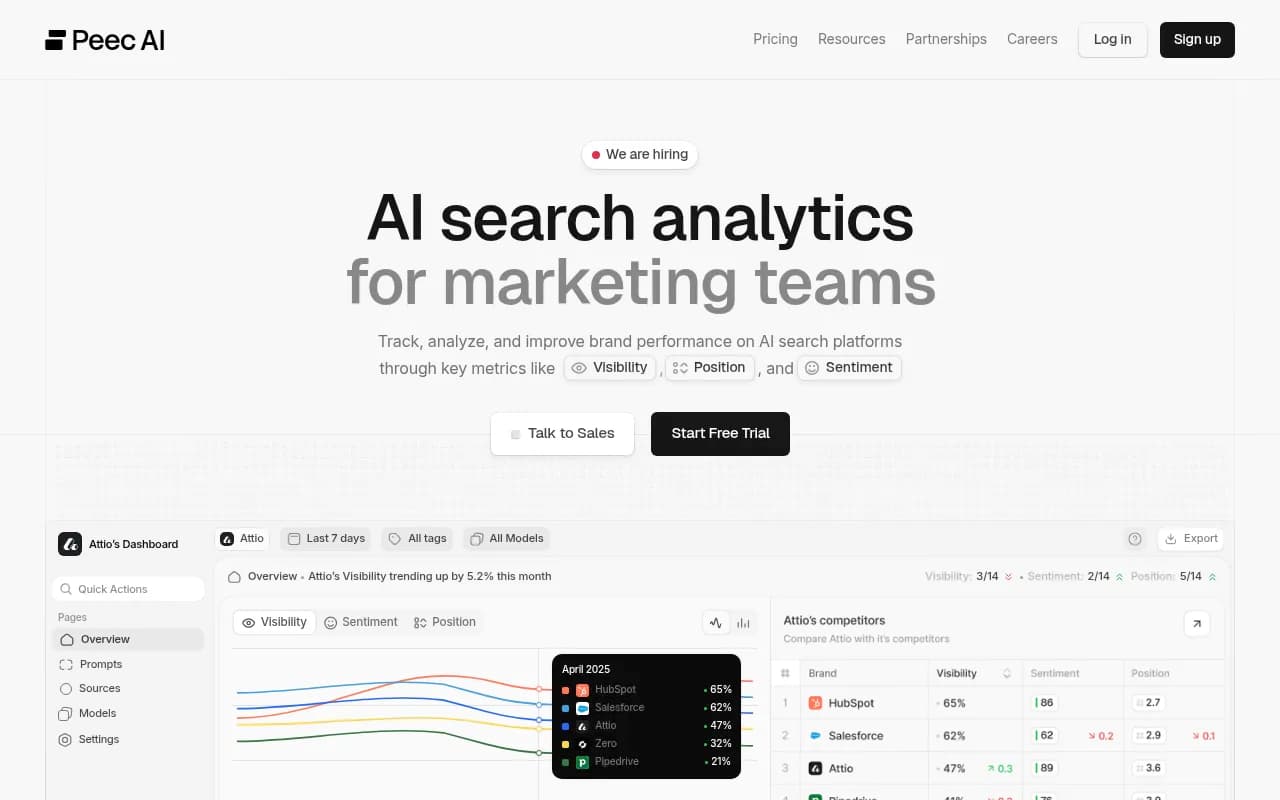
Other options in the same space include Otterly.AI and Peec AI for lighter prompt tracking, and Semrush if you already live in that suite. For a wider view, the directory at bestgeosoftware.com lists more.
Otterly.AI

The full checklist at a glance
| # | Fix | Group |
|---|---|---|
| 1 | Confirm indexability | Technical |
| 2 | Check snippet controls | Technical |
| 3 | Verify rendering without heavy JS | Technical |
| 4 | Fix speed and Core Web Vitals | Technical |
| 5 | Sitemap and internal links | Technical |
| 6 | Verify in Search Console | Technical |
| 7 | Direct answer in first 40-60 words | Structure |
| 8 | Question-style H2s | Structure |
| 9 | One idea per section | Structure |
| 10 | TL;DR block | Structure |
| 11 | Lists and tables where they fit | Structure |
| 12 | Honest FAQ | Structure |
| 13 | Plain definitions | Structure |
| 14 | Add original information | Substance |
| 15 | Match format to cited types | Substance |
| 16 | Strengthen product pages | Substance |
| 17 | Keep list content in the mix | Substance |
| 18 | Named author, first-hand experience | Substance |
| 19 | Matching schema | Markup |
| 20 | Consistent entity names | Markup |
| 21 | Honest last-updated date | Markup |
| 22 | Plan brand mentions | Off-page |
| 23 | Add video | Off-page |
| 24 | Complete social profiles | Off-page |
| 25 | Baseline and tracking | Measurement |
What to do when a page still does not get cited
It will happen. A few diagnostic questions, in order:
- Is the page indexed and eligible for snippets? If not, stop here.
- Does it rank anywhere for the query? Citation correlates with ranking more than it used to, so a page on page four is a long shot.
- Is the format right? If every cited result is a product page and yours is a blog post, no amount of polish fixes that.
- Does your page say anything the cited ones do not? If not, add something original.
- Are there any third-party mentions? Fix 22 matters more than most people expect.
A fair reaction to all of this is that it sounds like regular good SEO. A Reddit thread on the topic lands in the same place: fix your normal SEO first, keep content updated, make sure technical SEO is solid. I agree. The extra work specific to AI Overviews is mostly format choice, answer placement, and off-site presence.
Where an agency fits
If you would rather not run this yourself, an agency that does technical SEO and generative engine optimization together can handle the audit and the ongoing work. 1001 SEO Media does exactly that, though everything above can also be done in-house with the tools listed.
Final word
Run the 25 items on each page before it goes live, then check Search Console and your tracker two to four weeks later. Start with fixes 1, 7, 15, and 25 if you are short on time: indexability, a direct answer, the right format, and a baseline to measure against. For the data behind the format advice, Promptwatch Data at promptwatch.com/data is updated regularly, and the numbers above will shift, so recheck them before you rebuild a content plan around any one of them.