Key takeaways
- Product pages overtook listicles as the most cited format in AI Overviews in July 2026, per Promptwatch Data. Your money pages now compete directly for citations.
- Google's own surfaces (YouTube, google.com, Merchant Center, Business Profile) take a growing share of sources, so treat them as a channel.
- Structured specs, clear pricing, fresh availability and answer-first copy matter more than keyword density.
- Video and public social profiles carry real weight in AI Overviews, unlike in ChatGPT.
- Measure with Search Console plus a dedicated AI visibility tracker, not rank position alone.
Why commercial queries are a different game
Informational AI Overviews mostly pull from explainers, news and Q&A. Commercial queries ("best CRM for small teams", "waterproof hiking boots under $150", "Brand A vs Brand B") behave differently. The Overview has to recommend something, so it leans on sources that contain specs, prices, comparisons and reviews.
Several vendor studies claim AI Overviews now show up on roughly half of US searches and most commercial ones. I would treat those exact percentages with caution, since they come from vendor marketing pages I could not verify against Google. The direction is not in doubt, though. If you sell something, an Overview is probably sitting above your listing.
And there is a second effect. A top organic position no longer guarantees a click. One vendor cites an Ahrefs figure of a 58% CTR drop for position-one content when an Overview appears. Treat that number as indicative, not gospel, but plan around the idea that being named inside the answer matters as much as ranking under it.
What AI Overviews actually cite for buying queries
The best first-party data I have is Promptwatch Data's July 2026 AI Overviews citation types report, which classifies citations by content type across the month.
| Content type | Avg. daily citation share, July 2026 |
|---|---|
| Listicle | 18.0% |
| Product page | 16.3% |
| How-to | 15.1% |
| News article | 13.5% |
| Video | 5.9% |
| Social post | 5.1% |
| Landing page | 4.7% |
| Comparison | 3.6% |
The monthly average hides the interesting part. Product pages overtook listicles for the first time and were number one every day from July 28, ending the month at 17.9% against 16.2% for listicles. Listicles averaged about 26% in Q1 and were near 18% in July. Product pages sat around 9% in January and have nearly doubled.
So the old playbook of writing "best X" roundups and hoping to be included is losing ground to brand-owned product pages. That is good news if you own the product. It is bad news if your whole strategy was affiliate listicles.
Video is the other quiet climber, up from about 2.7% in January to roughly 6% by late July. How-tos hold steady near 15%.
Step 1: Make product pages worth citing
Most product pages are thin: a hero image, three bullets, a price and a buy button. That is not citable. An AI system assembling an answer needs facts it can lift cleanly.
What to put on the page
- A short, answer-first summary near the top: what the product is, who it is for, and what makes it different, in two or three plain sentences.
- A specs table with real values (dimensions, materials, compatibility, battery life, plan limits), not marketing adjectives.
- Visible pricing and current availability. Promptwatch's own recommendation from the July data is structured specs, clear pricing and fresh availability.
- A short FAQ that answers actual pre-purchase questions: sizing, returns, compatibility, setup time.
- Honest pros and cons, including who should not buy it. Pages that admit limits read as more trustworthy to both people and models.
- Review content and ratings on the page itself, not hidden behind a JavaScript widget a crawler may never render.
Structured data
Add Product, Offer, AggregateRating and FAQPage schema where the content genuinely exists on the page. Schema will not force a citation, but it removes ambiguity about what the page is. If you run WordPress, plugins like Yoast SEO or Rank Math handle the basics.
For entity-heavy catalogs, WordLift focuses specifically on structured data and entity markup.
Step 2: Keep a comparison and listicle layer, but own it
Listicles are still the largest single format at 18%. Dropping them would be a mistake. The shift is that you should not rely on them alone.
Write your own "best for" and "X vs Y" pages, and be fair. If your product loses on one criterion, say so. Comparison pages are only 3.6% of AI Overview citations, which suggests the format is under-supplied relative to how many people search for it. That is an opening.
A practical structure for a comparison page:
- One-paragraph verdict at the top.
- A comparison table with the same attributes for every option.
- Short sections per option: best for, weaknesses, pricing.
- A "how we evaluated" note so the claims have a basis.
Step 3: Treat Google's own ecosystem as a channel
This part surprised me. In the Promptwatch Data June 2026 AI Overview citation share report (May 31 to Jun 26, a partial month, so momentum may be overstated), YouTube held 4.16% of citations, Reddit 2.72%, and google.com 2.30%, about six times its 0.37% share in January. Google properties together make up roughly 6.5% of sources.
For a product seller, that means:
- Keep your Merchant Center feed clean and current. Titles, GTINs, prices and availability should match your site.
- Complete and maintain your Google Business Profile if you have any local or physical presence.
- Publish product videos on YouTube: demos, comparisons, unboxings, setup guides. Give them descriptive titles and chapters.
- Check which of your target queries produce Overviews citing google.com surfaces, then decide whether to compete on the page or via the feed.
Video production
You do not need a studio. Screen recordings, phone demos and short explainer clips are enough for most products. If you need help, tools like Synthesia, InVideo or Pictory can turn scripts and product pages into publishable video.
Step 4: Use social and community sources deliberately
AI Overviews behaves very differently from ChatGPT on social sources. Per Promptwatch Data's social citation report for Sep 28 to Oct 4, 2026, Google AI Overviews gets 12.2% of its citations from social platforms, while ChatGPT gets just 0.46%.
Within AI Overviews that week:
| Platform | Share of AI Overviews citations |
|---|---|
| YouTube | 4.28% |
| 2.38% (more than doubled) | |
| 2.15% | |
| 1.61% | |
| 1.55% | |
| TikTok | 0.22% |
The practical takeaway is YouTube first, then complete, active public Facebook pages and Instagram profiles. Many brands neglect Facebook. In this data it is the second-biggest social source for Overviews.
Reddit still matters here, even though reddit.com's share of ChatGPT citations collapsed on August 14, 2026, with AI Overviews declining more gradually. Mine the threads Overviews cites for your category. The questions people ask there make good content briefs, and GummySearch or AlsoAsked can help surface them.
Step 5: Write answer-first copy for the queries that matter
Target the long, specific, buying-stage questions: "is X worth it for Y", "X vs Y for small teams", "best X under $Z". Open each section with the direct answer, then support it. This is the one piece of advice repeated across nearly every source I read, and it is repeated because it works.
A few habits that help:
- Use question-style subheadings that match how people phrase queries.
- Put the number, the verdict or the recommendation in the first sentence.
- Cut fluff. Q&A-style factual pages target the same retrieval behavior that favors Wikipedia and Quora.
- Update pages when prices, versions or availability change, and show the date.
For research and briefs, AlsoAsked and Frase are useful, and Surfer SEO or Clearscope can check coverage against what already ranks.

Step 6: Fix the technical basics
A great product page nobody can crawl gets nothing. Check these:
- Content renders without JavaScript, or you use prerendering for key templates.
- Product pages are in the sitemap and not orphaned.
- Canonicals, hreflang and variant URLs do not split signals across duplicates.
- Pages load fast and pass Core Web Vitals.
- You are not blocking Googlebot or the AI crawlers you want visiting.
Screaming Frog, Sitebulb and Google PageSpeed Insights cover most of this.

Step 7: Measure what is actually happening
Google Search Console reports AI Overview links at average position 1 for the queries involved, according to the vendor study I read. That makes it a rough proxy, not a clean AI Overview report. You will want two layers:
- Search Console for impressions, clicks and which queries have shifted.
- An AI visibility tracker to see whether you are named or cited, and by which sources.
For the second layer, there are many options. Promptwatch tracks Google AI Overviews alongside ChatGPT, Gemini, Perplexity and others, and goes beyond monitoring by showing content gaps, citation sources and AI crawler activity so you know what to fix.

| Tool | Type | Good for |
|---|---|---|
| Promptwatch | Visibility plus optimization | Teams that want tracking, gap analysis and content action in one place |
| Otterly.AI | Prompt tracker | Lightweight brand mention monitoring |
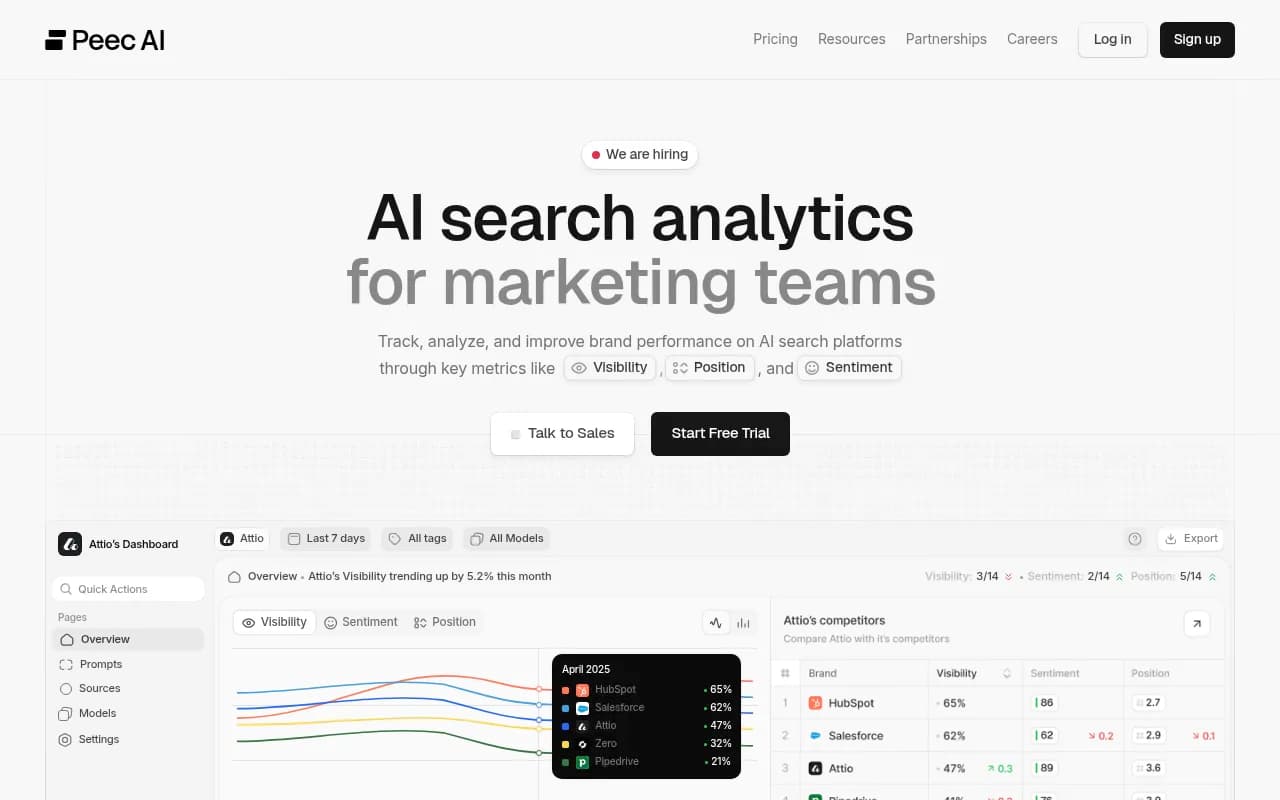
| Peec AI | Prompt tracker | Marketing teams that mostly need share-of-voice reporting |
| Semrush | SEO suite with AI toolkit | Teams already living in Semrush |
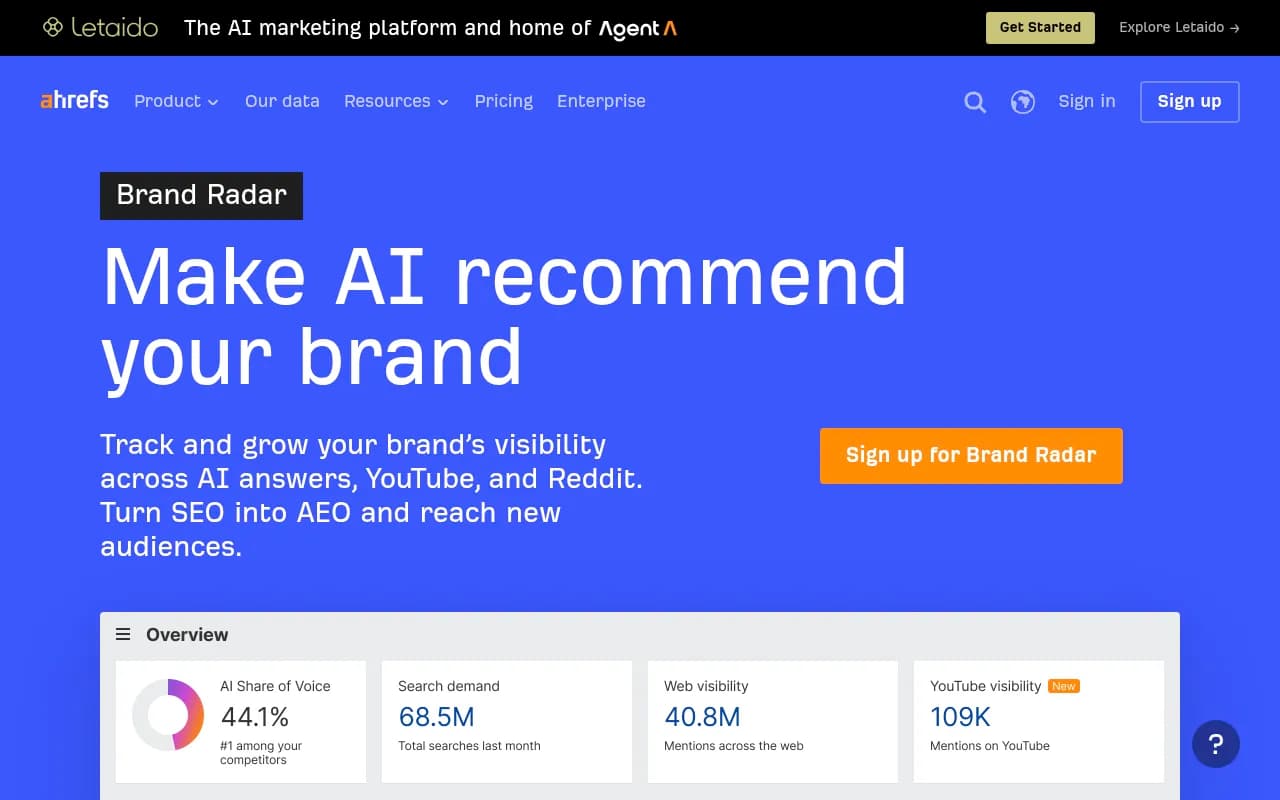
| Ahrefs Brand Radar | SEO suite add-on | Ahrefs users who want AI mentions next to backlinks |
Otterly.AI

If you want to browse more options, the GEO software directory at bestgeosoftware.com lists a wide range.
Metrics worth watching
- Share of voice on a fixed set of commercial prompts.
- Which of your pages get cited, and which competitor pages sit beside them.
- Whether you are mentioned without a link (a content or crawlability problem) or linked without being recommended (a positioning problem).
- Clicks and conversions from AI surfaces in your analytics. Mentions that never convert are vanity.
A 30-day plan
Week 1: Audit
Pick 30 to 50 commercial queries. Record which trigger Overviews, who is cited, and in what format. Note where Google surfaces (YouTube, google.com) show up.
Week 2: Fix product pages
Start with your top ten revenue pages. Add answer-first summaries, spec tables, current pricing, FAQs and schema.
Week 3: Fill format gaps
Publish two or three honest comparison pages and a handful of product videos. Clean your Merchant Center feed.
Week 4: Distribute and measure
Update Facebook, Instagram and Business Profile pages. Re-check your query set and compare against the baseline. Repeat with the next ten pages.
What I would not bother with
I would skip chasing every vendor-claimed trick. Several sources I reviewed are marketing pages for tools, and some of their numbers (such as the exact share of searches with Overviews) are unverified. Claims about new Google link features like "Further Exploration" sections came from one vendor and I could not confirm them against Google's documentation, so check Google's own announcements before building a plan on them.
I would also skip schema-only strategies and mass-produced thin content. The data points the other way: specific, factual, current pages are what get cited.
Bottom line
For commercial queries in 2026, the winning asset is a product page that reads like a good answer: specs, price, availability, honest trade-offs. Back it with video, a clean Google feed and active public profiles, then measure citations rather than just rankings. The shares move month to month, so recheck the Promptwatch Data reports and your own tracking regularly.