Ahrefs Brand Radar Review 2026
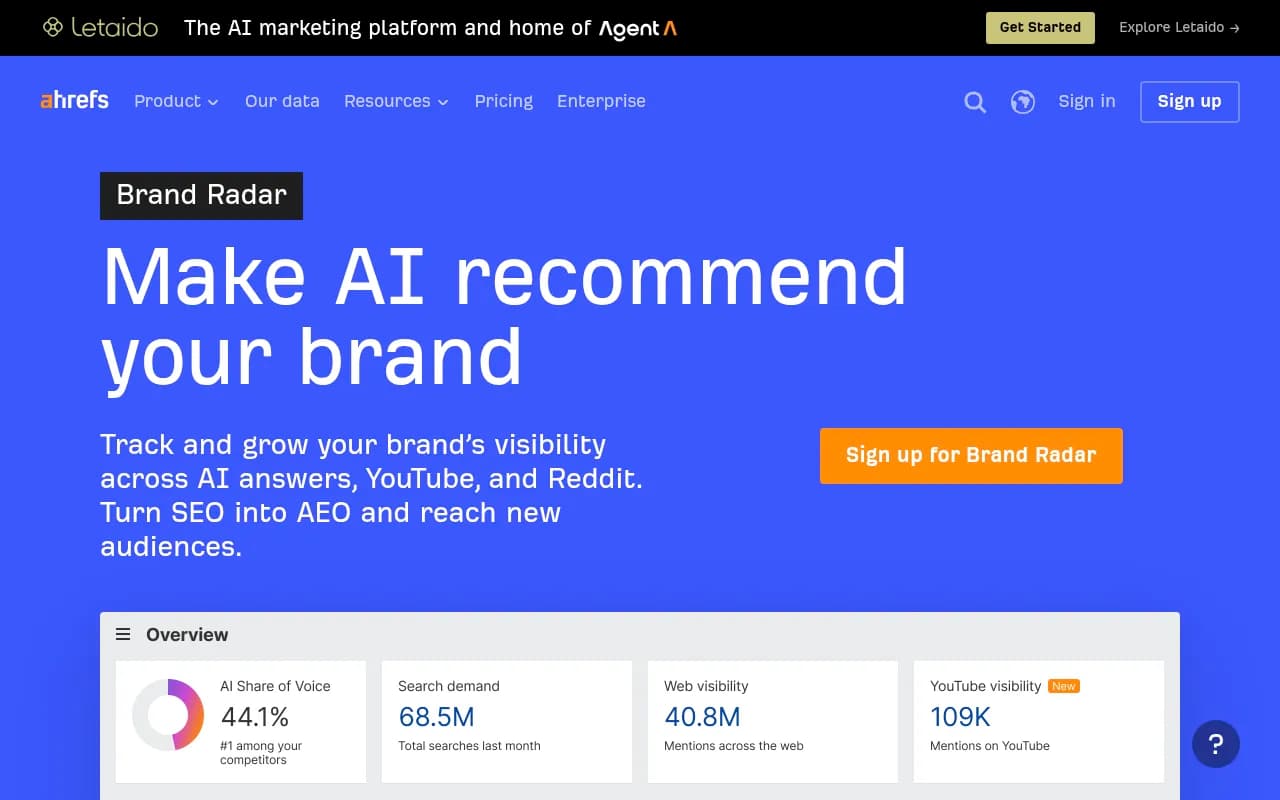
Part of the Ahrefs suite, Brand Radar tracks how your brand appears in AI-generated search results. Suited for teams already using Ahrefs for traditional SEO analytics.
Key takeaways
- Ahrefs Brand Radar is an AI visibility monitoring tool built on top of Ahrefs' existing web index, covering 6 AI platforms with 402M+ monthly prompts
- Monitoring-only: it shows you where your brand appears (or doesn't) but offers no content gap analysis, content generation, AI crawler logs, or traffic attribution -- capabilities that Promptwatch provides as part of its core workflow
- Strong differentiator is the scale of its prompt database (search-backed, not synthetic) and the zero-setup experience for existing Ahrefs users
- Pricing starts at $398/mo for select platforms and $699/mo for all platforms -- expensive for what is essentially a tracking dashboard
- Best suited for SEO teams already paying for Ahrefs who want a quick read on AI visibility without switching tools
Ahrefs Brand Radar is the AI visibility monitoring module inside the Ahrefs suite, one of the most established names in traditional SEO tooling. Ahrefs has been around since 2010 and built its reputation on backlink analysis and keyword research. Brand Radar is a newer addition, positioned as Ahrefs' answer to the growing demand for understanding how brands appear in AI-generated search results -- across platforms like ChatGPT, Google AI Overviews, Perplexity, Gemini, Microsoft Copilot, and Grok.
The pitch is straightforward: instead of manually querying AI tools to see if your brand shows up, Brand Radar automates that process at scale. It pulls from a database of 402 million monthly prompts, which Ahrefs says are "search-backed" rather than synthetic -- meaning they're derived from real search queries rather than made up by the platform. That's a meaningful distinction. Synthetic prompts can miss the actual questions real users are asking, so grounding the database in real search behavior gives the data more credibility.
The target audience is primarily SEO professionals and digital marketing teams at mid-to-large companies who are already Ahrefs customers. If you're paying for Ahrefs' core suite, Brand Radar is a natural extension. For teams coming in cold, the pricing and the monitoring-only scope may give pause.
Key features
Search-backed prompt database at scale
The headline number is 402M+ monthly prompts across 6 AI platforms. The breakdown is roughly: AI Overviews at 317M, then ChatGPT, Gemini, Perplexity, Copilot, and Grok each in the 12-16M range. The key claim is that these prompts come from real search data, not synthetic generation. In practice, this means Brand Radar can surface how your brand appears for queries that real users are actually typing -- not just queries someone at Ahrefs thought seemed relevant. This is a genuine advantage over tools that build their prompt sets manually or algorithmically without grounding in actual search behavior.
Multi-platform AI coverage
Brand Radar covers six AI platforms: Google AI Overviews, Google AI Mode, ChatGPT, Microsoft Copilot, Gemini, and Perplexity, with Grok also in the mix. You can choose to track individual platforms or pay for full access. This is solid coverage for the major players. Notably absent from the platform list is Claude (Anthropic) and Meta AI/Llama, which some competitors do include.
Competitor benchmarking
You can compare your brand's AI visibility against competitors side by side. The tool shows which brands are appearing more frequently in AI answers for the same prompts, and where you're being outpaced. This is useful for understanding the competitive landscape in AI search, though it stops at showing you the gap -- it doesn't help you close it.
Citation and source tracking
Brand Radar surfaces the sources that AI models are citing when they mention (or don't mention) your brand. This includes web pages, but also YouTube videos, Reddit threads, and TikTok content. The YouTube tracking covers thumbnails, video titles, descriptions, and transcripts. Reddit tracking covers titles, descriptions, and subreddit snippets. TikTok tracking is listed as in beta. This multi-channel source view is genuinely useful -- knowing that a competitor is getting AI citations from a popular Reddit thread or YouTube video gives you a concrete target to address.
Custom prompts
Beyond the 402M prompt database, you can add your own custom prompts to track how your brand appears for specific questions relevant to your business. The "All platforms" plan includes 2,500 custom prompt checks per month. Additional custom prompts are available as a paid add-on. This is a reasonable feature for brands with niche use cases or very specific product categories that might not be well-represented in the organic prompt database.
Zero-setup, instant search
Ahrefs emphasizes that Brand Radar requires no setup and delivers results immediately. You can search for any brand, product, region, or person without creating a project first. Unlimited projects are supported, which is useful for agencies managing multiple clients. The free AI Visibility Checker on the Ahrefs site lets you preview visibility data before committing to a paid plan.
Web visibility and search demand
Alongside AI visibility, Brand Radar includes web visibility data (how often your brand appears in traditional web search results) and search demand metrics. This integration with Ahrefs' existing search data is one of the cleaner aspects of the product -- you get a side-by-side view of traditional SEO performance and AI visibility in the same interface.
Unlimited projects and domain analysis
You can analyze any domain's AI visibility, not just your own. This makes it useful for competitive research, prospecting, or auditing client sites. There's no cap on the number of projects, which is a practical advantage for agencies.
Who is it for
Brand Radar fits best with SEO teams at mid-to-large companies who are already embedded in the Ahrefs ecosystem. If your team runs keyword research, backlink audits, and site audits through Ahrefs, adding Brand Radar is a low-friction way to extend that workflow into AI visibility monitoring. You're not learning a new tool or migrating data -- you're adding a module to something you already use daily.
It also works for digital agencies managing multiple client accounts, particularly those doing competitive analysis. The unlimited projects feature and the ability to analyze any domain without setup makes it practical for agency workflows where you're constantly spinning up new client reports. A case study on the Ahrefs site features Octopus Energy's SEO team, who used Brand Radar to replace a manual process of querying AI platforms one by one -- a common pain point for SEO specialists trying to monitor AI visibility without dedicated tooling.
Who should probably look elsewhere: teams that want to do something with their AI visibility data, not just observe it. Brand Radar is a monitoring dashboard. It tells you where you stand and where competitors are outpacing you, but it doesn't help you create content to close those gaps, doesn't provide AI crawler logs to understand how AI engines are discovering your site, and doesn't connect AI visibility to actual traffic or revenue. For teams that want to move from insight to action, the tool's scope is a real limitation. Similarly, smaller businesses or solo practitioners will likely find the $398-699/mo price point hard to justify for what is essentially a reporting layer.
Integrations and ecosystem
Brand Radar sits inside the broader Ahrefs suite, which means it benefits from Ahrefs' existing integrations and data infrastructure. The web visibility and search demand data pulls directly from Ahrefs' web index, so there's no separate connection to set up.
Ahrefs has also launched related products: Letaido (described as an AI marketing platform built on Ahrefs' web index) and Firehose (real-time brand mention tracking). These are separate products but share the Ahrefs data layer, suggesting the company is building out a broader AI marketing ecosystem around Brand Radar.
Export functionality is available -- the Octopus Energy case study specifically mentions exporting data directly from the platform. There's no detailed API documentation surfaced on the Brand Radar landing page, though Ahrefs does have API access for its core suite at the enterprise level.
There's no mention of native integrations with tools like Slack, Google Data Studio/Looker Studio, or Zapier on the Brand Radar page specifically. For teams that want to pipe AI visibility data into their existing reporting stack, this could be a friction point.
Pricing and value
Brand Radar uses an add-on pricing model on top of Ahrefs' existing subscription tiers:
- Select platforms: $398/mo -- choose individual AI platforms to track
- All platforms: $699/mo -- full access to 402M+ prompts across all platforms, plus 2,500 custom prompt checks per month
- YouTube, TikTok, and Reddit tracking are included free while in beta
- Custom prompts beyond the included 2,500 are available as a separate add-on purchase
This pricing is on top of whatever you're already paying for Ahrefs' core tools (Lite starts at $129/mo, Standard at $249/mo, Advanced at $449/mo). So a team on the Standard plan adding Brand Radar's "All platforms" tier is looking at roughly $950/mo combined.
For comparison, dedicated AI visibility platforms like Promptwatch offer more complete functionality -- including content generation, AI crawler logs, and traffic attribution -- starting at $99/mo for the Essential tier and $249/mo for Professional. The price-to-capability ratio is noticeably different.
Where Brand Radar's pricing makes more sense is if you're already paying for Ahrefs and the incremental cost of adding AI visibility monitoring is the relevant comparison, not the total bill. For an existing Ahrefs Advanced customer, $398/mo for select platforms is a meaningful but not unreasonable add-on.
There's a free AI Visibility Checker available on the Ahrefs site that gives a preview of Brand Radar's data without signing up. No free trial is mentioned for the full product.
Strengths and limitations
What it does well
- The 402M+ search-backed prompt database is genuinely large and grounded in real user behavior, which gives the visibility data more credibility than platforms using synthetic prompts
- Zero-setup experience is a real advantage -- you can search any brand instantly without configuring projects, which matters for agencies doing quick competitive checks
- YouTube, Reddit, and TikTok source tracking gives a more complete picture of where AI citations are coming from, including channels that many competitors ignore
- The integration with Ahrefs' existing web index means you get traditional SEO context alongside AI visibility data in one place, which is useful for teams that think about both
Where it falls short
- Monitoring only: Brand Radar shows you the data but provides no tools to act on it. There's no content gap analysis to identify what topics you're missing, no content generation to help you create pages that might earn AI citations, and no optimization workflow. You see the problem; you're on your own to fix it.
- No AI crawler logs: understanding how AI crawlers are actually discovering and reading your site -- which pages they visit, how often, what errors they encounter -- is absent. Platforms like Promptwatch provide this as a core feature, and it's genuinely useful for diagnosing why certain pages aren't being cited.
- No AI traffic attribution: Brand Radar doesn't connect AI visibility to actual website traffic or revenue. You can't see whether your AI citations are driving clicks or conversions, which makes it hard to justify the investment or prioritize which visibility gaps to close first.
- Fixed prompts with no query fan-out analysis: while custom prompts are available, there's no feature for understanding how a single prompt branches into sub-queries, or for scoring prompts by difficulty and volume to help you prioritize.
- Claude and Meta AI are not covered, which leaves gaps in the AI model landscape.
Bottom line
Ahrefs Brand Radar is a solid monitoring tool for teams already living in the Ahrefs ecosystem who want to add AI visibility tracking without switching platforms. The search-backed prompt database is its strongest differentiator, and the zero-setup experience makes it easy to get data quickly.
But it's a dashboard, not an optimization platform. If your goal is to understand your AI visibility and then do something about it -- create content, fix crawl issues, attribute traffic -- Brand Radar will leave you with data and no clear path forward. For teams that want to close the loop between AI visibility insights and actual content and technical improvements, Promptwatch covers the full workflow: gap analysis, content generation, crawler logs, and traffic attribution in one platform. Brand Radar is best used as a reporting layer by teams that already have the content and technical resources to act on what they find.
Best use case: SEO teams at established companies who are already Ahrefs subscribers and want a quick, low-friction way to monitor AI brand visibility alongside their existing SEO reporting.
Frequently asked questions
What is Ahrefs Brand Radar?
How much does Ahrefs Brand Radar cost?
Does Ahrefs Brand Radar help you improve AI visibility or just monitor it?
Which AI platforms does Ahrefs Brand Radar cover?
Is there a free version of Ahrefs Brand Radar?
How does Ahrefs Brand Radar compare to dedicated GEO platforms like Promptwatch?
Similar and alternative tools to Ahrefs Brand Radar