Key takeaways
- Ahrefs Brand Radar is a monitoring-only add-on that requires an existing Ahrefs subscription starting at $398/month. AirOps is a standalone platform with a free tier and paid plans from $199/month.
- AirOps does both tracking and content creation. Brand Radar only tracks -- there's no way to act on what you find inside the tool.
- Ahrefs Brand Radar covers 7 AI platforms and draws on 210M+ search-backed prompts, which is a genuinely impressive data breadth. AirOps covers 5+ platforms with a stronger focus on actionable insights.
- If your team is already paying for Ahrefs, Brand Radar is a natural extension. If you're starting fresh or want content workflows built in, AirOps makes more sense.
- Neither tool offers AI crawler logs or real-time indexing data -- a gap worth knowing about if you want to understand how AI engines actually discover your pages.
- AirOps has documented case studies showing measurable results (Chime 3x citations, Webflow 5x content velocity). Brand Radar's value is more about visibility reporting than driving outcomes.
Overview
Ahrefs Brand Radar
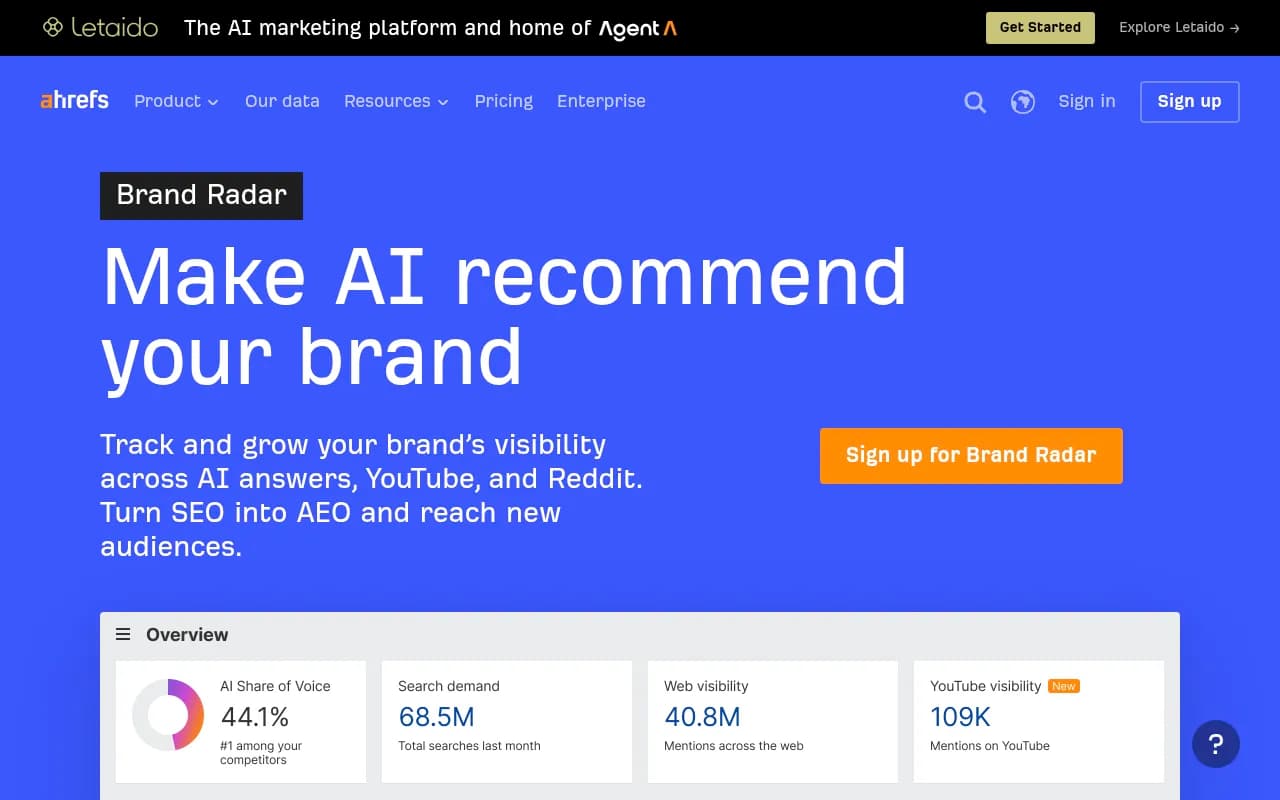
Ahrefs Brand Radar is the AI visibility module inside the Ahrefs suite. It lets you track how your brand (and competitors) appear across AI-generated search results on platforms like ChatGPT, Perplexity, and Google AI Overviews. The pitch is breadth: 210M+ search-backed prompts, coverage across 7 AI tools, and zero setup required. You can see any brand's AI visibility, not just your own.
The catch is that it's an add-on. You can't buy Brand Radar without an Ahrefs subscription, and the pricing reflects that. It's built for teams already living in Ahrefs who want to extend their existing workflow into AI search monitoring -- not for teams starting from scratch.
AirOps
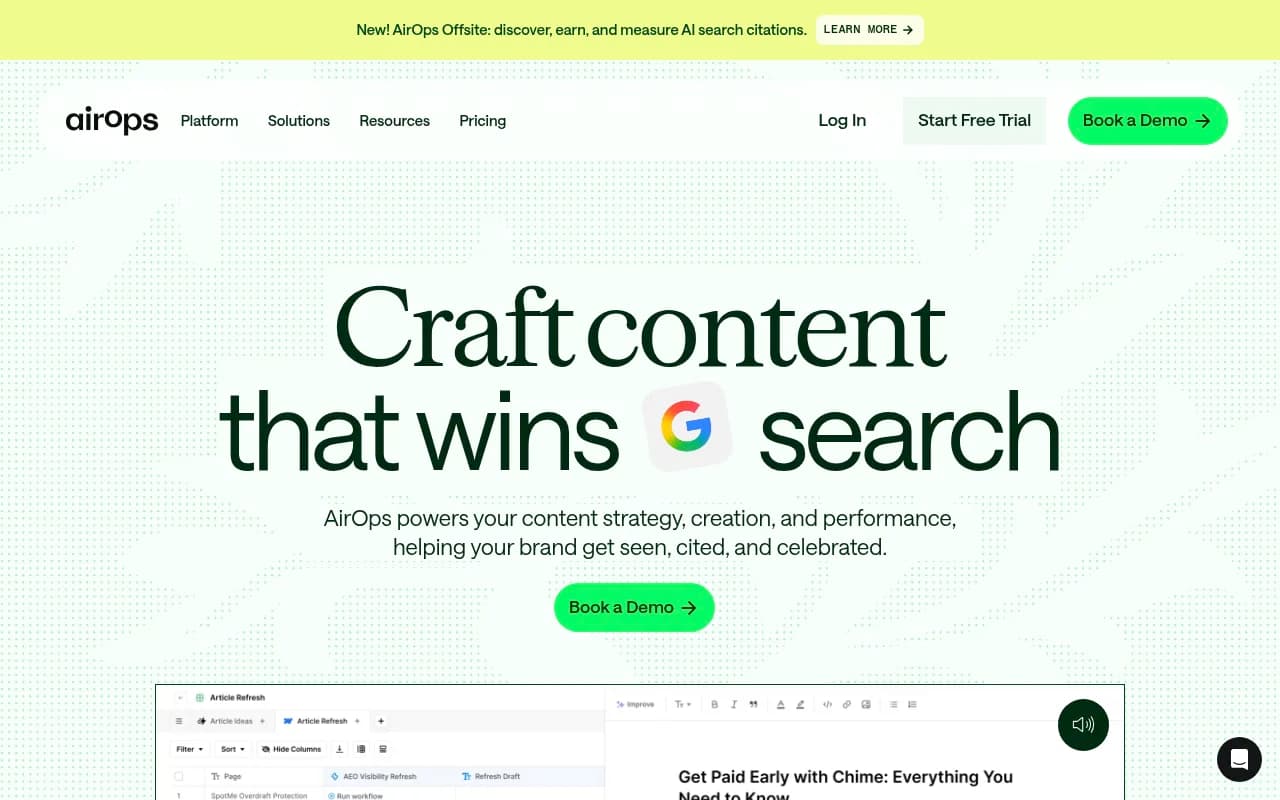
AirOps positions itself as a "content engineering platform" for AI search. It tracks visibility across ChatGPT, Perplexity, Gemini, Claude, and Google AI Mode, but the real differentiator is what happens after you see the data. AirOps has built-in content gap analysis and AI-powered writing workflows that let teams generate and publish content designed to earn AI citations.
Customers like Webflow, Chime, Ramp, and Carta have published case studies showing real results. Chime went from being cited in 24 to 68 priority questions after using AirOps. That kind of outcome-focused story is central to how AirOps markets itself -- and it's a meaningful contrast to Brand Radar's reporting-first approach.
Side-by-side comparison
| Feature | Ahrefs Brand Radar | AirOps |
|---|---|---|
| Standalone product | No (requires Ahrefs subscription) | Yes |
| Free tier | No | Yes (1,000 tasks/month) |
| Starting price | $398/month (add-on) | $199/month |
| AI platforms covered | 7 | 5+ |
| Prompt database | 210M+ search-backed prompts | Custom + AI search insights |
| Custom prompts | Yes | Yes |
| Competitor tracking | Yes | Yes |
| Content generation | No | Yes (AI writing workflows) |
| Content gap analysis | Limited | Yes |
| AI crawler logs | No | No |
| Traffic attribution | No | Yes (AI-attributed signups) |
| Case studies / ROI data | Limited | Yes (Webflow, Chime, Ramp, Carta) |
| Requires existing tool | Yes (Ahrefs) | No |
| Best for | Ahrefs users, monitoring | Content teams, growth teams |
Head-to-head feature deep-dive
AI search monitoring
Both tools track brand visibility across major AI platforms, but they approach it differently.
Ahrefs Brand Radar leans on scale. The 210M+ search-backed prompt database means you're not just tracking a handful of custom queries -- you're getting a broad picture of where your brand shows up across the kinds of prompts real users are actually typing. Coverage spans 7 AI tools, which is more than most competitors. You can also look up any brand, not just your own, which is useful for competitive research.
AirOps covers 5+ platforms (ChatGPT, Perplexity, Gemini, Claude, Google AI Mode) and focuses more on the specific prompts that matter to your business. The monitoring is solid, but the prompt database isn't as large as Ahrefs'. Where AirOps pulls ahead is in connecting monitoring data to action -- the gap analysis feeds directly into content workflows.
Verdict: Brand Radar wins on raw monitoring breadth. AirOps wins on turning monitoring into something useful.
Content creation and optimization
This is where the two tools diverge most sharply.
Ahrefs Brand Radar has no content creation features. It shows you where you're visible and where you're not. What you do with that information is entirely up to you and whatever other tools you're using. That's not necessarily a flaw -- plenty of teams have their own content processes -- but it does mean Brand Radar is a data source, not a workflow.
AirOps was built around the idea that visibility data is only valuable if you can act on it. The platform includes AI writing workflows that generate content based on gap analysis, prompt data, and competitor research. Webflow used it to 5x their content refresh velocity. That's a concrete outcome that Brand Radar can't replicate on its own.
Verdict: AirOps wins decisively. Brand Radar doesn't compete here.
Prompt intelligence and data quality
Ahrefs Brand Radar's 210M+ prompt database is its strongest card. These prompts are search-backed, meaning they're derived from real search behavior rather than manually curated lists. That gives you confidence that you're tracking prompts people actually use, not just prompts someone thought seemed relevant.
AirOps uses AI search insights and custom prompts, but doesn't publish a comparable prompt volume figure. The platform focuses more on helping you identify which prompts matter for your specific business and competitive situation.
Verdict: Brand Radar has the edge on prompt data scale. AirOps is more targeted but less transparent about its data sourcing.
Competitor analysis
Both tools let you track competitors' AI visibility. Brand Radar's "see any brand's AI visibility" framing makes this a first-class feature -- you can benchmark against anyone without needing them to be in your account. AirOps also supports competitor tracking and feeds that data into content gap analysis, so you can see not just where competitors rank but what content is driving their citations.
Verdict: Roughly equal, with AirOps having a slight edge because competitor data connects to actionable content recommendations.
Integrations and ecosystem fit
Brand Radar is part of the Ahrefs ecosystem, which is either a strength or a constraint depending on your situation. If you're already using Ahrefs for keyword research, backlink analysis, and site audits, Brand Radar slots in naturally. Your team is already in the tool, the data lives in one place, and there's no new login to manage. If you're not an Ahrefs customer, you have to buy into the full suite before you can even access Brand Radar.
AirOps is standalone. You can sign up, use the free tier, and evaluate it without committing to anything else. It also integrates with content publishing workflows, which matters for teams that want to go from insight to published article without leaving the platform.
Verdict: Depends entirely on your existing stack. Ahrefs users should lean toward Brand Radar. Everyone else should start with AirOps.
Ease of use and setup
Brand Radar advertises "zero setup" -- and that's largely true if you're already an Ahrefs customer. The prompt database is pre-built, so you're not starting from scratch. The interface will feel familiar to anyone who's used Ahrefs before.
AirOps has a bit more onboarding involved because you're setting up both monitoring and content workflows. The free tier helps here -- you can poke around without pressure. The platform also has AirOps University, a dedicated learning resource for getting up to speed on content engineering for AI search.
Verdict: Brand Radar is faster to start if you're already in Ahrefs. AirOps has more to learn but also more to gain.
Pricing comparison
| Plan | Ahrefs Brand Radar | AirOps |
|---|---|---|
| Free tier | None | Yes (1,000 tasks/month) |
| Entry-level | $398/month (add-on, some platforms) | $199/month (Starter: 10,000 tasks/month) |
| Full platform coverage | $699/month | Scale (custom pricing) |
| Enterprise | Custom | Custom |
| Requires base subscription | Yes (Ahrefs plan required) | No |
A few things worth noting on pricing:
The $398/month for Brand Radar is on top of whatever you're paying for Ahrefs. The cheapest Ahrefs plan that makes sense for a marketing team runs $199-$399/month on its own. So the real cost of Brand Radar for most teams is closer to $600-$1,100/month before you even get to the full $699/month add-on tier.
AirOps at $199/month is genuinely standalone. The free tier is also real -- 1,000 tasks/month is enough to evaluate whether the platform works for your use case before spending anything.
Pros and cons
Ahrefs Brand Radar
Pros:
- 210M+ search-backed prompts is a genuinely large dataset
- Covers 7 AI platforms, more than most competitors
- Zero setup if you're already an Ahrefs customer
- Can track any brand's visibility, not just your own
- Familiar interface for existing Ahrefs users
Cons:
- Requires an Ahrefs subscription -- not a standalone product
- No content creation or optimization features
- No AI crawler logs or indexing data
- No traffic attribution
- Pricing stacks up quickly when you factor in the base Ahrefs subscription
- Fixed prompts with no content gap analysis feeding into workflows
AirOps
Pros:
- Free tier available -- low barrier to try
- Built-in content generation and AI writing workflows
- Content gap analysis connects monitoring to action
- Documented case studies with real outcomes (Chime, Webflow, Ramp, Carta)
- Standalone -- no other subscription required
- Traffic attribution (AI-attributed signups)
- AirOps University for onboarding and skill-building
Cons:
- Smaller prompt database than Ahrefs Brand Radar
- Covers 5+ AI platforms vs Brand Radar's 7
- More complex to set up than Brand Radar for monitoring-only use cases
- Scale and Enterprise pricing is not public
- No AI crawler logs
Who should pick which tool
Choose Ahrefs Brand Radar if:
- You're already paying for Ahrefs and want to extend it into AI search monitoring
- Your primary need is broad visibility reporting across many prompts and platforms
- You want to research competitor AI visibility without a lot of setup
- Your team has a separate content production process and doesn't need an integrated workflow
Choose AirOps if:
- You want a standalone platform without a prerequisite subscription
- Content creation is part of your goal, not just monitoring
- You want to see measurable outcomes (citations, traffic, conversions) from your AI search efforts
- You're a growth or content team that needs to move fast and produce content at scale
- Budget is a consideration and you want to start free before committing
A note on what neither tool covers
Both Brand Radar and AirOps are missing AI crawler logs -- the ability to see when AI engines like ChatGPT or Perplexity actually crawl your pages, what errors they encounter, and how long it takes for a crawled page to become a citation. That's a meaningful gap if you want to understand the full picture of how AI engines discover and index your content. If that level of technical visibility matters to your team, it's worth looking at platforms built specifically around that capability.
If you're also thinking about tracking how your brand appears in AI search results more broadly -- across more models, with prompt volume data and offsite citation analysis -- Promptwatch is worth a look as a complement to either of these tools.

Final verdict
Ahrefs Brand Radar and AirOps are solving related but different problems. Brand Radar is a solid monitoring layer for teams already inside the Ahrefs ecosystem -- the prompt database is large, the setup is minimal, and the competitive research features are genuinely useful. But it stops at reporting. You see the data and then you're on your own.
AirOps is the better choice for teams that want to close the loop between "where am I invisible?" and "here's the content that fixes it." The free tier makes it easy to test, the pricing is more accessible, and the case studies suggest it actually moves the needle on citations and traffic.
If you're an Ahrefs shop looking to add AI monitoring with minimal friction, Brand Radar makes sense. For everyone else -- especially growth and content teams who need to produce results, not just reports -- AirOps is the stronger pick in 2026.