Key takeaways
- Insurance and insurtech brands face a specific AI visibility challenge: AI engines cite a small pool of trusted sources for complex financial topics, making it harder to break in without a deliberate GEO strategy.
- Most GEO tools on the market only monitor -- they show you where you're invisible but don't help you fix it. For regulated industries like insurance, the gap between "knowing" and "doing" matters a lot.
- The tools worth using in 2026 range from full-platform solutions (Promptwatch, Profound, Otterly.AI) to focused trackers (Peec AI, ZipTie, LLM Pulse) and content-side tools (Frase, Semrush).
- For insurance and insurtech specifically, prompt coverage across product-level queries (e.g. "best term life insurance for self-employed") matters more than broad brand monitoring.
- Picking the right tool depends on your team size, whether you need content generation alongside tracking, and how many AI engines you need to cover.
Why AI visibility matters differently in insurance
When someone asks ChatGPT "what's the best home insurance for first-time buyers" or Perplexity "how does parametric insurance work," they're not browsing -- they're close to a decision. AI engines have effectively become the first stop for financial product research, especially among younger buyers who'd rather ask a question than read a comparison site.
The problem for insurance brands is that AI engines are conservative about which sources they cite for financial topics. They tend to pull from established publishers, government sites, and a handful of well-structured brand pages. If your content isn't structured in a way AI models can parse -- clear definitions, direct answers, schema markup, authoritative entity signals -- you simply won't appear.
Insurtech companies face an additional layer: they're often newer, with thinner content footprints and less third-party citation history. A startup offering embedded insurance or usage-based auto coverage might have a genuinely better product than incumbents, but if AI models don't know it exists, that advantage is invisible.
This is where GEO (Generative Engine Optimization) tools come in. They help you understand what AI engines are saying about your brand and category, identify where competitors are getting cited that you aren't, and -- in the better platforms -- actually help you create content that closes those gaps.
What to look for in a GEO tool for insurance
Not all GEO tools are built the same, and some features matter more in insurance than in other verticals.
Prompt coverage for financial queries. Generic brand monitoring ("does ChatGPT mention us?") is a starting point, but insurance teams need visibility into product-level and comparison prompts. "Best cyber insurance for SMBs," "how does whole life insurance work," "compare travel insurance providers" -- these are the queries that drive actual pipeline. A good tool lets you track custom prompt sets, not just a fixed list.
Multi-model coverage. Different AI engines behave differently on financial topics. Google AI Overviews tends to cite established publishers. Perplexity pulls more from recent web content. ChatGPT's responses vary by model version. You need coverage across at least 5-6 engines to get a real picture.
Competitor visibility. In insurance, knowing that a competitor is being cited for "best renters insurance under $20/month" while you aren't is actionable intelligence. Heatmaps and share-of-voice comparisons are more useful than raw mention counts.
Content gap analysis and generation. This is where most tools fall short. Monitoring tells you what's missing. A real optimization platform helps you fix it -- by identifying which topics you need to cover and generating content that's actually structured to get cited.
Compliance-aware content. This is insurance-specific. Any AI-generated content needs to be reviewed for regulatory accuracy before publishing. The best tools give you content briefs and drafts that your compliance team can review, rather than auto-publishing.
Crawler and indexing visibility. If AI crawlers can't access your content -- due to JavaScript rendering issues, bot-blocking rules, or slow page loads -- you'll never get cited regardless of content quality. Tools that show you AI crawler logs are genuinely useful here.
The best GEO tools for insurance and insurtech in 2026
Promptwatch -- best for teams that want to monitor and fix
Promptwatch is the most complete option on the market for insurance and insurtech teams that want to go beyond monitoring. The core difference from most competitors is that it's built around an action loop: find gaps, create content, track results.

For insurance specifically, the Answer Gap Analysis feature is particularly useful. It shows you exactly which prompts competitors are being cited for that you're not -- so instead of guessing what content to create, you can see that, say, a competitor is dominating "best business interruption insurance for restaurants" while your site has nothing on that topic. The Content Agents then generate articles, comparisons, and briefs grounded in that real prompt data, which you can review and publish.
The AI Crawler Logs are another standout feature for insurance brands. They show you which pages AI crawlers are actually reading, how often they return, and whether they're hitting errors. If your policy pages are being blocked or your JavaScript-heavy quote forms are invisible to crawlers, you'll see it here.
Promptwatch monitors 10 AI models including ChatGPT, Perplexity, Google AI Overviews, Claude, Gemini, and DeepSeek. Pricing starts at $99/month for the Essential plan (1 site, 50 prompts), with the Professional plan at $249/month adding crawler logs and city-level tracking.
Profound -- best for enterprise insurance brands
Profound

Profound is built for large organizations that need deep monitoring across AI platforms. For a major insurer running multiple product lines and brands, the depth of competitive intelligence and citation tracking is genuinely impressive. It covers brand visibility, how AI systems interact with content, and competitor benchmarking at scale.
The trade-off is price and complexity -- Profound is enterprise-priced and probably overkill for a mid-sized insurtech. It also focuses more on monitoring than content optimization, so you'll still need a separate workflow for actually fixing the gaps it surfaces.
Otterly.AI -- best entry-level option
Otterly.AI

Otterly.AI is a clean, accessible monitoring tool that tracks brand mentions across ChatGPT, Perplexity, and Google AI Overviews. For an insurance brand just starting to think about AI visibility, it's a reasonable entry point -- the setup is quick and the interface is straightforward.
The limitations become apparent as you scale. Otterly.AI doesn't have crawler logs, content generation, or deep competitor analysis. It's a monitoring dashboard, not an optimization platform. For a small insurtech team that just wants to know "are we appearing in AI answers for our core prompts," it works. For a team that wants to actively improve visibility, you'll hit its ceiling quickly.
Peec AI -- best for ongoing brand tracking

Peec AI focuses on tracking brand mentions and citations across AI engines over time. The time-series data is useful for insurance brands running campaigns or publishing new content -- you can see whether a new piece of thought leadership is actually getting picked up by AI models, and how your visibility trends against competitors.
Like Otterly.AI, it's primarily a monitoring tool. The prompt tracking and citation analysis are solid, but there's no content generation or gap analysis built in.
ZipTie -- best for citation depth
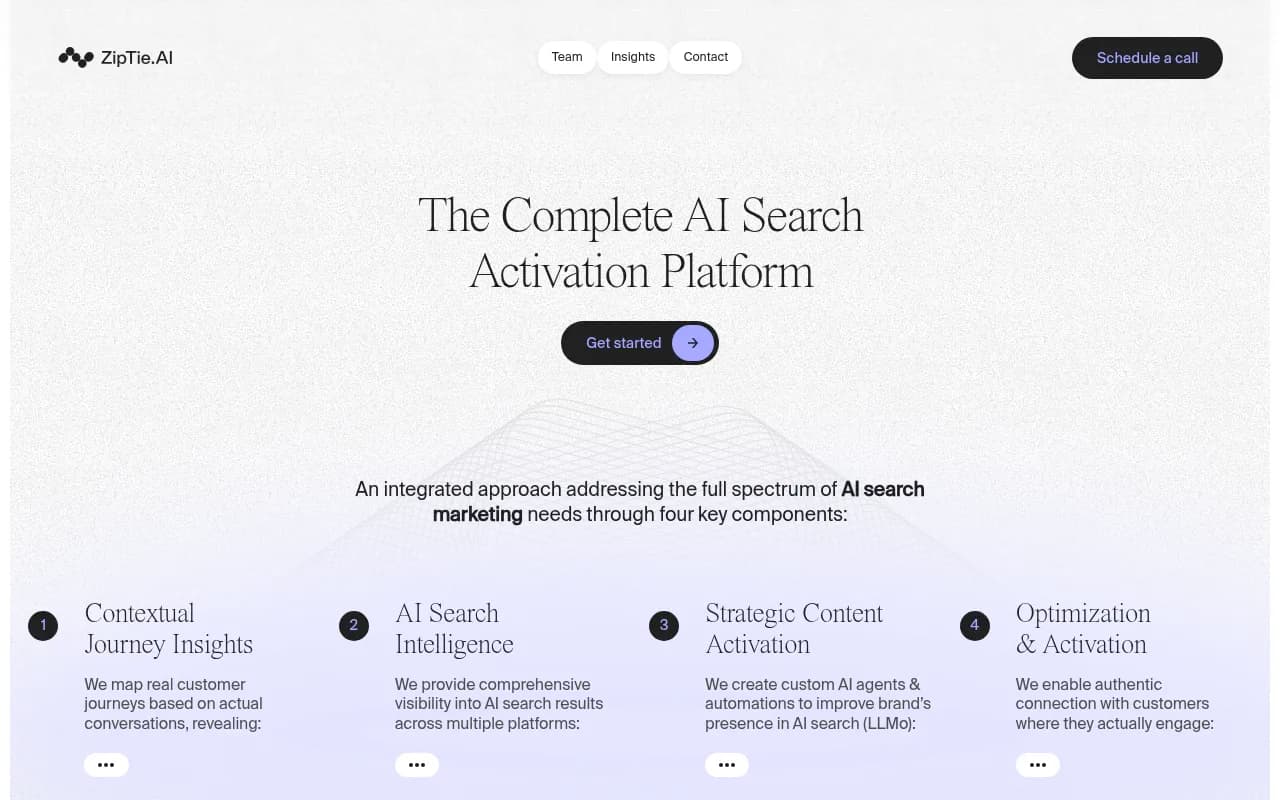
ZipTie goes deep on citation analysis -- it shows you not just whether you're being cited, but which specific pages, external sources, and third-party content are driving AI mentions. For insurance brands that rely on press coverage, industry reports, or comparison sites to build AI visibility (which is common in this space), ZipTie's source analysis is genuinely useful.
It's more of a research and analysis tool than a full GEO platform. Useful as a complement to a broader stack, or for teams doing a specific audit of their citation profile.
LLM Pulse -- best for lightweight multi-model tracking
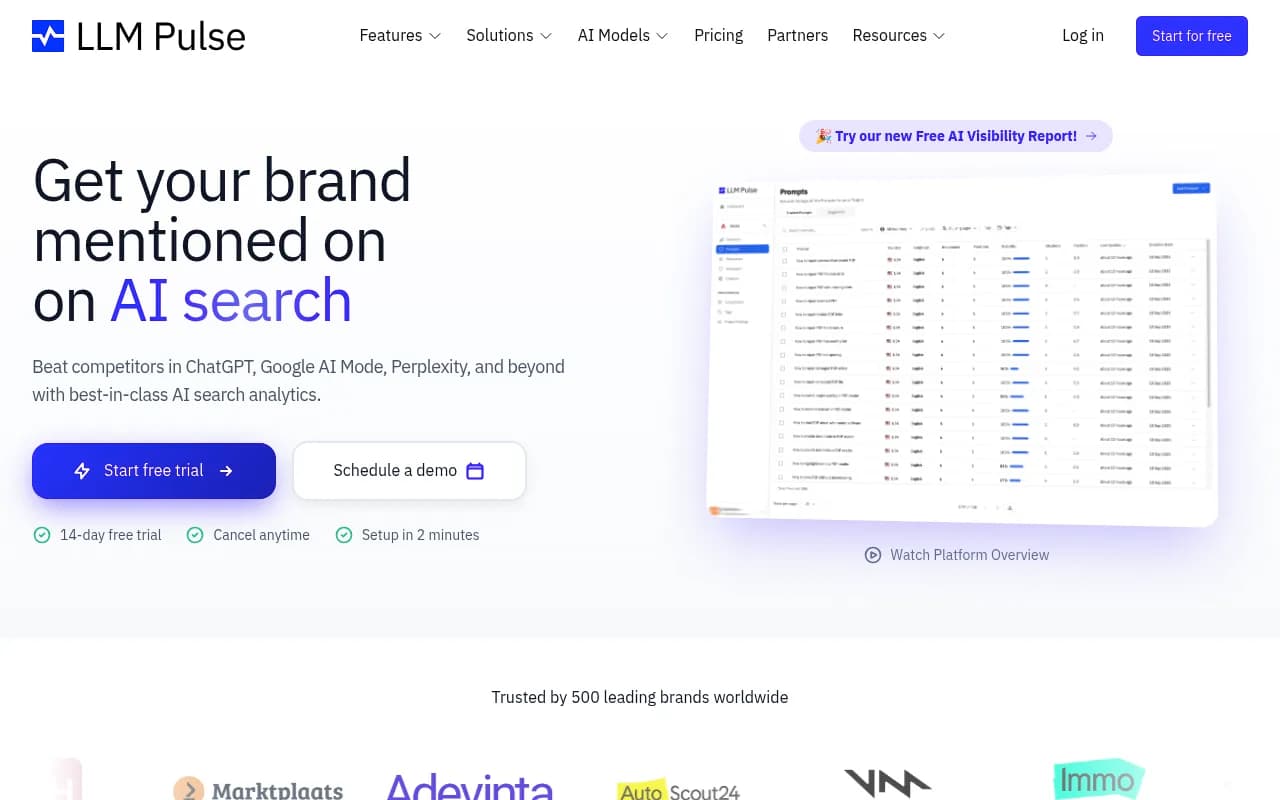
LLM Pulse tracks brand visibility across ChatGPT, Perplexity, and other AI search engines with a focus on simplicity. For insurtech teams that want a quick read on AI visibility without a complex setup, it's worth evaluating. Coverage across multiple models is the main draw.
Frase -- best for content optimization alongside GEO
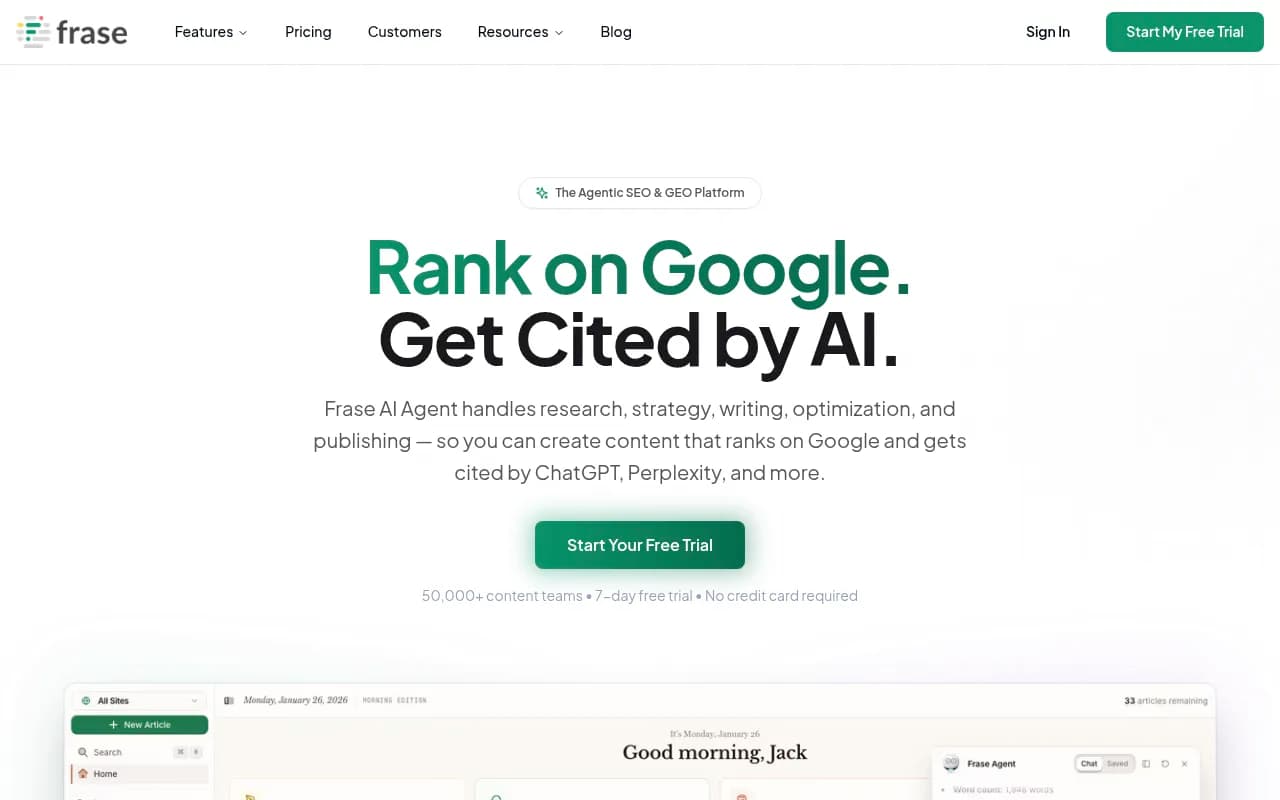
Frase sits on the content side rather than the monitoring side, but it's worth including here because insurance brands often struggle with the content creation piece. Frase helps you research topics, build content briefs, and optimize articles for search -- and increasingly, content that ranks well in traditional search also performs better in AI citations.
It's not a GEO tool in the strict sense, but for an insurance content team that needs to produce more structured, authoritative content quickly, it's a useful addition to the stack.
Semrush -- best if you're already in the ecosystem
Semrush has added AI visibility features to its existing SEO platform. If your insurance team is already using Semrush for keyword research and rank tracking, the AI Toolkit adds some GEO monitoring without requiring a separate tool. The coverage is narrower than dedicated GEO platforms -- Semrush uses fixed prompts rather than custom ones -- and there's no AI traffic attribution, but for teams that want a single platform, it's a practical option.
Feature comparison
| Tool | AI models covered | Custom prompts | Competitor analysis | Content generation | Crawler logs | Best for |
|---|---|---|---|---|---|---|
| Promptwatch | 10 | Yes | Yes (heatmaps) | Yes (Content Agents) | Yes | Full optimization cycle |
| Profound | 9+ | Yes | Yes | No | No | Enterprise monitoring |
| Otterly.AI | 4 | Limited | Basic | No | No | Entry-level monitoring |
| Peec AI | Multiple | Yes | Yes | No | No | Ongoing brand tracking |
| ZipTie | Multiple | Yes | Citation-focused | No | No | Citation depth analysis |
| LLM Pulse | Multiple | Yes | Basic | No | No | Lightweight tracking |
| Frase | N/A | N/A | No | Yes | No | Content creation |
| Semrush | Limited | Fixed only | Basic | Partial | No | Existing Semrush users |
How insurance brands should actually use these tools
Start with prompt research, not brand monitoring
The instinct is to set up brand monitoring first -- "tell me when ChatGPT mentions [Brand Name]." That's useful, but it's not where the value is. Start by mapping the prompts your potential customers are actually using: product comparisons, explainer questions, "best X for Y" queries. These are the prompts that drive consideration and purchase intent.
Tools like Promptwatch let you track custom prompt sets, so you can build a library of 50-100 insurance-specific prompts and monitor your visibility across all of them. That gives you a much more actionable picture than brand mention counts.
Use competitor gaps as your content roadmap
Once you're tracking the right prompts, the competitor gap analysis becomes your editorial calendar. If three competitors are being cited for "how does umbrella insurance work" and you're not, that's a content gap with a clear business case. You're not guessing at what to write -- you're filling a documented hole.
This is the workflow that separates teams making real GEO progress from teams that are just watching dashboards.
Treat AI crawler logs as a technical audit
Insurance websites often have complex structures -- separate domains for different product lines, heavy JavaScript for quote tools, gated content behind login walls. AI crawlers can't access any of that. The crawler logs in Promptwatch show you exactly which pages AI engines are reading and which they're skipping. For many insurance brands, fixing crawler access issues is the fastest path to improved AI visibility, because the content is already there -- it's just invisible.
Build a compliance review step into the content workflow
This is specific to insurance. Any content generated by AI tools needs a compliance review before publishing -- not because the tools are unreliable, but because insurance content has regulatory requirements around accuracy, disclosures, and jurisdiction-specific rules. The best workflow is to use AI content generation to produce a well-structured first draft, then route it through your compliance team before publishing. The time savings are still significant even with that step.
The insurtech-specific challenge: building citation authority from scratch
Established insurers have an advantage in AI visibility: years of content, press coverage, and third-party citations that AI models have already indexed. An insurtech launching a new product doesn't have that history.
The fastest way to build citation authority as a newer brand is to focus on a few things:
- Definitional content. AI models love clear, authoritative definitions. If you're in parametric insurance, embedded insurance, or usage-based coverage, write the best explanation of that product category on the internet. Not a sales page -- a genuine explainer that AI models will want to cite.
- Third-party mentions. AI models cite external sources heavily. Getting mentioned in industry publications, comparison sites, and Reddit discussions matters. Tools like Promptwatch track offsite citations, so you can see which external sources are driving AI visibility in your category and prioritize getting featured there.
- Structured data. Schema markup, clear entity signals, and well-structured FAQ sections all help AI models parse your content. This is basic but often overlooked.
The monitoring tools in this guide will show you where you stand. The optimization platforms -- particularly Promptwatch -- will help you close the gap.
Picking the right tool for your team
If you're a mid-sized insurer or insurtech with a dedicated marketing or SEO team, Promptwatch is the most complete option. The combination of custom prompt tracking, competitor gap analysis, content generation, and crawler logs covers the full optimization cycle without requiring multiple tools.
If you're enterprise-scale with complex brand monitoring needs across multiple product lines, Profound is worth evaluating alongside Promptwatch.
If you're a small team or just starting to think about AI visibility, Otterly.AI or Peec AI give you a low-friction entry point. You'll outgrow them, but they're a reasonable way to get a baseline read on your current visibility.
For content teams that need to produce more structured insurance content quickly, Frase is a useful addition regardless of which monitoring tool you use.
The one thing to avoid is treating any of these tools as a "set and forget" solution. AI search is moving fast -- new models, new citation patterns, new prompt behaviors. The brands that win in AI visibility in insurance are the ones running a continuous loop: track prompts, find gaps, publish content, measure results, repeat.