Key takeaways
- Rankability and Promptwatch solve different halves of the same problem. Rankability is a content production system for agencies, with AI visibility tracking bundled in. Promptwatch is an AI visibility platform first, with content generation as the action layer on top of the data.
- The biggest structural difference: Promptwatch has AI crawler logs (Agent Analytics) that show which pages AI bots actually read and which of those get cited. Rankability's public feature set has no equivalent.
- Rankability bundles a lot at every price point: unlimited users, WordPress/Webflow publishing, GitHub pull requests, approval workflows, and its Serena AI assistant. For agencies producing content at volume, that bundle is genuinely attractive.
- Pricing overlaps at the entry tier (both start around $95–$99/mo) but diverges at scale. Promptwatch's Professional tier at $245/mo is the popular middle; Rankability's upper tiers run $299–$799/mo depending on which pricing page you believe (more on that confusion below).
- Your choice should follow your workflow: if you produce content for clients weekly and need a production pipeline, Rankability fits. If you need to understand why you're visible (or not) in ChatGPT, Perplexity, and AI Overviews, and then fix it, Promptwatch is the stronger fit.
The short version
These two tools get compared a lot in 2026, and I get why: both sit in the overlap between SEO content work and AI search visibility, both start around $100/month, and both promise to close the loop between "where am I invisible" and "here's content to fix that."
But they come at that loop from opposite ends.
Rankability was built as an agency content production system. Its pitch is essentially "you don't have a writing problem, you have a production system problem." The AI visibility tracker (called Track) is one component of a six-tool platform. Promptwatch was built as a measurement layer first: crawler logs, citation analytics, prompt intelligence, and visitor analytics, with content generation bolted on downstream of the data.
Neither approach is wrong. They just serve different teams. Let's break down where each one wins.
What Rankability actually is
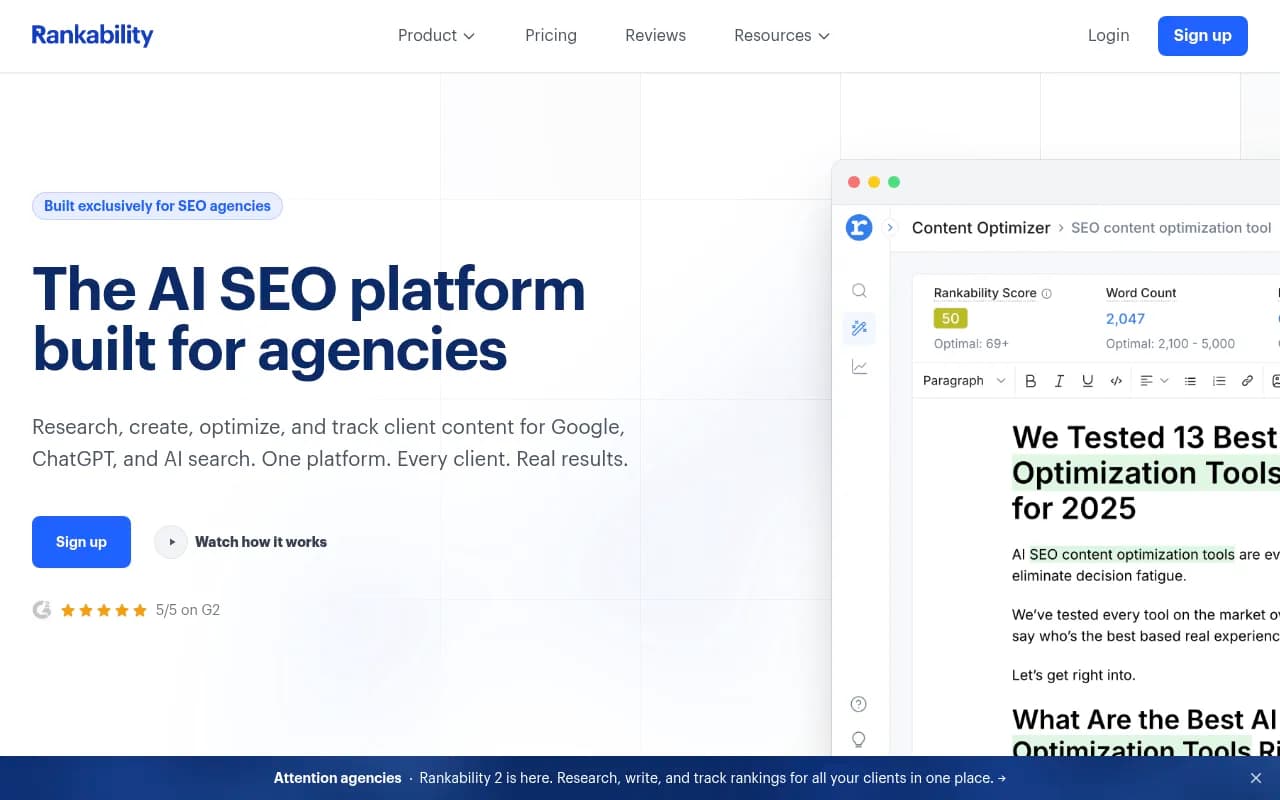
Rankability describes itself as an agency-focused SEO platform covering both Google and AI search. In practice it's a bundle of six tools: Research, Create (the Copywriter), Optimize, Track, Local, and Serena (an AI search assistant that works from client-specific context).
The Copywriter is the heart of it. The workflow runs Brief → Draft → Uniqueness → Optimize → Finalize, and the briefs pull competitor and topic data from both Google SERPs and AI platforms (ChatGPT, Gemini, Perplexity, DeepSeek, Copilot), so you're writing against what actually gets cited, not just what ranks. Drafts are grounded in a client Knowledge Base of USPs and proof points, which is a smart hedge against the generic-AI-slop problem. There's also a "Uniqueness" step designed to inject proprietary insight for information gain, plus built-in originality scoring.
The Track tool monitors three things together: traditional Google rankings (plus Bing, DuckDuckGo, Brave), AI mentions/citations/sentiment across up to 10 platforms depending on tier, and video plus local pack visibility (YouTube, TikTok search, Google map grids up to 7×7). All of it rolls into a single 0–100 "Search Performance Index."
That last part is worth pausing on. Rankability cites its own research that no pair of AI platforms shares more than 24.1% of cited pages, which is a real finding and a solid argument for tracking platforms individually rather than assuming ChatGPT visibility carries over to Perplexity. Promptwatch's data tells a similar story from the other direction: ChatGPT cites roughly 5 sources per web-search answer while Google AI Overviews sits near 10, and Perplexity holds almost exactly 10 day after day, per Promptwatch's average sources per response research. Different engines, different citation appetites, different optimization targets.
Where Rankability is thin: there's no AI crawler log analysis anywhere in its public feature set. You can see that ChatGPT mentioned your brand, but not that ChatGPTBot crawled 1,200 pages last week, hit errors on 40 of them, and cited only 25% of what it read. That distinction matters more than most teams realize, and I'll come back to it.
What Promptwatch actually is
Promptwatch is an AI search visibility and GEO platform, and it's the more complete stack of the two. It tracks how your brand appears across ChatGPT, Claude, Gemini, Perplexity, Grok, DeepSeek, Copilot, Mistral, Meta Llama, Google AI Overviews, and Google AI Mode, built on a dataset of more than 4.5 billion analyzed citations, clicks, and prompts. It's used by 1,840+ brands and agencies and rates 4.7/5 on G2.

The piece that separates it from Rankability, and from most of the market, is Agent Analytics: real-time logs of ChatGPTBot, ClaudeBot, PerplexityBot, GoogleOther, and 400+ other crawlers hitting your site. You see which pages they read, which ones they hit errors on, and, critically, the crawl-to-citation path. A sample dashboard shows 1,248 pages crawled, 312 cited, a 25% citation rate. That number answers a question Rankability can't: am I investing in content that AI systems read but never use?
Around that core sits the rest of the stack: prompt volumes and difficulty scores, query fan-outs showing how AI expands a prompt into sub-queries, citation trends classified by content type, Reddit and YouTube citation tracking, offsite mentions, sentiment analysis, ChatGPT Shopping and Ads Radar (including which competitors bid on your prompts), visitor analytics that attribute actual traffic and conversions from AI platforms, and country/state/city-level tracking.
Then the action layer: content gap analysis, Content Agents that plan, write, and publish GEO-optimized articles to WordPress, Webflow, or Framer on a schedule you control, Unified Actions (a prioritized GEO to-do list), and Agent Chat, a conversational analyst over your live data that also runs in Slack.
So both tools close the insight-to-content loop. Promptwatch just has a much deeper insight layer underneath it.
Head-to-head comparison
| Capability | Rankability | Promptwatch |
|---|---|---|
| Core identity | Agency content production system | AI visibility and GEO platform |
| AI platforms tracked | Up to 10 by tier (ChatGPT, Perplexity, AI Overviews, AI Mode, Gemini, Claude, Grok, Copilot, Brave AI, DeepSeek) | 11+ including AI Overviews, AI Mode, Grok, DeepSeek, Mistral, Meta Llama |
| AI crawler logs | Not in public feature set | Yes, 400+ crawlers, with crawl-to-citation rate per page |
| Prompt volumes and difficulty | Not advertised | Yes, with monthly volumes per prompt |
| Citation analytics depth | Mentions, citations, sentiment | Citation trends by 22 content types, Reddit/YouTube tracking, offsite mentions |
| AI traffic attribution | Not advertised | Yes, visitor analytics with conversions from AI platforms |
| ChatGPT Shopping / ads tracking | No | Yes, Shopping insights and Ads Radar (Business tier) |
| Content generation | Strong: brief-to-publish workflow, Knowledge Base grounding, originality scoring | Content Agents with CMS publishing to WordPress, Webflow, Framer |
| Traditional rank tracking | Yes, Google top 100 plus Bing, DuckDuckGo, Brave | No (integrates with Google Search Console instead) |
| Video and local visibility | Yes, YouTube, TikTok, Google local pack with map grids | No |
| Users | Unlimited on every plan | Seat-based, 10 seats on agency plans |
| Publishing | WordPress, Webflow, GitHub pull requests, approval workflows | WordPress, Webflow, Framer |
| Starting price | $99/mo | $95/mo (free tier available) |
Pricing, and a warning about Rankability's pricing page
Here's where buying Rankability gets annoying. The official pricing page lists Starter at $99/mo, Core at $199/mo, and Team at $399/mo, with tracked prompts at 60/125/250 per day and AI platform coverage of 3/5/8 by tier. But an independent review from August 2026 describes a different, apparently newer structure: Core at $99/mo (30 content assets/month), Scale at $299/mo, Advanced at $799/mo. The pricing page calls the top tier "Advanced" while the help-center docs call it "Agency." G2 lists yet another configuration. Legacy tiers apparently still exist for grandfathered customers.
I'm not saying any of this is deceptive, but it does mean you should confirm current pricing and tier names with their sales team before budgeting. The one thing that's consistent: unlimited users on every plan, no overage charges, and unused content allowances reset monthly rather than rolling over.
Promptwatch's pricing is cleaner:
| Tier | Price | What you get | | --- | --- | | Explore | Free | 10 prompts, ChatGPT only, 1 project | | Essential | $95/mo | 1 site, 50 prompts, 6,000 responses, all LLM tracking, MCP and API access, 7-day trial | | Professional | $245/mo | 2 sites, 150 prompts, 18,000 responses, crawler logs, automated content generation, custom reports | | Business | $579/mo | 5 sites, 350 prompts, 42,000 responses, shopping insights, Ads Radar, city-level tracking | | Agency plans | $199–$799/mo | Unlimited projects and prompts, 10 seats, white-label options |
Annual billing gets you 12 months for the price of 10 on both platforms, roughly a 17% discount.
The honest read on value: at the entry tier they're nearly identical in price, and Rankability gives you more raw software (six tools, unlimited users). Promptwatch Essential gives you less breadth but deeper AI-specific data. At the mid tier, Promptwatch Professional at $245 vs Rankability's $199–$299 depending on which page you trust, and the comparison gets sharper: crawler logs and AI traffic attribution versus a bigger content allowance.
Why crawler logs matter more than they sound like they do
This is the single biggest functional gap between the two, so it deserves its own section.
Every AI visibility tracker can tell you "ChatGPT didn't mention you for this prompt." Almost none can tell you why. The why usually lives in one of three places: the AI system never crawled the relevant page, it crawled the page but hit an error or got blocked, or it crawled the page fine and just chose not to cite it. Those three failure modes have completely different fixes, and without crawler logs you're guessing which one you have.
Promptwatch's Agent Analytics connects the crawl to the citation, so you can see that your pricing page gets crawled weekly and cited constantly while your comparison hub gets crawled and never cited. That's an editorial signal, not a technical one. Meanwhile a 404 the ChatGPTBot keeps hitting is a technical fix that takes five minutes and might unlock visibility you've been chasing for months.
Rankability's tracker tells you the outcome (mentioned or not, sentiment, competitor presence) but not the mechanism. For an agency running content production for 20 clients, that's usually acceptable, you're paid to produce and rank, and the tracker confirms whether it worked. For a brand team trying to debug a visibility problem, it's a real limitation.
What the citation data says about content strategy (relevant to both)
Whichever tool you pick, the underlying content strategy should reflect how AI search actually behaves right now, and the data has moved fast in 2026.
Product pages became the single most-cited format on ChatGPT Search in July 2026 at roughly 32.8% of daily citations, nearly double their ~18% share in March, per Promptwatch's ChatGPT citation types research. Listicles were the fastest-growing format within the month, how-tos and comparison pages are still cited at low rates, meaning relatively low competition. If your content plan is all blog posts and no structured product pages, both tools will show you invisible, but only one will show you the citation-type breakdown explaining the pattern.
Volatility is the other story. Reddit's share of ChatGPT citations fell from 6.11% in May to 3.71% in June 2026, a ~40% month-over-month drop, per Promptwatch's June citation share data, while GitHub and Trustpilot gained share in the same period. Citation patterns are not stable enough to check quarterly. Whatever you track with, track it continuously, and be suspicious of any tool that samples prompts sporadically rather than monitoring real UI responses.
Which one should you actually pick
Choose Rankability if
- You're an agency producing content for multiple clients and the brief-to-publish pipeline is your daily reality. The Copywriter workflow, Knowledge Base grounding, approval flows, and unlimited users are built exactly for this.
- You need traditional rank tracking and AI visibility in one dashboard, with local and video visibility included. Promptwatch doesn't do map grids or TikTok search at all.
- Your clients pay for content deliverables, not visibility diagnostics. Rankability's SPI score is a clean client-facing number.
Choose Promptwatch if
- You need to diagnose why visibility is missing, not just confirm that it is. Crawler logs, citation rates per page, and AI traffic attribution are the diagnostic layer, and Rankability doesn't have them.
- You care about the full citation surface: Reddit posts, YouTube videos, offsite mentions on third-party pages, ChatGPT shopping recommendations, and competitors bidding on your prompts via ads.
- You want the measurement and the fix in one loop. Content gap analysis feeding Content Agents that publish to your CMS is a tighter loop than exporting insights into a separate writing tool.
- You're a brand team rather than an agency. The seat-based pricing and project structure fit in-house marketing teams better than Rankability's agency-shaped bundle.
The honest overlap case
Some teams genuinely need both halves and will be tempted to buy both. Before you do, look at the middle ground: Promptwatch's Professional tier covers tracking plus automated content generation, and Rankability's bundle covers content plus tracking. Buying both means paying twice for the overlapping middle. Pick based on which half is load-bearing for your workflow, and if the answer is genuinely "both, equally," consider whether a content tool plus a visibility platform stitched together via API is cheaper than two full platforms.
Alternatives worth a look
If neither quite fits, a few neighbors in this category are worth knowing about:
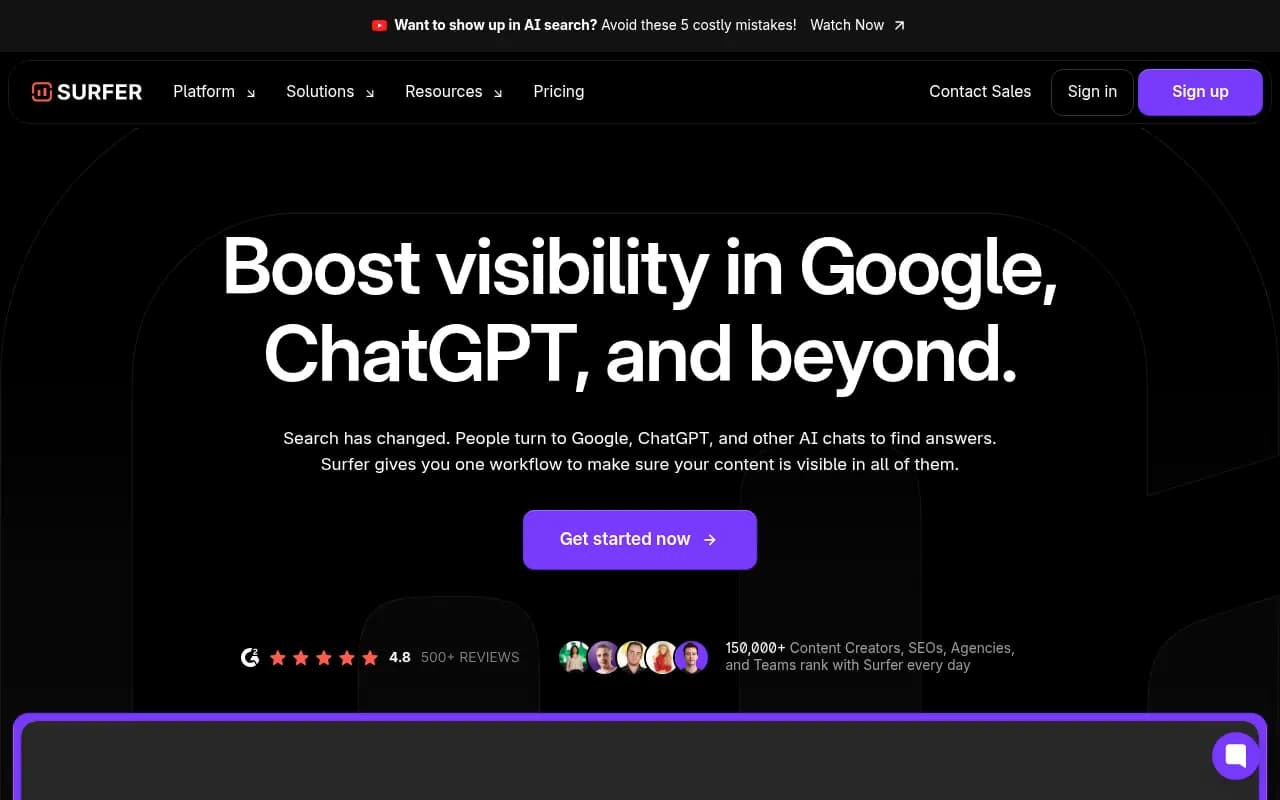
- Surfer SEO — content optimization scoring with basic AI tracking built into the Standard plan at $119/mo (ChatGPT, 25 prompts, weekly refresh). A real entry point if content optimization is 80% of your need.
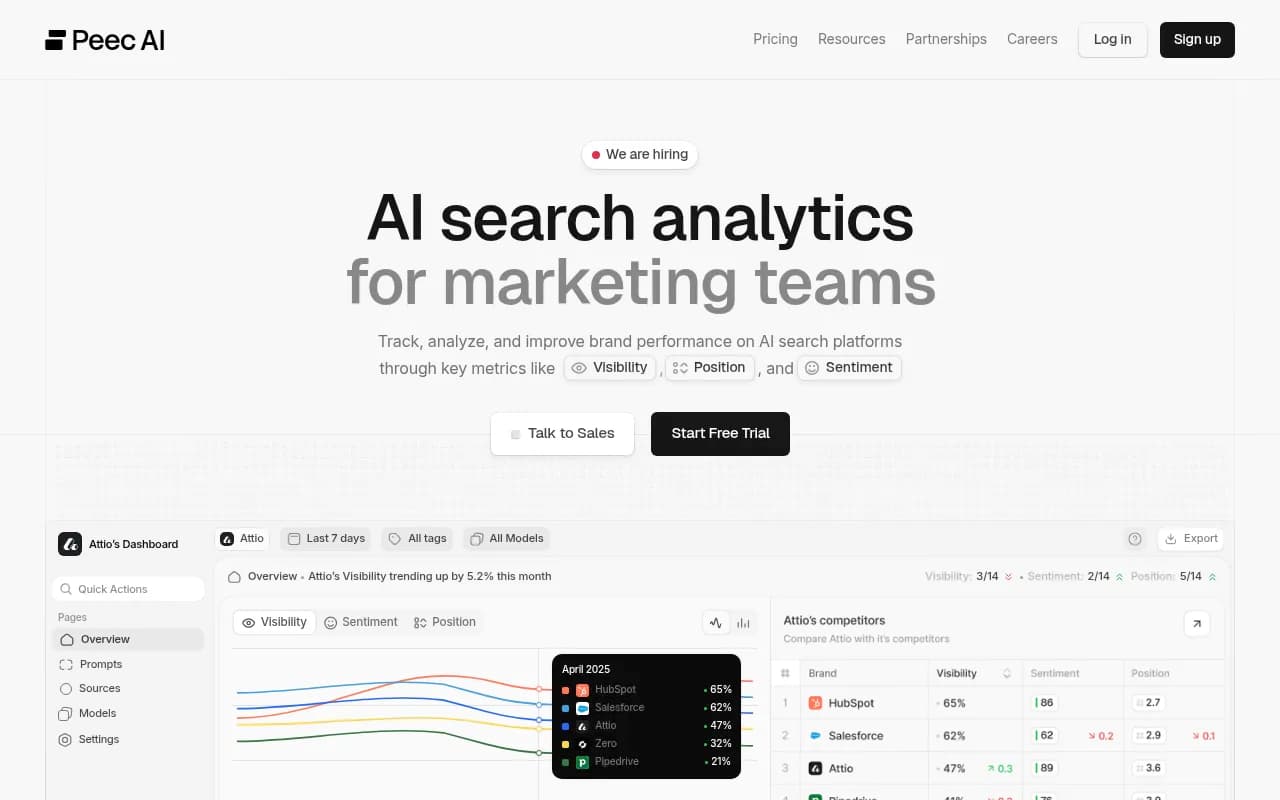
- Peec AI — clean, focused AI visibility analytics from $95/mo. Good if you want Rankability's tracking without the content bundle, though it stops at monitoring.
- Semrush — the AI Visibility add-on at $99/mo per domain makes sense if you already live in Semrush and want to reduce tool sprawl.
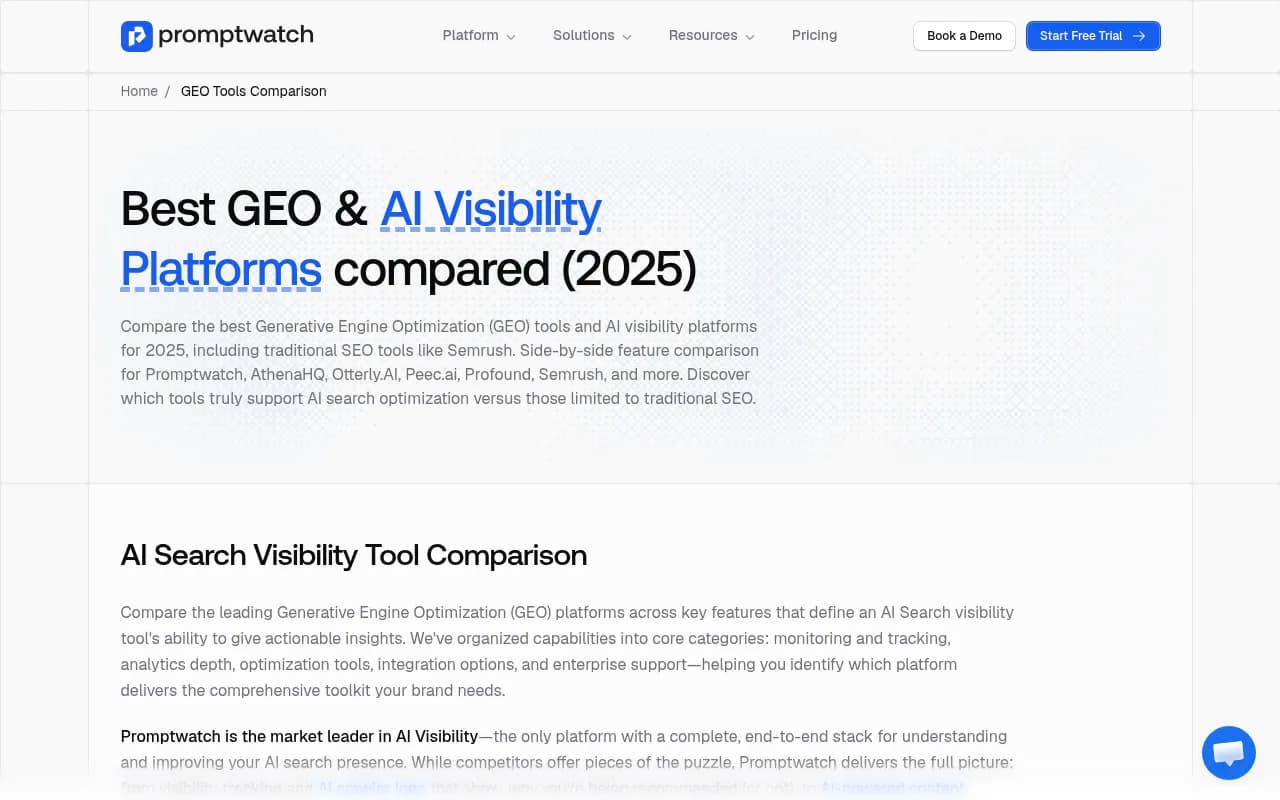
For a broader view of this category, the GEO software directory at bestgeosoftware.com covers the full landscape, and Promptwatch's own comparison of 21 GEO platforms is a useful reference for how the rest of the market stacks up on crawler logs, content generation, and Reddit tracking.
Bottom line
Rankability is the better content production system. Promptwatch is the better visibility platform. That sounds like a cop-out, but it's the actual answer: the tools barely compete on their home turf. Rankability's Copywriter workflow and agency bundle have no real equivalent in Promptwatch, and Promptwatch's crawler logs, citation analytics, and AI traffic attribution have no equivalent in Rankability.
If you're forced to pick one on a budget: agencies producing client content should lean Rankability, and brand teams diagnosing and fixing AI visibility should lean Promptwatch. And whichever you choose, verify Rankability's current pricing directly before you sign anything, because their own pages currently disagree with each other.