Key takeaways
- SEO content scoring (word count, keyword density, topical coverage) tells you whether a page matches what already ranks on Google. It says nothing about whether ChatGPT, Perplexity, or Google AI Overviews will ever cite that page.
- AI visibility tracking measures a different thing entirely: how often your brand shows up in generated answers, which pages get cited, and whether that traffic converts. There is no such thing as a stable AI "rank" to optimize toward.
- Rankability is a real product that does both jobs inside one dashboard, which is exactly why people confuse a good content score with actual AI visibility. The two systems in Rankability don't talk to each other.
- If your goal is genuinely tracking and improving AI citations (not just SEO scores with an AI label slapped on), you need crawler-level data and a closed feedback loop, not two separate tools bolted together.
- Tools like Promptwatch close that loop by connecting citation gaps directly to content that gets written and published.
The confusion is understandable
I've watched a lot of marketing teams add "AI visibility" to their reporting deck and assume they've covered the new frontier. Usually what happened is someone turned on an AI Overviews column in their existing SEO tool, or bought a platform that promises both a content score and a brand mention tracker under one login. Neither of those things is wrong exactly. But they're not the same discipline, and treating them as interchangeable is going to cost you real opportunity.
Here's the blunt version: SEO content scoring answers "does this page look like the pages that already rank on Google?" AI visibility tracking answers "does an AI system choose to cite, mention, or recommend my brand when someone asks it a question?" Those are related problems in the sense that both involve content and both involve search engines. They are not the same problem, and a tool that's excellent at one is not automatically good at the other.
What SEO content scoring actually measures
Content scoring tools like Surfer SEO, Clearscope, MarketMuse, and NeuronWriter work off a shared premise: pull the top-ranking pages for a keyword, extract the terms, entities, and structural patterns those pages share, and grade your draft against that pattern. It's pattern-matching against the current SERP.
That's genuinely useful for what it's built for. If Google's ranking algorithm rewards comprehensive topical coverage, a content score nudges you toward comprehensive topical coverage. The scoring model assumes:
- There's a stable ranking to reverse-engineer (ten blue links, refreshed periodically)
- Matching the patterns of top performers improves your odds of matching their rank
- One score, checked once before publishing, captures most of the signal
None of those three assumptions hold up in an AI answer engine.
The tools in this category
| Tool | What it scores against | Best for |
|---|---|---|
| Surfer SEO | Live SERP content patterns | Writers optimizing individual articles |
| Clearscope | Top-ranking page semantics | Content teams standardizing briefs |

| MarketMuse | Topical authority modeling | Sites building content clusters |
| NeuronWriter | SERP + competitor gap analysis | Agencies on a budget |
All four are solid at their actual job: making sure a draft doesn't miss obvious subtopics before it ships. None of them tell you whether ChatGPT is citing you, why Perplexity picked a competitor's page instead, or whether an AI crawler even fetched your URL last week.
What AI visibility tracking actually measures
AI visibility platforms start from a different, harder problem. As Searchable's research on the topic puts it plainly: "AI rankings" are basically fiction. Fewer than 1 in 1,000 identical prompt runs return the same brand list in the same order. There's no stable target to reverse-engineer because the answer regenerates every time, shaped by the user's phrasing, location, conversation history, and whatever the model decided to retrieve that second.
So instead of a rank, AI visibility tools track frequency, citation rate, and sentiment over repeated sampling. A serious platform is running the same prompt (or a cluster of related prompts) dozens or hundreds of times across models, then reporting how often your brand or page showed up, how often it got cited with a link versus just mentioned, and how the model talked about you when it did.
That's a measurement problem closer to polling than to rank tracking. And it needs infrastructure a content scorer was never built to have:
- Repeated prompt sampling across ChatGPT, Perplexity, Gemini, Claude, and Google's AI surfaces, not a single scheduled scan
- Citation-level detail: which specific page got cited, for which prompt, how often
- Crawler log visibility: is GPTBot, ClaudeBot, or PerplexityBot even reading your pages, and where do they hit errors
- Traffic attribution: is any of this actually sending visitors, and do those visitors convert
Promptwatch's own citation data illustrates how fast the underlying landscape shifts. Reddit's share of ChatGPT Search citations collapsed from roughly 4% to 0.5% in a single day in August 2026, according to Promptwatch's Reddit citation data. A content score checked once at publish time has no way of catching a shift like that. AI visibility tracking, done properly, catches it because it's sampling continuously.
Where the two disciplines genuinely overlap
It's not that SEO content quality is irrelevant to AI visibility. Structured, well-organized, entity-rich content is easier for both Google's ranking algorithm and an LLM's retrieval pipeline to parse. Schema markup (Article, FAQPage, HowTo, Organization) helps rich results in Google and helps AI systems build a clean entity graph, as makebttr's comparison of AI search visibility and traditional SEO notes. That's shared infrastructure, not a coincidence.
But overlap in inputs doesn't mean the outputs are the same thing to measure. A page can score 95/100 on a content optimization tool and never get cited by an AI engine because it's missing the specific factual claim, the comparison table, or the up-to-date statistic the model's retrieval step actually needed. Conversely, a scrappy forum thread with zero SEO optimization can get cited constantly because it directly answers a narrow question with a clear, quotable sentence.
Rankability: one product, two systems that don't talk
This is where Rankability is worth calling out specifically, because it's a real example of the confusion rather than a hypothetical one.
Rankability, built by the Gotch SEO team, is genuinely useful as an agency operating system: keyword research, content creation with SEO scoring, traditional rank tracking, and a bolted-on layer of AI mention monitoring, all under one login at a price agencies can justify. For a shop juggling a dozen clients that mostly need Google rankings with an "and we watch AI too" line in the report, that consolidation has real appeal.
But a detailed comparison from Profound lays out the structural problem clearly: Rankability's AI visibility monitoring runs on scheduled keyword scans with user-configured prompts, not real user prompt data, and its content creation tool (Copywriter) and its AI monitoring tool (Reporter) run as separate systems. A citation gap identified in Reporter doesn't flow into a brief in Copywriter. Content published through Copywriter doesn't feed back into what Reporter tells you to write next. Every step in between requires a human to notice the gap and manually translate it into a content decision.
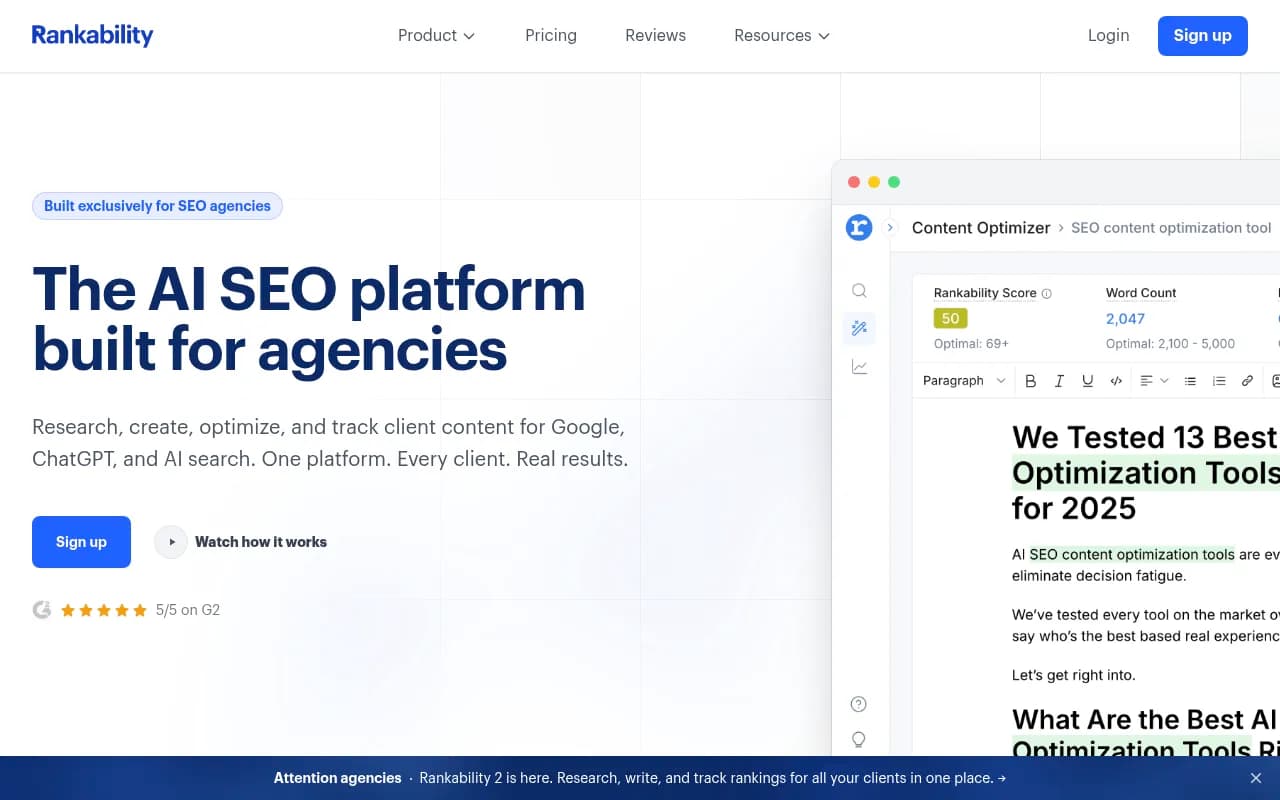
That's the exact pattern this whole guide is warning about. Rankability didn't unify SEO content scoring and AI visibility tracking into one discipline. It put two separate disciplines in the same dashboard and left the wiring between them for you to do by hand. If your team reads a decent "content score" in Rankability and assumes that translates into AI citations, you're making the same category error as someone reading a Clearscope score and assuming it means the same thing as a citation rate. It doesn't. They're adjacent tools solving different problems, sharing a login screen.
What a closed loop actually looks like
The fix isn't complicated conceptually, it's just rarely built. You need the visibility data (where are we not being cited, and why) to flow directly into the content system (write and publish something that fixes it), and then have the results of that content flow back into the visibility tracking so you know if it worked.
Crisp, for example, used this kind of loop to scale to 5-10 published articles a day and saw 2x higher conversion rates from AI-driven traffic compared to their traditional channels, according to Promptwatch's customer data. That only works when the platform doing the tracking is the same platform (or tightly integrated with the platform) doing the content creation.
This is the gap Promptwatch is built to close. Rather than stopping at "here's your citation rate," it runs content gap analysis against actual AI responses, generates briefs with brand instructions and internal linking baked in, and its Content Agents can write and publish directly to Webflow, Framer, or WordPress on a schedule. Crawler logs (Agent Analytics) show which pages GPTBot, ClaudeBot, and PerplexityBot actually read and where they hit errors, so "why aren't we cited" has an actual answer instead of a guess. Unified Actions turns all of that into a prioritized to-do list instead of a dashboard you have to interpret yourself.

A practical comparison
| Capability | Content scoring tools (Surfer, Clearscope, MarketMuse) | Basic AI trackers (Otterly, LLM Pulse, Peec) | Rankability | Promptwatch |
|---|---|---|---|---|
| Grades drafts against current SERP | Yes | No | Yes | Partial (content agents write directly) |
| Samples real AI conversations repeatedly | No | Limited | No (scheduled scans, configured prompts) | Yes |
| AI crawler log visibility | No | No | No | Yes |
| Reddit/YouTube citation tracking | No | Rarely | No | Yes |
| Content gap identified auto-feeds a brief | N/A | No | No, manual handoff | Yes |
| Publishes content to your CMS | No | No | Yes, but disconnected from visibility data | Yes, connected to gap analysis |
| Traffic/conversion attribution from AI | No | Rarely | No | Yes |
How to pick the right tool for the right job
If you genuinely just need better on-page SEO drafts checked against a keyword's current SERP, a content scorer is the right tool and you don't need to overpay for AI visibility features you won't use. Surfer, Clearscope, and NeuronWriter all do that job well and cheaply.
If you're an agency managing many small clients where AI visibility is a nice-to-have line item rather than a strategic bet, Rankability's consolidation genuinely saves money and login sprawl. Just don't mistake its content score for proof of AI citations, and budget time for the manual translation between its two halves.
If AI visibility is a real growth channel for your business, meaning you actually expect meaningful traffic and revenue from ChatGPT, Perplexity, and AI Overviews, you need a platform built around the closed loop from the start: real repeated prompt sampling, crawler-level attribution, and content creation that's fed directly by the citation gaps it finds. That's a narrower list, and it's worth browsing the broader category at the GEO software directory on bestgeosoftware.com or the AI rank tracking options at ai-rank-tools.com before committing.
Most teams end up running two tools side by side for a while: one for polishing drafts against Google's current SERP, one for the harder job of tracking and fixing AI citations. That's not a failure of consolidation. It's an honest acknowledgment that SEO content scoring and AI visibility tracking measure genuinely different things, and no single score should be asked to answer both questions at once.