Key takeaways
- Rankability bundles classic SEO tracking, content creation, and AI search visibility in one platform starting at $99/mo. Most alternatives do one of those jobs better, but few do all of them.
- The biggest trap when comparing tools in this category is engine gating: nearly every platform charges extra for Claude, Gemini, Grok, or AI Mode access, so headline prices are misleading.
- Promptwatch is the strongest overall replacement if you want tracking and execution in one place: crawler logs, citation analytics, and Content Agents that actually publish fixes.
- Profound, Peec AI, and LLMrefs each win on specific niches (enterprise monitoring, clean analytics, and budget keyword-first tracking respectively).
- AI search behavior shifts fast. Reddit's ChatGPT citation share collapsed from roughly 4% to 0.5% in a single day in August 2026, and ChatGPT now shows ads in ~30% of responses. Whatever tool you pick needs to track these changes, not just your brand.
Why teams look beyond Rankability
Rankability occupies an unusual spot in the market. It's an agency-first platform that combines traditional rank tracking (Google, Bing, local packs, video), content briefs, AI-assisted writing, and AI search visibility under one subscription. Starter runs $99/mo with 60 daily prompts across 3 AI platforms; Team at $399/mo unlocks 8 platforms and 10 workspaces.
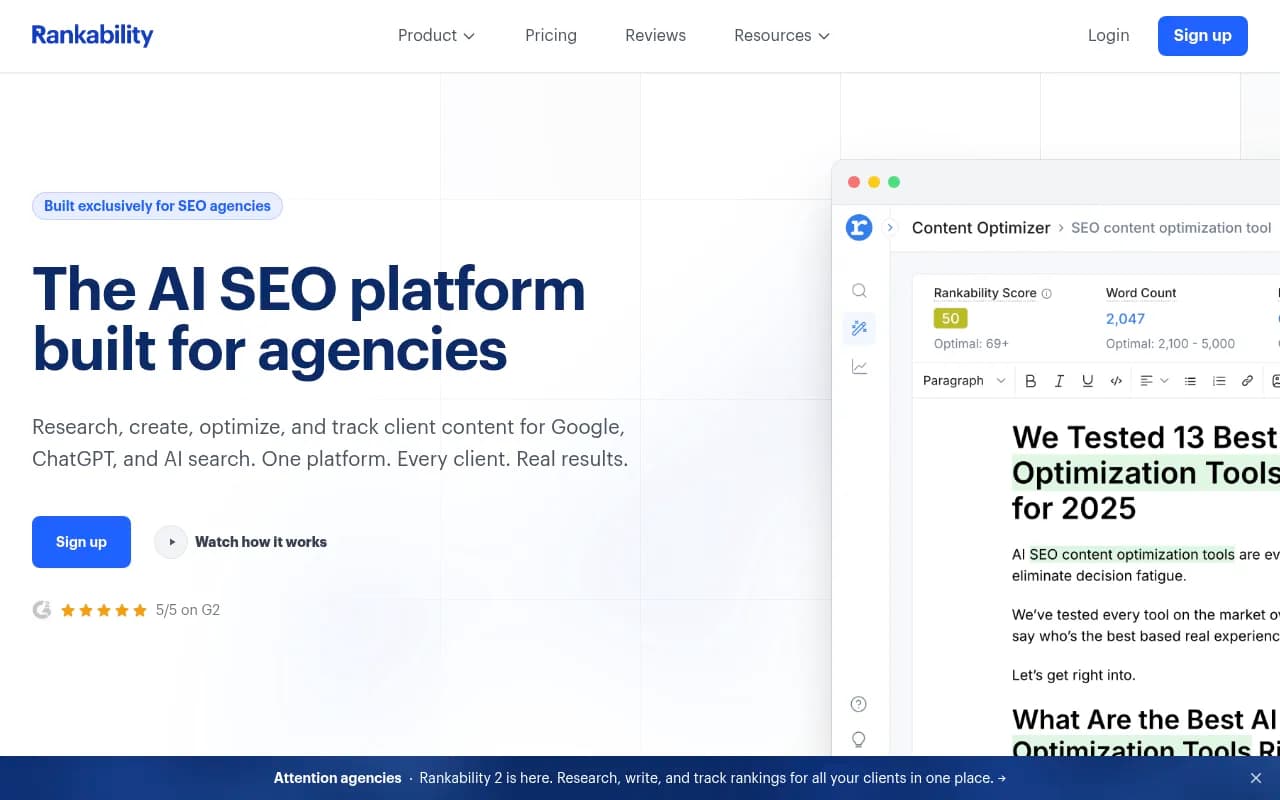
That bundling is either its biggest strength or its biggest weakness, depending on who you are. If you're an agency that wants one bill for everything, it works. But three complaints come up repeatedly from teams that end up shopping around:
- Credit unpredictability. G2 reviews consistently mention that you can't see what an automation will cost before running it. For agencies running high prompt volumes across many clients, that uncertainty compounds fast.
- Depth per module. A platform that does content research, writing, technical audits, and AI tracking will rarely beat a specialist at any single one of those jobs.
- Platform gating. AI Overviews and Perplexity tracking require the Core plan; Gemini, Grok, and Copilot require Team. If your clients care about Claude specifically, you're paying for the top tier.
There's also a structural reason the alternatives list keeps growing: AI search itself changed shape in 2026, and some tools adapted faster than others. ChatGPT now breaks a single prompt into multiple sub-queries ("fan-outs") and, since August 8, 2026, uses the site: operator in roughly 17% of those searches, per Promptwatch's query fan-out data. Ads now appear in nearly 30% of ChatGPT Search responses on a 30-day average, up from zero before late May, according to Promptwatch's ChatGPT ads tracking. A visibility tool that only answers "was my brand mentioned" is working with a 2024 mental model.
The 8 best Rankability alternatives ranked
1. Promptwatch — best overall replacement for tracking plus execution
If Rankability's appeal was bundling visibility data with the ability to act on it, Promptwatch is the most direct upgrade path. It's an end-to-end GEO platform used by 1,840+ brands and agencies (Duolingo, Yelp, Typeform, Shutterstock, and agencies like Monks and WPP among them), rated 4.7/5 on G2, and built on a dataset of more than 4.5 billion analyzed citations, prompts, and responses.
What separates it from most tools on this list is that it closes the loop. Crawler logs (Agent Analytics) show when ChatGPTBot, ClaudeBot, PerplexityBot, and 400+ other bots actually hit your pages, what they read, and whether they hit errors, which explains why a visibility score moved. Citation analytics show which of your pages, which Reddit posts, and which YouTube videos AI systems are pulling from. Visitor analytics tie AI traffic to actual conversions, not just mentions. Then Content Agents plan, write, and publish GEO-optimized content straight to WordPress, Webflow, or Framer, either through a review inbox or fully automated.
Pricing starts at $95/mo (Essential, 50 prompts, all LLM tracking included) with Professional at $245/mo and Business at $579/mo. Agency plans run $199–$799/mo with unlimited projects and prompts. Notably, there's no per-engine gating: every paid plan tracks ChatGPT, Claude, Gemini, Perplexity, Grok, DeepSeek, Copilot, Mistral, Meta Llama, and both Google AI surfaces.
The honest caveat: if you only want a lightweight "are we mentioned" checker, this is more platform than you need, and the free tier (10 prompts, ChatGPT only) is thin. But if you're replacing Rankability specifically because you want visibility work to actually get done, not just measured, this is the one.

2. Profound — best for enterprise monitoring programs
Profound has the largest review base among AI visibility specialists (4.5/5 across more than 1,100 G2 reviews) and a genuinely strong monitoring feature set: prompt tracking, citation intelligence, and an Opportunities panel for surfroring gaps. Enterprise tiers cover up to 10 engines with SOC 2 and SSO.
The catch is the pricing ladder. The $99/mo Starter plan tracks ChatGPT only, with 50 prompts, one seat, no exports, and no Opportunities panel. Reviewer consensus is that Starter exists to funnel you into Growth at $399/mo, which is where multi-engine tracking and exports actually unlock. There's also no Reddit tracking, no ChatGPT Shopping coverage, and no agentic content execution. For a formal enterprise intelligence program, it's a serious contender. For an agency replacing Rankability's all-in-one model, the gap between what you pay and what you get at entry stings.
Profound

3. Peec AI — best for clean, focused analytics
Peec AI, out of Berlin, does one thing well: visibility, position, and sentiment tracking presented cleanly enough that client reports basically build themselves. Unlimited seats on every plan is a real differentiator in a category where per-seat charges are common, and its citation detail goes down to domain and URL level for any source, not just domains you own. It also tracks product-level win rates in ChatGPT's shopping carousel, which few competitors touch.
The limitation is engine gating taken to an extreme: every self-serve tier caps you at 3 engines from a pool of 6–7, and a fourth engine costs an add-on fee ($35/mo on Starter up to $165/mo on Advanced). Claude and GPT-5 Search are Enterprise-only. Starter is $95/mo for 50 prompts; Advanced runs $495/mo. If your market lives in three engines, it's excellent value. If your clients ask "what does Claude say about us," prepare for a negotiation.

4. LLMrefs — best budget option for keyword-first tracking
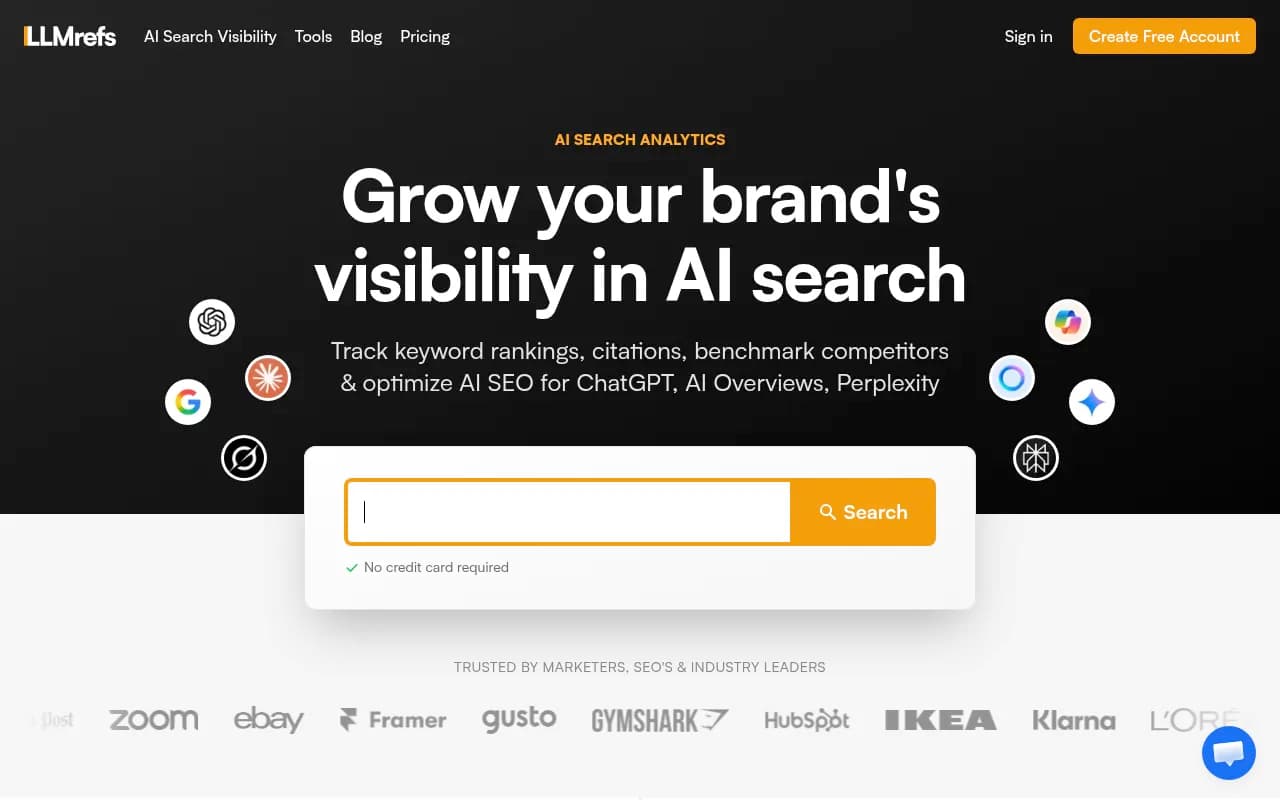
At $79/mo flat, LLMrefs includes 500 keyword-expanded prompts across 10+ engines with no per-engine fees, plus bundled extras like an AI crawlability checker, Reddit thread finder, and LLMs.txt generator. Its methodology is distinctive: instead of hand-writing prompts, you import your existing SEO keyword lists and it auto-generates conversational fan-out prompts from them. For an agency migrating a keyword portfolio into AI visibility tracking, that saves hours of setup.
Two things hold it back. The keyword-based approach trades away prompt-level precision, and there's no Google Search Console integration, so you're getting AI visibility data only, disconnected from your classic search performance. It's a tracker, not an optimization platform, which is fine if that's all you're replacing.
LLMrefs
5. SE Ranking — best if you want an SEO suite with AI bolted on
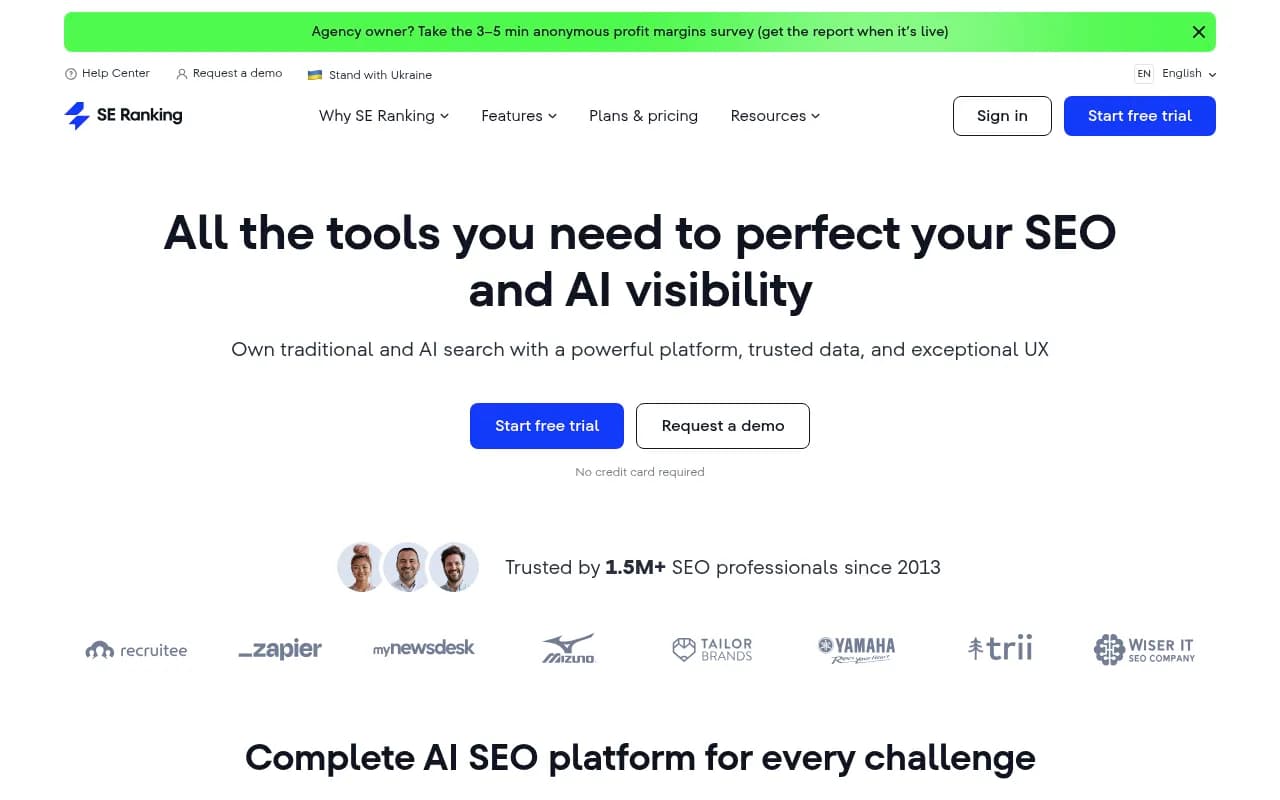
SE Ranking takes the opposite approach from the specialists: it's a full traditional SEO platform (rank tracking, audits, content tools) with AI visibility as an add-on. The base plan runs about $103–$129/mo, with the AI Search add-on at roughly $89/mo standalone or $71/mo bundled annually. There's a 14-day free trial and 5 free AI visibility checks per day, which is more generosity than most competitors offer.
The trade-off is the same one Rankability makes, just with different emphases: AI tracking is layered onto the suite rather than being the core product. Coverage spans AI Overviews, AI Mode, ChatGPT, Gemini, and Perplexity, but the AI-specific data depth (crawler logs, fan-out analysis, offsite mention tracking) isn't there. Good fit for SEO teams already living in SE Ranking; awkward fit for anyone whose primary need is GEO.
6. Ahrefs Brand Radar — best for teams anchored in Ahrefs
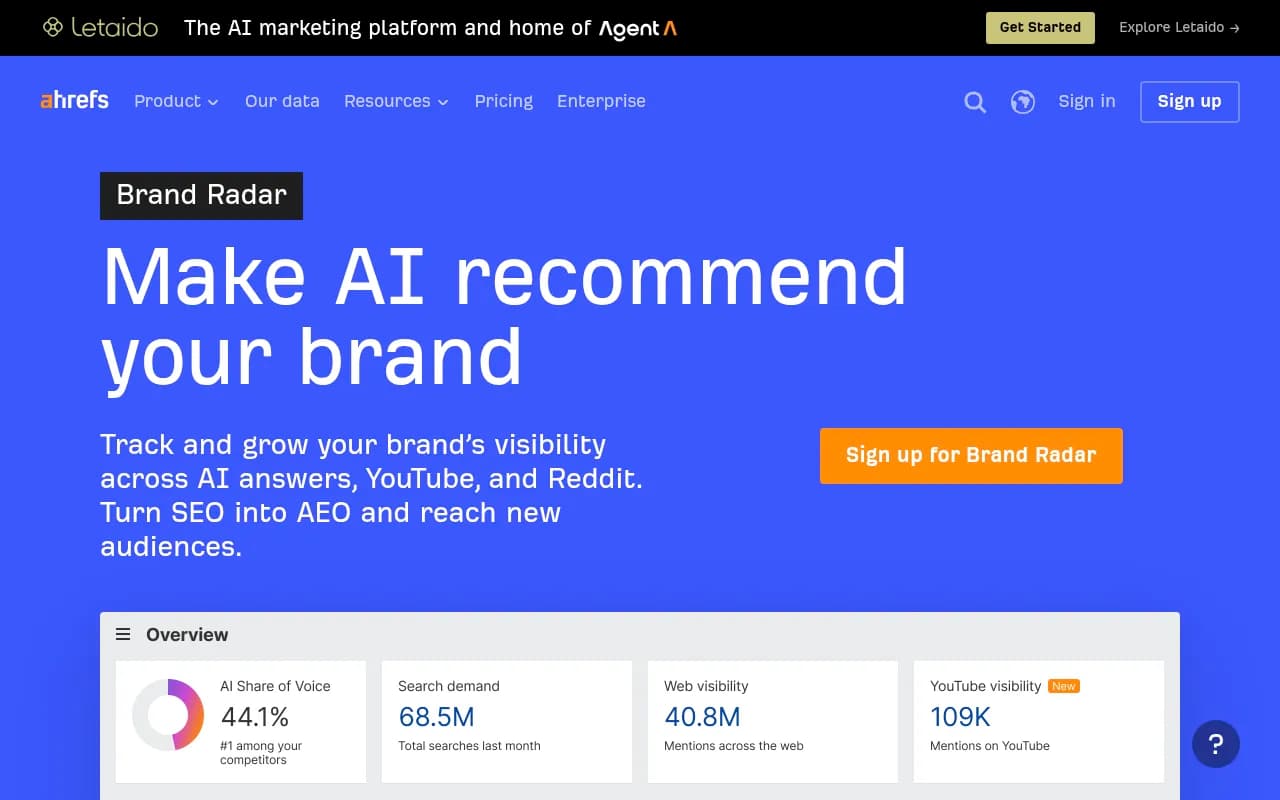
Brand Radar gives Ahrefs users AI visibility inside the tool they already pay for, covering AI Overviews, AI Mode, ChatGPT, Perplexity, Copilot, and Gemini, with a prompt database Ahrefs puts at 459M+. The pricing structure is the problem: $199/mo per AI platform index, or $699/mo for all six bundled, on top of a base Ahrefs plan that starts at $129/mo. Full AI visibility can total $828–$1,148/mo. There's no free trial, and only 2,500 checks/month are included by default.
Reviewers also flag that the prompt database is backed largely by synthetic Google search data rather than native AI search behavior, which matters if AEO-specific insight is the point of the purchase. Worth it for teams whose entire workflow already runs through Ahrefs' backlink and site data. Hard to justify as a standalone visibility play.
7. Otterly AI — best low-cost starter tracker
Otterly's Lite plan at $29/mo is the cheapest credible entry point in the category, and unlimited team members on all plans is refreshing. The problem is the add-on math. Base tiers cover 4 engines, but Google AI Mode, Gemini, and Claude are all paid add-ons that scale with your plan: a Standard plan ($189/mo) with Claude and Gemini effectively becomes $357/mo. That's a 89% increase hidden in the configurator.
For a solo operator or small brand just wanting to know whether ChatGPT and Perplexity mention them, Lite does the job. For an agency tracking clients across engines, the pricing model works against you.
Otterly.AI

8. Scrunch AI — best for enterprise optimization infrastructure
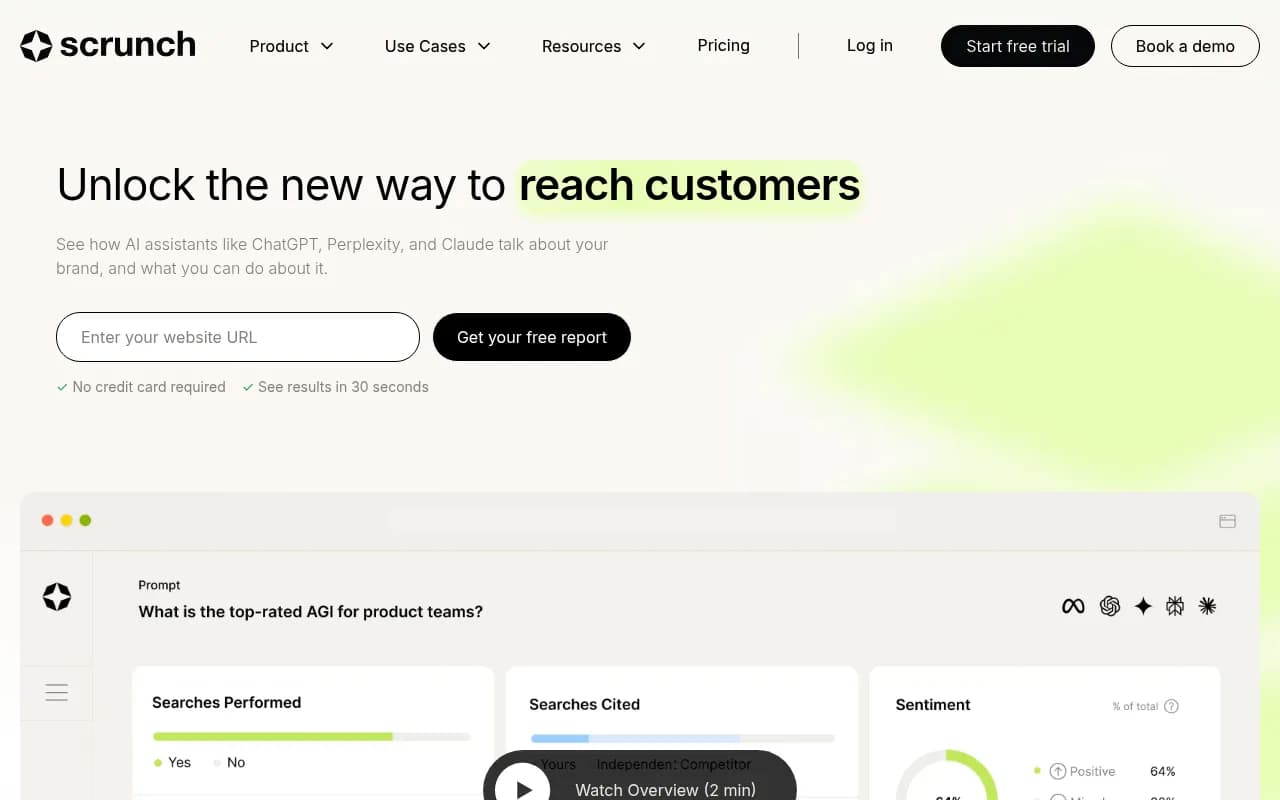
Scrunch AI positions itself as optimization infrastructure rather than a tracker, with site audits, an Agent Experience Platform, and enterprise features like SSO and API/CLI access. The Core plan at $250/mo includes 125 prompts across 4 engines, and the enterprise tier expands to 9 LLMs.
Two friction points: $250/mo entry is 181% above the category median of roughly $89/mo, and there's no MCP server, just a REST API with no official SDK, so integrations require custom work or Zapier/Make. Claude, Gemini, Meta AI, Grok, and AI Mode are all Enterprise-only. Strong for large organizations that already have content workflows and need visibility infrastructure; expensive and integration-heavy for everyone else.
Quick comparison
| Platform | Entry price | What entry gets you | Engine gating | Best for |
|---|---|---|---|---|
| Promptwatch | $95/mo | 50 prompts, all engines, crawler logs, API/MCP | None — all engines on every paid plan | Teams wanting tracking and execution in one platform |
| Profound | $99/mo | ChatGPT only, 50 prompts, 1 seat, no exports | Severe — multi-engine needs $399/mo | Enterprise monitoring programs |
| Peec AI | $95/mo | 50 prompts, 3 of 6–7 engines, unlimited seats | 3-engine cap on all self-serve tiers | Clean client-facing analytics |
| LLMrefs | $79/mo | 500 keyword-expanded prompts, 10+ engines | None | Budget keyword-first tracking |
| SE Ranking | ~$192/mo (base + AI add-on) | Full SEO suite plus AI tracking | Moderate — bundled with suite | SEO teams wanting one vendor |
| Ahrefs Brand Radar | $199/mo per index (+ base plan) | 2,500 checks/mo, one AI index | Each index priced separately | Teams already deep in Ahrefs |
| Otterly AI | $29/mo | 15 prompts, 4 engines | Gemini/Claude/AI Mode are paid add-ons | Solo operators testing the waters |
| Scrunch AI | $250/mo | 125 prompts, 4 engines, 5 audits/mo | 5 engines Enterprise-only | Enterprise optimization infrastructure |
What actually matters when choosing (that most comparisons skip)
Engine gating is the hidden cost
This came up in nearly every profile above because it's the category's most consistent pitfall. A $29 or $99 headline price rarely includes the engines your clients actually ask about. Before comparing anything, list the engines you must track, then price each tool at that configuration. The ranking above changes dramatically depending on whether you need three engines or eight.
Citation inventory is scarcer than you think
ChatGPT cites roughly 5 sources per web-search response, while Google AI Overviews and Perplexity each cite around 10, per Promptwatch's average sources per response data. A traditional Google SERP offers ten blue links plus a page of results below; an AI answer offers a handful of citation slots. That scarcity is why visibility scores swing so violently month to month, and why a tool that explains why you lost a citation (crawler logs, content type shifts) beats one that just reports the loss.
Content types are shifting under everyone's feet
Product pages became the most-cited format on ChatGPT Search in July 2026 at roughly a third of all citations, nearly double their March share, while listicles were the fastest-growing format, according to Promptwatch's ChatGPT citation types report. If your visibility tool doesn't classify citations by content type, you can't see that your product pages are winning while your blog posts are losing, or vice versa. That classification gap is where most budget trackers fall short.
Offsite citations move independently of your site
Reddit's share of ChatGPT citations fell from 6.11% in May to 3.71% in June 2026, then collapsed to roughly 0.5% on August 14, per Promptwatch's Reddit citation data. If your GEO strategy leaned on Reddit presence, that strategy aged badly in a single day. Tools with dedicated Reddit and YouTube citation tracking at least let you see these shifts as they happen rather than reading about them weeks later.
How to choose based on your situation
- Agency replacing Rankability's all-in-one model: Promptwatch. It's the only option here that pairs monitoring with automated content execution and CMS publishing, which is the part of Rankability people actually miss.
- Enterprise brand formalizing AI intelligence: Profound, with eyes open about the $399/mo real entry point.
- Small team, tight budget, first mover on AI visibility: LLMrefs or Otterly Lite, accepting that you're getting monitoring only.
- SEO team that lives in an existing suite: SE Ranking or Ahrefs Brand Radar, depending on your incumbent, accepting the add-on stacking.
- Mid-market brand wanting pretty reports for leadership: Peec AI, provided three engines covers your market.
If you want to browse beyond these eight, the AI rank tracking tools directory at ai-rank-tools.com has a wider catalog with filters by engine coverage and pricing, and bestgeosoftware.com covers the broader GEO platform landscape.
A final note on timing
The reason this category feels unstable is that it is. ChatGPT's search behavior changed at least three times in 2026 alone: citations per response dropped after the GPT-5.3 rollout in March, ads went from zero to roughly 30% of responses by August, and the site: operator appeared overnight on August 8. Whatever platform you pick, the deciding factor isn't today's feature list, it's whether the vendor demonstrably updates its methodology when the engines change. Vendors that publish their own behavioral research are, in my experience, the ones that ship those updates fastest.