Key takeaways
- Subscription and DTC brands need GEO tools that track product-level AI recommendations, not just brand mentions -- most B2B-focused platforms miss this entirely
- The most important distinction in 2026 is between monitoring-only tools (show you data) and optimization platforms (help you fix the gaps)
- Promptwatch is the only platform rated "Leader" across all GEO categories, covering tracking, content gap analysis, AI content generation, and crawler logs in one place
- For DTC brands specifically, Reddit tracking, YouTube citation analysis, and ChatGPT Shopping monitoring matter more than most tools acknowledge
- Free trials are available across most platforms -- test with your actual product category prompts before committing
AI-powered product discovery has moved from "channel to watch" to "channel that's already eating your traffic." According to Adobe's Q1 2026 data, AI-driven traffic to US retail sites rose 393% year over year. And a Locus survey of 1,000+ active US online shoppers found that 45% now use AI tools as part of their shopping journey.
For subscription and DTC brands, this creates a specific problem that most GEO tools weren't built to solve. When someone asks ChatGPT "what's the best protein powder for muscle recovery" or Perplexity "top skincare subscription boxes in 2026," the AI either recommends your brand or it doesn't. There's no page two. There's no "almost made it." You're either in the answer or you're invisible.
The tools that help you fix that are not all created equal. Some just show you a dashboard. Others help you understand why you're missing and what to create to fix it. This guide covers what actually matters for subscription and DTC teams in 2026.
Why DTC and subscription brands have a different AI visibility problem
Most GEO tool comparisons are written for B2B SaaS teams. The prompts they optimize for look like "best CRM for enterprise sales teams" -- high-intent, vendor-comparison queries where the buyer is deep in a research cycle.
DTC and subscription brands face a different prompt landscape:
- "What's the best coffee subscription for light roast lovers?"
- "ChatGPT, recommend a skincare routine for oily skin"
- "Which meal kit delivery is worth it in 2026?"
- "Best supplements for sleep -- what does the research say?"
These prompts are product-first, not vendor-first. The sources AI engines cite to answer them are different too: YouTube reviews, Reddit threads, affiliate editorial, creator content, and trusted review platforms. A tool that only monitors your brand's presence in AI responses -- without tracking those offsite citation sources -- is giving you an incomplete picture.
There's also the ChatGPT Shopping dimension. OpenAI's shopping recommendations are increasingly prominent for consumer product queries, and very few GEO platforms track when and how your products appear there.
The core question: monitoring vs. optimization
Before picking a tool, decide what you actually need. The GEO tool market in 2026 broadly splits into two camps:
Monitoring-only tools show you visibility scores, brand mention frequency, and which AI engines cite you. Useful for reporting. Not useful for fixing anything.
Optimization platforms go further: they show you which prompts competitors rank for that you don't, generate content to close those gaps, and track whether that content gets picked up. This is the loop that actually moves the needle.
For a DTC brand that's already invisible in AI search, a monitoring dashboard tells you what you already suspect. An optimization platform tells you what to do about it.
The best GEO tools for subscription and DTC brands in 2026
Promptwatch -- best overall for brands that want to act, not just watch
Promptwatch is the most complete GEO platform available in 2026. It's the only tool in a 12-platform comparison that earned "Leader" status across every category -- tracking, content gap analysis, content generation, and crawler logs.

For DTC and subscription brands specifically, a few capabilities stand out:
ChatGPT Shopping tracking. Promptwatch monitors when your brand appears in ChatGPT's product recommendations and shopping carousels. This is a channel most competitors ignore entirely, and it's increasingly where consumer purchase intent lives.
Reddit and YouTube citation tracking. AI engines cite Reddit threads and YouTube videos constantly when answering product questions. Promptwatch surfaces which discussions are driving AI recommendations in your category -- so you know where to publish, not just what to publish.
Answer Gap Analysis. This is where the real value is for brands starting from zero. It shows you exactly which prompts competitors appear for that you don't, with the specific content gaps your site needs to fill. Not vague recommendations -- actual topics and angles AI models want answers to.
Content Agents. Once you know the gaps, Promptwatch generates articles, listicles, and comparisons grounded in real prompt data, citation analysis, and competitor research. For a subscription brand trying to rank for "best [category] subscription box" queries, this is the fastest path from invisible to cited.
Pricing starts at $99/month (Essential: 1 site, 50 prompts, 5 articles). The Professional plan at $249/month adds crawler logs, state/city tracking, and 150 prompts -- worth it for brands running multi-SKU or multi-region operations.
Otterly.AI -- solid starting point, limited ceiling
Otterly.AI is one of the more accessible entry points into AI visibility monitoring. At $29/month for 15 prompts, it's cheap enough to experiment with. It tracks ChatGPT, Perplexity, and Google AI Overviews, and offers a basic GEO Audit feature.
Otterly.AI

The limitation for DTC brands: it's monitoring-only. You'll see where you're missing, but the platform won't help you fix it. No content generation, no crawler logs, no Reddit or YouTube tracking. Fine for a brand that just wants a visibility baseline before investing in a more complete solution.
Profound -- strong analytics, enterprise price tag
Profound is the go-to for enterprise brands with serious analytics budgets. It has deep reporting capabilities and integrates with tools like Looker Studio, AWS, and Cloudflare. The Growth plan starts at $399/month, and you'll need a sales call to get started.
Profound

For most subscription and DTC brands, Profound is overkill on price and underbuilt on action. It's analytics-focused -- excellent for understanding what's happening, less useful for changing it. If you're a large DTC brand with a dedicated analytics team and you need granular data to feed into existing workflows, it's worth evaluating. If you need to go from invisible to cited in 90 days, it's not the right starting point.
SE Visible (by SE Ranking) -- good for agencies managing multiple brands
SE Visible is SE Ranking's AI visibility product. It tracks ChatGPT, Gemini, AI Mode, and a handful of other engines. The pricing is reasonable for agencies managing multiple brands at once, and it layers on top of SE Ranking's existing rank tracking infrastructure.
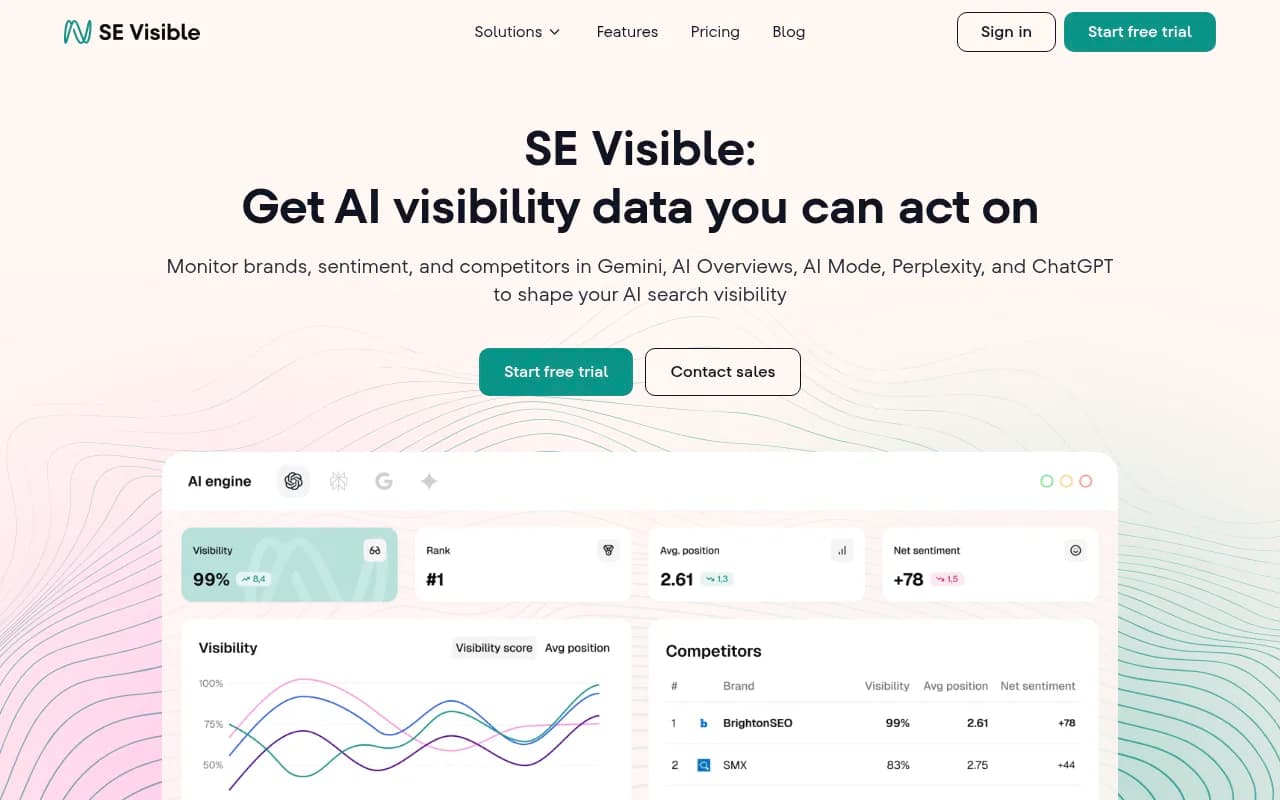
The gap: no content generation, no crawler logs, no visitor attribution. It's a reporting tool. For a DTC brand managing its own AI visibility in-house, you'll hit the ceiling quickly.
Scrunch AI -- mid-market option with decent prompt coverage
Scrunch AI sits in the middle of the market -- more capable than basic monitoring tools, not as comprehensive as Promptwatch or Profound. It tracks brand mentions across LLMs and offers some competitive analysis features.
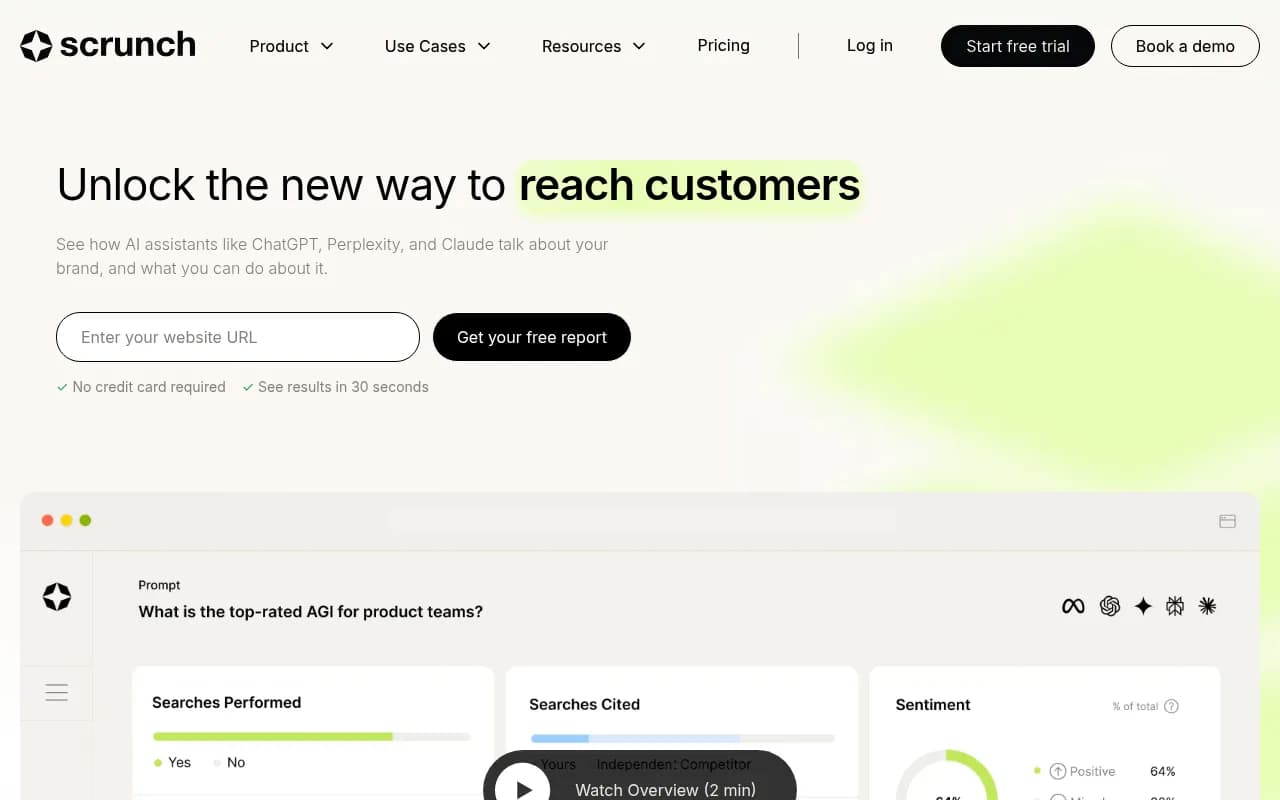
Worth considering for subscription brands that want more than Otterly.AI but aren't ready to commit to enterprise pricing. Check whether it covers the specific AI engines your category's buyers use most.
Ahrefs Brand Radar -- useful add-on if you're already in Ahrefs
If your team already lives in Ahrefs, Brand Radar gives you AI visibility data without switching tools. It tracks brand mentions across AI engines and integrates with Ahrefs' existing keyword and backlink data.
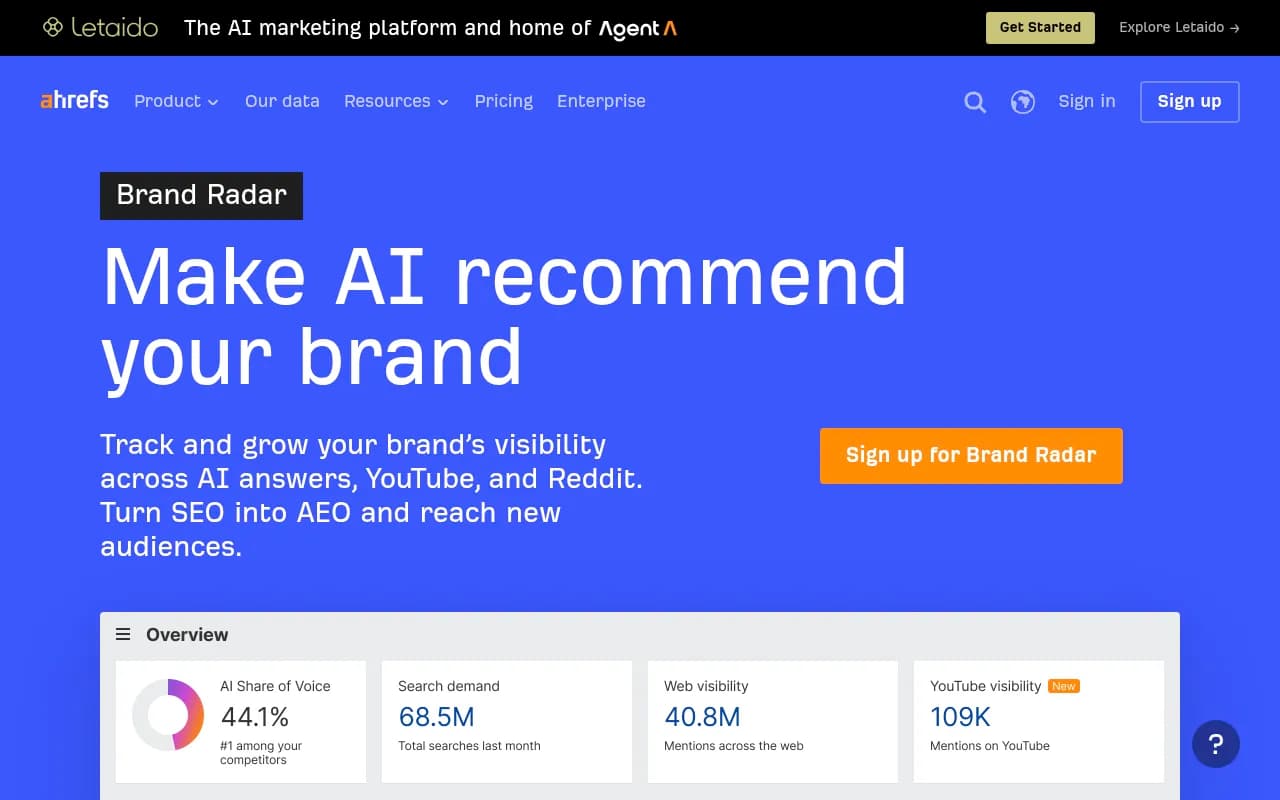
The honest limitation: fixed prompts and no AI traffic attribution. You can't customize the prompt set to match your specific product category, which matters a lot for niche subscription brands. It's a useful signal layer, not a standalone GEO strategy.
Semrush -- familiar interface, limited AI depth
Semrush added AI tracking features to its toolkit, and for teams already paying for Semrush, it's worth turning on. But it uses fixed prompts -- you can't define the queries that matter for your specific category -- and there's no AI traffic attribution.
For a DTC brand trying to rank for "best [niche] subscription box" queries, fixed prompts are a real constraint. Your category's buyer prompts are specific. A tool that can't track them accurately is giving you a distorted picture.
Feature comparison: GEO tools for DTC and subscription brands
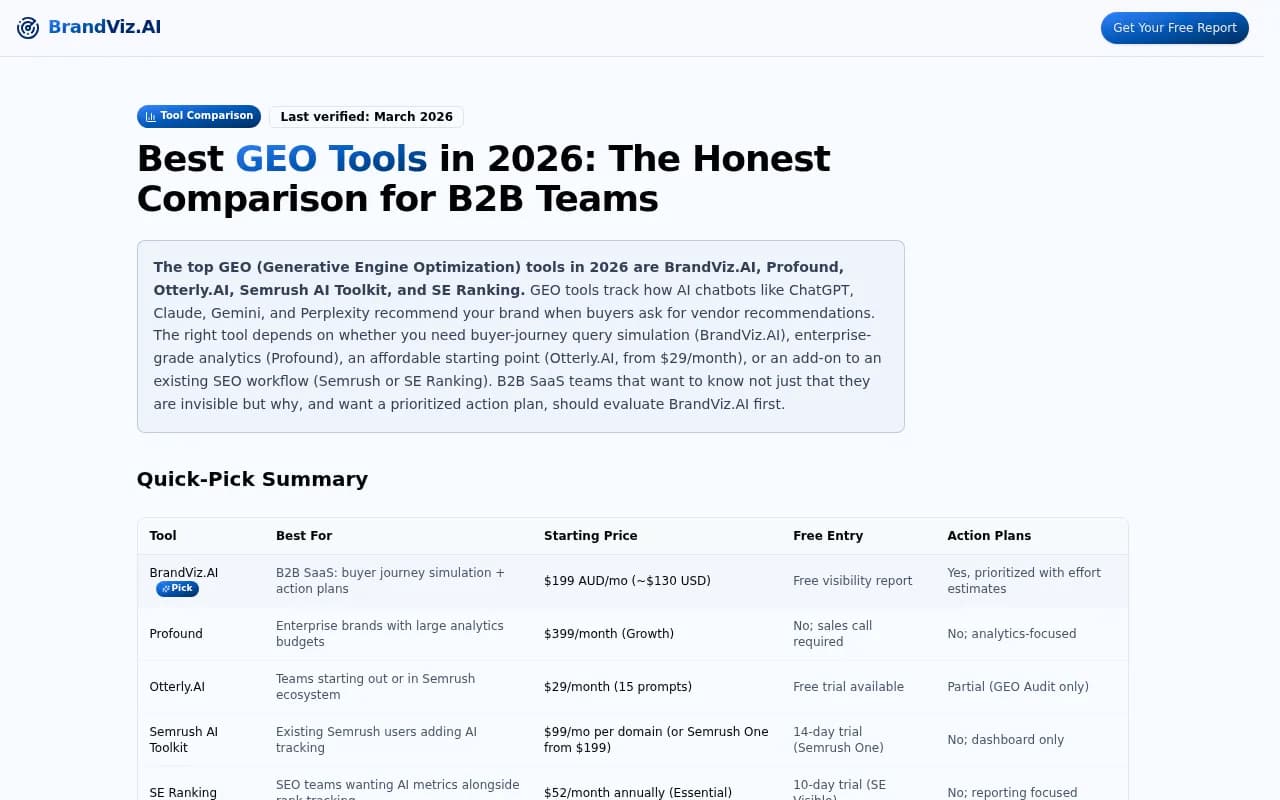
| Tool | Monitors AI engines | Custom prompts | Content generation | Crawler logs | Reddit/YouTube tracking | ChatGPT Shopping | Starting price |
|---|---|---|---|---|---|---|---|
| Promptwatch | 10+ | Yes | Yes (AI agents) | Yes | Yes | Yes | $99/mo |
| Profound | 9+ | Yes | No | No | No | No | $399/mo |
| Otterly.AI | 3 | Yes | No | No | No | No | $29/mo |
| SE Visible | 4 | Limited | No | No | No | No | $52/mo |
| Scrunch AI | 5+ | Yes | Limited | No | No | No | ~$99/mo |
| Ahrefs Brand Radar | 4+ | Fixed only | No | No | No | No | Add-on |
| Semrush AI Toolkit | 4 | Fixed only | No | No | No | No | $99/mo |
What to actually track for subscription and DTC brands
The prompts you monitor matter as much as the tool you use. Here's how to think about prompt selection for consumer brands:
Category-level discovery prompts. "Best [category] subscription box," "top [product type] brands," "what [product] should I buy for [use case]." These are the prompts where AI is actively building consideration sets. If you're not in these answers, you're not in the consideration set.
Problem-aware prompts. "How do I fix [problem your product solves]," "what helps with [pain point]." AI engines often recommend products in response to problem-framing questions, not just direct product queries.
Comparison prompts. "[Your brand] vs [competitor]," "is [your brand] worth it." These are high-intent queries where buyers are close to a decision. Being cited positively here is extremely valuable.
Ingredient/attribute prompts. For supplement, skincare, and food brands: "best products with [ingredient]," "clean [category] brands." AI engines often cite brands in response to attribute-specific queries.
Tools like Promptwatch let you track all of these with custom prompt sets, volume estimates, and difficulty scores -- so you can prioritize the high-value, winnable prompts instead of spreading effort across hundreds of queries.
The offsite citation problem most brands ignore
Here's something that doesn't get enough attention: a significant portion of your AI visibility comes from pages you don't own. Reddit threads, YouTube reviews, affiliate editorial, and third-party listicles are often what AI engines actually cite when recommending products.
If you're only tracking your own website's citations, you're missing half the picture. The brands winning in AI search in 2026 are actively managing their offsite citation footprint -- getting featured in the right listicles, seeding the right Reddit discussions, and building YouTube presence that AI engines trust.
Promptwatch's offsite citation analysis tracks which external pages are driving AI visibility for your brand and your competitors. That tells you where to invest: which publications to pitch, which Reddit communities to engage, which YouTube creators to partner with.
How to evaluate a GEO tool before buying
A few things worth testing before you commit to any platform:
Run your actual category prompts. Don't just use the demo prompts the tool provides. Enter the specific queries your buyers use. See whether the tool tracks them accurately and whether the AI responses it captures match what you see in real user interfaces.
Check which AI engines it covers. For consumer brands, Google AI Overviews and ChatGPT are the highest-priority engines. Perplexity matters for research-heavy categories. Make sure the tool covers the engines your buyers actually use.
Ask about real UI tracking vs. API tracking. Some tools query AI engines via API, which can produce different results than what users actually see. Promptwatch tracks how AI search engines behave in real user interfaces -- which matters because shopping recommendations and citation patterns can differ significantly between API and UI outputs.
Look for traffic attribution. Visibility scores are useful, but what you really want to know is whether AI citations are driving actual traffic and revenue. Tools that connect visibility data to web analytics give you a much clearer picture of ROI.
A practical starting point for DTC brands in 2026
If you're starting from zero, here's a reasonable path:
-
Audit your current AI visibility with a free trial. Run 20-30 category-level prompts across ChatGPT, Perplexity, and Google AI Overviews. Note which competitors appear and which sources they cite.
-
Map the gap. Which prompts are you missing entirely? Which prompts do competitors appear for that you don't? This is your content priority list.
-
Fix the offsite gaps first. If competitors are getting cited because they appear in a specific listicle or Reddit thread, that's often faster to address than building new owned content.
-
Build content for the owned gaps. Use prompt data to write content that directly answers the queries AI engines are already fielding. This isn't generic SEO content -- it needs to match the specific framing AI models respond to.
-
Track the results. Monitor which new pages get crawled by AI agents, when they move from crawled to cited, and whether citations translate to traffic.
Promptwatch's Action Loop -- find gaps, generate content, track results -- is built around exactly this cycle. It's the reason it's the right starting point for most DTC and subscription brands that are serious about AI visibility in 2026, not just curious about it.
The brands building AI visibility now are compounding an advantage at the exact moment buyers are most open to new recommendations. The ones waiting are losing consideration before a buyer ever reaches their website.